Results by title
101 books match the query 'Environmentalism' and 3 start with d
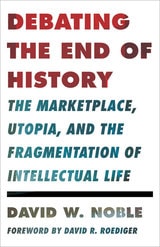
Debating the End of History
The Marketplace, Utopia, and the Fragmentation of Intellectual LifeDavid W. Noble
University of Minnesota Press, 2012
Why do modern people assume that there will be perpetual economic growth? Because, David W. Noble tells us in this provocative study of cultural criticism, such a utopian conviction is the necessary foundation for bourgeois culture. One can imagine the existence of modern middle classes only as long as the capitalist marketplace is expanding. For Noble, the related—and relevant—question is, how can the middle classes believe that a finite earth is an environment in which infinite growth is possible? The answer, which Noble so painstakingly charts, is nothing less than a genealogy of the uses and abuses of knowledge that lie at the heart of so many of our political problems today.
As far back as Plato and as recently as Alan Greenspan, Noble finds proponents of the idea of a world of independent, rational individuals living in timeless simplicity, escaping from an old world of interdependence and generations. Such notions, although in sync with Newtonian science, have come up against the subsequent conclusions of geology, biology, and the physics of Einstein. In a survey of the responses to this quandary of historians, economists, literary critics, and ecologists, Noble reveals how this confrontation, and its implications for a single global marketplace, has forced certain academic disciplines into unnatural—and untenable—positions.
David Noble’s work exposes the cost—not academic at all—of the segregation of the physical sciences from the humanities and social sciences, even as it demonstrates the required movement of the humanities toward the ecological vision of a single, interconnected world.
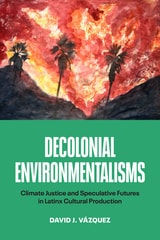
Decolonial Environmentalisms
Climate Justice and Speculative Futures in Latinx Cultural ProductionDavid J. Vázquez
University of Texas Press, 2025
A critical examination of the environmental movement and the Latinx voices that are shifting how to think about a future shaped by climate change.
In Decolonial Environmentalisms, David Vázquez argues that the mainstream environmental movement is implicated in racial capitalism, not least through its ignorance of environmental justice as it pertains to Latinx people. Through close readings of eco-minded novels, films, visual art, and short stories by Chicanx, Puerto Rican, Dominican, Cuban American, Peruvian, and Central American culture makers, Vázquez surfaces diverse Latinx visions for an equitable and sustainable humanity.
In the creations of Helena María Viramontes, Ester Hernández, Salvador Plascencia, the printmaking collective Dominican York Proyecto GRAFICA, and others, Vázquez locates a bracing critique of racist elisions and assumptions in hegemonic environmentalist thought. At the same time, he shows that the roles of Latinx people in the exploitation of the US West and the ruin of Indigenous communities are ripe for self-examination, in hopes of sparking reform. Indeed, Decolonial Environmentalisms is a work of guarded optimism, finding glimmers of possibility even in dystopic science fiction. The overlooked experiences of Latinx people, Vázquez suggests, can inspire environmental movements capable of transformative advocacy.

Do It Yourself
A Handbook For Changing Our WorldEdited by Trapese Trapese
Pluto Press, 2007
Ethical consumerism is now big business. But leading a sustainable and truly radical life encompasses a whole variety of things that challenge the mainstream. This book shows how we can make real changes to the way we live. In simple steps, it describes how you can create sustainable and equitable ways of living that can help transform not just your own life, but the culture around you.
The book weaves together analysis, stories and experiences. It combines in-depth analytical chapters followed by easy to follow 'How to Guides' with practical ideas for change. Taken together, these small steps can move us towards taking back control of our lives from governments and corporations.