Results by title
177 books match the query 'Equality' and 14 start with d
Data Equals
Democratic Equality and Technological HierarchyColin Koopman
University of Chicago Press, 2025
When we gave algorithms power over our world, we hoped that the apparent neutrality of machine thinking would create a more egalitarian age. Yet we are more divided than ever, staring down threats to democracy itself. In Data Equals, Colin Koopman argues that data technologies fail us so often because we built them around a deficient notion of equality.
It is not enough, Koopman explains, that algorithms engage everyone’s data with the same measuring stick. The data themselves are all too often structured in ways that obscure and exacerbate stratifying distinctions. Koopman contends that we must also work to ensure that those people subject to computational assessment enter data systems on equal terms. Part philosophical argument, part practical guide (replete with case studies from education technology), Data Equals offers novel methods for realizing democratic equality in a digital age.

Debating Women's Equality
Toward a Feminist Theory of Law from a European PerspectiveGerhard, Ute
Rutgers University Press, 2001
Ute Gerhard places women's rights at the center of legal philosophy and sees the struggle for equality as a driving force in the history of law. Focusing on Europe and taking the course of German feminism and law as primary examples, she incorporates the various social contexts in which questions of equality and gender difference have been raised into an analysis that challenges misconceptions about the principle of equality itself.
Gerhard reviews the history of women's movements in the nineteenth and twentieth centuries and traces the historical development of claims to gender equality as well as obstacles to these claims. Critically exploring the influence of philosophers such as Rousseau, Fichte, and Kant, Gerhard concludes that women need to be recognized as both equal and different-that claims to equality do not simply eliminate difference, but also articulate it. Mindful of the social and political contexts surrounding equality arguments, Gerhard probes three legal issues: women's rights in the public sphere, especially the right to vote; women's legal capacities in private law, or the legal doctrine of so-called gender tutelage; and women's human rights, a prominent concern in the current international women's movement.
Debating the American Dream
How Explanations for Inequality Polarize PoliticsElizabeth Suhay
Russell Sage Foundation, 2025
Drawing on public opinion surveys spanning more than four decades, Suhay finds that Americans’ belief in the American Dream is strongly related to their political party affiliation. Democratic Party leaders have increasingly questioned the fairness of the American economy, and, in effect, have called into question whether the American Dream is “real.” Republican Party leaders, by contrast, have consistently defended the fairness of the economy and the American Dream. While it is true that Americans have become more skeptical of the American Dream overall, Suhay finds this skepticism is concentrated among Democratic members of the public. Despite the increasingly working-class make-up of the Republican coalition, most Republican members of the public continue to believe the American Dream is reality.
Suhay finds that both Democrats and Republicans tend to adhere to their party’s economic narratives when identifying the causes of inequality between rich and poor, White and Black and Latino Americans, and men and women. Democrats and liberals often attribute inequality between these groups to societal causes, such as lack of access to education and jobs or discrimination. Republicans and conservatives, on the other hand, are more likely to blame individuals and lower income groups for their difficulties. However, Americans’ beliefs are less polarized when they consider socioeconomic inequalities rarely debated by politicians. For example, when asking Republicans and Democrats about the roots of rural-urban and White-Asian inequality, there is no clear unequal opportunity-individual responsibility partisan divide. Suhay argues that the availability of partisan “scripts” helps to explain differences in the public’s views on inequality between groups that have been politicized. These beliefs appear to bolster support for the two parties’ policy agendas among party supporters, driving a wedge between Democrats and Republicans in support for redistributive economic policy as well as the political candidates who support or oppose redistribution.
Debating the American Dream provides fascinating insights into politics’ role in Americans’ beliefs and attitudes concerning inequality.
Deep Dish Conversations
Voices of Social Change in NashvilleJerome Moore
Vanderbilt University Press, 2023
This book is a curated collection of the most striking interviews from the first few seasons of the series, with a foreword by Dr. Sekou Franklin, an introduction by Moore, and contextual introductions to each interviewee. Figures like Judge Sheila Calloway, comedian Josh Black, anti-racism speaker Tim Wise, organizer Jorge Salles Diaz, and many more explore their wide-ranging perspectives on social change in a city in the midst of massive demographic and ideological shifts.
For anyone in any twenty-first-century city, Deep Dish Conversations offers a lot to think about—and a lot of ways to think about it.

Degrees of Risk
Navigating Insecurity and Inequality in Public Higher EducationBlake R. Silver
University of Chicago Press, 2024
Institutions of higher education are often described as “ivory towers,” places of privilege where students exist in a “campus bubble,” insulated from the trials of the outside world. These metaphors reveal a widespread belief that college provides young people with stability and keeps insecurity at bay. But for many students, that’s simply not the case.
Degrees of Risk reveals how insecurity permeates every facet of college life for students at public universities. Sociologist Blake Silver dissects how these institutions play a direct role in perpetuating uncertainty, instability, individualism, and anxiety about the future. Silver examined interviews with more than one hundred students who described the risks that surrounded every decision: which major to choose, whether to take online classes, and how to find funding. He expertly identified the ways the college experience played out differently for students from different backgrounds. For students from financially secure families with knowledge of how college works, all the choices and flexibility of college felt like an adventure or a wealth of opportunities. But for many others, especially low-income, first-generation students, their personal and family circumstances meant that that flexibility felt like murkiness and precarity. In addition, he discovered that students managed insecurity in very different ways, intensifying inequality at the intersections of socioeconomic status, race, gender, and other sociodemographic dimensions. Drawing from these firsthand accounts, Degrees of Risk presents a model for a better university, one that fosters success and confidence for a diverse range of students.
Democracy and Higher Education
Traditions and Stories of Civic EngagementScott J. Peters
Michigan State University Press, 2010
How are we to understand the nature and value of higher education's public purposes, mission, and work in a democratic society? How do-and how should-academic professionals contribute to and participate in civic life in their practices as scholars, scientists, and educators?
Democracy and Higher Education addresses these questions by combining an examination of several normative traditions of civic engagement in American higher education with the presentation and interpretation of a dozen oral history profiles of contemporary practitioners. In his analysis of these profiles, Scott Peters reveals and interprets a democratic-minded civic professionalism that includes and interweaves expert, social critic, responsive service, and proactive leadership roles.
Democracy and Higher Education contributes to a new line of research on the critically important task of strengthening and defending higher education's positive roles in and for a democratic society.
Democracy and the Left
Social Policy and Inequality in Latin AmericaEvelyne Huber and John D. Stephens
University of Chicago Press, 2012
Although inequality in Latin America ranks among the worst in the world, it has notably declined over the last decade, offset by improvements in health care and education, enhanced programs for social assistance, and increases in the minimum wage.
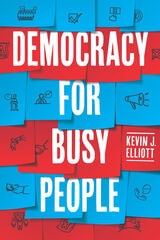
Democracy for Busy People
Kevin J. Elliott
University of Chicago Press, 2023
How do we make democracy more equal? Although in theory, all citizens in a democracy have the right to participate in politics, time-consuming forms of participation often advantage some groups over others. Where some citizens may have time to wait in long lines to vote, to volunteer for a campaign, to attend community board meetings, or to stay up to date on national, state, and local news, other citizens struggle to do the same. Since not all people have the time or inclination to devote substantial energy to politics, certain forms of participation exacerbate existing inequalities.
Democracy for Busy People takes up the very real challenge of how to build a democracy that empowers people with limited time for politics. While many plans for democratic renewal emphasize demanding forms of political participation and daunting ideals of democratic citizenship, political theorist Kevin J. Elliott proposes a fundamentally different approach. He focuses instead on making democratic citizenship undemanding so that even busy people can be politically included. This approach emphasizes the core institutions of electoral democracy, such as political parties, against deliberative reforms and sortition. Timely and action-focused, Democracy for Busy People is necessary reading.
Democracy, Inequality, and Representation in Comparative Perspective
Pablo Beramendi
Russell Sage Foundation, 2008
Difference without Domination
Pursuing Justice in Diverse DemocraciesEdited by Danielle Allen and Rohini Somanathan
University of Chicago Press, 2020
Using examples from the United States, India, Germany, and Cameroon, the contributors offer paradigm-changing approaches to the concepts of justice, identity, and social groups while also taking a fresh look at the idea that the demographic make-up of institutions should mirror the make-up of a populace as a whole. After laying out the conceptual framework, the volume turns to a number of provocative topics, among them the pernicious tenacity of implicit bias, the logical contradictions inherent to the idea of universal human dignity, and the paradoxes and problems surrounding affirmative action. A stimulating blend of empirical and interpretive analyses, Difference without Domination urges us to reconsider the idea of representation and to challenge what it means to measure equality and inequality.

Discourse on the Origins of Inequality (Second Discourse), Polemics, and Political Economy
Jean-Jacques Rousseau
Dartmouth College Press, 1993
Distributions of the Sensible
Rancière, between Aesthetics and PoliticsEdited by Scott Durham and Dilip Gaonkar With an afterword by Jacques Rancière
Northwestern University Press, 2019
Jacques Rancière’s work is increasingly central to several debates across the humanities. Distributions of the Sensible confronts a question at the heart of his thought: How should we conceive the relationship between the “politics of aesthetics” and the “aesthetics of politics”? Specifically, the book explores the implications of Rancière’s rethinking of the relationship of aesthetic to political democracy from a wide range of critical perspectives.
Distributions of the Sensible contains original essays by leading scholars on topics such as Rancière’s relation to political theory, critical theory, philosophical aesthetics, and film. The book concludes with a new essay by Rancière himself that reconsiders the practice of theory between aesthetics and politics.

Doing Good
Racial Tensions and Workplace Inequalities at a Community Clinic in El Nuevo SouthNatalia Deeb-Sossa
University of Arizona Press, 2013
Deeb-Sossa argues persuasively that “moral identities” have been constructed by clinic staff. The high-status staff—nearly all of whom are white—see themselves as heroic workers. Mid- and lower-status Latina staff feel like they are guardians of people who are especially needy and deserving of protection. In contrast, the moral identity of African American staffers had previously been established in response to serving “their people.” Their response to the evolving clientele has been to create a self-image of superiority by characterizing Latina/o clients as “immoral,” “lazy,” “working the system,” having no regard for rules or discipline, and being irresponsible parents.
All of the health-care workers want to be seen as “doing good.” But they fail to see how, in constructing and maintaining their own moral identity in response to their personal views and stereotypes, they have come to treat each other and their clients in ways that contradict their ideals.
Doing Meritocracy Right
How Business Leaders Can Turn an American Aspiration into Reality (and Why They Should)Thomas A. Cole
University of Chicago Press, 2025
As America’s most vaunted cultural value, meritocracy is celebrated by some as an institution and derided by others as a myth—or even a trap. Thomas A. Cole argues in Doing Meritocracy Right that if meritocracy is to persist as an institution—and it must—it requires structural support in the private sector. For America to achieve a version of meritocracy that more closely matches our aspirations, our business leaders must first offer equity of opportunity for individuals to demonstrate and develop their talents on equal terms.
Drawing on his decades of experience in advising CEOs and corporate boards, personally serving on the boards of major not-for-profits, and leading a large global law firm, Cole cites elite professional-service institutions—consultancies and law firms especially—as improbable laboratories for equity of opportunity. These workplaces, out of self-interest, are laser-focused on the quality of their professionals, seeking out talent and representation and then judging these individuals on (ideally) equal terms once they’re in place. Here, Cole sees an opportunity that no public initiative or platitudes can deliver: if workplaces seek out representational diversity by applying, with thought and care, a single standard of merit—one that emphasizes character—and by providing training and mentoring on an equitable basis, then they will offer a ladder to social and economic mobility that serves both individuals and society.
Cole argues that a meritocratic society is achieved in two interrelated stages: access to education; and post-education promotion to membership in the elite. The latter, he says, is the domain of business. Cole argues that the private sector is better positioned to effect reform and he encourages leaders in the private sector to pursue reform both in their organizations, in government, and in the universities and communities where they have influence.
Meritocracy in the private sector can’t control the many American inequities that exist on the ground of American society. But it can do social good by serving as a reliable, merit-determined path to the highest echelons of business and industry. Cole sets the stage for the discussion of reforms with a “brief history of our imperfect meritocracy,” and rounds out the book with a to-do list for business leaders.