Results by title
198 books match the query 'Food' and 8 start with d

Dead Moose on Isle Royale
Off Trail with the Citizen Scientists of the Wolf-Moose ProjectJeffrey M Holden
Michigan State University Press, 2025

Dethroning the Deceitful Pork Chop
Rethinking African American Foodways from Slavery to ObamaJennifer Jensen Wallach
University of Arkansas Press, 2015
2017 Association for the Study of Food and Society Award, best edited collection.
The fifteen essays collected in Dethroning the Deceitful Pork Chop utilize a wide variety of methodological perspectives to explore African American food expressions from slavery up through the present. The volume offers fresh insights into a growing field beginning to reach maturity. The contributors demonstrate that throughout time black people have used food practices as a means of overtly resisting white oppression—through techniques like poison, theft, deception, and magic—or more subtly as a way of asserting humanity and ingenuity, revealing both cultural continuity and improvisational finesse. Collectively, the authors complicate generalizations that conflate African American food culture with southern-derived soul food and challenge the tenacious hold that stereotypical black cooks like Aunt Jemima and the depersonalized Mammy have on the American imagination. They survey the abundant but still understudied archives of black food history and establish an ongoing research agenda that should animate American food culture scholarship for years to come.
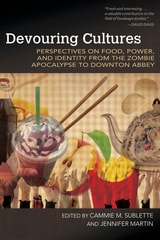
Devouring Cultures
Perspectives on Food, Power, and Identity from the Zombie Apocalypse to Downton AbbeyCammie M. Sublette
University of Arkansas Press, 2016
Devouring Cultures brings together contributors from a wide range of disciplines including media studies, rhetoric, gender studies, philosophy, anthropology, literary criticism, film criticism, race theory, history, and linguistics to examine the ways food signifies both culture and identity.
These scholars look for answers to intriguing questions: What does our choice of dining house say about our social class? Can restaurants teach us about a culture? How does food operate in Downton Abbey? How does food consumption in zombie apocalypse films and apocalyptic literature relate to contemporary food-chain crises and food nostalgia? What aspects of racial conflict, assimilation, and empowerment may be represented in restaurant culture and food choice?
Restaurants, from their historical development to their modern role as surrogate kitchen, are studied as markers of gender, race, and social class, and also as forums for the exhibition of tensions or spaces where culture is learned through the language of food. Food, as it is portrayed in literature, movies, and television, is illuminated as a platform for cultural assimilation, a way for the oppressed to find agency, or even a marker for the end of a civilization.
The essays in Devouring Cultures show how our choices about what we eat, where we eat, and with whom we eat are linked to identity and meaning and how the seemingly simple act of consumption has implications that extend far beyond sustenance.
Dietary Reconstruction at Chalcatzingo
A Formative Period Site in Morelos, MexicoMargaret J. Schoeninger
University of Michigan Press, 2019
Digestible Governance
Gastrocracy and Spanish FoodwaysEdited by Eugenia Afinoguénova, Lara Anderson, and Rebecca Ingram
Vanderbilt University Press, 2024
Eliciting wide public participation, co-opted for political purposes, regarded as a factor of economic development on any scale, and integrated into every so-called banal nationalism, the production, distribution, and consumption of food are highly relevant for historical analysis. Seeking to encourage a broader discussion about Peninsular gastrocracies, this book brings together an interdisciplinary group of scholars from different sides of the Atlantic and the Pacific who have spearheaded research on gastronomy and governance in Spain.
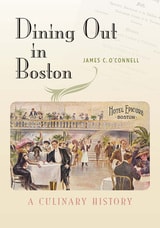
Dining Out in Boston
A Culinary HistoryJames C. O'Connell
University Press of New England, 2016
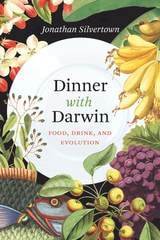
Dinner with Darwin
Food, Drink, and EvolutionJonathan Silvertown
University of Chicago Press, 2017
A delectable concoction of coevolution and cookery, gut microbiomes and microherbs, and both the chicken and its egg, Dinner with Darwin reveals that our shopping lists, recipe cards, and restaurant menus don’t just contain the ingredients for culinary delight. They also tell a fascinating story about natural selection and its influence on our plates—and palates. Digging deeper, Silvertown’s repast includes entrées into GMOs and hybrids, and looks at the science of our sensory interactions with foods and cooking—the sights, aromas, and tastes we experience in our kitchens and dining rooms. As is the wont of any true chef, Silvertown packs his menu with eclectic components, dishing on everything from Charles Darwin’s intestinal maladies to taste bud anatomy and turducken.
Our evolutionary relationship with food and drink stretches from the days of cooking cave dwellers to contemporary crêperies and beyond, and Dinner with Darwin serves up scintillating insight into the entire, awesome span. This feast of soup, science, and human society is one to savor. With a wit as dry as a fine pinot noir and a cache of evolutionary knowledge as vast as the most discerning connoisseur’s wine cellar, Silvertown whets our appetites—and leaves us hungry for more.
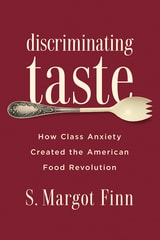
Discriminating Taste
How Class Anxiety Created the American Food RevolutionFinn, S. Margot
Rutgers University Press, 2017
For the past four decades, increasing numbers of Americans have started paying greater attention to the food they eat, buying organic vegetables, drinking fine wines, and seeking out exotic cuisines. Yet they are often equally passionate about the items they refuse to eat: processed foods, generic brands, high-carb meals. While they may care deeply about issues like nutrition and sustainable agriculture, these discriminating diners also seek to differentiate themselves from the unrefined eater, the common person who lives on junk food.
Discriminating Taste argues that the rise of gourmet, ethnic, diet, and organic foods must be understood in tandem with the ever-widening income inequality gap. Offering an illuminating historical perspective on our current food trends, S. Margot Finn draws numerous parallels with the Gilded Age of the late nineteenth century, an era infamous for its class divisions, when gourmet dinners, international cuisines, slimming diets, and pure foods first became fads.
Examining a diverse set of cultural touchstones ranging from Ratatouille to The Biggest Loser, Finn identifies the key ways that “good food” has become conflated with high status. She also considers how these taste hierarchies serve as a distraction, leading middle-class professionals to focus on small acts of glamorous and virtuous consumption while ignoring their class’s larger economic stagnation. A provocative look at the ideology of contemporary food culture, Discriminating Taste teaches us to question the maxim that you are what you eat.