Results by title
147 books match the query 'Freedom' and 4 start with d
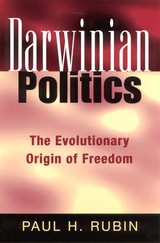
Darwinian Politics
The Evolutionary Origin of FreedomRubin, Paul H.
Rutgers University Press, 2002
Darwinian Politics is the first book to examine political behavior from a modern evolutionary perspective. Here, Paul H. Rubin discusses group or social behavior, including ethnic and racial conflict; altruism and cooperation; envy; political power; and the role of religion in politics ¾ issues that have formed the hallmark of human social behavior.
Adopting a Darwinian perspective, Rubin demonstrates why certain political-moral philosophies succeed or fail in modern Western culture. He begins by showing relationships between biology and natural selection and the history of political philosophy and explains why desirable policies must treat each person as an individual. He considers the notion of group identity and conflict, observing a human propensity to form in-groups, a behavior that does not necessitate but often leads to deviancies such as racism. In discussing altruism, Rubin shows that people are willing to aid the poor if they are convinced that the recipients are not shirkers or free loaders. This explains why recent welfare reforms are widely viewed as successful. Envy, a trait that is often counterproductive in today’s world, is also addressed. In comparing major moral philosophical systems, Rubin contends that utilitarianism is broadly consistent with our evolved preferences. He illustrates evolutionary premises for religious belief and for desires to regulate the behavior of others, and how in today’s world such regulation may not serve any useful purpose.
Ultimately, Rubin argues that humans naturally seek political freedom, and modern Western society provides more freedom than any previous one. In light of his analysis, the author extrapolates that, while there are still areas for improvements, humans have done a remarkably good job of satisfying their evolved political preferences.

Degrees of Mixture, Degrees of Freedom
Genomics, Multiculturalism, and Race in Latin AmericaPeter Wade
Duke University Press, 2017

Dread Poetry and Freedom
Linton Kwesi Johnson and the Unfinished RevolutionDavid Austin
Pluto Press, 2018
Standing at the forefront of political poetry since the 1970s, Linton Kwesi Johnson has been fighting neo-fascism, police violence and promoting socialism while putting pen to paper to refute W.H. Auden's claim that 'poetry makes nothing happen'. For Johnson, only the second living poet to have been published in the Penguin Modern Classics series, writing has always been 'a political act' and poetry 'a cultural weapon'.
In Dread Poetry and Freedom - the first book dedicated to the work of this 'political poet par excellence' - David Austin explores the themes of poetry, political consciousness and social transformation through the prism of Johnson's work. Drawing from the Bible, reggae and Rastafari, and surrealism, socialism and feminism, and in dialogue with Aime Cesaire and Frantz Fanon, C.L.R. James and Walter Rodney, and W.E.B. Du Bois and the poetry of d'bi young anitafrika, Johnson's work becomes a crucial point of reflection on the meaning of freedom in this masterful and rich study.
In the process, Austin demonstrates why art, and particularly poetry, is a vital part of our efforts to achieve genuine social change in times of dread.

Dreams in Double Time
On Race, Freedom, and BebopJonathan Leal
Duke University Press, 2023