Results by title
60 books match the query 'Ghana' and 3 start with d
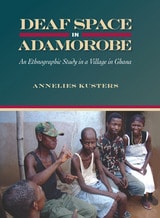
Deaf Space in Adamorobe
An Ethnographic Study in a Village in GhanaAnnelies Kusters
Gallaudet University Press, 2015
Shared signing communities consist of a relatively high number of hereditarily deaf people living together with hearing people in relative isolation. In the United States, Martha’s Vineyard gained mythical fame as a paradise for deaf people where everyone signed up until the 19th century. That community disappeared when deaf people left the island, newcomers moved in, married locals, and changed the gene pool. These unique communities still exist, however, one being the Akan village in Ghana called Adamorobe. Annelies Kusters, a deaf anthropologist, traveled to Adamorobe to conduct an ethnographic study of how deaf and hearing people live together in the village. In her new book, Kusters reveals how deaf people in Adamorobe did not live in a social paradise and how they created “deaf spaces” by seeking each other out.
Deaf Space in Adamorobe reveals one example of the considerable variation in shared signing communities regarding rates of sign language proficiency and use, deaf people’s marriage rates, deaf people’s participation in village economies and politics, and the role of deaf education. Kusters describes spaces produced by both deaf and hearing people as a cohesive community where living together is an integral fact of their sociocultural environments. At the same time, Kusters identifies tension points between deaf and hearing perspectives and also between outside perspectives and discourses that originated within the community. Because of these differences and the relatively high number of deaf people in the community, Kusters concludes it is natural that they form deaf spaces within the shared space of the village community.
Deaf Space in Adamorobe reveals one example of the considerable variation in shared signing communities regarding rates of sign language proficiency and use, deaf people’s marriage rates, deaf people’s participation in village economies and politics, and the role of deaf education. Kusters describes spaces produced by both deaf and hearing people as a cohesive community where living together is an integral fact of their sociocultural environments. At the same time, Kusters identifies tension points between deaf and hearing perspectives and also between outside perspectives and discourses that originated within the community. Because of these differences and the relatively high number of deaf people in the community, Kusters concludes it is natural that they form deaf spaces within the shared space of the village community.
[more]
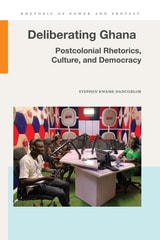
Deliberating Ghana
Postcolonial Rhetorics, Culture, and DemocracyStephen Kwame Dadugblor
Michigan State University Press, 2025
In the early 2010s electoral disputes in Ghana garnered global attention and raised questions concerning the nature and future of democratic practice in postcolonial countries. In Deliberating Ghana: Postcolonial Rhetorics, Culture, and Democracy Stephen Kwame Dadugblor examines these disputes as they unfolded in Ghana’s Supreme Court and in the public domain. Reading a diverse set of materials including courtroom discourse, social media artifacts, documentaries, parliamentary records, and op-eds, Dadugblor theorizes a cultural imaginaries orientation as a viable approach for understanding and decolonizing knowledge of democratic practice frequently tethered to Western epistemologies and conceptions. Organized around four key ideas about deliberation—the notion of speech, the utility of genre, the promises and perils of digital political participation, and the politics of memory—Deliberating Ghana situates rhetorical studies of democracy within African epistemologies, calling attention to how centering the postcolony can contribute to moving beyond well-worn binaries of West/non-West in studies of rhetoric, democracy, and deliberation, and toward decolonial possibilities. It offers fresh perspectives on foregrounding a society’s indigenous knowledge and the messiness of its socio-political and rhetorical traditions to intervene in debates about the politics of knowledge production.
[more]
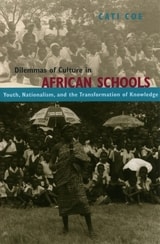
Dilemmas of Culture in African Schools
Youth, Nationalism, and the Transformation of KnowledgeCati Coe
University of Chicago Press, 2005
In working to build a sense of nationhood, Ghana has focused on many social engineering projects, the most meaningful and fascinating of which has been the state's effort to create a national culture through its schools. As Cati Coe reveals in Dilemmas of Culture in African Schools, this effort has created an unusual paradox: while Ghana encourages its educators to teach about local cultural traditions, those traditions are transformed as they are taught in school classrooms. The state version of culture now taught by educators has become objectified and nationalized—vastly different from local traditions.
Coe identifies the state's limitations in teaching cultural knowledge and discusses how Ghanaians negotiate the tensions raised by the competing visions of modernity that nationalism and Christianity have created. She reveals how cultural curricula affect authority relations in local social organizations—between teachers and students, between Christians and national elite, and between children and elders—and raises several questions about educational processes, state-society relations, the production of knowledge, and the making of Ghana's citizenry.
Coe identifies the state's limitations in teaching cultural knowledge and discusses how Ghanaians negotiate the tensions raised by the competing visions of modernity that nationalism and Christianity have created. She reveals how cultural curricula affect authority relations in local social organizations—between teachers and students, between Christians and national elite, and between children and elders—and raises several questions about educational processes, state-society relations, the production of knowledge, and the making of Ghana's citizenry.
[more]