Results by title

7 books match the query 'Beatles'
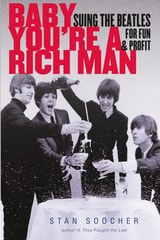
cover of Baby You're a Rich Man: Suing the Beatles for Fun and Profit

Baby You're a Rich Man

Suing the Beatles for Fun and Profit

Stan Soocher

University Press of New England, 2015

The Beatles, the most popular, influential, and important band of all time, have been the subject of countless books of biography, photography, analysis, history, and conjecture. But this long and winding road has produced nothing like Baby You’re a Rich Man, the first book devoted to the cascade of legal actions engulfing the band, from the earliest days of the loveable mop-heads to their present prickly twilight of cultural sainthood. Part Beatles history, part legal thriller, Baby You’re a Rich Man begins in the era when manager Brian Epstein opened the Pandora’s box of rock ’n’ roll merchandising, making a hash of the band’s licensing and inviting multiple lawsuits in the United States and the United Kingdom. The band’s long breakup period, from 1969 to 1971, provides a backdrop to the Machiavellian grasping of new manager Allen Klein, who unleashed a blizzard of suits and legal motions to take control of the band, their music, and Apple Records. Unsavory mob associate Morris Levy first sued John Lennon for copyright infringement over “Come Together,” then sued him again for not making a record for him. Phil Spector, hired to record a Lennon solo album, walked off with the master tapes and held them for a king’s ransom. And from 1972 to 1975, Lennon was the target of a deportation campaign personally spearheaded by key aides of President Nixon (caught on tape with a drug-addled Elvis Presley) that wound endlessly through the courts. In Baby You’re a Rich Man, Stan Soocher ties the Beatles’ ongoing legal troubles to some of their most enduring songs. What emerges is a stirring portrait of immense creative talent thriving under the pressures of ill will, harassment, and greed. Praise for They Fought the Law: Rock Music Goes to Court “Stan Soocher not only ably translates the legalese but makes both the plaintiffs and defendants engrossingly human. Mandatory reading for every artist who tends to skip his contract’s fine print.”—Entertainment Weekly
[more]
cover of Let Me Take You Down: Penny Lane and Strawberry Fields Forever

Let Me Take You Down

Penny Lane and Strawberry Fields Forever

Jonathan Cott

University of Minnesota Press, 2024

The conception, creation, recording, and significance of the Beatles’ “Penny Lane” and “Strawberry Fields Forever”

John Lennon wrote “Strawberry Fields Forever” in Almería, Spain, in fall 1966, and in November, in response to that song, Paul McCartney wrote “Penny Lane” at his home in London. A culmination of what was one of the most life-altering and chaotic years in the Beatles’ career, these two songs composed the 1967 double A-side 45 rpm record that has often been called the greatest single in the history of popular music and was, according to Beatles producer George Martin, “the best record we ever made.”


In Let Me Take You Down: Penny Lane and Strawberry Fields Forever, Jonathan Cott recounts the conception and creation of these songs; describes the tumultuous events and experiences that led the Beatles to call it quits as a touring band and redefine themselves solely as recording artists; and details the complex, seventy-hour recording process that produced seven minutes of indelible music. In writing about these songs, he also focuses on them as inspired artistic expressions of two unique ways of experiencing and being in the world, as Lennon takes us down to Strawberry Fields and McCartney takes us back to Penny Lane.


In order to gain new vistas and multiple perspectives on these multifaceted songs, Cott also engages in conversation with five remarkable people: media artist Laurie Anderson; guitarist Bill Frisell; actor Richard Gere; Jungian analyst Margaret Klenck; and urban planner, writer, and musician Jonathan F. P. Rose. The result is a wide-ranging, illuminating exploration of the musical, literary, psychological, cultural, and spiritual aspects of two of the most acclaimed songs in rock and roll history.
[more]
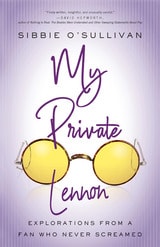
cover of My Private Lennon: Explorations from a Fan Who Never Screamed

My Private Lennon

Explorations from a Fan Who Never Screamed

Sibbie O'Sullivan

The Ohio State University Press, 2020

My Private Lennon: Explorations from a Fan Who Never Screamed offers a new point of view from which to consider the Beatles’ impact on society and on the individual. In a series of linked autobiographical essays that explore the musical, cultural, and personal aspects of intense music fandom, Sibbie O’Sullivan dismantles the grand narrative of the fifteen-year-old hysterical female Beatles fan and replaces it with an introspective and often humorous tale about how the band shaped her intellectual and artistic development.
 
My Private Lennon charts the author’s realization that the Beatles, especially John Lennon, were a crucial force in her development. A radical departure from other books written by Beatles fans, My Private Lennon invites its readers to consider subjects not usually found in works about Lennon and the band, such as the constraints of memory, the male body, grief, the female breast, race, cultural issues, and the importance of privacy in our over-mediated world. In pieces that engage cultural issues and historical contexts, My Private Lennon creates a witty and provocative intimacy with readers who value the power of art to change one’s life and who love John Lennon and the Beatles.
 
[more]
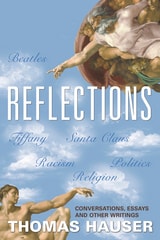
cover of Reflections: Conversations, Essays, and Other Writings

Reflections

Conversations, Essays, and Other Writings

Thomas Hauser

University of Arkansas Press, 2014

Thomas Hauser is well known to readers as Muhammad Ali's biographer and for his recording of the contemporary boxing scene. But Hauser began his writing career in the political arena as the author of Missing, a novel later made into an AcademyAward-winning film starring Jack Lemmon and Sissy Spacek. He has written books on subjects as diverse as public education, moral values, and Chernobyl, and his articles have appeared in publications ranging from the New Yorker to Penthouse. Reflections brings together all of Hauser's articles on subjects other than sports. The book begins with a never-published essay on the Beatles. It then takes readers on a remarkable journey that moves from an exploration of racism, religion, and other hot-button political issues to personal memories and reflections on the origins of Santa Claus and the Tiffany box. Combining personal memories with issue-oriented commentary, Reflections creates a portrait of some of the most remarkable people and most compelling issues of our time.
[more]
cover of The Beatles in Hamburg

The Beatles in Hamburg

Ian Inglis

Reaktion Books, 2012

John Lennon, Paul McCartney, George Harrison, and Ringo Starr are four of the most famous names in the history of music. In the 1960s, the Beatles became the bestselling pop band in the world, inspiring legions of fans and developing into popular music icons. Fifty years later, their recordings are still in demand. But none of this happened overnight. As Ian Inglis reveals in this tale of the band’s early years, before they took the world by storm, the Beatles were little more than an inexperienced, semi-professional group of talented musicians in dire need of practice.
Inglis tells the story of the Beatles in Hamburg, Germany, where their agent, Allan Williams, first sent them in August of 1960. In addition to showing how Hamburg itself played a role in the Beatles’ remarkable story, Inglis details the difficulties they faced— unusual performance venues, age restrictions, and deportations—and the experiences and personalities that shaped them as performers and composers. Ultimately, Inglis explains, the Beatles not only became proficient musicians in Hamburg, but while there they began to build the reputation that would eventually make them the most popular band in the world.
 
An illuminating look at the group’s formative years, The Beatles in Hamburg is the perfect book for any one in thrall of Beatlemania or fan of popular music history.
[more]
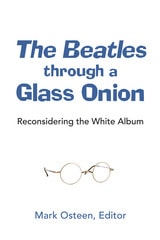
cover of The Beatles through a Glass Onion: Reconsidering the White Album

The Beatles through a Glass Onion

Reconsidering the White Album

Mark Osteen, Editor

University of Michigan Press, 2019

The Beatles, the 1968 double LP more commonly known as the White Album, has always been viewed as an oddity in the group’s oeuvre. Many have found it to be inconsistent, sprawling, and self-indulgent. The Beatles through a Glass Onion is the first-ever scholarly volume to explore this seminal recording at length, bringing together contributions by some of the most eminent scholars of rock music writing today. It marks a reconsideration of this iconic but under-appreciated recording and reaffirms the White Album’s significance in the Beatles’ career and in rock history.

This volume treats the White Album as a whole, with essays scrutinizing it from a wide range of perspectives. These essays place the album within the social and political context of a turbulent historical moment; locate it within the Beatles’ lives and  careers, taking into consideration the complex personal forces at play during the recording sessions; investigate the musical as well as pharmaceutical influences on the record; reveal how it reflects new developments in the Beatles’ songwriting and arranging; revisit the question of its alleged disunity; and finally, track its legacy and the breadth of its influence on later rock, pop, and hip-hop artists.

The Beatles through a Glass Onion features the scholarship of Adam Bradley, Vincent Benitez, Lori Burns, John Covach, Walter Everett, Michael Frontani, Steve Hamelman, Ian Inglis, John Kimsey, Mark Osteen, Russell Reising, Stephen Valdez, Anthony D. Villa, Kenneth Womack, and Alyssa Woods. John Covach’s Afterword summarizes the White Album’s lasting impact and value. The Beatles through a Glass Onion represents a landmark work of rock music scholarship. It will prove to be an essential and enduring contribution to the field.
[more]
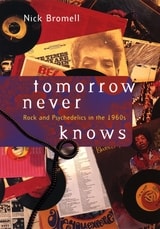
cover of Tomorrow Never Knows: Rock and Psychedelics in the 1960s

Tomorrow Never Knows

Rock and Psychedelics in the 1960s

Nick Bromell

University of Chicago Press, 2000

Tomorrow Never Knows takes us back to the primal scene of the 1960s and asks: what happened when young people got high and listened to rock as if it really mattered—as if it offered meaning and sustenance, not just escape and entertainment? What did young people hear in the music of Dylan, Hendrix, or the Beatles? Bromell's pursuit of these questions radically revises our understanding of rock, psychedelics, and their relation to the politics of the 60s, exploring the period's controversial legacy, and the reasons why being "experienced" has been an essential part of American youth culture to the present day.
[more]