Results by title
767 books match the query 'Hispanic & Latino Studies' and 34 start with d

Dancing Bahia
Essays on Afro-Brazilian Dance, Education, Memory, and RaceEdited by Lucia M. Suarez, Amélia Conrado and Yvonne Daniel
Intellect Books, 2018
Dancing Bahia is an edited collection that draws together the work of leading scholars, artists, and dance activists from Brazil, Canada, and the United States to examine the particular ways in which dance has responded to socio-political notions of race and community, resisting stereotypes, and redefining African Diaspora and Afro-Brazilian traditions.
Using the Brazilian city of Salvador da Bahia as its focal point, this volume brings to the fore questions of citizenship, human rights, and community building. The essays within are informed by both theory and practice, as well as black activism that inspires and grounds the research, teaching, and creative output of dance professionals from, or deeply connected to, Bahia.

Dancing across Borders
Danzas y Bailes MexicanosEdited by Olga Najera-Ramirez, Norma E. Cantu, and Brenda M. Romero
University of Illinois Press, 2009
Contributors are Norma E. Cantú, Susan Cashion, María Teresa Ceseña, Xóchitl C. Chávez, Adriana Cruz-Manjarrez, Renée de la Torre Castellanos, Peter J. García, Rudy F. García, Chris Goertzen, Martha González, Elisa Diana Huerta, Sydney Hutchinson, Marie "Keta" Miranda, Olga Nájera-Ramírez, Shakina Nayfack, Russell Rodríguez, Brenda M. Romero, Nancy Lee Chalfa Ruyter, José Sánchez Jiménez, and Alberto Zárate Rosales.

Dancing with the Devil
Society and Cultural Poetics in Mexican-American South TexasJose Limon
University of Wisconsin Press, 1994
Combining shrewd applications of current cultural theory with compelling autobiography and elegant prose, José E. Limón works at the intersection of anthropology, folklore, popular culture, history, and literary criticism. A native of South Texas, he renders a historical and ethnographic account of its rich Mexican-American folk culture. This folk culture, he shows—whether expressed through male joking rituals, ballroom polka dances, folk healing, or eating and drinking traditions—metaphorically dances with the devil, both resisting and accommodating the dominant culture of Texas.
Critiquing the work of his precursors— John Gregory Bourke, J. Frank Dobie, Jovita Gonzalez, and Americo Paredes—Limón deftly demonstrates that their accounts of Mexican-Americans in South Texas contain race, class, and gender contradictions, revealed most clearly in their accounts of the folkloric figure of the devil. Limón's own field-based ethnography follows, and again the devil appears as a recurrent motif, signaling the ideological contradictions of folk practices in a South Texas on the verge of postmodernity.
Dark Governance
Illegal Organizations and State PowerJavier Auyero
University of Chicago Press, 2027
A revelatory account of the ways covert, nefarious relationships between state officials and criminal groups shape daily life for all.
Far too often, the line between legal and illegal action is crossed by actors and organizations on both sides of the law. From the old Chicago Machine getting rich off criminal activity to Mexican drug cartels placing politicians in office, these relationships between criminals and the government coordinate forms of power in ways that affect where people live, what opportunities they can pursue, how they spend money, and how they treat one another. In Dark Governance, sociologist Javier Auyero describes how this kind of governance works and what it means for civic life.
Auyero analyzes instances of dark governance, including gangs in Ecuador and paramilitaries in Colombia who exert territorial control through violent specialists and government actors. He then turns to the less-studied case of the “colectivos” in Venezuela to show the scope of political work clandestine connections can achieve by thwarting grassroots organizations. In El Salvador and Honduras, the ties between gang members on the one hand, and politicians and elected officials on the other, serve to illustrate the impact dark governance has on urban spatial arrangements and on electoral campaigns. Dark Governance also offers an in-depth study of police-trafficker collusion in Argentina, which allows Auyero to identify the ways covert connections between state actors and drug traffickers operate in marginalized communities, affecting interpersonal violence. In addition to these examples in Latin America, Auyero also shares case studies in the United States and China. Dark governance can be seen in US organizations that patrol the borders and assert their control over migrants through their illicit connections with state authorities. In China, land expropriation and development projects are sometimes delayed when some households refuse to leave their properties. Enter the thugs-for-hire frequently contracted by local governments across the country to coerce residents into complying with government orders.
Demonstrating the very real effects of dark governance, Auyero argues that though the organizations involved in these dark arrangements differ, their collaboration results in a singular effect: the ability to control populations. But when these relationships come out of the shadows, collective action can bring them down.
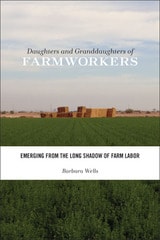
Daughters and Granddaughters of Farmworkers
Emerging from the Long Shadow of Farm LaborWells, Barbara
Rutgers University Press, 0
In Daughters and Granddaughters of Farmworkers, Barbara Wells examines the work and family lives of Mexican American women in a community near the U.S.-Mexican border in California’s Imperial County. Decades earlier, their Mexican parents and grandparents had made the momentous decision to migrate to the United States as farmworkers. This book explores how that decision has worked out for these second- and third-generation Mexican Americans.
Wells provides stories of the struggles, triumphs, and everyday experiences of these women. She analyzes their narratives on a broad canvas that includes the social structures that create the barriers, constraints, and opportunities that have shaped their lives. The women have constructed far more settled lives than the immigrant generation that followed the crops, but many struggle to provide adequately for their families.
These women aspire to achieve the middle-class lives of the American Dream. But upward mobility is an elusive goal. The realities of life in a rural, agricultural border community strictly limit social mobility for these descendants of immigrant farm laborers. Reliance on family networks is a vital strategy for meeting the economic challenges they encounter. Wells illustrates clearly the ways in which the “long shadow” of farm work continues to permeate the lives and prospects of these women and their families.
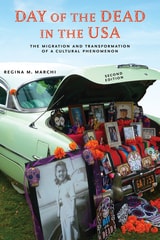
Day of the Dead in the USA, Second Edition
The Migration and Transformation of a Cultural PhenomenonRegina M Marchi
Rutgers University Press, 2022
Focusing on the power of public ritual to serve as a communication medium, this revised and updated edition combines a mix of ethnography, historical research, oral history, and critical cultural analysis to explore the manifold and unexpected transformations that occur when the tradition is embraced by the mainstream. A testament to the complex role of media and commercial forces in constructions of ethnic identity, Day of the Dead in the USA provides insight into the power of art and ritual to create community, transmit oppositional messages, and advance educational, political, and economic goals.
Today Chicano-style Day of the Dead events take place in all fifty states. This revised edition provides new information about:
- The increase in events across the US, incorporating media coverage and financial aspects,
- Recent political movements expressed in contemporary Day of the Dead celebrations, including #BlackLivesMatter and #MeToo
- Greater media coverage and online presence of the celebration in blogs, websites, and streaming video
- Día de los Muertos themes and iconography in video games and films
- The proliferation of commercialized merchandise such as home goods, apparel, face paints and jewelry at mainstream big box and web retailers, as well as the widespread proliferation of calavera-themed decorations and costumes for Halloween
- 24 new full color illustrations
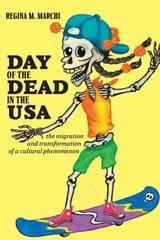
Day of the Dead in the USA
The Migration and Transformation of a Cultural PhenomenonMarchi, Regina M
Rutgers University Press, 2009
Focusing on the power of ritual to serve as a communication medium, Regina M. Marchi combines a mix of ethnography, historical research, oral history, and critical cultural analysis to explore the manifold and unexpected transformations that occur when the tradition is embraced by the mainstream. A testament to the complex nature of ethnic identity, Day of the Dead in the USA provides insight into the power of ritual to create community, transmit oppositional messages, and advance educational, political, and economic goals.

Dead Subjects
Toward a Politics of Loss in Latino StudiesAntonio Viego
Duke University Press, 2007
Viego argues that the repeated themes of wholeness, completeness, and transparency with respect to ethnic and racialized subjectivity are fundamentally problematic as these themes ultimately lend themselves to the project of managing and controlling ethnic and racialized subjects by positing them as fully knowable, calculable sums: as dead subjects. He asserts that the refusal of critical race and ethnic studies scholars to read ethnic and racialized subjects in a Lacanian framework—as divided subjects, split in language—contributes to a racist discourse. Focusing on theoretical, historical, and literary work in Latino studies, he mines the implicit connection between Latino studies’ theory of the “border subject” and Lacan’s theory of the “barred subject” in language to argue that Latino studies is poised to craft a critical multiculturalist, anti-racist Lacanian account of subjectivity while adding historical texture and specificity to Lacanian theory.
Decoding Gender
Law and Practice in Contemporary MexicoBaitenmann, Helga
Rutgers University Press, 2007
By bringing new interdisciplinary perspectives to issues such as the quality of citizenship and the rule of law in present-day Mexico, this book raises important issues for research on the relationship between law and gender more widely.
Decolonial Witnessing
Cold War Afterlives in Latin American and Latinx TestimoniosGuadalupe Escobar
University of Texas Press, 2026
Examining the power of testimonios in illuminating political injustice in Latin America from the Cold War to the present.
During the Cold War, testimonio emerged as a powerful genre of political nonfiction in Latin America. Artists created first-person narratives of censorship and state violence, highlighting broader circumstances of oppression carried out by local right-wing oligarchies in collusion with the US empire. Decolonial Witnessing explores the continuing vitality of testimonio in the twenty-first century, as it has evolved into narratives contesting neoliberal dispossession and disposability.
Considering the cultural work of Ana Castillo, Regina José Galindo, Jayro Bustamante, Alberto Ledesma, Javier Zamora, Lila Downs, and others, Guadalupe Escobar shows how artists, authors, musicians, and filmmakers are using testimonial narratives to identify and resist the architecture of post–Cold War militarized democracy. Contemporary testimonios center migrant children, torture abolitionists, Indigenous land defenders—figures whose perspectives and, indeed, presence disrupt dominant paradigms of citizenship. Cast against the law, their stories—their memories—constitute a critical optic on the construction of belonging. In these acts of bearing witness, Escobar locates the possibility of a new, counterhegemonic political imagination.
Decolonizing Latinx Masculinities
Edited by Arturo J. Aldama and Frederick Luis Aldama
University of Arizona Press, 2020
Together they explore how legacies of colonization and capitalist exploitation and oppression have created toxic forms of masculinity that continue to suffocate our existence as Latinxs. And while the authors seek to identify all cultural phenomena that collectively create reductive, destructive, and toxic constructions of masculinity that traffic in misogyny and homophobia, they also uncover the many spaces—such as Xicanx-Indígena languages, resistant food cultures, music performances, and queer Latinx rodeo practices—where Latinx communities can and do exhale healing masculinities.
With unity of heart and mind, the creative and the scholarly, Decolonizing Latinx Masculinities opens wide its arms to all non-binary, decolonial masculinities today to grow a stronger, resilient, and more compassionate new generation of Latinxs tomorrow.
Contributors
Arturo J. Aldama
Frederick Luis Aldama
T. Jackie Cuevas
Gabriel S. Estrada
Wayne Freeman
Jonathan D. Gomez
Ellie D. Hernández
Alberto Ledesma
Jennie Luna
Sergio A. Macías
Laura Malaver
Paloma Martinez-Cruz
L. Pancho McFarland
William Orchard
Alejandra Benita Portillos
John-Michael Rivera
Francisco E. Robles
Lisa Sánchez González
Kristie Soares
Nicholas Villanueva Jr.
Defending Their Own in the Cold
The Cultural Turns of U.S. Puerto RicansMarc Zimmerman
University of Illinois Press, 2011
Del Otro Lado
Literacy and Migration across the U.S.-Mexico BorderSusan V. Meyers
Southern Illinois University Press, 2014
In Del OtroLado: Literacy and Migration across the U.S.-Mexico Border, author Susan V. Meyers draws on her year-long ethnographic study in Mexico and the United States to analyze the literacy practices of Mexican-origin students on both sides of the border.
Meyers begins by taking readers through the historical development of the rural Mexican town of Villachuato. Through a series of case studies spanning the decades between the Mexican Revolution and the modern-day village, Meyers explores the ever-widening gulf between the priorities of students and the ideals of the public education system. As more and more of Villachuato’s families migrate in an effort to find work in the wake of shifting transnational economic policies like NAFTA, the town’s public school teachers find themselves frustrated by spiraling drop-out rates. Meyers discovers that students often consider the current curriculum irrelevant and reject the established value systems of Mexico’s public schools. Meyers debunks the longstanding myth that literacy is tied to economic development, arguing that a “literacy contract” model, in which students participate in public education in exchange for access to increased earning potential, better illustrates the situation in rural Mexico.
Meyers next explores literacy on the other side of the border, traveling to Marshalltown, Iowa, where many former citizens of Villachuato have come to reside because of the availability of jobs for unskilled workers at the huge Swift meat-packing plant there. Here she discovers that Mexican-origin families in the United States often consider education a desirable end in itself rather than a means to an end. She argues that migration has a catalyzing effect on literacy, particularly as Mexican migrant families tend to view education as a desirable form of prestige.
Meyers reveals the history and policies that have shaped the literacy practices of Mexican-origin students, and she raises important questions about not only the obligation of the United States to educate migrant students, but also those students’ educational struggles and ways in which these difficulties can be overcome. This transnational study is essential reading for scholars, students, educators and lawmakers interested in shaping the future of educational policy.
Democratizing Texas Politics
Race, Identity, and Mexican American Empowerment, 1945-2002By Benjamin Márquez
University of Texas Press, 2014
Winner, Outstanding Book Award, NACCS Tejas Foco Award for Non-Fiction, National Association for Chicana and Chicano Studies Tejas, 2015
By the beginning of the twenty-first century, Texas led the nation in the number of Latino officeholders, despite the state’s violent history of racial conflict. Exploring this and other seemingly contradictory realities of Texas’s political landscape since World War II, Democratizing Texas Politics captures powerful, interrelated forces that drive intriguing legislative dynamics. These factors include the long history of Mexican American activism; population growth among Mexican American citizens of voting age; increased participation among women and minorities at state and national levels in the Democratic Party, beginning in the 1960s; the emergence of the Republican Party as a viable alternative for Southern conservatives; civil rights legislation; and the transition to a more representative two-party system thanks to liberal coalitions.
Culling extensive archival research, including party records and those of both Latino activists and Anglo elected officials, as well as numerous interviews with leading figures and collected letters of some of Texas’s most prominent voices, Benjamin Márquez traces the slow and difficult departure from a racially uniform political class to a diverse one. As Texas transitioned to a more representative two-party system, the threat of racial tension and political exclusion spurred Mexican Americans to launch remarkably successful movements to ensure their incorporation. The resulting success and dilemmas of racially based electoral mobilization, embodied in pivotal leaders such as Henry B. Gonzalez and Tony Sanchez, is vividly explored in Democratizing Texas Politics.
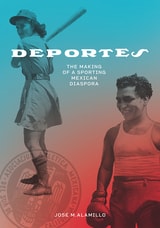
Deportes
The Making of a Sporting Mexican DiasporaJosé M Alamillo
Rutgers University Press, 2020
These sporting achievements were not theirs alone, an entire cadre of supporters—families, friends, coaches, managers, promoters, sportswriters, and fans—rallied around them and celebrated their athletic success. The Mexican nation and community, at home or abroad, elevated Mexican athletes to sports hero status with a deep sense of cultural and national pride. Alamillo argues that Mexican-origin males and females in the United States used sports to empower themselves and their community by developing and sustaining transnational networks with Mexico. Ultimately, these athletes and their supporters created a “sporting Mexican diaspora” that overcame economic barriers, challenged racial and gender assumptions, forged sporting networks across borders, developed new hybrid identities and raised awareness about civil rights within and beyond the sporting world.
Dialectical Imaginaries
Materialist Approaches to U.S. Latino/a Literature in the Age of NeoliberalismMarcial González and Carlos Gallego, editors
University of Michigan Press, 2018
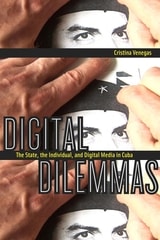
Digital Dilemmas
The State, the Individual, and Digital Media in CubaVenegas, Cristina
Rutgers University Press, 2010
Digital Dilemmas views Cuba from the Soviet Union's demise to the present, to assess how conflicts over media access play out in their both liberating and repressive potential. Drawing on extensive scholarship and interviews, Cristina Venegas questions myths of how Internet use necessarily fosters global democracy and reveals the impact of new technologies on the country's governance and culture. She includes film in the context of broader media history, as well as artistic practices such as digital art and networks of diasporic communities connected by the Web. This book is a model for understanding the geopolitic location of power relations in the age of digital information sharing.
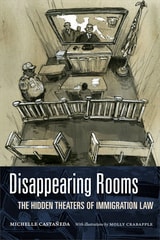
Disappearing Rooms
The Hidden Theaters of Immigration LawMichelle Castañeda
Duke University Press, 2023
Duke University of Press Scholars of Color First Book Award Recipient
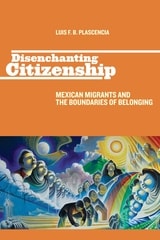
Disenchanting Citizenship
Mexican Migrants and the Boundaries of BelongingLuis F. B. Plascencia
Rutgers University Press, 2012
The book explores the meaning of U.S. citizenship through the experience of a unique group of Mexican migrants who were granted Temporary Status under the “legalization” provisions of the 1986 IRCA, attained Lawful Permanent Residency, and later became U.S. citizens. Plascencia integrates an extensive and multifaceted collection of interviews, ethnographic fieldwork, ethno-historical research, and public policy analysis in examining efforts that promote the acquisition of citizenship, the teaching of citizenship classes, and naturalization ceremonies. Ultimately, he unearths citizenship’s root as a Janus-faced construct that encompasses a simultaneous process of inclusion and exclusion. This notion of citizenship is mapped on to the migrant experience, arguing that the acquisition of citizenship can lead to disenchantment with the very status desired. In the end, Plascencia expands our understanding of the dynamics of U.S. citizenship as a form of membership and belonging.
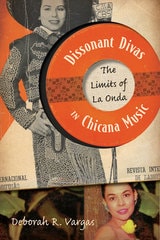
Dissonant Divas in Chicana Music
The Limits of La OndaDeborah R. Vargas
University of Minnesota Press, 2012
Musical sound has been central to heteromasculinist productions of nation and homeland, whether Chicano, Tejano, Texan, Mexican, or American. If this assertion holds true, as Deborah R. Vargas suggests, then what are we to make of those singers and musicians whose representations of gender and sexuality are irreconcilable with canonical Chicano/Tejano music or what Vargas refers to as “la onda”? These are the “dissonant divas” Vargas discusses, performers who stimulate our listening for alternative borderlands imaginaries that are inaudible within the limits of “la onda.”
Dissonant Divas in Chicana Music focuses on the Texan monument of the Alamo and its association with Rosita Fernandez; Tejano corrido folklore and its musical antithesis in Chelo Silva; the female accordion-playing bodies of Ventura Alonza and Eva Ybarra as incompatible with the instrumental labor of conjunto music; geography as national border, explored through the multiple national music scales negotiated by Eva Garza; and racialized gender, viewed through Selena’s integration of black diasporic musical sound. Vargas offers a feminist analysis of these figures’ contributions by advancing a notion of musical dissonance—a dissonance that recognizes the complexity of gender, sexuality, and power within Chicana/o culture.
Incorporating ethnographic fieldwork, oral history, and archival research, Vargas’s study demonstrates how these singers work together to explode the limits of Texan, Chicano, Tejano, Mexican, and American identities.
Doing Good
Racial Tensions and Workplace Inequalities at a Community Clinic in El Nuevo SouthNatalia Deeb-Sossa
University of Arizona Press, 2013
Deeb-Sossa argues persuasively that “moral identities” have been constructed by clinic staff. The high-status staff—nearly all of whom are white—see themselves as heroic workers. Mid- and lower-status Latina staff feel like they are guardians of people who are especially needy and deserving of protection. In contrast, the moral identity of African American staffers had previously been established in response to serving “their people.” Their response to the evolving clientele has been to create a self-image of superiority by characterizing Latina/o clients as “immoral,” “lazy,” “working the system,” having no regard for rules or discipline, and being irresponsible parents.
All of the health-care workers want to be seen as “doing good.” But they fail to see how, in constructing and maintaining their own moral identity in response to their personal views and stereotypes, they have come to treat each other and their clients in ways that contradict their ideals.
Domestic Disturbances
Re-Imagining Narratives of Gender, Labor, and ImmigrationBy Irene Mata
University of Texas Press, 2014
The issue of immigration is one of the most hotly debated topics in the national arena, with everyone from right-wing pundits like Sarah Palin to alternative rockers like Zack de la Rocha offering their opinion. The traditional immigrant narrative that gained popularity in the nineteenth and twentieth centuries continues to be used today in describing the process of the “Americanization” of immigrants. Yet rather than acting as an accurate representation of immigrant experiences, this common narrative of the “American Dream” attempts to ideologically contain those experiences within a story line that promotes the idea of achieving success through hard work and perseverance.
In Domestic Disturbances, Irene Mata dispels the myth of the “shining city on the hill” and reveals the central truth of hidden exploitation that underlies the great majority of Chicana/Latina immigrant stories. Influenced by the works of Latina cultural producers and the growing interdisciplinary field of scholarship on gender, immigration, and labor, Domestic Disturbances suggests a new framework for looking at these immigrant and migrant stories, not as a continuation of a literary tradition, but instead as a specific Latina genealogy of immigrant narratives that more closely engage with the contemporary conditions of immigration. Through examination of multiple genres including film, theatre, and art, as well as current civil rights movements such as the mobilization around the DREAM Act, Mata illustrates the prevalence of the immigrant narrative in popular culture and the oppositional possibilities of alternative stories.
Domestic Economies
Women, Work, and the American Dream in Los AngelesSusanna Rosenbaum
Duke University Press, 2017
Domestic Negotiations
Gender, Nation, and Self-Fashioning in US Mexicana and Chicana Literature and ArtMcMahon, Marci R
Rutgers University Press, 2013
This interdisciplinary study explores how US Mexicana and Chicana authors and artists across different historical periods and regions use domestic space to actively claim their own histories. Through “negotiation”—a concept that accounts for artistic practices outside the duality of resistance/accommodation—and “self-fashioning,” Marci R. McMahon demonstrates how the very sites of domesticity are used to engage the many political and recurring debates about race, gender, and immigration affecting Mexicanas and Chicanas from the early twentieth century to today.
Domestic Negotiations covers a range of archival sources and cultural productions, including the self-fashioning of the “chili queens” of San Antonio, Texas, Jovita González’s romance novel Caballero, the home economics career and cookbooks of Fabiola Cabeza de Baca, Sandra Cisneros’s “purple house controversy” and her acclaimed text The House on Mango Street, Patssi Valdez’s self-fashioning and performance of domestic space in Asco and as a solo artist, Diane Rodríguez’s performance of domesticity in Hollywood television and direction of domestic roles in theater, and Alma López’s digital prints of domestic labor in Los Angeles. With intimate close readings, McMahon shows how Mexicanas and Chicanas shape domestic space to construct identities outside of gendered, racialized, and xenophobic rhetoric.

Doom Patterns
Latinx Speculations and the Aesthetics of ViolenceMaia Gil'Adí
Duke University Press, 2025
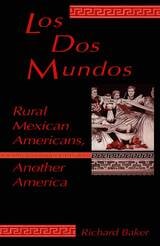
Dos Mundos
Rural Mexican Americans, Another AmericaRichard Baker
Utah State University Press, 1995
Mexican Americans make up the largest minority in Idaho, yet they seemingly live in a different world from the dominant Anglo population, and because of pervasive stereotypes and exclusive policies, their participation in the community's social, economic, and political life is continually impeded.
This unique ethnographic study of a small Idaho community with a large Hispanic population examines many dimensions of the impact race relations have on everyday life for rural Mexican Americans.
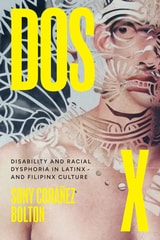
Dos X
Disability and Racial Dysphoria in Latinx and Filipinx CultureSony Coráñez Bolton
University of Texas Press, 2025
An examination of the interconnectedness of brown-racialized people across multiple identities, told through case studies of television, literature, and writing.
As a Filipinx immigrant to the United States, Sony Coráñez Bolton has frequently been mistaken as Mexican. Dos X theorizes such misrecognition. What does it mean to exist in this liminal state, which Coráñez Bolton dubs the “racial uncanny”? What generative possibilities emerge from the presumed interchangeability of Latinx and Filipinx bodies—and from the in-betweenness of brownness as such?
Dos X tracks misrecognition through cultural products like the TV series Undone, Brian Ascalon Roley’s American Son, and the nonfiction work of Jose Antonio Vargas. Misrecognition, Coráñez Bolton argues, produces moments of uncanniness in which subjects experience dysphoric attachments to identities that aren’t supposed to be theirs. In the context of racial capitalism, racial dysphoria is a disability because it undermines certainty about what one’s body is and therefore what role one is meant to play as a laborer. But racial dysphoria can also be revealing. Coráñez Bolton identifies vast potential in this supposed disability, which compels its “sufferers” to confront their shared position within the social, political, and economic organization of capital’s empire, opening new avenues for liberatory solidarity.

Down and Dirty
Toward a Sucialogy of Queer Chicane LifeDeborah R. Vargas
Duke University Press, 2027
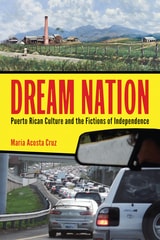
Dream Nation
Puerto Rican Culture and the Fictions of IndependenceAcosta Cruz, María
Rutgers University Press, 2014
Bringing together texts from Puerto Rican literature, history, and popular culture, Dream Nation shows how imaginings of national independence have served many competing purposes. They have given authority to the island’s literary and artistic establishment but have also been a badge of countercultural cool. These ideas have been fueled both by nostalgia for an imagined past and by yearning for a better future. They have fostered local communities on the island, and still helped define Puerto Rican identity within U.S. Latino culture.
In clear, accessible prose, Acosta Cruz takes us on a journey from the 1898 annexation of Puerto Rico to the elections of 2012, stopping at many cultural touchstones along the way, from the canonical literature of the Generación del 30 to the rap music of Tego Calderón. Dream Nation thus serves both as a testament to how stories, symbols, and heroes of independence have inspired the Puerto Rican imagination and as an urgent warning about how this culture has become detached from the everyday concerns of the island’s people.
A volume in the American Literature Initiatives series
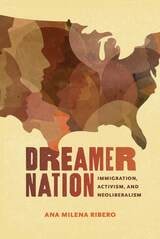
Dreamer Nation
Immigration, Activism, and NeoliberalismAna Milena Ribero
University of Alabama Press, 2023
Dreamer Nation tells the story of how Dreamers in the Obama era creatively confronted a complex sociopolitical landscape to advocate for immigrant rights and empower undocumented youth to proudly represent their lives and identities, all while under the ever-present threat of detention and deportation. Contributing to rhetorical studies of social movements, immigration, and minoritized rhetorics, Ribero argues that even though Dreamer rhetorics were reflective of the discursive limits of the neoliberal milieu, they also worked to disrupt neoliberal constraints through activism that troubled the primacy of the nation-state and citizenship, refused to adhere to respectability politics, forwarded embodied identity and transnational belonging, and looked for liberation in community—not solely in legislative action.
Each chapter presents a different rhetorical situation within the US “crisis” of immigration and the rhetoric that Dreamers used to respond to it. Organized chronologically, the chapters document Dreamer activism during the Obama presidency, from the 2010 hunger strikes advocating for the DREAM Act to undocuqueer “artivism” responding to Trump’s presidential campaign. The author draws not only on the methods and theories of rhetorical studies but also on women of color feminisms, ethnic studies, critical theory, and queer theory. In this way, the book looks across disciplines to illustrate the rhetorical savvy of one of the most important US social movements of our time.
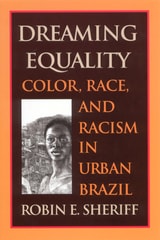
Dreaming Equality
Color, Race, and Racism in Urban BrazilSheriff, Robin E.
Rutgers University Press, 2001
This myth contrasts starkly with the realities of a pernicious racial inequality that permeates every aspect of Brazilian life. To study the grip of this myth on African Brazilians’ views of themselves and their nation, Robin E. Sheriff spent twenty months in a primarily black shantytown in Rio de Janeiro, studying the inhabitants’s views of race and racism. How, she asks, do poor African Brazilians experience and interpret racism in a country where its very existence tends to be publicly denied? How is racism talked about privately in the family and publicly in the community—or is it talked about at all?
Sheriff’s analysis is particularly important because most Brazilians live in urban settings, and her examination of their views of race and racism sheds light on common but underarticulated racial attitudes. This book is the first to demonstrate that urban African Brazilians do not subscribe to the racial democracy myth and recognize racism as a central factor shaping their lives.
Dreams Achieved and Denied
Mexican Intergenerational MobilityRobert Courtney Smith
Russell Sage Foundation, 2024
For over twenty years, Smith followed the lives and mobility of nearly one hundred children of Mexican immigrants in New York City. Smith’s longitudinal, ethnographic data enabled him to intimately describe how specific mechanisms blocked or promoted mobility for years as his participants moved from adolescence through early adulthood and into established adulthood. Smith documents how having or gaining legal status made certain New York City or New York State policies and practices more efficacious in supporting individual and family efforts and strategies for mobility. Such immigrant-inclusive and mobility-promoting measures include enabling undocumented people to attend public colleges at in-state tuition rates, and later to get driver’s licenses, offering healthcare to all in New York City, and the City’s subway and school choice systems, which enabled students to attend better schools or take opportunities outside their neighborhoods.
Smith finds that keeping the immigrant bargain – whereby children of immigrants redeem their parents’ sacrifice by doing well in school, helping their parents and siblings, and becoming “good” people (in their parents’ words) – helped them towards better adult outcomes and lives. Having mentors, picking academically stronger schools and friends, and using second chance mechanisms also promoted more adult mobility. However, lacking legal status blocked mobility, by preventing them from benefiting from these same mobility-promoting city and state policies, from mentors, or from working hard and keeping the immigrant bargain.
Dreams Achieved and Denied deeply analyzes the historic upward mobility of U.S.-born Mexicans in New York City. Itcounters the dominant story research and public discourse tell about Mexican mobility in the U.S. and shows how thoughtful public policy can improve the lives of young immigrants and families.
Dreams Derailed
Undocumented Youths in the Trump EraWilliam A. Schwab
University of Arkansas Press, 2018
During the 2016 presidential campaign millions of voters, concerned about the economic impact of illegal immigration, rallied behind the notion of a border wall between the United States and Mexico. Well into the Trump presidency, immigration endures as a hotly contested issue in United States politics.
In Dreams Derailed sociologist William A. Schwab shares the stories of immigration reform advocates and follows up on stories told in his 2013 book Right to DREAM, which argued in favor of the DREAM Act that would have provided conditional residency for undocumented youth brought to the United States as children, a version of which was later enacted by executive order and referred to as DACA (Deferred Action for Childhood Arrivals).
Taking as its focal point the Trump administration’s decision to rescind Obama-era DACA protection, Dreams Derailed delves into the economic, political, and social factors that inform the public conversation about immigration, making a clear case for the many benefits of inclusive policies and the protection of undocumented youths. Schwab also takes a close look at the factors that carried Donald Trump to the White House, demonstrates how economic upheaval and the issue of immigration influenced the 2016 presidential election, analyzes current immigration laws, and suggests next steps for reform.
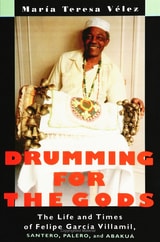
Drumming For The Gods
Maria Velez
Temple University Press, 2000
This book focuses on three periods of Felipe's life, each marked by changes in his personal life and by important historical events. The first period covers his formative years during which he received his initial training. Through Felipe's story, we explore the legacy of slavery in Cuba, the nature of Afro-Cuban religions and their musical traditions, and the history of bata drums. The second period covers the critical years of the Cuban Revolution. Here we see the effect of social turmoil both n music and religious practice (santero, palero, and abakua). The third period covers Felipe's life in New York as a refugee/immigrant, and the role of music in rebuilding his identity. Felipe's story illuminates his cultural practices and beliefs as well as the ways in which an individual musician selects and modifies the elements of his cultural heritage to create a voice that is personal and unique. Felipe not only lives through history but also makes history, shaping an identity that cannot be described as "Cuban immigrant," "Afro-Cuban," "religious drummer," or "santeria initiate," but is composed of all of them.
Through Felipe's experiences, Maria Teresa Velez reveals the interaction between social, political, economic, and cultural forces and an individual's own actions. The professionalization of musicians in Cuba following the Revolution and the plight of Afro-Cuban immigrants in New York are seen as large historical and social problems to which Felipe must personally respond. A noted ethnomusicologist, Velez provides the most insightful and comprehensive English-language study of an individual Cuban religious drummer available.
Drumming for the Gods is a must-read for those interested in ethnomusicology, Caribbean studies, and Afro-Cuban religions and culture.