Results by title
192 books match the query 'Humor' and 8 start with d
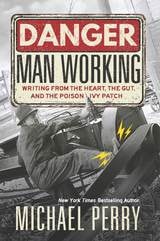
Danger, Man Working
Writing from the Heart, the Gut, and the Poison Ivy PatchArenas
Wisconsin Historical Society Press, 2017
"Every writer has advice for aspiring writers. Mine is predicated on formative years spent cleaning my father’s calf pens: Just keep shoveling until you’ve got a pile so big, someone has to notice. The fact that I cast my life’s work as slung manure simply proves that I recognize an apt metaphor when I accidentally stick it with a pitchfork. . . . Poetry was my first love, my gateway drug—still the poets are my favorites—but I quickly realized I lacked the chops or insights to survive on verse alone. But I wanted to write. Every day. And so I read everything I could about freelancing, and started shoveling."
The pieces gathered within this book draw on fifteen years of what Michael Perry calls "shovel time"—a writer going to work as the work is offered. The range of subjects is wide, from musky fishing, puking, and mountain-climbing Iraq War veterans to the frozen head of Ted Williams. Some assignments lead to self-examination of an alarming magnitude (as Perry notes, "It quickly becomes obvious that I am a self-absorbed hypochondriac forever resolving to do better nutritionally and fitness-wise but my follow-through is laughable.") But his favorites are those that allow him to turn the lens outward: "My greatest privilege," he says, "lies not in telling my own story; it lies in being trusted to tell the story of another."
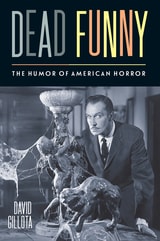
Dead Funny
The Humor of American HorrorDavid Gillota
Rutgers University Press, 2023
Dead Funny locates humor as a key element in the American horror film, one that is not merely used for extraneous “comic relief” moments but often serves to underscore major themes, intensify suspense, and disorient viewers. Each chapter focuses on a different comic style or device, from the use of funny monsters and scary clowns in movies like A Nightmare on Elm Street to the physical humor and slapstick in movies ranging from The Evil Dead to Final Destination. Along the way, humor scholar David Gillota explores how horror films employ parody, satire, and camp to comment on gender, sexuality, and racial politics. Covering everything from the grotesque body in Freaks to the comedy of awkwardness in Midsommar, this book shows how integral humor has been to the development of the American horror film over the past century.

Dicta and Contradicta
Karl Kraus. Translated from the German by Jonathan McVity
University of Illinois Press, 2001
"The mission of the press is to spread culture while destroying the attention span."
"Art serves to rinse out our eyes."
Uniquely combining humor with profundity and venom with compassion, Dicta and Contradicta is a bonanza of scandalous wit from Vienna's answer to Oscar Wilde.
From the decadent turn of the century to the Third Reich, the acerbic satirist Karl Kraus was one of the most famous–and feared–intellectuals in Europe. Through the polemical and satirical magazine Die Fackel (The torch), which he founded in 1899, Kraus launched wicked but unrelentingly witty attacks on literary and media corruption, sexual repression and militarism, and the social hypocrisy of fin-de-siècle Vienna.
Kraus's barbed aphorisms were an essential part of his running commentary on Viennese culture. These miniature gems, as sharp as diamonds, demonstrate Kraus's highly cultivated wit and his unerring eye for human weakness, flaccidity, and hypocrisy. Kraus shies away from nothing; the salient issues of the day are lined up side by side, as before a firing squad, with such perennial concerns as sexuality, religion, politics, art, war, and literature. By turns antagonistic, pacifistic, realistic, and maddeningly misogynistic, Kraus's aphorisms provide the sting that precedes healing.
For Dicta and Contradicta, originally published in 1909 (with the title Spruche und Widerspruche) and revised in 1923, Kraus selected nearly 1,000 of the scathing aphorisms that had appeared in Die Fackel. In this new translation, Jonathan McVity masterfully renders Kraus's multilayered meanings, preserving the clever wordplay of the German in readable colloquial English. He also provides an introductory essay on Kraus's life and milieu and annotations that clarify many of Kraus's literary and sociohistorical allusions.
Dirty Jokes and Bawdy Songs
The Uncensored Life of Gershon LegmanSusan G. Davis
University of Illinois Press, 2019
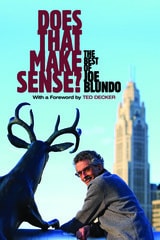
Does That Make Sense?
The Best of Joe BlundoJoe Blundo
The Ohio State University Press, 2019
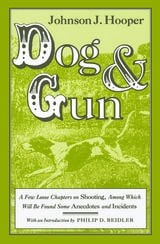
Dog and Gun
A Few Loose Chapters on Shooting, Among Which Will Be Found Some Anecdotes and IncidentsJohnson J. Hooper, with an Introduction by Philip D. Beidler
University of Alabama Press, 1992
A classic portrait of hunting, sport, and gentlemanly culture in the antebellum South.
The least well known of Johnson Jones Hooper’s works, Dog and Gun was first published as a newspaper series, then appeared in six book editions between 1856 and 1871. Hooper is Alabama’s most celebrated antebellum author, and here he gives insight into the meaning of a culture where every male hunts – and a man who shoots as a gentleman will be assumed a gentleman. Beidler’s introduction to this reprint edition explores the social, literary, and technical dimensions of Dog and Gun, which he sees as an important commentary on class distinctions in the antebellum South, as well as a straightforward treatise on hunting.
Although the book is a manual for the hunter, with characteristic humor and a certain disdain, Hooper gives a full picture of the gentlemanly sport of hunting – clearly distinct from hunting for food – in all aspects including hunter, weaponry, and sporting dogs. He takes us back to an autumnal ritual of the hunt, where one is always a boy with his first gun – to the natural mystery of quest, competition, predation, pursuit, survival, bravery, endurance, and eventual defeat, called the mystery of the hunt.

Down the River
or Practical Lessons Under The Code DuelloGeorge W Hooper
University of Alabama Press, 2007
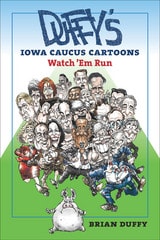
Duffy's Iowa Caucus Cartoons
Watch 'Em RunBrian Duffy
University of Iowa Press, 2015
Whether you’re anticipating or dreading the onset of another caucus season in 2016, this book will put it all into perspective. From Jimmy Carter’s innovative 1976 effort to Barack Obama’s come-from-behind win in 2008, from George H. W. Bush’s storming to victory in 1980 to George W. Bush’s coasting to his win in 2000, from Gary Hart’s peccadillos in 1988 to John Edwards’s missteps in 2008, from Elizabeth Dole’s determination to breach the White House boys’ club in 2000 to Hillary Clinton’s fall from frontrunner to third place in 2008, here is American presidential campaigning in all its glory. With pigs.