Results by title
468 books match the query 'Industries' and 18 start with d
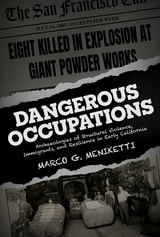
Dangerous Occupations
Archaeologies of Structural Violence, Immigrants, and Resilience in Early CaliforniaMarco G. Meniketti
University of Alabama Press, 2026
Addresses structural violence through history and archaeology of immigrant workers
Dangerous Occupations: Archaeologies of Structural Violence, Immigrants, and Resilience in Early California is an impactful work of historical archaeology combined with social history that addresses structural violence in key California industries from the Gold Rush in 1849 until 1920. Monopolistic industries, such as railroading, mining, timbering, explosive manufacturing, lime production, meatpacking, textile milling, and fishing/whaling, relied on immigrant laborers who were recruited and perceived as expendable. Restrictive laws and lack of employment opportunities based on bigotry often forced immigrants into the most dangerous occupations. In the days before workmen’s compensation insurance and strict labor safety laws, laborers often risked their health and even their lives for employment.
Marco G. Meniketti’s analysis comes from examining excavation of labor camps and housing, landscape studies, bioarchaeological data, architectural footprints, and archival sources. Each chapter offers a case study of industries to exemplify structural violence and its broader consequences among various immigrant labor groups, such as Chinese, Scandinavian, Irish, Italian, Chilean, Cornish, and Portuguese. The narrative includes a historical overview of the industries, identifies who the immigrant laborers were and how they came to be there, examines the dangers and health risks of their jobs, and details their living conditions and daily life, including foodways, leisure, and efforts to treat their job-inflicted maladies. Dangerous Occupations introduces a new generation of readers to how immigrants built the West Coast and at what great cost.
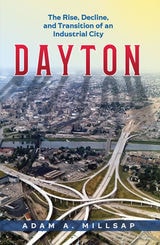
Dayton
The Rise, Decline, and Transition of an Industrial CityAdam A. Millsap
The Ohio State University Press, 2019
Thoroughly researched and engagingly written, Millsap’s book explores the economic background of the region made famous by J. D. Vance’s Hillbilly Elegy. From early twentieth-century optimism, through the Great Depression and post-WWII manufacturing decline, to Dayton now, with its labor-force problems and opioid crisis, Millsap tracks the underlying forces driving the city’s trajectory. Race relations, interstates, suburbanization, climate, crime, geography, and government policies all come into play as Millsap develops a picture of the city, past and present. By examining the past, Millsap proposes a plan for the future, claiming that there is hope for Dayton to thrive again. And if Dayton can rise from its industrial ashes, then perhaps the Rust Belt can shed its stigma and once again become the backbone of American innovation.
Democracy in Power
A History of Electrification in the United StatesSandeep Vaheesan
University of Chicago Press, 2024
Private money, public good, and the original fight for control of America’s energy industry.
Until the 1930s, financial interests dominated electrical power in the United States. That changed with President Franklin D. Roosevelt’s New Deal, which restructured the industry. The government expanded public ownership, famously through the Tennessee Valley Authority, and promoted a new kind of utility: the rural electric cooperative that brought light and power to millions in the countryside. Since then, public and cooperative utilities have persisted as an alternative to shareholder control. Democracy in Power traces the rise of publicly governed utilities in the twentieth-century electrification of America.
Sandeep Vaheesan shows that the path to accountability in America’s power sector was beset by bureaucratic challenges and fierce private resistance. Through a detailed and critical examination of this evolution, Vaheesan offers a blueprint for a publicly led and managed path to decarbonization. Democracy in Power is at once an essential history, a deeply relevant accounting of successes and failures, and a guide on how to avoid repeating past mistakes.
Democracy in Power
A History of Electrification in the United StatesSandeep Vaheesan
University of Chicago Press, 2024
This is an auto-narrated audiobook version of this book.
Private money, public good, and the original fight for control of America’s energy industry.
Until the 1930s, financial interests dominated electrical power in the United States. That changed with President Franklin D. Roosevelt’s New Deal which restructured the industry. The government expanded public ownership, famously through the Tennessee Valley Authority, and promoted a new kind of utility: the rural electric cooperative that brought light and power to millions in the countryside. Since then, public and cooperative utilities have persisted as an alternative to shareholder control. Democracy in Power traces the rise of publicly governed utilities in the twentieth-century electrification of America.
Sandeep Vaheesan shows that the path to accountability in America’s power sector was beset by bureaucratic challenges and fierce private resistance. Through a detailed and critical examination of this evolution, Vaheesan offers a blueprint for a publicly led and managed path to decarbonization. Democracy in Power is at once an essential history, a deeply relevant accounting of successes and failures, and a guide on how to avoid repeating past mistakes.
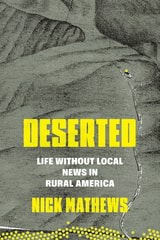
Deserted
Life Without Local News in Rural AmericaNick Mathews
University of Illinois Press, 2026
The devastation of local news organizations has left rural areas of the US marooned in information deserts. Nick Mathews offers a boots-on-the-ground examination of the human toll of local news’s erosion by the winds of de-localization and corporate indifference.
It is no secret that ownership transfers, corporate mergers, and hedge fund takeovers have relentlessly consolidated and closed local news organizations. Mathews exposes the impact of that process on journalism, journalists, and news consumers hungry for outlets that tell their stories. A fundamental breakdown within journalism itself, the abandonment of community news has left disgruntled and disconnected locals to piece together news and information themselves. Mathews draws on the personal experiences of news gatherers and consumers to illuminate why local news cannot be scaled. Mass-produced content inevitably severs ties to communities while distant ownership is indifferent to local concerns.
Nuanced and sympathetic, <i>Deserted</i> provides a vivid portrait of the people and places forsaken by journalism’s corporate owners.
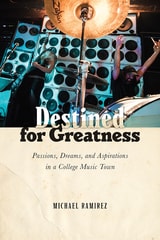
Destined for Greatness
Passions, Dreams, and Aspirations in a College Music TownRamirez, Michael
Rutgers University Press, 2018
In Destined for Greatness, sociologist Michael Ramirez examines the lives of forty-eight independent rock musicians who seek out such non-normative choices in a college town renowned for its music scene. He explores the rich life course trajectories of women and men to explore the extent to which pathways are structured to allow some, but not all, individuals to fashion careers in music worlds. Ramirez suggests a more nuanced understanding of factors that enable the pursuit of musical livelihoods well into adulthood.
Digital Depression
Information Technology and Economic CrisisDan Schiller
University of Illinois Press, 2014

Digital Rights at the Periphery
Making Brazil's Marco CivilGuy T. Hoskins
University of Illinois Press, 2025
Signed into law in 2014, the Marco Civil da Internet (Brazilian Civil Rights Framework for the Internet) appeared to offer pioneering legislation for a digital bill of rights that addressed issues like network neutrality and privacy. Guy T. Hoskins chronicles the Marco Civil’s development and its failure to confront the greatest concentration of power in the digital age: informational capitalism. Combining interviews with discourse and political-economic analysis, Hoskins reveals why the legislation fell short while examining the implications of its emergence in Brazil, which remains on the margins of the global system of informational capitalism. Hoskins places collectivist and public service principles at the core of any framework’s effectiveness. He also shows why we must create systems sensitive to the sociocultural and political-economic contexts that will shape digital rights and their usefulness.
Compelling and contrarian, Digital Rights at the Periphery looks at communications policy and internet governance in the Global South and the lessons they provide for the rest of the world.
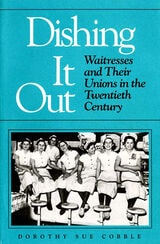
Dishing It Out
Waitresses and Their Unions in the Twentieth CenturyDorothy Sue Cobble
University of Illinois Press, 1991
Back when SOS or Adam and Eve on a raft were things to order if you were hungry but a little short on time and money, nearly one-fourth of all waitresses belonged to unions. By the time their movement peaked in the 1940s and 1950s, the women had developed a distinctive form of working-class feminism, simultaneously pushing for equal rights and pay and affirming their need for special protections.
Dorothy Sue Cobble shows how sexual and racial segregation persisted in wait work, but she rejects the idea that this was caused by employers' actions or the exclusionary policies of male trade unionists. Dishing It Out contends that the success of waitress unionism was due to several factors: waitresses, for the most part, had nontraditional family backgrounds, and most were primary wage-earners. Their close-knit occupational community and sex-separate union encouraged female assertiveness and a decidedly unromantic view of men and marriage. Cobble skillfully combines oral interviews and extensive archival records to show how waitresses adopted the basic tenets of male-dominated craft unions but rejected other aspects of male union culture. The result is a book that will expand our understanding of feminism and unionism by including the gender conscious perspectives of working women.
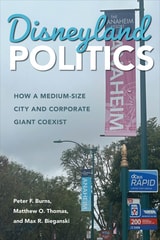
Disneyland Politics
How a Medium-Size City and Corporate Giant CoexistPeter F. Burns, Matthew O. Thomas, and Max R. Bieganski
Temple University Press, 2026
Disneyland Politics is a cogent examination of this urban power struggle, which has been playing out for 70 years. The authors show how the city was initially bound to the Disneyland Imperative, which placed the theme park above everything else in the city, including other economic development projects. However, starting in the 1990s, citizens pushed back against the corporation and its supporters, wanting a more balanced public policy agenda and ultimately loosening the stranglehold Disneyland had over the city’s political order.
Recounting the history of Disney’s power in action and the tension between democratic governance and reliance on private investment, Disneyland Politics illustrates how those who pursue alternative agendas attempt to get their way, and how the fight for a more balanced public policy agenda has changed local power dynamics to be less favorable to Disneyland over time.
In the series Urban Life, Landscape, and Policy
Doctors and Their Workshops
Economic Models of Physician BehaviorMark V. Pauly
University of Chicago Press, 1980
Doctors are obviously influential in determining the costs of their services. But even more important, many believe, is the influence physicians have over the use and cost of nonphysician health-care resources and services. Doctors and Their Workshops is the first comprehensive attempt to use economic analysis to understand some of the physician effects on nonphysician aspects of health care.

Doormen
Peter Bearman
University of Chicago Press, 2005
Combining observation, interviews, and survey information, Doormen provides a deep and enduring ethnography of the occupational role of doormen, the dynamics of the residential lobby, and the mundane features of highly consequential social exchanges between doormen and tenants. Here, Bearman explains why doormen find their jobs both boring and stressful, why tenants feel anxious about how much of a Christmas bonus their neighbors give, and how everyday transactions small and large affect tenants' professional and informal relationships with doormen.
In the daily life of the doorman resides the profound, and this book provides a brilliant account of how tenants and doormen interact within the complex world of the lobby.

Doormen
Peter Bearman
University of Chicago Press, 2005
This is an auto-narrated audiobook edition of this book.
Combining observation, interviews, and survey information, Doormen provides a deep and enduring ethnography of the occupational role of doormen, the dynamics of the residential lobby, and the mundane features of highly consequential social exchanges between doormen and tenants. Here, Bearman explains why doormen find their jobs both boring and stressful, why tenants feel anxious about how much of a Christmas bonus their neighbors give, and how everyday transactions small and large affect tenants' professional and informal relationships with doormen.
In the daily life of the doorman resides the profound, and this book provides a brilliant account of how tenants and doormen interact within the complex world of the lobby.
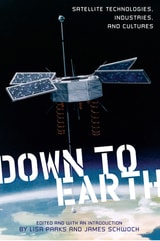
Down to Earth
Satellite Technologies, Industries, and CulturesParks, Lisa
Rutgers University Press, 2012
Down to Earth presents the first comprehensive overview of the geopolitical maneuvers, financial investments, technological innovations, and ideological struggles that take place behind the scenes of the satellite industry. Satellite projects that have not received extensive coverage—microsatellites in China, WorldSpace in South Africa, SiriusXM, the failures of USA 193 and Cosmos 954, and Iridium—are explored. This collection takes readers on a voyage through a truly global industry, from the sites where satellites are launched to the corporate clean rooms where they are designed, and along the orbits and paths that satellites traverse. Combining a practical introduction to the mechanics of the satellite industry, a history of how its practices and technologies have evolved, and a sophisticated theoretical analysis of satellite cultures, Down to Earth opens up a new space for global media studies.
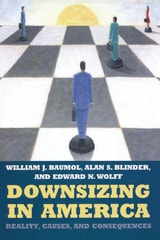
Downsizing in America
Reality, Causes, and ConsequencesWilliam J. Baumol
Russell Sage Foundation, 2003
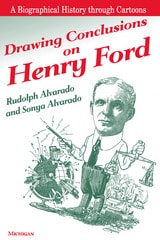
Drawing Conclusions on Henry Ford
Rudolph Alvarado and Sonya Alvarado
University of Michigan Press, 2001
For years political cartoons have shaped the often unflattering popular view of public figures. One of the most-often-portrayed figures of the twentieth century was the automobile manufacturer Henry Ford. Through editorial drawings, a vivid picture of Ford was presented that became the source of myths that surrounded him and continue even to this day.
Drawing Conclusions on Henry Ford is the first and only collection that brings together in one volume these editorial cartoons. They date back as far as the time Ford introduced the Model T in 1908 and extend forward to the introduction of the Model A and subsequent V8 engines in the 1930s. They illustrate the emergence of many of the popular myths surrounding Henry Ford, as seen and understood by the average citizen during the opening decades of the twentieth century. With 150 illustrations, the reader is able to trace the evolving images of Ford from a time period when caricature images of public figures were a primary source of information about those persons. Sometimes funny, sometimes sharp and critical, these cartoons are entertaining in themselves. Viewed as a whole, they create anew view of the Henry Ford story.
Rudolph V. Alvarado is a freelance writer and museum consultant, as well as the former programs leader for the Henry Ford Museum and Greenfield Village. Sonya Y. Alvarado is an instructor of English, at Eastern Michigan University and a former adjunct faculty member, Wayne State University.

Dream Lovers
The Gamification of RelationshipsAlfie Bown
Pluto Press, 2022
'An exciting, astute analysis of how our capacity for desire has been slotted into the grooves of digital capitalism, and made to work for profit - from porn to Pokémon' - Richard Seymour
We are in the middle of a 'desirevolution' - a fundamental and political transformation of the way we desire as human beings. Perhaps as always, new technologies - with their associated and inherited political biases - are organizing and mapping the future. What we don't seem to notice is that the primary way in which our lives are being transformed is through the manipulation and control of desire itself.
Our very impulses, drives and urges are 'gamified' to suit particular economic and political agendas, changing the way we relate to everything from lovers and friends to food and politicians. Digital technologies are transforming the subject at the deepest level of desire - re-mapping its libidinal economy - in ways never before imagined possible.
From sexbots to smart condoms, fitbits to VR simulators and AI to dating algorithms, the 'love industries' are at the heart of the future smart city and the social fabric of everyday life. This book considers these emergent technologies and what they mean for the future of love, desire, work and capitalism.
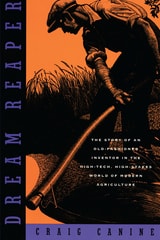
Dream Reaper
The Story of an Old-Fashioned Inventor in the High-Tech, High-Stakes World of Modern AgricultureCraig Canine
University of Chicago Press, 1997
"This intriguing tale weaves together the creativity and ingenuity of an inventor and the hurdles he and his partner face in selling and producing what appears to be an amazingly efficient Bi-Rotor combine."—Science News
"Canine writes with style and flourish. . . Dream Reaper is a riveting journey into America's heartland, where necessity is the mother of invention—and hard work, conviction, and sacrifice are its lifeblood."—People Magazine
"Canine deftly interweaves the story of the two men's struggles with a history of the mechanization of agriculture. This lively account of men working under pressure, improvising repairs and demonstrating the new machine, is also a story of courage that illustrates the barriers facing an independent inventor."—Publishers Weekly
"Craig Canine's Dream Reaper is a delight. It's an important book, rich with history and stories. It brings our most essential industry—farming—into new perspective. Reading it made me want to get out a crop."—Bobbie Ann Mason
A volume in the Sloan Technology Series. The series presents to a general audience highly readable accounts of the development of 20th century technologies and the ways these have shaped and are shaped by society.