Results by title
89 books match the query 'Interpersonal relations' and 6 start with d
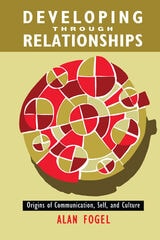
Developing Through Relationships
Alan Fogel
University of Chicago Press, 1993
Fogel explores the origins of communication, personal identity, and cultural participation and argues that from birth communication, self, and culture are inseparable. He shows that the ability to participate as a human being in the world does not come about only with the acquisition of language, as many scholars have thought, but begins during an infant's earliest nonverbal period. According to Fogel, the human mind and sense of self start to develop at birth through communication and relationships between individuals.
Fogel weaves together theory and research from a variety of disciplines, including psychology, biology, linguistics, philosophy, anthropology, and cognitive science. He rejects the objectivist perspective on development in favor of a relational perspective: to treat the mind as an objective, mechanical thing, Fogel contends, is to ignore the interactive character of thinking. He argues that the life of the mind is a dialogue between imagined points of view, like a dialogue between two different people, and he uses this view to explain his relational theory of human development.
Developing through Relationships makes a substantial contribution not only to developmental psychology but also to the fields of communication, cognitive science, linguistics, and biology.
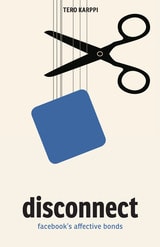
Disconnect
Facebook's Affective BondsTero Karppi
University of Minnesota Press, 2018
An urgent examination of the threat posed to social media by user disconnection, and the measures websites will take to prevent it
No matter how pervasive and powerful social media websites become, users always have the option of disconnecting—right? Not exactly, as Tero Karppi reveals in this disquieting book. Pointing out that platforms like Facebook see disconnection as an existential threat—and have undertaken wide-ranging efforts to eliminate it—Karppi argues that users’ ability to control their digital lives is gradually dissipating.
Taking a nonhumancentric approach, Karppi explores how modern social media platforms produce and position users within a system of coded relations and mechanisms of power. For Facebook, disconnection is an intense affective force. It is a problem of how to keep users engaged with the platform, but also one of keeping value, attention, and desires within the system. Karppi uses Facebook’s financial documents as a map to navigate how the platform sees its users. Facebook’s plans to connect the entire globe through satellites and drones illustrates the material webs woven to keep us connected. Karppi analyzes how Facebook’s interface limits the opportunity to opt-out—even continuing to engage users after their physical death. Showing how users have fought to take back their digital lives, Karppi chronicles responses like Web2.0 Suicide Machine, an art project dedicated to committing digital suicide.
For Karppi, understanding social media connectivity comes from unbinding the bonds that stop people from leaving these platforms. Disconnection brings us to the limit of user policies, algorithmic control, and platform politics. Ultimately, Karppi’s focus on the difficulty of disconnection, rather than the ease of connection, reveals how social media has come to dominate human relations.
Divorce Talk
Women and Men Make Sense of Personal RelationshipsCatherine Kohler Riessman
Rutgers University Press, 1990
Riessman looks at the ideology of the companionate marriage: husband and wife should be each other's closest companion, and in marriage one should achieve emotial intimacy and sexual fulfillment. These beliefs imply a level of equality that rarely exists. In reality, most wives are subordinate to their husbands, most husbands want neither "deep talk" nor small talk that women want, and many husbands resent their wife's ties to kin and friends. To explain divorce, women and men construct gendered visions of what marriage should provide, and at the same time they mourn gender divisions and blame their divorces on them. Riessman examines the stories people tell about their marriages--the protagonists, inciting conditions, and culminating events--and how these narrative structures provide ways to persuade both teller and listener that divorce was justified.
Although divorce is invariably stressful, many people believe that men suffer less than women. This is an artifact of what Riessman calls the "feminization of psychological distress"--traditional ways of measuring distress reflect women's idioms, not men's. Departing from a literature that casts divorce in only negative terms, she finds paradoxically that women sense rewards, even as they report hardship. There is a shakeup in gender roles, and women more than men feel they gain a fuller idea of who they are. The author allows us to enter the points of view of her subjects, while her analytic approach makes links between the self and society.
Divorce Talk
Women and Men Make Sense of Personal RelationshipsCatherine Kohler Riessman
Rutgers University Press, 1990
Riessman looks at the ideology of the companionate marriage: husband and wife should be each other's closest companion, and in marriage one should achieve emotial intimacy and sexual fulfillment. These beliefs imply a level of equality that rarely exists. In reality, most wives are subordinate to their husbands, most husbands want neither "deep talk" nor small talk that women want, and many husbands resent their wife's ties to kin and friends. To explain divorce, women and men construct gendered visions of what marriage should provide, and at the same time they mourn gender divisions and blame their divorces on them. Riessman examines the stories people tell about their marriages--the protagonists, inciting conditions, and culminating events--and how these narrative structures provide ways to persuade both teller and listener that divorce was justified.
Although divorce is invariably stressful, many people believe that men suffer less than women. This is an artifact of what Riessman calls the "feminization of psychological distress"--traditional ways of measuring distress reflect women's idioms, not men's. Departing from a literature that casts divorce in only negative terms, she finds paradoxically that women sense rewards, even as they report hardship. There is a shakeup in gender roles, and women more than men feel they gain a fuller idea of who they are. The author allows us to enter the points of view of her subjects, while her analytic approach makes links between the self and society.

Dream Lovers
The Gamification of RelationshipsAlfie Bown
Pluto Press, 2022
'An exciting, astute analysis of how our capacity for desire has been slotted into the grooves of digital capitalism, and made to work for profit - from porn to Pokémon' - Richard Seymour
We are in the middle of a 'desirevolution' - a fundamental and political transformation of the way we desire as human beings. Perhaps as always, new technologies - with their associated and inherited political biases - are organizing and mapping the future. What we don't seem to notice is that the primary way in which our lives are being transformed is through the manipulation and control of desire itself.
Our very impulses, drives and urges are 'gamified' to suit particular economic and political agendas, changing the way we relate to everything from lovers and friends to food and politicians. Digital technologies are transforming the subject at the deepest level of desire - re-mapping its libidinal economy - in ways never before imagined possible.
From sexbots to smart condoms, fitbits to VR simulators and AI to dating algorithms, the 'love industries' are at the heart of the future smart city and the social fabric of everyday life. This book considers these emergent technologies and what they mean for the future of love, desire, work and capitalism.

Duped
Truth-Default Theory and the Social Science of Lying and DeceptionTimothy R. Levine
University of Alabama Press, 2020
Unmasking the science of deception—and why truth wins by default.
From the advent of fake news to climate-science denial and Bernie Madoff’s appeal to investors, people can be astonishingly gullible. Some people appear authentic and sincere even when the facts discredit them, and many people fall victim to conspiracy theories and economic scams that should be dismissed as obviously ludicrous. This happens because of a near-universal human tendency to operate within a mindset that can be characterized as a “truth-default.” We uncritically accept most of the messages we receive as “honest.” We all are perceptually blind to deception. We are hardwired to be duped. The question is, can anything be done to militate against our vulnerability to deception without further eroding the trust in people and social institutions that we so desperately need in civil society?
Timothy R. Levine’s Duped: Truth-Default Theory and the Social Science of Lying and Deception recounts a decades-long program of empirical research that culminates in a new theory of deception—truth-default theory. This theory holds that the content of incoming communication is typically and uncritically accepted as true, and most of the time, this is good. Truth-default allows humans to function socially. Further, because most deception is enacted by a few prolific liars, the so called “truth-bias” is not really a bias after all. Passive belief makes us right most of the time, but the catch is that it also makes us vulnerable to occasional deceit.
Levine’s research on lie detection and truth-bias has produced many provocative new findings over the years. He has uncovered what makes some people more believable than others and has discovered several ways to improve lie-detection accuracy. In Duped, Levine details where these ideas came from, how they were tested, and how the findings combine to produce a coherent new understanding of human deception and deception detection.