Results by title
122 books match the query 'Journalists' and 9 start with d

Dairylandia
Dispatches from a State of MindSteve Hannah
University of Wisconsin Press, 2022
Dairylandia recounts Steve Hannah’s burgeoning love for his adopted state through the writings of his long-lived column, “State of Mind.” He profiles the lives of the seemingly ordinary, yet quite (and quietly) extraordinary folks he met and befriended on his travels. From Norwegian farmers to rattlesnake hunters to a woman who kept her favorite dead bird in the freezer, Hannah was charmed and fascinated by practically everyone he met. These captivating vignettes are by turns humorous, tragic, and remarkable—and remind us of our shared humanity.
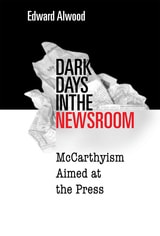
Dark Days in the Newsroom
McCarthyism Aimed at the PressEdward Alwood
Temple University Press, 2007
Dark Days in the Newsroom traces how journalists became radicalized during the Depression era, only to become targets of Senator Joseph McCarthy and like-minded anti-Communist crusaders during the 1950s. Edward Alwood, a former news correspondent describes this remarkable story of conflict, principle, and personal sacrifice with noticeable élan. He shows how McCarthy's minions pried inside newsrooms thought to be sacrosanct under the First Amendment, and details how journalists mounted a heroic defense of freedom of the press while others secretly enlisted in the government's anti-communist crusade.
Relying on previously undisclosed documents from FBI files, along with personal interviews, Alwood provides a richly informed commentary on one of the most significant moments in the history of American journalism. Arguing that the experiences of the McCarthy years profoundly influenced the practice of journalism, he shows how many of the issues faced by journalists in the 1950s prefigure today's conflicts over the right of journalists to protect their sources.
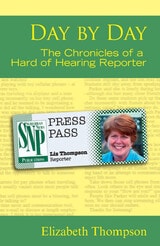
Day by Day
The Chronicles of a Hard of Hearing ReporterElizabeth Thompson
Gallaudet University Press, 2008
The Seventh Volume in the Deaf Lives Series
Elizabeth Thompson’s hearing loss was detected when she was in elementary school, and her hearing continued to deteriorate until she became completely deaf. Like many other hard of hearing and late-deafened individuals, her hearing loss complicated the general challenges of life. She struggled through school, worked as a secretary, married, had a daughter, and then found herself living as a single mother. She remarried, and soon after learned that she had contracted Multiple Sclerosis (MS). Despite these hurdles, Thompson always expressed her determination to enjoy the best life had to offer. Her astonishing exuberance might have gone unnoticed if she hadn’t accepted a new position as a reporter/columnist in 1998 for the Suburban News Publications (SNP). Day by Day: The Chronicles of a Hard of Hearing Reporter presents a marvelous blend of her experiences and best SNP columns that illustrate how she crafted her remarkable outlook.
In her columns, Thompson presented how she handled her hearing loss as a personal guide for readers. She used every stratagem available to function full-throttle – hearing aids, FM systems, lights for alarms, TTYs, even training her dog Snert. She also gently counseled readers on how to treat deaf and hard of hearing people with practical consideration and respect. Her pursuit of a fully realized life enabled her to do what she loved most, to meet and write about inspiring persons, many of whom are profiled in her memoir. Thompson eventually underwent cochlear implantation that restored 95% of her hearing, an exalting moment for her. Yet, Day by Day celebrates the entire arc of her life, a wonderful testament to her joyous resilience.

Deadline
200 Years of Violence Against Journalists in the United StatesElizabeth Atwood
University of Missouri Press, 2025
To help us understand these attacks, Atwood presents a framework for categorizing them, built on John Nerone’s studies on assaults on American media workers. Atwood categorizes attacks against journalists as attacks against individuals, ideas, and media institutions, and undertaken to suppress reporting on certain topics and in the context of wars and other international or conflicts. Crucially, Deadline utilizes this framework to offer possible solutions to the issue of violence against journalists.
Atwood was inspired to explore the pressing issue of violence against American journalists after the tragic death of one of her colleagues at the Baltimore Sun, Rob Hiaasen, in the Capital Gazette shooting in 2018. Throughout, she demonstrates that distrust of the media and violence against the press in the United States are hardly new developments. Her work examines how intimidation, violence, and censorship have, in fact, been used against the American press since both its and the nation’s founding.
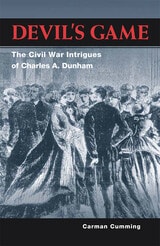
Devil's Game
The Civil War Intrigues of Charles A. DunhamCarman Cumming
University of Illinois Press, 2003
The first book-length study of one of the Civil War's most outlandish and mysterious characters
Devil's Game traces the amazing career of Charles A. Dunham, Civil War spy, forger, journalist, and master of dirty tricks. Writing for a variety of New York papers under alternate names, Dunham routinely faked stories, created new identities, and later boldly cast himself to play those roles. He achieved his greatest infamy when he was called to testify in Washington concerning Abraham Lincoln's assassination. Many parts of Dunham's career remain shadowy, but Cumming offers the first detailed tour of Dunham's convoluted, high-stakes, international deceits, including his effort to sell Lincoln on plans for a raid to capture Jefferson Davis.
Exhaustively researched and unprecedented in depth, this carefully crafted assessment of Dunham's motives, personality, and the complex effects of his schemes changes assumptions about covert operations during the Civil War.
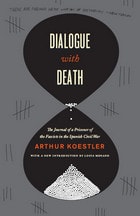
Dialogue with Death
The Journal of a Prisoner of the Fascists in the Spanish Civil WarArthur Koestler
University of Chicago Press, 2011
In 1937 during the Spanish Civil War, Arthur Koestler, a German exile writing for a British newspaper, was arrested by Nationalist forces in Málaga. He was then sentenced to execution and spent every day awaiting death—only to be released three months later under pressure from the British government. Out of this experience, Koestler wrote Darkness at Noon, his most acclaimed work in the United States, about a man arrested and executed in a Communist prison.
Dialogue with Death is Koestler’s riveting account of the fall of Málaga to rebel forces, his surreal arrest, and his three months facing death from a prison cell. Despite the harrowing circumstances, Koestler manages to convey the stress of uncertainty, fear, and deprivation of human contact with the keen eye of a reporter.
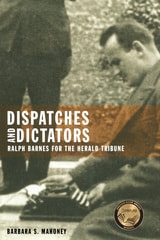
Dispatches and Dictators
Ralph Barnes for the Herald TribuneBarbara S. Mahoney
Oregon State University Press, 2002
Dispatches and Dictators uncovers the fascinating story of Oregon native Ralph Barnes, the New York Herald Tribune’s European correspondent, who served in Paris, Rome, Moscow, Berlin, and London in the years between the two world wars. Barnes has been praised by colleagues and competitors alike as one of the best reporters of that pivotal era. But since his death in the 1940 crash of a British bomber in Yugoslavia, he has been largely forgotten.
With persistence and unusually keen insight, Ralph Barnes reported on Fascism, Communism, Nazism, and the events leading to World War II. Stalin confined Barnes to Moscow for disclosing that millions were dying during the Soviet collectivization of agriculture, and Hitler expelled Barnes from Germany for predicting the Nazi attack on the Soviet Union.
In Dispatches and Dictators, historian Barbara Mahoney chronicles the short life and brilliant career of Ralph Barnes. Her biography of this extraordinary reporter provides new insights into the tumultuous decade leading up to World War II.

Done in a Day
Telex from the Fall of SaigonElisa Tamarkin
University of Chicago Press, 2026
Named one of Lit Hub's most anticipated books of the year.
A searing reflection on the last day of the Vietnam War and the beginning of the end of foreign reporting in the nation’s daily newspapers.
Done in a Day turns on a single event: the April 30, 1975, departure of the last helicopter evacuating civilians from the rooftop of the US embassy in Saigon. Elisa Tamarkin’s interest in that helicopter begins with the fact that her stepfather, the Saigon bureau chief for the Chicago Daily News, was on it—the last American correspondent to leave Saigon as it fell. His report was filed from a naval ship on the South China Sea at a time when no other telexes were going through.
Now, more than fifty years later, Tamarkin offers a social and cultural autopsy of that moment, based in personal history but vividly unfolding amid the vast documentation of America’s obvious defeat, which never seemed to register even as it got out, in the writings of journalists and essayists, in the backchannel cables between US ambassador Graham Martin and Henry Kissinger, in congressional hearings, and in photographs of the war’s end. The story is also set against the imminent disappearance of war coverage in city newspapers—and of the newspapers themselves—once proud, in the words of the Chicago Daily News, of bringing readers the “literature of the day” that was “done in a day.”
Done in a Day braids history, criticism, and memoir to tell the paired stories of Saigon’s liberation and the demise of the news. The result is a haunting essay about all that ended in a day—and about what it means to recognize and to write about endings even as we live through them.
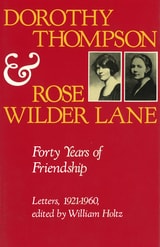
Dorothy Thompson and Rose Wilder Lane
Forty Years of Friendship, Letters, 1921-1960Edited by William Holtz
University of Missouri Press, 1991
The friendship between Dorothy Thompson and Rose Wilder Lane began in 1920 in the publicity office of the American Red Cross in Paris and continued until Thompson’s death in 1961. Although both women are today remembered primarily for their connections with others —Thompson as the wife of Sinclair Lewis, and Lane as the daughter of Laura Ingalls Wilder, author of the “Little House” books —each was remarkable in her own right.
Both women had a vital engagement with life that led them in fearless pursuit of experience. In 1939, Thompson appeared on the cover of Time, which judged her second only to Eleanor Roosevelt among influential women of the day. Typical of Lane were her travels through the mountains of Albania, the deserts of Syria, and Soviet Georgia in the 1920s and her visit as a journalist to Vietnam in 1965 at the age of seventy-eight.
The correspondence of these two talented and articulate women reveals their personal concerns, social ideas, and political/economic philosophies and how they changed over time. Their letters tell the story of the first generation of women to come of age during the twentieth century, as they tried to cope with problems that women still face today. Along with the letters themselves, Holtz has included annotations and footnotes that provide biographical information, as well as explaining personal and topical references.