Results by title
108 books match the query 'Knowledge and learning' and 8 start with d
Dante and the Limits of the Law
Justin Steinberg
University of Chicago Press, 2013
Examining how Dante probes the limits of the law in this juridical otherworld, Steinberg argues that exceptions were vital to the medieval legal order and that Dante’s otherworld represents an ideal “system of exception.” In the real world, Dante saw this system as increasingly threatened by the dual crises of church and empire: the abuses and overreaching of the popes and the absence of an effective Holy Roman Emperor. Steinberg shows that Dante’s imagination of the afterlife seeks to address this gap between the universal validity of Roman law and the lack of a sovereign power to enforce it. Exploring the institutional role of disgrace, the entwined phenomena of judicial discretion and artistic freedom, medieval ideas about privilege and immunity, and the place of judgment in the poem, this cogently argued book brings to life Dante’s sense of justice.
Dark Twins
Imposture and Identity in Mark Twain's AmericaSusan Gillman
University of Chicago Press, 1989
Gillman shows that laws regulating race classification, paternity, and rape cases underwrite Twain's critical exploration of racial and sexual difference in the writings of the 1890s and after, most strikingly in the little-known manuscripts that Gillman calls the "tales of transvestism." The "pseudoscience" of spiritualism and the "science" of psychology provide the cultural vocabularies essential to Twain's fantasy and science fiction writings of his last two decades. Twain stands forth finally as a representative man, not only a child of his culture, but also as one implicated in a continuing American anxiety about freedom, race, and identity.
Darwin's Evolving Identity
Adventure, Ambition, and the Sin of SpeculationAlistair Sponsel
University of Chicago Press, 2018
Drawing on his own ambitious research in Darwin’s manuscripts and at the Beagle’s remotest ports of call, Sponsel takes us from the ocean to the Origin and beyond. He provides a vivid new picture of Darwin’s career as a voyaging naturalist and metropolitan author, and in doing so makes a bold argument about how we should understand the history of scientific theories.
Descartes' Metaphysical Physics
Daniel Garber
University of Chicago Press, 1992
Garber achieves a philosophically rigorous reading of Descartes that is sensitive to the historical and intellectual context in which he wrote. What emerges is a novel view of this familiar figure, at once unexpected and truer to the historical Descartes.
The book begins with a discussion of Descartes' intellectual development and the larger project that frames his natural philosophy, the complete reform of all the sciences. After this introduction Garber thoroughly examines various aspects of Descartes' physics: the notion of body and its identification with extension; Descartes' rejection of the substantial forms of the scholastics; his relation to the atomistic tradition of atoms and the void; the concept of motion and the laws of motion, including Descartes' conservation principle, his laws of the persistence of motion, and his collision law; and the grounding of his laws in God.
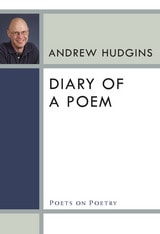
Diary of a Poem
Andrew Hudgins
University of Michigan Press, 2011
Praise for Andrew Hudgins
"Hudgins . . . [is] one of the few poets of the American South who can be both solemn and sidesplitting in a single poem."
---Publishers Weekly
"Andrew Hudgins is a natural storyteller . . . The surface[s] of Hudgins's poems---their quirky economy, the sheer music of his prosody---are so right because he goes so deep."
---Washington Post
A volume in the Poets on Poetry series, which collects critical works by contemporary poets, gathering together the articles, interviews, and book reviews by which they have articulated the poetics of a new generation.
Andrew Hudgins's Diary of a Poem is an engaging collection of essays that offers pleasure and profit to its readers. The title essay discusses the author's amusing travails as he attempts to write an ode about intestines, while other pieces explore the poetry of James Agee, Donald Justice, Allen Tate, and other poets, as well as the musician Johnny Winter, who is the subject of a rollicking segment about rock 'n' roll. More seriously, Hudgins writes with lively good humor about his tomato garden, the unread books piled up precipitously around his bed, and the emotional problems that led to an embarrassingly intimate, yet funny encounter with his father-in-law.
Diary of a Poem is lively, charming, often humorous, and a pleasurable read for the general reader and the poetry specialist alike.
Author photo by Jo McCulty
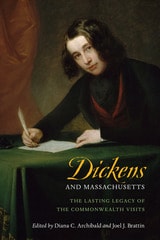
Dickens and Massachusetts
The Lasting Legacy of the Commonwealth VisitsDiana C. Archibald
University of Massachusetts Press, 2015
Charles Dickens traveled to North America twice, in 1842 and twenty-five years later in 1867–68, and on both trips Massachusetts was part of his itinerary. Although many aspects of his U.S. travels disappointed him, Massachusetts was the one state that met and even exceeded Dickens's expectations for “the republic of [his] imagination.” From the mills of Lowell to the Perkins School for the Blind, it offered an alternate vision of America that influenced his future writings, while the deep and lasting friendships he formed with Bostonians gave him enduring ties to the commonwealth.
This volume provides insight from leading scholars who have begun to reassess the significance of Massachusetts in the author's life and work. The collection begins with a broad biographical and historical overview taken from the full-length narrative of the award-winning exhibition Dickens and Massachusetts: A Tale of Power and Transformation, which attracted thousands of visitors while on display in Lowell. Abundant images from the exhibition, many of them difficult to find elsewhere, enhance the story of Dickens's relationship with the vibrant cultural and intellectual life of Massachusetts. The second section includes essays that consider the importance of Dickens's many connections to the commonwealth.
In addition to the volume editors, contributors include Chelsea Bray, Iain Crawford, Andre DeCuir, Natalie McKnight, Lillian Nayder, and Kit Polga.
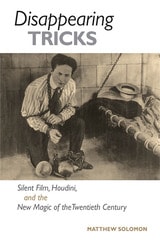
Disappearing Tricks
Silent Film, Houdini, and the New Magic of the Twentieth CenturyMatthew Solomon
University of Illinois Press, 2010
Disappearing Tricks revisits the golden age of theatrical magic and silent film to reveal how professional magicians shaped the early history of cinema. Where others have called upon magic as merely an evocative metaphor for the wonders of cinema, Matthew Solomon focuses on the work of the professional illusionists who actually made magic with moving pictures between 1895 and 1929.
The first to reveal fully how powerfully magic impacted the development of cinema, the book combines film and theater history to uncover new evidence of the exchanges between magic and filmmaking in the United States and France during the silent period. Chapters detailing the stage and screen work of Harry Houdini and Georges Méliès show how each transformed theatrical magic to create innovative cinematic effects and thrilling new exploits for twentieth-century mass audiences. The book also considers the previously overlooked roles of anti-spiritualism and presentational performance in silent film.
Highlighting early cinema's relationship to the performing body, visual deception, storytelling, and the occult, Solomon treats cinema and stage magic as overlapping practices that together revise our understanding of the origins of motion pictures and cinematic spectacle.
Dostoevsky and Romantic Realism
A Study of Dostoevsky in Relation to Balzac, Dickens, and GogolDonald Fanger
Northwestern University Press, 1998