Results by title
171 books match the query 'Labor unions' and 8 start with d

Deregulating Desire
Flight Attendant Activism, Family Politics, and Workplace JusticeRyan Patrick Murphy
Temple University Press, 2016
In 1975, National Airlines was shut down for 127 days when flight attendants went on strike to protest long hours and low pay. Activists at National and many other U.S. airlines sought to win political power and material resources for people who live beyond the boundary of the traditional family. In Deregulating Desire, Ryan Patrick Murphy, a former flight attendant himself, chronicles the efforts of single women, unmarried parents, lesbians and gay men, as well as same-sex couples to make the airline industry a crucible for social change in the decades after 1970.
Murphy situates the flight attendant union movement in the history of debates about family and work. Each chapter offers an economic and a cultural analysis to show how the workplace has been the primary venue to enact feminist and LGBTQ politics.
From the political economic consequences of activism to the dynamics that facilitated the rise of what Murphy calls the “family values economy” to the Airline Deregulation Act of 1978, Deregulating Desire emphasizes the enduring importance of social justice for flight attendants in the twenty-first century.
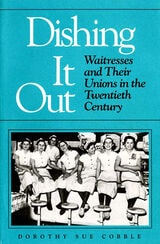
Dishing It Out
Waitresses and Their Unions in the Twentieth CenturyDorothy Sue Cobble
University of Illinois Press, 1991
Back when SOS or Adam and Eve on a raft were things to order if you were hungry but a little short on time and money, nearly one-fourth of all waitresses belonged to unions. By the time their movement peaked in the 1940s and 1950s, the women had developed a distinctive form of working-class feminism, simultaneously pushing for equal rights and pay and affirming their need for special protections.
Dorothy Sue Cobble shows how sexual and racial segregation persisted in wait work, but she rejects the idea that this was caused by employers' actions or the exclusionary policies of male trade unionists. Dishing It Out contends that the success of waitress unionism was due to several factors: waitresses, for the most part, had nontraditional family backgrounds, and most were primary wage-earners. Their close-knit occupational community and sex-separate union encouraged female assertiveness and a decidedly unromantic view of men and marriage. Cobble skillfully combines oral interviews and extensive archival records to show how waitresses adopted the basic tenets of male-dominated craft unions but rejected other aspects of male union culture. The result is a book that will expand our understanding of feminism and unionism by including the gender conscious perspectives of working women.
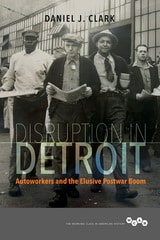
Disruption in Detroit
Autoworkers and the Elusive Postwar BoomDaniel J. Clark
University of Illinois Press, 2018
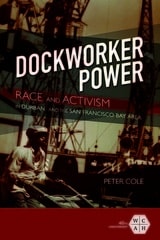
Dockworker Power
Race and Activism in Durban and the San Francisco Bay AreaPeter Cole
University of Illinois Press, 2018
Philip Taft Labor History Book Award, Labor and Working-Class History Association (LAWCHA) and the Cornell ILR School, 2019
A Black Perspectives Best Black History Book of 2018
Dockworkers have power. Often missed in commentary on today's globalizing economy, workers in the world's ports can harness their role, at a strategic choke point, to promote their labor rights and social justice causes. Peter Cole brings such overlooked experiences to light in an eye-opening comparative study of Durban, South Africa, and the San Francisco Bay Area, California. Path-breaking research reveals how unions effected lasting change in some of the most far-reaching struggles of modern times. First, dockworkers in each city drew on longstanding radical traditions to promote racial equality. Second, they persevered when a new technology--container ships--sent a shockwave of layoffs through the industry. Finally, their commitment to black internationalism and leftist politics sparked transnational work stoppages to protest apartheid and authoritarianism. Dockworker Power not only brings to light surprising parallels in the experiences of dockers half a world away from each other. It also offers a new perspective on how workers can change their conditions and world.
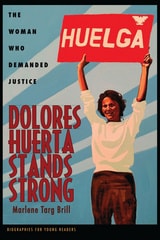
Dolores Huerta Stands Strong
The Woman Who Demanded JusticeMarlene Targ Brill
Ohio University Press, 2018
Selected as a Bank Street College of Education Best Children’s Book of the Year for 2018 (Category: Twelve–Fourteen)
“A biography for the times … An excellent read for anyone hoping to believe one person can make a difference.” —Kirkus (starred review)
“This well-told, age-appropriate account of a vital and essential activist deserves a place in all middle grade collections.” —School Library Journal (starred review)
Today, we know Dolores Huerta as the cofounder, with Cesar Chavez, of the National Farmworkers Association, which later became the United Farm Workers of America. We know her as a tireless advocate for the rights of farmworkers, Mexican American immigrants, women, and LGBTQ populations. And we know her as the recipient of the Presidential Medal of Freedom from Barack Obama in 2012.
Before all that, though, Huerta was a child in the farming community of Stockton, California, and then a teenager whose teachers underestimated her because she was Chicana. When she became a teacher herself, she witnessed her students coming to school shoeless and hungry. Many took days off from school to work in the farm fields to help feed their families. What could she do to help them? A young mother at the time, Huerta quit her teaching job to organize their parents. That began her journey to educate a nation about who produces our food and the conditions under which they work.
Dolores Huerta Stands Strong follows Huerta’s life from the mining communities of the Southwest where her father toiled, to the vineyards and fields of California, and across the country to the present day. As she worked for fair treatment for others, Dolores earned the nation’s highest honors. More important, she found her voice.

Down on the Killing Floor
Black and White Workers in Chicago's Packinghouses, 1904-54Rick Halpern
University of Illinois Press, 1997
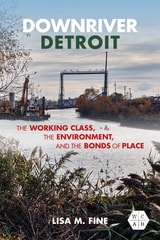
Downriver Detroit
The Working Class, the Environment, and the Bonds of PlaceLisa M. Fine
University of Illinois Press, 2026
Lisa M. Fine examines important moments in the ongoing efforts of the area’s citizens to create a humane and habitable environment. Her analysis shows how people preserved wetlands and the river by working through sportsmen’s organizations, appealing to state agencies, and forming grassroots movements. Fueled by enduring connections to place, local unions fought a proposed nuclear power plant in the 1950s. Years later, steel workers facing the steamroller of deindustrialization tried to preserve their communities by purchasing their own company. The ties that bind gave a unique character to activism in the Downriver region, challenging stereotypes of working-class attitudes toward the environment.
A creative merger of labor and environmental history, Downriver Detroit shows that working people have a right to live in and protect the places they love.
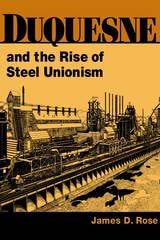
Duquesne and the Rise of Steel Unionism
James D. Rose
University of Illinois Press, 2001
Dismissed as a flimsy front for management interests, industrial unions nonetheless carved out a role in the Carnegie Steel Company empire and then at U.S. Steel. James D. Rose examines the pivotal role played by these company-sponsored employee representation plans (ERPs) at the legendary steel works in Duquesne, Pennsylvania.
As Rose reveals, ERPs matured from tools of the company into worker-led organizations that represented the interests of the mills' skilled tradesmen and workers. ERPs and management created a sophisticated bargaining structure. Meanwhile, the independent trade union gave way to the Steel Workers Organizing Committee (SWOC), a professionalized organization that expended huge resources on companywide unionization. Yet even when the SWOC secured a collective bargaining agreement in 1937, it failed to sign up a majority of the Duquesne workforce.
Sophisticated and persuasive, Duquesne and the Rise of Steel Unionism confirms that what people did on the shop floor played a critical role in the course of steel unionism.