Results by title
328 books match the query 'Literature and society' and 13 start with d
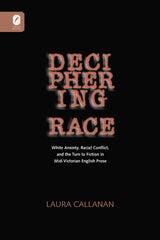
DECIPHERING RACE
WHITE ANXIETY, RACIAL CONFLICT, & THE TURN TO FICTION IN MID-VICTORIAN ENGLISH PROSELaura Callanan
The Ohio State University Press, 2005
In this manner these narratives confront the complexity, indeterminacy, and irrationality of both racial difference and the systems put in place to understand that difference. Deciphering Race unpacks this narrative turn to the aesthetic in writings by white English individuals and thus reveals the instability at the heart of cultural understanding of race and racial tropes at mid-century. This series of readings will help to see how figurative structures, while providing a bridge between different cultures and epistemologies, also reinforce a distance that keeps groups separate. Only by disentangling these structures, by addressing and unpacking our assumptions and narratives about those different from ourselves, and by understanding our deep cultural anxiety and investment in these ways of talking about one another, can we begin to create the conditions for productive, local understanding between different cultures, races, and communities.

Danger Zones
Homosexuality, National Identity, and Mexican CultureClaudia Schaefer
University of Arizona Press, 1996
Contents:
1. El diario de José Toledo: The Fantasies of a Middle-Class Bureaucrat
2. The Power of Subversive Imagination: Utopian Discourse in the Novels of Luis Zapata and José Rafael Calva
3. On the Cutting Edge: El jinete azul and the Aesthetics of the Abyss
4. Monobodies, Antibodies, and the Body Politic: Sara Levi Calderón’s Dos mujeres
5. Just Another Material Girl? La hermana secreta de Angélica María and the Seduction of the Popular
6. From "Infernal Realms of Delinquency" to Cozy Cabañas in Cuernavaca: José Joaquín Blanco’s Visions of Homosexuality

Dark End Of The Street
Margins in American Vanguard PoetryMaria Damon
University of Minnesota Press, 1993
Damon foregrounds a number of modern American poets work and lives in order to argue that the American avant-garde is located in the experimental literary works of social "outsiders." Discussed is the work of Black/Jewish surrealist street poet Bob Kaufman, Boston-Brahmin Robert Lowell and three teenaged women writing from a South Boston housing project, pre-Stonewall gay poets Jack Spicer and Robert Duncan, and Jewish lesbian-in-exile Gertrude Stein.
"An engaging and important book. Damon's sophisticated, theoretical approaches to American verse, coupled with her fresh, writerly style in The Dark End of The Street, put her on the forefront of American poetry's next generation of literary criticism." -American Literature"A work of art as well as a work of criticism. Addresses important questions about art and social life, about the margins and the center, and about oppression and suppression." -George Lipsitz
Dear Charles Dickens, Love, South LA
Literature, Place, and BelongingJacqueline Jean Barrios
University of Iowa Press, 2026
Jacqueline Jean Barrios confronts the cultural challenges that big canonical books pose to new generations of readers. Instead of erasing the differences between Dickens’s implied audiences and his current ones, Barrios demonstrates how youth can serve as the visionaries who bridge the gap. By placing literature in everyday surroundings, students at any school and in any location can learn from the embodied and the poetic and even question the universalism that masks unexamined reverence for the Western canon.
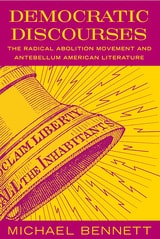
Democratic Discourses
The Radical Abolition Movement and Antebellum American LiteratureBennett, Michael
Rutgers University Press, 2005
Ever since the hallowed statement, "All men are created equal," was penned in the Declaration of Independence, it has become a historical tenet that freedom and equality were brought to American shores by the so-called Founding Fathers.
In this path-breaking study, Michael Bennett departs from tradition to argue that the democratic ideal of equality and the actual ways in which it has been practiced are grounded less in the fledgling government documents written by a handful of white men than in the actions and writings of the radical abolitionists of the nineteenth century. Bringing together key texts of both African American and European American authors, Democratic Discourses shows the important ways that abolitionist writing shaped a powerful counterculture within a slave-holding society. Bennett offers fresh new analysis through unusual pairings of authors, including Frederick Douglass with Henry David Thoreau, Frances Ellen Watkins Harper with Walt Whitman, and Margaret Fuller with Sojourner Truth. These rereadings avoid the tendency to view antebellum writing as a product primarily of either European American or African American influences and, instead, illustrate the interconnections of white and black literature in the creation and practice of democracy.
Drawing on discourses about race, the body, gender, economics, and aesthetics, this unique study encourages readers to reconsider the reality and roots of freedoms experienced in the United States today.
Dialectical Imaginaries
Materialist Approaches to U.S. Latino/a Literature in the Age of NeoliberalismMarcial González and Carlos Gallego, editors
University of Michigan Press, 2018
Disaffected
The Cultural Politics of Unfeeling in Nineteenth-Century AmericaXine Yao
Duke University Press, 2021
Duke University Press Scholars of Color First Book Award recipient
Discourse and the Other
The Production of the Afro-American TextW. Lawrence Hogue
Duke University Press, 1986
Hogue presents an illuminating discussion of the publication and review history of "major" and neglected texts. He illustrates the acceptance of texts as exotica, as sociological documents, or as carriers of sufficient literary conventions to receive approbation. Although the sixties movement allowed the text to move to the periphery of the dominant ideology, providing some new myths about the Afro-American historical past, this marginal position was subsequently sabotaged, co-opted, or appropriated (Afros became a fad; presidents gave the soul handshake; the hip-talking black was dressing one style and talking another.)
This study includes extended discussion of four works; Ernest J. Gaines's The Autobiography of Miss Jane Pittman, Alice Walker's The Third Life of Grange Copeland, Albert Murray's Train Whistle Guitar, and Toni Morrison's Sula. Hogue assesses the informing worldviews of each and the extent and nature of their acceptance by the dominant American cultural apparatus.

Distancing English
A Chapter in the History of the InexpressiblePage Richards
The Ohio State University Press, 2009
Doris Lessing
The Poetics of ChangeGayle Greene
University of Michigan Press, 1997
Doris Lessing has been a chronicler of our age for nearly half a century, and a study of her writing career does not yield easy generalizations. Difficult though she is to categorize, she is always concerned with change, with a search for "something new" against "the nightmare repetition" of history. The feminist quest she articulated in The Children of Violence and The Golden Notebook entered the culture with the force of a new myth: these books changed lives. The Golden Notebook--together with such works as The Second Sex and The Feminine Mystique--raised the consciousness of a generation of women readers and played a major part in making the second wave of feminism. It is the power of Lessing's novels to change people's lives, the effect she had raising the consciousness of a generation of women and the effect she continues to have on young readers, that is the subject of this book.
Gayle Greene employs an eclectic range of approaches (psychoanalytic, Marxist, biographical, historical, intertextual, formalist, feminist) to shed new light on Lessing's remarkable achievement. She sees Lessing as a feminist writer, not in offering strong female role models who climb top the top of existing social structures, but in envisioning, and indeed helping to bring about, a transformation of those structures. Lessing critiques Western values of individualism, competition, and materialism in terms similar to those developed by feminism; and, in getting us to view our culture from without, in teaching us to read cultural constructs as systems, her novels perform the deconstructing and demystifying work of feminism.
Double-Consciousness/Double Bind
Theoretical Issues in Twentieth-Century Black LiteratureSandra Adell
University of Illinois Press, 1994

Dreaming Revolution
Transgression in the Development of American RomanceScott Bradfield
University of Iowa Press, 1993
Dreaming Revolution usefully employs current critical theory to address how the European novel of class revolt was transformed into the American novel of imperial expansion. Bradfield shows that early American romantic fiction—including works by William Godwin, Charles Brockden Brown, James Fenimore Cooper, and Edgar Allan Poe—can and should be considered as part of a genre too often limited to the nineteenth-century European novel. In a spirited discussion of the works from these four authors, Bradfield argues that Americans take the class dynamics of the European psychological novel and apply them to the American landscape, reimagining psychological spaces as geographical ones.
Dreiser and Veblen, Saboteurs of the Status Quo
Clare Virginia Eby
University of Missouri Press, 1999
In this important interdisciplinary study, Clare Eby argues that the writings of Theodore Dreiser and Thorstein Veblen form a neglected chapter in the history of United States cultural criticism that is especially relevant today.
This study leaves behind the narrow frameworks through which most of Veblen's and Dreiser's writings have been interpreted, covering a wide range of both authors' major and minor works. Moving beyond Veblen's The Theory of the Leisure Class and Dreiser's Sister Carrie, Eby shows how the two writers, as saboteurs of the status quo, anticipated many preoccupations of cultural critics today: the cultural role of the intellectual, the relationship of science to society, the place of consumption in modern life, and the intersection of class, gender, and power.
Eby uses cultural criticism as a unifying concept that shows how Veblen fuses satire, sociology, economics, history, psychology, anthropology, political science, and philosophy; and how Dreiser connects fiction, travelogue, literary manifesto, occasional essay, autobiography, biography, and philosophy. By reading Veblen through Dreiser, and Dreiser through Veblen, Eby illustrates the striking parallels between their works, demonstrating how literature and social science can merge in cultural criticism.
Although Dreiser's interest in the natural and social sciences has often been noted, this study provides the only extended analysis of how his works actually resemble, and strive to become, critically informed social science. Similarly, despite the singularity of Veblen's rhetoric, the centrality of literary devices to his works has never been systematically examined. By placing the works of Veblen and Dreiser into dialogue, this study contributes significantly to the recent attempts to bring together the concerns of literary analysts and social scientists.
Dreiser and Veblen, Saboteurs of the Status Quo makes an important contribution not only to Dreiser and Veblen studies but also to cultural criticism itself.