Results by title
138 books match the query 'Meaning' and 3 start with d
Defining Reality
Definitions and the Politics of MeaningEdward Schiappa
Southern Illinois University Press, 2003
In Defining Reality, Edward Schiappa argues that definitional disputes should be treated less as philosophical questions of “is”and more as sociopolitical questions of “ought.” Instead of asking “What is X?” he advocates that definitions be considered as proposals for shared knowledge and institutional norms, as in “What should count as X in context Y, given our needs and interests?”
Covering a broad scope of argument in rhetorical theory, as well as in legal, medical, scientific, and environmental debates, Schiappa shows the act of defining to be a specialized and learned behavior, and therefore one that can be studied and improved. In response to theories that deem discourse to be persuasive, the author asserts that all discourse is definitive discourse that contributes to our construction of a shared reality.
Defining Reality sheds light on our methods of creating common truths through language and argumentation and forces us to reconsider the contexts, limitations, and adaptability of our definitions. Hinging on a synthesis of arguments regarding the significance of definitional practices, the book is bolstered by a series of case studies of debates about rape, euthanasia, abortion, and political and environmental issues. These case studies ground Schiappa’s concepts in reality and delineate the power of public discourse within legal contexts. Ranging widely among disciplines from philosophy and classical philology to constitutional law and cognitive psychology, this study substantially contributes to the scholarship of rhetoric and argumentation, particularly as they function in the realm of public discourse.
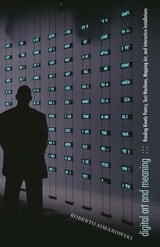
Digital Art and Meaning
Reading Kinetic Poetry, Text Machines, Mapping Art, and Interactive InstallationsRoberto Simanowski
University of Minnesota Press, 2010
Digital Art and Meaning offers close readings of varied examples from genres of digital art such as kinetic concrete poetry, computer-generated text, interactive installation, mapping art, and information sculpture. For instance, Simanowski deciphers the complex meaning of words that not only form an image on a screen but also react to the viewer’s behavior; images that are progressively destroyed by the human gaze; text machines generating nonsense sentences out of a Kafka story; and a light show above Mexico City’s historic square, created by Internet users all over the world.
Simanowski combines these illuminating explanations with a theoretical discussion that employs art philosophy and history to achieve a deeper understanding of each particular example of digital art and, ultimately, of the genre as a whole.
Dynamics of Meaning
Anaphora, Presupposition, and the Theory of GrammarGennaro Chierchia
University of Chicago Press, 1995
Chapter 1 introduces the notion of dynamic semantics and discusses in detail the phenomena that have been used to motivate it, such as "donkey" sentences and adverbs of quantification. The second chapter explores in greater depth the interpretation of indefinites and issues related to presuppositions of uniqueness and the "E-type strategy." In Chapter 3, Chierchia extends the dynamic approach to the domain of syntactic theory, considering a range of empirical problems that includes backwards anaphora, reconstruction effects, and weak crossover. The final chapter develops the formal system of dynamic semantics to deal with central issues of definites and presupposition. Chierchia shows that an approach based on a principled enrichment of the mechanisms dealing with meaning is to be preferred on empirical grounds over approaches that depend on an enrichment of the syntactic apparatus.
Dynamics of Meaning illustrates how seemingly abstract stances on the nature of meaning can have significant and far-reaching linguistic consequences, leading to the detection of new facts and influencing our understanding of the syntax/semantics/pragmatics interface.