Results by title
6 books match the query 'Faithful'
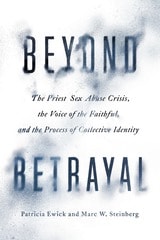
Beyond Betrayal
The Priest Sex Abuse Crisis, the Voice of the Faithful, and the Process of Collective IdentityPatricia Ewick and Marc W. Steinberg
University of Chicago Press, 2019
Beyond Betrayal charts a nationwide identity shift through the story of one chapter of Voice of the Faithful (VOTF), an organization founded in the scandal’s aftermath. VOTF had three goals: helping survivors of abuse; supporting priests who were either innocent or took risky public stands against the wrongdoers; and pursuing a broad set of structural changes in the church. Patricia Ewick and Marc W. Steinberg follow two years in the life of one of the longest-lived and most active chapters of VOTF, whose thwarted early efforts at ecclesiastical reform led them to realize that before they could change the Catholic Church, they had to change themselves. The shaping of their collective identity is at the heart of Beyond Betrayal, an ethnographic portrait of how one group reimagined their place within an institutional order and forged new ideas of faith in the wake of widespread distrust.

Defender of the Faithful
The Life and Thought of Rabbi Levi Yitshak of BerdychivArthur Green
Brandeis University Press, 2022
Defender of the Faithful explores the life and thought of Levi Yitshak of Berdychiv (1740–1809), one of the most fascinating and colorful Hasidic leaders of his time. This is an intellectual and religious biography, a reading of the development of his thought and career. Featuring examples of Levi Yitshak’s extraordinary texts alongside insightful analysis by scholar and theologian Arthur Green, Defender of the Faithful is a compelling study of both Levi Yitshak’s theology and broader philosophy.

Faithful to Our Tasks
Arkansas's Women and the Great WarElizabeth Griffin Hill
Butler Center for Arkansas Studies, 2017
The United States was a vital, if brief, participant in World War I—spending only eighteen months fighting in “the Great War.” But that short span marked an era of tremendous change for women as they moved out of the Victorian nineteenth century and came into their own as social activists during the early years of the twentieth century.
Faithful to Our Tasks provides the context for women’s actions and reactions during the war. It incorporates the mitigating factors and experiences of American women in general and compares Arkansas women’s Progressive Era actions with those of other southern women. The contextual underpinnings provide a rich tapestry as we attempt to understand our grandmothers and great-grandmothers’ responses to wartime needs.
Primary records of the World War I era, accessed in archives in central Arkansas, reveal that the state’s organized women were suddenly faced with a devastating world war for which they were expected to make a significant contribution of time and effort. “Club women” were already tackling myriad problems to be found in abundance within a poor, rural state as they worked for better schools, a centralized education system, children’s well-being, and improved medical care.
Under wartime conditions, their contributions were magnified as the women followed a barrage of directions from Washington, DC, within a disconcerting display of micromanagement by the federal government. The important takeaway, however, is that the Great War created a scenario in which Arkansas’s organized women—as well as women throughout the nation—would step forward and excel as men and governments stood up and took notice. After the war, these same organized women won the right to vote.
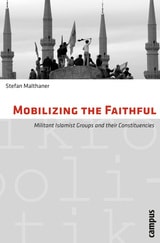
Mobilizing the Faithful
Militant Islamist Groups and Their ConstituenciesStefan Malthaner
Campus Verlag, 2011
One of the keys to dealing with militant Islamic groups is understanding how they work with, relate to, and motivate their constituencies. Mobilizing the Faithful offers a pair of detailed case studies—of the Egyptian groups al-Jamaa al-Islamiyya and al-Jihad and Lebanon's Hizbullah—to identify typical forms of support relationships, development patterns, and dynamics of both radicalization and restraint. The insights it offers into the crucial relationship between militants and the communities from which they arise are widely applicable to violent insurgencies not only in the Middle East but around the world.

The Eyes of Faith
The Sense of the Faithful and the Church's Reception of RevelationOrmond Rush
Catholic University of America Press, 2009

The Religion of SEC Football
Gameday Rituals of the Football FaithfulTerry Barr and Michael Nelson
University of Alabama Press, 2026
A testament to the rituals, rivalries, loyalties, and generational faith of SEC football
For most of the United States, September marks the arrival of autumn. In the South, it signals something else entirely: the return of college football season. “It Just Means More” is not merely a conference slogan—it’s a reflection of SEC football’s divine influence on Southern culture.
For generations, fans across the South have organized life around kickoff times and these “sacred Saturdays.” Weddings, family gatherings, and travel plans are often arranged around the football calendar. They make pilgrimages to beloved stadiums, gather with family and friends to observe longstanding game-day traditions, and invest their hopes, memories, and identities in the teams they love. For many, college football is more than entertainment—it’s a shared culture, a lifelong inheritance, and an enduring act of faith.
In The Religion of SEC Football, Terry Barr and Michael Nelson explore how SEC football has become one of the South’s most distinctive cultural traditions and the parallels it shares with religious devotion. Using history, humor, archival research, personal testimony, and decades of fandom, they examine the rituals, rivalries, communities, and legacies that transform ordinary Saturdays into something more sacred.
From tailgate lore to stadium pilgrimages, Barr and Nelson reveal a world where coaches become saints, miracle plays become scripture, and fandom becomes a family inheritance. Along the way, they celebrate the stories, passions, and personalities that have made SEC football a defining part of Southern life and an enduring act of faith. Regardless of your team’s colors, mascot, or fight song, The Religion of SEC Football celebrates the traditions, stories, and experiences that unite generations of fans across the South and remind us why, year after year, it truly just “means more.”