Results by title
9 books match the query 'Camp'
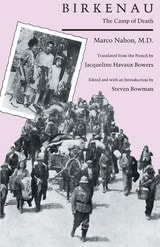
Birkenau, The Camp Of Death
Marco Nahon
University of Alabama Press, 1989

Birkenau
The Camp of DeathMarco Nahon, translated from the French by Jacqueline Bowers, edited and with an introduction by Steven B. Bowan
University of Alabama Press, 1989
Step into Birkenau, Marco Nahon’s unflinching memoir of survival in Auschwitz, where a Greek doctor bears witness to brutality, loss, and endurance—preserving forgotten voices and compelling readers to confront history through one unforgettable, human testimony
Birkenau is a searing firsthand Holocaust memoir by Greek physician Marco Nahon, recounting his deportation to Auschwitz-Birkenau and survival of one of history’s most lethal extermination camps. Writing soon after liberation, Nahon offers a deeply personal chronicle of Nazi persecution. He recounts the occupation of Greece, the ghettoization of Greek Jews, their transport to German death camps, and the daily horrors of camp life. He documents the dehumanization and destruction of Greek Jews while preserving the memory of those who perished.
Nahon presents his story episodically, guiding readers through his arrest, transport, forced labor, and survival. He illuminates the historical context of the Holocaust with vivid stories from daily life in the death camps. Rounding out the work are maps, appendices, and Bowman’s introduction, which provides background on Greek Jewry—whose complex story is little known—and describes the progress of the Nazi occupation of Greece and the Balkans.
Nahon, an MD trained in Beirut who lost much of his family, writes with restrained objectivity that heightens the emotional force of his account, while the translation and editorial framing make this early memoir accessible to modern readers.
This book will resonate with scholars of the Holocaust, students of World War II, and general readers seeking an authentic survivor voice. It is especially valuable for those interested in lesser-known aspects of the genocide, such as the fate of Greek Jewish communities. Both an indispensable historical document and a powerful act of remembrance, it speaks urgently to anyone committed to understanding—and never forgetting—the human realities of genocide.
Camp
Queer Aesthetics and the Performing Subject--A ReaderFabio Cleto, Editor
University of Michigan Press, 1999
This groundbreaking collection addresses the multi-layered issue of camp, whose inexhaustible breadth of reference and theoretical relevance have made it one of the most salient and challenging issues on the contemporary critical stage. Reassessing the role and significance of the finest essays on camp written by leading intellectuals in cultural studies, lesbian and gay studies and queer theory, this critical anthology both "queers" camp as an issue and offers an excellent key to rethinking the history, theory, and practice of camp.
The anthology is divided into five thematic/historical sections: Tasting It; Flaunting the Closet; Gender, and Other Spectacles; Pop Camp, Surplus Counter-Value, or the Camp of Cultural Economy; and The Queer Issue. These groupings help the reader situate the critical debates around the subject. Fabio Cleto's introduction brings new theoretical insights to the subject of camp while tracing its history as an object of intellectual and cultural critique and analysis.
A comprehensive bibliography that traces the earliest use of the word 'camp' to the present completes this unique and exciting volume.
“Is ‘camp’ a kind of irony, an effect of one’s historic vantage point, an art form or an elitist aesthetic? … From landmark early works by Christopher Isherwood and Susan Sontag to influential contemporary pieces by Esther Newton, Andrew Ross and Judith Butler, this anthology encapsulates the philosophical discussion of this slippery postmodern concept.”
--Publishers Weekly
“As an object of critical inquiry, camp has proven notoriously difficult to define. Fabio Cleto takes this difficulty as his point of departure in the most recent anthology of a growing body of scholarly literature on the topic…Cleto resists defining camp [but] does not abandon the task of framing, in a coherent but flexible way, camp as a problematic.”
--Semiotica
“Fabio Cleto’s collection variously associates ‘camp’ with the 1960s, aestheticism, androgyny, cross-dressing, the cultural figure of the dandy, decadence, drag, exaggeration, kitsch, parody, pastiche, postmodernism, the sentimental, and the transvestite… The essayists in Camp disagree freely and fiercely over definitions. This is to be expected in a queer reader, one whose contributors endeavor to ‘read across’ the meanings of camp.”
--The Gay & Lesbian Review
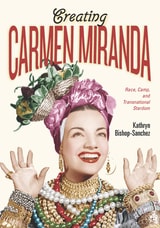
Creating Carmen Miranda
Race, Camp, and Transnational StardomKathryn Bishop-Sanchez
Vanderbilt University Press, 2016
This final performance in many ways exemplified the power of Carmen Miranda. The actress, singer, and dancer pursued a relentless mission to demonstrate the provocative theatrical force of her cultural roots in Brazil. Armed with bare-midriff dresses, platform shoes, and her iconic fruit-basket headdresses, Miranda stole the show in films like That Night in Rio and The Gang's All Here. For American film audiences, her life was an example of the exoticism of a mysterious, sensual South America. For Brazilian and Latin American audiences, she was an icon. For the gay community, she became a work of art personified and a symbol of courage and charisma.
In Creating Carmen Miranda, Kathryn Bishop-Sanchez takes the reader through the myriad methods Miranda consciously used to shape her performance of race, gender, and camp culture, all to further her journey down the road to becoming a legend.
Gasa Gasa Girl Goes to Camp
A Nisei Youth Behind A World War II FenceLily Yuriko Nakai Havey
University of Utah Press, 2014
In this creative memoir, Lily Havey combines storytelling, watercolor, and personal photographs to recount her youth in two Japanese-American internment camps during World War II. In short vignettes snapshots of people, recreated scenes and events a ten-year-old girl develops into a teenager while confined. Vintage photographs reveal the historical, cultural, and familial contexts of that growth and of the Nakais’ dislocation. The paintings and her animated writing together pull us into a turbulent era when America disgracefully incarcerated, without due process, thousands of American citizens because of their race.
These stories of love, loss, and discovery recall a girl balancing precariously between childhood and adolescence. In turn wrenching, funny, touching, and biting but consistently engrossing, they elucidate the daily challenges of life in the camp and the internees’ many adaptations.
Winner of the Evans Biography Award.
Selected by the American Library Association as one the Best of the Best from University Presses.
Finalist in the cover design category in the Southwest Book Design and Production Awards.
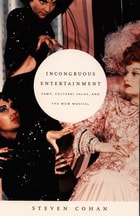
Incongruous Entertainment
Camp, Cultural Value, and the MGM MusicalSteven Cohan
Duke University Press, 2005
In addition to examining the spectatorship of the mgm musical, Cohan investigates the genre’s production and marketing, paying particular attention to the studio’s employment of a largely gay workforce of artists and craftspeople. He reflects on the role of the female stars—including Judy Garland, Debbie Reynolds, Esther Williams, and Lena Horne—and he explores the complex relationship between Gene Kelley’s dancing and his masculine persona. Cohan looks at how, in the decades since the 1950s, the marketing and reception of the mgm musical have negotiated the more publicly recognized camp value attached to the films. He considers the status of Singin’ in the Rain as perhaps the first film to be widely embraced as camp; the repackaging of the musicals as nostalgia and camp in the That’s Entertainment! series as well as on home video and cable; and the debates about Garland’s legendary gay appeal among her fans on the Internet. By establishing camp as central to the genre, Incongruous Entertainment provides a new way of looking at the musical.
Occupied Refuge
Humanitarian Colonization and the Camp in KenyaHanno Brankamp
Duke University Press, 2026

The Music Diva Spectacle
Camp, Female Performers and Queer Audiences in the Arena Tour ShowConstantine Chatzipapatheodoridis
Intellect Books, 2021
In this original new work, Constantine Chatzipapatheodoridis pulls back the curtain on the production of camp as a queer praxis that constantly feeds the diva-queer culture relationship. By examining the iconography and theatrics of the diva tour show, the author presents a performance studies reading of camp and the culture-sharing process of production and audience reception. Detailed case studies take a close look at popular contemporary performers like Madonna, Kylie Minogue, Beyoncé, and Lady Gaga, and a final section analyzes audience drag in the arena space. Chatzipapatheodoridis also investigates the relationship between camp theory as an academic subject and the figure of the diva as an expression of camp.
A rich and insightful revival of the question of camp in contemporary queer performance, The Music Diva Spectacle seeks to establish how camp is appropriated by the diva and explores how this affects—and is in turn appropriated by—the audience.
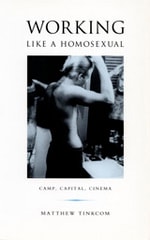
Working Like a Homosexual
Camp, Capital, CinemaMatthew Tinkcom
Duke University Press, 2002
With a special emphasis on the tensions between high and low forms of culture and between good and bad taste, Matthew Tinkcom offers a new vision of queer politics and aesthetics that is critically engaged with Marxist theories of capitalist production. He argues that camp—while embracing the cheap, the scorned, the gaudy, the tasteless, and what Warhol called “the leftovers” of artistic production—is a mode of intellectual production and a critical philosophy of modernity as much as it is an expression of a dissident sex/gender difference. From Minnelli’s musicals and the “everyday glamour” of Warhol’s films to Anger’s experimental films and Waters’s “trash aesthetic,” Tinkcom demonstrates how camp allowed these gay men to design their own relationship to labor and to history in a way that protected them from censure even as they struggled to forge a role for themselves within a system of “value” that failed to recognize them.