364 books match the query 'Michigan' and 18 start with d

cover of Danes and Icelanders in Michigan

Danes and Icelanders in Michigan

Howard L. Nicholson

Michigan State University Press, 2013

Immigration of Danes and Icelanders to Michigan began in the 1850s and continued well into the twentieth century. Beginning with their origins, this book takes a detailed look at their arrival and settlement in Michigan, answering some key questions: What brought Danes and Icelanders to Michigan? What challenges did they face? How did they adjust and survive here? Where did they settle? What kind of lasting impact have they had on Michigan’s economic and cultural landscape? Extensively researched, this book examines the public and private lives of Danish and Icelandic immigrants in Michigan, drawing from both individual and institutional histories. Shedding new light on the livelihood, traditions, religion, social life, civic organizations, and mutual benefit societies, this thorough, insightful book highlights a small but important population within Michigan’s borders.

[more]
cover of Dead Moose on Isle Royale: Off Trail with the Citizen Scientists of the Wolf-Moose Project

Dead Moose on Isle Royale

Off Trail with the Citizen Scientists of the Wolf-Moose Project

Jeffrey M Holden

Michigan State University Press, 2025
Isle Royale in Michigan is one of the most remote and pristine of all the U.S. national parks, and it is the site of the world’s longest-running predator–prey study. Every summer, Jeffrey M. Holden leads groups of citizen scientists on week-long expeditions to search for dead moose. Those intrepid enough to join him backpacking off trail in Isle Royale’s rugged beauty face challenges from treacherous weather conditions, to wildlife, primitive backcountry camping, traveling through swamps and wetlands, and backpacks that grow heavier with bones every time a new dead moose is found. Sometimes the moose they find are long dead, with only a scattering of bones remaining. Sometimes they are freshly departed, rotted, stinking, and covered with thousands of bloodthirsty ticks. Scientists use the bones, photos, and data they collect to reconstruct the moose population through the years, correlating it against other data on wolves, weather, and ticks. This book provides a fascinating look into the day-to-day realities of backpacking in the wilderness, while featuring the extraordinary scientific discoveries of the Wolf-Moose Project itself and highlighting the role and rewards for volunteers in this extraordinary endeavor. This is a must read for anyone who is interested in off-trail hiking, becoming a citizen scientist, or exploring America’s least-visited national park.
[more]
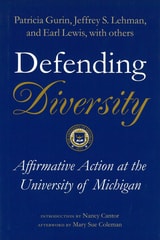
cover of Defending Diversity: Affirmative Action at the University of Michigan

Defending Diversity

Affirmative Action at the University of Michigan

Patricia Gurin, Jeffrey S. Lehman, and Earl Lewis, with Eric L. Dey, Gerald Gurin, and Sylvia Hurtado

University of Michigan Press, 2004
Even as lawsuits challenging its admissions policies made their way through the courts, the University of Michigan carried the torch for affirmative action in higher education.In June 2003, the Supreme Court vindicated UM's position on affirmative action when it ruled that race may be used as a factor for universities in their admissions programs, thus confirming what the UM had argued all along: diversity in the classroom translates to a beneficial and wide-ranging social value. With the green light given to the law school's admissions policies, Defending Diversity validates the positive benefits gained by students in a diverse educatioN/Al setting.Written by prominent University of Michigan faculty, Defending Diversity is a timely response to the court's ruling. Providing factual background, historical setting, and the psychosocial implications of affirmative action, the book illumiN/Ates the many benefits of a diverse higher educational setting -- including preparing students to be full participants in a pluralistic democracy -- and demonstrates why affirmative action is necessary to achieve that diversity.Defending Diversity is a significant contribution to the ongoing discussion on affirmative action in higher education. Perhaps more important, it is a valuable record of the history, events, arguments, and issues surrounding the original lawsuits and the Supreme Court's subsequent ruling, and helps reclaim the debate from those forces opposed to affirmative action.
[more]
cover of Demolition Means Progress: Flint, Michigan, and the Fate of the American Metropolis

Demolition Means Progress

Flint, Michigan, and the Fate of the American Metropolis

Andrew R. Highsmith

University of Chicago Press, 2015

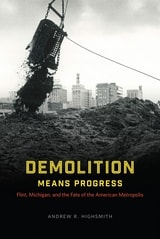
In 1997, after General Motors shuttered a massive complex of factories in the gritty industrial city of Flint, Michigan, signs were placed around the empty facility reading, “Demolition Means Progress,” suggesting that the struggling metropolis could not move forward to greatness until the old plants met the wrecking ball. Much more than a trite corporate slogan, the phrase encapsulates the operating ethos of the nation’s metropolitan leadership from at least the 1930s to the present. Throughout, the leaders of Flint and other municipalities repeatedly tried to revitalize their communities by demolishing outdated and inefficient structures and institutions and overseeing numerous urban renewal campaigns—many of which yielded only more impoverished and more divided metropolises. After decades of these efforts, the dawn of the twenty-first century found Flint one of the most racially segregated and economically polarized metropolitan areas in the nation.

In one of the most comprehensive works yet written on the history of inequality and metropolitan development in modern America, Andrew R. Highsmith uses the case of Flint to explain how the perennial quest for urban renewal—even more than white flight, corporate abandonment, and other forces—contributed to mass suburbanization, racial and economic division, deindustrialization, and political fragmentation. Challenging much of the conventional wisdom about structural inequality and the roots of the nation’s “urban crisis,” Demolition Means Progress shows in vivid detail how public policies and programs designed to revitalize the Flint area ultimately led to the hardening of social divisions.
[more]
cover of Destination Detroit: Discourses on the Refugee in a Post-Industrial City

Destination Detroit

Discourses on the Refugee in a Post-Industrial City

Rashmi Luthra

University of Michigan Press, 2024

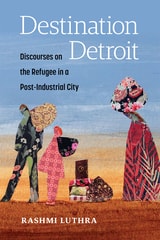
Deindustrialized cities in the United States are at a particular crossroads when it comes to the contest over refugees. Do refugees represent opportunity or danger? These cities are in desperate need to stem population and resource loss, problems that an influx of refugees could seemingly help address. However, the cities are simultaneously dealing with local communities that are already feeling internally displaced by economic and technological flux. For these existing citizens, the prospect of incoming refugee populations can be perceived as a threat to financial, cultural, and personal security. 

Few U.S. locations provide a more vivid case study of this fight than Metro Detroit, where competing interest groups are waging war over the meaning of the figure of the refugee. This book dives deeply into the discourse on refugees occurring among  various institutions in Metro Detroit. The way in which local institutions talk about refugees gives us vital clues as to how they are negotiating competing pressures and how the city overall is negotiating competing imperatives. Indeed, this local discourse gives us a crucial glimpse into how U.S. cities are defining and redefining themselves today. The figure of the refugee becomes a slate on which groups with varied interests write their stories, aspirations, and fears. Consequently, we can figure out from local refugee discourses the ongoing question of what it means to be a Metro Detroiter—and by extension, what it means to be a revitalizing U.S. city in this age.

[more]
cover of Detroit Country Music: Mountaineers, Cowboys, and Rockabillies

Detroit Country Music

Mountaineers, Cowboys, and Rockabillies

Craig Maki with Keith Cady

University of Michigan Press, 2013

The richness of Detroit’s music history has by now been well established. We know all about Motown, the MC5, and Iggy and the Stooges. We also know about the important part the Motor City has played in the history of jazz. But there are stories about the music of Detroit that remain untold. One of the lesser known but nonetheless fascinating histories is contained within Detroit’s country music roots. At last, Craig Maki and Keith Cady bring to light Detroit’s most important country and western and bluegrass stars, such as Chief Redbird, the York Brothers, and Roy Hall. Beyond the individuals, Maki and Cady also map out the labels, radio programs, and performance venues that sustained Detroit’s vibrant country and bluegrass music scene. In the process, Detroit Country Music examines how and why the city’s growth in the early twentieth century, particularly the southern migration tied to the auto industry, led to this vibrant roots music scene.

This is the first book—the first resource of any kind—to tell the story of Detroit’s contributions to country music. Craig Maki and Keith Cady have spent two decades collecting music and images, and visiting veteran musicians to amass more than seventy interviews about country music in Detroit. Just as astounding as the book’s revelations are the photographs, most of which have never been published before. Detroit Country Musicwill be essential reading for music historians, record collectors, roots music fans, and Detroit music aficionados.
[more]
cover of Detroit Is No Dry Bones: The Eternal City of the Industrial Age

Detroit Is No Dry Bones

The Eternal City of the Industrial Age

Camilo José Vergara

University of Michigan Press, 2016

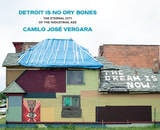
Over the past 25 years, award-winning ethnographer and photographer Camilo José Vergara has traveled annually to Detroit to document not only the city’s precipitous decline but also how its residents have survived. From the 1970s through the 1990s, changes in Detroit were almost all for the worse, as the fabric of the city was erased through neglect and abandonment. But over the last decade, Detroit has seen the beginnings of a positive transformation, and the photography in Detroit Is No Dry Bones provides unique documentation of the revival and its urbanistic possibilities. Beyond the fate of the city’s buildings themselves, Vergara’s camera has consistently sought to capture the distinct culture of this largely African American city. The photographs in this book, for example, are organized in part around the way people have re-used and re-purposed structures from the past. Vergara is unique in his documentation of local churches that have re-occupied old bank buildings and other impressive structures from the past and turned them into something unexpectedly powerful architecturally as well as spiritually.

[more]
cover of Detroit Lives

Detroit Lives

Robert Mast

Temple University Press, 1994
[more]
cover of Detroit Remains: Archaeology and Community Histories of Six Legendary Places

Detroit Remains

Archaeology and Community Histories of Six Legendary Places

Krysta Ryzewski

University of Alabama Press, 2021

WINNER OF THE UNIVERSITY OF MARY WASHINGTON CENTER FOR HISTORIC PRESERVATION BOOK PRIZE,  THE JAMES DEETZ BOOK AWARD, AND THE JOAN GERO BOOK AWARD

An interdisciplinary study of urban archaeology, community heritage, and social justice in modern Detroit.

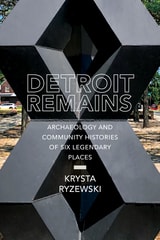
The city of Detroit has endured periods of unprecedented industrial growth, decline, and revitalization between the late nineteenth century and the present. In Detroit Remains: Archaeology and Community Histories of Six Legendary Places, Krysta Ryzewski presents six archaeological case studies of legendary Detroit institutions—Little Harry speakeasy, the Ransom Gillis house, the Blue Bird Inn, Gordon Park, the Grande Ballroom, and the Halleck Street log cabin—that trace the contours of the city’s underrepresented communities and their relationship to local currents of capitalism and social justice. Through a combination of rigorous historical archaeological research and narrative storytelling, Ryzewski deftly contextualizes the cases within the city’s current struggles, including recovery from bankruptcy, and future-oriented recovery efforts.

This is the first historical archaeology book focused on Detroit and one of the few to foreground the archaeology of the Great Migration era (ca. 1915–1970). The archaeological scholarship is rooted in collaborative, community-involved, and public-facing initiatives. The case studies examine how power is and has been exercised in Detroit’s communities over the past century: how it was stripped from the city’s twentieth- and twenty-first-century residents, but also how they acquired alternative sources of agency by establishing creative and illicit economies, most of which still operated within the city’s capitalist framework.

Throughout this book, connections run deep between archaeology, heritage, politics, historic preservation, and storytelling. Detroit Remains demonstrates how the city’s past, present, and future lie not in ruins but in the tangible archaeological traces of the everyday lives of Detroiters and their legacies.
 

[more]
cover of Detroit Resurgent

Detroit Resurgent

Howard Bossen

Michigan State University Press, 2014

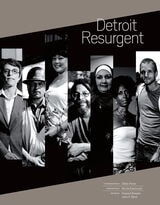
Detroit is frequently viewed as a city where hope has been lost, government is totally dysfunctional, and the infrastructure is beyond repair. For far too many people around the world, the Motor City is perceived as a city whose greatness is in distant memory. Detroit Resurgent, while not ignoring the problems facing the city, explores Detroit in a new way that reveals a culturally rich, very alive, and undeniably present side of the city. Through photographic portraits, interviews, essays, and poetry, it demonstrates the vitality and humanity of Detroit’s people, providing a powerful counternarrative to the vision of Detroit as a Rust Belt wasteland. Giving voice to people with hopes for a brighter future and aspirations to create a new city out of the old required recording their own words and engaging a portrait photographer grounded in humanism whose approach is based upon the traditions of social documentary photography. Detroit Resurgent explores the city through the voices of those working in a multitude of ways to reshape it into a twenty-first-century urban space, through the auto industry, urban agriculture and food production, entrepreneurial action and small business, visual and performing arts, activism, and visionary leadership.
[more]
cover of Detroit's Cold War: The Origins of Postwar Conservatism

Detroit's Cold War

The Origins of Postwar Conservatism

Colleen Doody

University of Illinois Press, 2017
Detroit's Cold War locates the roots of American conservatism in a city that was a nexus of labor and industry in postwar America. Drawing on meticulous archival research focusing on Detroit, Colleen Doody shows how conflict over business values and opposition to labor, anticommunism, racial animosity, and religion led to the development of a conservative ethos in the aftermath of World War II.
 
Using Detroit--with its large population of African-American and Catholic immigrant workers, strong union presence, and starkly segregated urban landscape--as a case study, Doody articulates a nuanced understanding of anticommunism during the Red Scare. Looking beyond national politics, she focuses on key debates occurring at the local level among a wide variety of common citizens. In examining this city's social and political fabric, Doody illustrates that domestic anticommunism was a cohesive, multifaceted ideology that arose less from Soviet ideological incursion than from tensions within the American public.
[more]
cover of Detroit's Hidden Channels: The Power of French-Indigenous Families in the Eighteenth Century

Detroit's Hidden Channels

The Power of French-Indigenous Families in the Eighteenth Century

Karen L. Marrero

Michigan State University Press, 2020
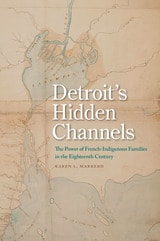
French-Indigenous families were a central force in shaping Detroit’s history. Detroit’s Hidden Channels: The Power of French-Indigenous Families in the Eighteenth Century examines the role of these kinship networks in Detroit’s development as a site of singular political and economic importance in the continental interior. Situated where Anishinaabe, Wendat, Myaamia, and later French communities were established and where the system of waterways linking the Atlantic Ocean to the Gulf of Mexico narrowed, Detroit’s location was its primary attribute. While the French state viewed Detroit as a decaying site of illegal activities, the influence of the French-Indigenous networks grew as members diverted imperial resources to bolster an alternative configuration of power relations that crossed Indigenous and Euro-American nations. Women furthered commerce by navigating a multitude of gender norms of their nations, allowing them to defy the state that sought to control them by holding them to European ideals of womanhood. By the mid-eighteenth century, French-Indigenous families had become so powerful, incoming British traders and imperial officials courted their favor. These families would maintain that power as the British imperial presence splintered on the eve of the American Revolution.
[more]
cover of Detroit: Race Riots, Racial Conflicts, and Efforts to Bridge the Racial Divide

Detroit

Race Riots, Racial Conflicts, and Efforts to Bridge the Racial Divide

Joe T. Darden and Richard Thomas

Michigan State University Press, 2013
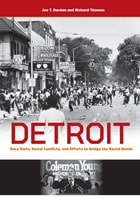
Episodes of racial conflict in Detroit form just one facet of the city’s storied and legendary history, and they have sometimes overshadowed the less widely known but equally important occurrence of interracial cooperation in seeking solutions to the city’s problems. The conflicts also present many opportunities to analyze, learn from, and interrogate the past in order to help lay the groundwork for a stronger, more equitable future. This astute and prudent history poses a number of critical questions: Why and where have race riots occurred in Detroit? How has the racial climate changed or remained the same since the riots? What efforts have occurred since the riots to reduce racial inequality and conflicts, and to build bridges across racial divides? Unique among books on the subject, Detroit pays special attention to post-1967 social and political developments in the city, and expands upon the much-explored black-white dynamic to address the influx of more recent populations to Detroit: Middle Eastern Americans, Hispanic Americans, and Asian Americans. Crucially, the book explores the role of place of residence, spatial mobility, and spatial inequality as key factors in determining access to opportunities such as housing, education, employment, and other amenities, both in the suburbs and in the city.
[more]
cover of Detroit: Race and Uneven Development

Detroit

Race and Uneven Development

Joe T. Darden, Richard Child Hill, June Thomas and Richard Thomas

Temple University Press, 1990

Hub of the American auto industry and site of the celebrated Riverfront Renaissance, Detroit is also a city of extraordinary poverty, unemployment, and racial segregation. This duality in one of the mightiest industrial metropolises of twentieth-century North America is the focus of this study. Viewing the Motor City in light of sociology, geography, history, and planning, the authors examine the genesis of modern Detroit. They argue that the current situation of metropolitan Detroit—economic decentralization, chronic racial and class segregation, regional political fragmentation—is a logical result of trends that have gradually escalated throughout the post-World War II era. Examining its recent redevelopment policies and the ensuing political conflicts, Darden, Hill, Thomas, and Thomas, discuss where Detroit has been and where it is going.


In the series Comparative American Cities, edited by Joe T. Darden.
[more]
cover of Digital Detroit: Rhetoric and Space in the Age of the Network

Digital Detroit

Rhetoric and Space in the Age of the Network

Jeff Rice

Southern Illinois University Press, 2012

Since the 1967 riots that ripped apart the city, Detroit has traditionally been viewed either as a place in ruins or a metropolis on the verge of rejuvenation. In Digital Detroit: Rhetoric and Space in the Age of the Network, author Jeff Rice goes beyond the notion of Detroit as simply a city of two ideas. Instead he explores the city as a web of multiple meanings which, in the digital age, come together in the city’s spaces to form a network that shapes the writing, the activity, and the very thinking of those around it.

Rice focuses his study on four of Detroit’s most iconic places—Woodward Avenue, the Maccabees Building, Michigan Central Station, and 8 Mile—covering each in a separate chapter. Each of these chapters explains one of the four features of network rhetoric: folksono(me), the affective interface, response, and decision making. As these rhetorical features connect, they form the overall network called Digital Detroit. Rice demonstrates how new media, such as podcasts, wikis, blogs, interactive maps, and the Internet in general, knit together Detroit into a digital network whose identity is fluid and ever-changing. In telling Detroit’s spatial story, Rice deftly illustrates how this new media, as a rhetorical practice, ultimately shapes understandings of space in ways that computer applications and city planning often cannot. The result is a model for a new way of thinking and interacting with space and the imagination, and for a better understanding of the challenges network rhetorics pose for writing.
[more]
cover of Disruption in Detroit: Autoworkers and the Elusive Postwar Boom

Disruption in Detroit

Autoworkers and the Elusive Postwar Boom

Daniel J. Clark

University of Illinois Press, 2018
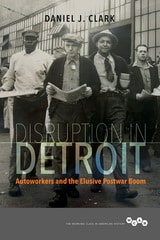
It is a bedrock American belief: the 1950s were a golden age of prosperity for autoworkers. Flush with high wages and enjoying the benefits of generous union contracts, these workers became the backbone of a thriving blue-collar middle class. It is also a myth. Daniel J. Clark began by interviewing dozens of former autoworkers in the Detroit area and found a different story--one of economic insecurity caused by frequent layoffs, unrealized contract provisions, and indispensable second jobs. Disruption in Detroit is a vivid portrait of workers and an industry that experienced anything but stable prosperity. As Clark reveals, the myths--whether of rising incomes or hard-nosed union bargaining success--came later. In the 1950s, ordinary autoworkers, union leaders, and auto company executives recognized that although jobs in their industry paid high wages, they were far from steady and often impossible to find.
[more]
cover of Dutch in Michigan

Dutch in Michigan

Larry Ten Harmsel

Michigan State University Press, 2002

Even though they are historically one of the smaller immigrant streams, nineteenth-century Dutch migrants and their descendants have made parts of West Michigan their own. The first Dutch in Michigan were religious dissenters whose commitment to Calvinism had long-reaching effects on their communities, even in the face of later waves of radicalized industrial immigrants and the challenges of modern life. From Calvin College to Meijer Thrifty Acres and the Tulip Festival, the Dutch presence has enriched and informed people throughout the state. Larry ten Harmsel skillfully weaves together the strands of history and modern culture to create a balanced and sensitive portrayal of this vibrant community.

[more]
cover of Dutch is Beautiful: Fifty Years of Dutch and Flemish Studies at the University of Michigan

Dutch is Beautiful

Fifty Years of Dutch and Flemish Studies at the University of Michigan

Ton Broos, Annemarie Toebosch, and Karla Vandersypen

Michigan Publishing Services, 2019

Dutch is Beautiful tells the story of the fifty years of Dutch and Flemish Studies at the University of Michigan in Ann Arbor, Michigan, USA. It is an account of the efforts to promote Dutch and Flemish culture and language, as well as a description of how the teaching of Dutch language, literature, history and culture can be a tool to look at a world of diverse identities. It also offers a comprehensive overview of the beginnings of a successful program that included Dutch writers-in-residence, visiting Netherlands professors, cultural and educational events, arts, music, films, conferences and publications. Several alumni of  the program look back at their college years with appreciation. Articles and essays on history, Anne Frank, and conversations on colonialism discuss critical and educational views on Dutch and Flemish Studies in past, present and future, when diversity, equity and inclusion are important goals and objectives, and public scholarship and academic activism will be a larger part of the curriculum. This book will inform, entertain, stimulate and impress everyone who is interested in the culture of the Low Countries. The title says it all!

[more]