Results by title
138 books match the query 'Minority Studies' and 9 start with d
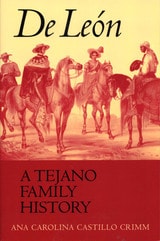
De León, a Tejano Family History
By Ana Carolina Castillo Crimm
University of Texas Press, 2003
Winner, Presidio La Bahia Award, 2004
San Antonio Conservation Society Citation, 2005
La familia de León was one of the foundation stones on which Texas was built. Martín de León and his wife Patricia de la Garza left a comfortable life in Mexico for the hardships and uncertainties of the Texas frontier in 1801. Together, they established family ranches in South Texas and, in 1824, the town of Victoria and the de León colony on the Guadalupe River (along with Stephen F. Austin's colony, the only completely successful colonization effort in Texas). They and their descendents survived and prospered under four governments, as the society in which they lived evolved from autocratic to republican and the economy from which they drew their livelihood changed from one of mercantile control to one characterized by capitalistic investments.
Combining the storytelling flair of a novelist with a scholar's concern for the facts, Ana Carolina Castillo Crimm here recounts the history of three generations of the de León family. She follows Martín and Patricia from their beginnings in Mexico through the establishment of the family ranches in Texas and the founding of the de León colony and the town of Victoria. Then she details how, after Martín's death in 1834, Patricia and her children endured the Texas Revolution, exile in New Orleans and Mexico, expropriation of their lands, and, after returning to Texas, years of legal battles to regain their property. Representative of the experiences of many Tejanos whose stories have yet to be written, the history of the de León family is the story of the Tejano settlers of Texas.
Deadliest Enemies
Law and Race Relations on and off Rosebud ReservationThomas Biolsi
University of Minnesota Press, 2007
Many people living far away from Indian reservations express sympathy for the poverty and misery experienced by Native Americans, yet, Thomas Biolsi argues, the problems faced by Native Americans are the results of white privilege.
In Deadliest Enemies, Biolsi connects the origins of racial tension between Indians and non-Indians on the Rosebud Reservation in South Dakota to federal laws, showing how the courts have created opposing political interests along race lines. Biolsi demonstrates that the court’s definitions of legal rights—both constitutional and treaty rights—make solutions to racial tensions intractable.
This powerful work sheds much-needed light on racial conflicts in South Dakota and in the rest of the United States, and holds white people accountable for the benefits of their racial privilege that come at the expense of Native Americans.
Thomas Biolsi is professor of Native American studies at the University of California at Berkeley.
Deaf to the Marrow
Deaf Social Organizing and Active Citizenship in Viet NamAudrey C. Cooper
Gallaudet University Press, 2017
Drawing on research data and work with Vietnamese Deaf colleagues covering an eight-year span, Cooper develops ethnographic and language-centered accounts of Deaf social organizing. These accounts illuminate the ways that Deaf citizens are assuming self-determining roles, or active citizenship, in decisions of local, national, and international importance. By placing Deaf social action in the historical context of state development and modernization projects, Cooper shows how educational structuring reflects dominant, spoken-language-centered views of Vietnamese Deaf people and signed languages. She also addresses the impact of international aid agendas on education, especially those related to disability. Deaf to the Marrow examines perspectives largely ignored in Deaf education, Deaf studies, signed-language linguistics, and anthropological literatures, thereby contributing to scholarship on language and sociopolitical formation broadly and the study of Deaf people’s citizenship practices specifically.

Deepening Divides
How Physical Borders and Social Boundaries Delineate our WorldDidier Fassin
Pluto Press, 2019

Democratic Theorizing from the Margins
Marla Brettschneider
Temple University Press, 2007

Dethroning the Deceitful Pork Chop
Rethinking African American Foodways from Slavery to ObamaJennifer Jensen Wallach
University of Arkansas Press, 2015
2017 Association for the Study of Food and Society Award, best edited collection.
The fifteen essays collected in Dethroning the Deceitful Pork Chop utilize a wide variety of methodological perspectives to explore African American food expressions from slavery up through the present. The volume offers fresh insights into a growing field beginning to reach maturity. The contributors demonstrate that throughout time black people have used food practices as a means of overtly resisting white oppression—through techniques like poison, theft, deception, and magic—or more subtly as a way of asserting humanity and ingenuity, revealing both cultural continuity and improvisational finesse. Collectively, the authors complicate generalizations that conflate African American food culture with southern-derived soul food and challenge the tenacious hold that stereotypical black cooks like Aunt Jemima and the depersonalized Mammy have on the American imagination. They survey the abundant but still understudied archives of black food history and establish an ongoing research agenda that should animate American food culture scholarship for years to come.
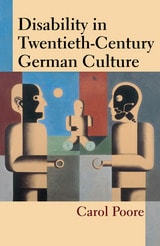
Disability in Twentieth-Century German Culture
Carol Poore
University of Michigan Press, 2010
"Comprehensively researched, abundantly illustrated and written in accessible and engaging prose . . . With great skill, Poore weaves diverse types of evidence, including historical sources, art, literature, journalism, film, philosophy, and personal narratives into a tapestry which illuminates the cultural, political, and economic processes responsible for the marginalization, stigmatization, even elimination, of disabled people---as well as their recent emancipation."
---Disability Studies Quarterly
"A major, long-awaited book. The chapter on Nazi images is brilliant---certainly the best that has been written in this arena by any scholar."
---Sander L. Gilman, Emory University
"An important and pathbreaking book . . . immensely interesting, it will appeal not only to students of twentieth-century Germany but to all those interested in the growing field of disability studies."
---Robert C. Holub, University of Tennessee
Disability in Twentieth-Century German Culture covers the entire scope of Germany's most tragic and tumultuous century---from the Weimar Republic to the current administration---revealing how central the notion of disability is to modern German cultural history. By examining a wide range of literary and visual depictions of disability, Carol Poore explores the contradictions of a nation renowned for its social services programs yet notorious for its history of compulsory sterilization and eugenic dogma. This comprehensive volume focuses particular attention on the horrors of the Nazi era, when those with disabilities were considered "unworthy of life," but also investigates other previously overlooked topics including the exile community's response to disability, socialism and disability in East Germany, current bioethical debates, and the rise and gains of Germany's disability rights movement.
Richly illustrated, wide-ranging, and accessible, Disability in Twentieth-Century German Culture gives all those interested in disability studies, German studies, visual culture, Nazi history, and bioethics the opportunity to explore controversial questions of individuality, normalcy, citizenship, and morality. The book concludes with a memoir of the author's experiences in Germany as a person with a disability.
Carol Poore is Professor of German Studies at Brown University.
Illustration: "Monument to the Unknown Prostheses" by Heinrich Hoerle © 2007 Artists Rights Society (ARS), New York / VG Bild-Kunst, Bonn
A volume in the series Corporealities: Discourses of Disability
"Insightful and meticulously researched . . . Using disability as a concept, symbol, and lived experience, the author offers valuable new insights into Germany's political, economic, social, and cultural character . . . Demonstrating the significant ‘cultural phenomena' of disability prior to and long after Hitler's reign achieves several important theoretical and practical aims . . . Highly recommended."
---Choice
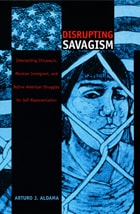
Disrupting Savagism
Intersecting Chicana/o, Mexican Immigrant, and Native American Struggles for Self-RepresentationArturo J. Aldama
Duke University Press, 2001
Arturo J. Aldama begins by presenting a genealogy of the term “savage,” looking in particular at the work of American ethnologist Lewis Henry Morgan and a sixteenth-century debate between Juan Ginés de Sepúlveda and Bartolomé de las Casas. Aldama then turns to more contemporary narratives, examining ethnography, fiction, autobiography, and film to illuminate the historical ideologies and ethnic perspectives that contributed to identity formation over the centuries. These works include anthropologist Manuel Gamio’s The Mexican Immigrant: His Life Story, Leslie Marmon Silko’s Ceremony, Gloria Anzaldúa’s Borderlands/La Frontera, and Miguel Arteta’s film Star Maps. By using these varied genres to investigate the complex politics of racialized, subaltern, feminist, and diasporic identities, Aldama reveals the unique epistemic logic of hybrid and mestiza/o cultural productions.
The transcultural perspective of Disrupting Savagism will interest scholars of feminist postcolonial processes in the United States, as well as students of Latin American, Native American, and literary studies.
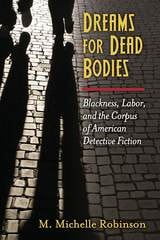
Dreams for Dead Bodies
Blackness, Labor, and the Corpus of American Detective FictionM. Michelle Robinson
University of Michigan Press, 2016
The author constructs an interracial genealogy of detective fiction to create a nuanced picture of the ways that black and white authors appropriated and cultivated literary conventions that coalesced in a recognizable genre at the turn of the twentieth century. These authors tinkered with detective fiction’s puzzle-elements to address a variety of historical contexts, including the exigencies of chattel slavery, the erosion of working-class solidarities by racial and ethnic competition, and accelerated mass production. Dreams for Dead Bodies demonstrates that nineteenth- and early twentieth-century American literature was broadly engaged with detective fiction, and that authors rehearsed and refined its formal elements in literary works typically relegated to the margins of the genre. By looking at these margins, the book argues, we can better understand the origins and cultural functions of American detective fiction.