Results by title
78 books match the query 'National security' and 4 start with d
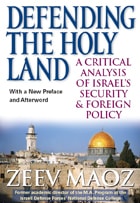
Defending the Holy Land
A Critical Analysis of Israel's Security and Foreign PolicyZeev Maoz
University of Michigan Press, 2008
Most of the wars in which Israel was involved, Maoz shows, were entirely avoidable, the result of deliberate Israeli aggression, flawed decision-making, and misguided conflict management strategies. None, with the possible exception of the 1948 War of Independence, were what Israelis call "wars of necessity." They were all wars of choice-or, worse, folly.
Demonstrating that Israel's national security policy rested on the shaky pairing of a trigger-happy approach to the use of force with a hesitant and reactive peace diplomacy, Defending the Holy Land recounts in minute-by-minute detail how the ascendancy of Israel's security establishment over its foreign policy apparatus led to unnecessary wars and missed opportunites for peace.
A scathing and brilliant revisionist history, Defending the Holy Land calls for sweeping reform of Israel's foreign policy and national security establishments. This book will fundamentally transform the way readers think about Israel's troubled history.
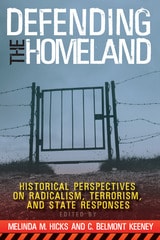
Defending the Homeland
Historical Perspectives on Radicalism, Terrorism, and State ResponsesMELINDA M. HICKS
West Virginia University Press, 2007
Terrorism and national security have been in the foreground of the nation’s political landscape since the uncertain times brought on by the attacks of September 11, 2001. This collection of scholarly essays provides a chance to learn from the past by offering an analytic—and sometimes provocative—look at the inseparability of security and history. This work is divided into separate elements depicting security on the national and international levels. "Part One–The US and National Security," focuses on topics such as “Rank-And-File Rednecks: Radicalism and Union Leadership in the West Virginia Mine Wars,” among others. "Part Two–International Terrorism," looks at violence overseas, such as “Beyond Victims and Perpetrators: Women Terrorists and Their Own Stories.”
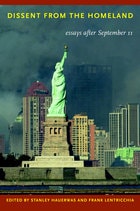
Dissent from the Homeland
Essays after September 11Stanley Hauerwas and Frank Lentricchia, eds.
Duke University Press, 2003
Whether illuminating the narratives that have been used to legitimate the war on terror, reflecting on the power of American consumer culture to transform the attack sites into patriotic tourist attractions, or insisting that to be a Christian is to be a pacifist, these essays refuse easy answers. They consider why the Middle East harbors a deep-seated hatred for the United States. They argue that the U.S. drive to win the cold war made the nation more like its enemies, leading the government to support ruthless anti-Communist tyrants such as Mobutu, Suharto, and Pinochet. They urge Americans away from the pitfall of national self-righteousness toward an active peaceableness—an alert, informed, practiced state of being—deeply contrary to both passivity and war. Above all, the essays assembled in Dissent from the Homeland are a powerful entreaty for thought, analysis, and understanding. Originally published as a special issue of the journal South Atlantic Quarterly, Dissent from the Homeland has been expanded to include new essays as well as a new introduction and postscript.
Contributors. Srinivas Aravamudan, Michael J. Baxter, Jean Baudrillard, Robert N. Bellah, Daniel Berrigan, Wendell Berry, Vincent J. Cornell, David James Duncan, Stanley Hauerwas, Fredric Jameson, Frank Lentricchia, Catherine Lutz, Jody McAuliffe, John Milbank, Peter Ochs, Donald E. Pease, Anne R. Slifkin, Rowan Williams, Susan Willis, Slavoj Zizek
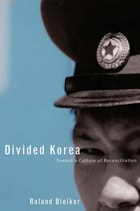
Divided Korea
Toward a Culture of ReconciliationRoland Bleiker
University of Minnesota Press, 2005
In 2002, North Korea precipitated a major international crisis when it revealed the existence of a secret nuclear weapons program and announced its withdrawal from the Nuclear Nonproliferation Treaty. Earlier in the year, George W. Bush had declared North Korea part of the “axis of evil,” and soon afterward his administration listed the country as a potential target of a preemptive nuclear strike. Pyongyang’s angry reaction ensured the complete deterioration of relations on the Korean peninsula, where only two years before the leaders of North and South Korea had come together in a historic summit meeting.
Few international conflicts are as volatile, protracted, or seemingly insoluble as the one in Korea, where mutual mistrust, hostile Cold War attitudes, and the possibility of a North Korean economic collapse threaten the security of the entire region. For Roland Bleiker, this persistently recurring pattern suggests profound structural problems within and between the two Koreas that have not been acknowledged until now. Expanding the discussion beyond geopolitics and ideology, Bleiker places peninsular tensions in the context of an ongoing struggle over competing forms of Korean identity. Divided Korea examines both domestic and international attitudes toward Korean identity, the legacy of war, and the possibilities for-and anxieties about-unification.
Divided Korea challenges the prevailing logic of confrontation and deterrence, embarking on a fundamental reassessment of both the roots of the conflict and the means to achieve a more stable political environment and, ultimately, peace. In order to realize a lasting solution, Bleiker concludes, the two Koreas and the international community must first show a willingness to accept difference and contemplate forgiveness as part of a broader reconciliation process.
Roland Bleiker is professor of international relations at the University of Queensland. From 1986 to 1988 he served as chief of office for the Swiss delegation to the Neutral Nations Supervisory Commission in Panmunjom.