Results by title
57 books match the query 'New Orleans' and 5 start with d
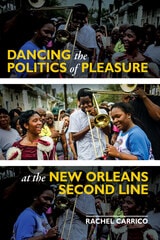
Dancing the Politics of Pleasure at the New Orleans Second Line
Rachel Carrico
University of Illinois Press, 2024
On many Sundays, Black New Orleanians dance through city streets in Second Lines. These processions invite would-be spectators to join in, grooving to an ambulatory brass band for several hours. Though an increasingly popular attraction for tourists, parading provides the second liners themselves with a potent public expression of Black resistance.
Rachel Carrico examines the parading bodies in motion as a form of negotiating and understanding power. Seeing pleasure as a bodily experience, Carrico reveals how second liners’ moves link joy and liberation, self and communal identities, play and dissent, and reclamations of place. As she shows, dancers’ choices allow them to access the pleasure of reclaiming self and city through motion and rhythm while expanding a sense of the possible in the present and for the future.
In-depth and empathetic, Dancing the Politics of Pleasure at the New Orleans Second Line blends analysis with a chorus of Black voices to reveal an indelible facet of Black culture in the Crescent City.
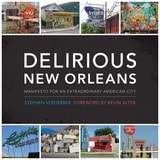
Delirious New Orleans
Manifesto for an Extraordinary American CityBy Stephen Verderber
University of Texas Press, 2008
Winner, Abbott Lowell Cummings Prize, Vernacular Architecture Forum, 2010
From iconic neighborhoods such as the French Quarter and the Garden District to more economically modest but no less culturally vibrant areas, architecture is a key element that makes New Orleans an extraordinary American city. Delirious New Orleans began as a documentary project to capture the idiosyncratic vernacular architecture and artifacts—vintage mom-and-pop businesses, roadside motels, live music clubs, neon signs, wall murals, fast-food joints, and so on—that helped give the city's various neighborhoods their unique character. But because so many of these places and artifacts were devastated by Hurricane Katrina, Delirious New Orleans has become both a historical record of what existed in the past and a blueprint for what must be rebuilt and restored to retain the city's unique multicultural landscape.
Stephen Verderber starts with the premise that New Orleans's often-overlooked neighborhoods imbue the city with deep authenticity as a place. He opens Delirious New Orleans with a photo-essay that vividly presents this vernacular architecture and its artifacts, both before Katrina and in its immediate aftermath. In the following sections of the book, which are also heavily illustrated, Verderber takes us on a tour of the city's commercial vernacular architecture, as well as the expressive folk architecture of its African American neighborhoods. He discusses how the built environment was profoundly shaped by New Orleans's history of race and class inequities and political maneuvering, along with its peculiar, below-sea-level geography. Verderber also considers the aftermath of Katrina and the armada of faceless FEMA trailers that have, at least temporarily and by default, transformed this urban landscape.
Desire and Disaster in New Orleans
Tourism, Race, and Historical MemoryLynnell L. Thomas
Duke University Press, 2014

Displaced
Life in the Katrina DiasporaEdited by Lynn Weber and Lori Peek
University of Texas Press, 2012
Hurricane Katrina forced the largest and most abrupt displacement in U.S. history. About 1.5 million people evacuated from the Gulf Coast preceding Katrina’s landfall. New Orleans, a city of 500,000, was nearly emptied of life after the hurricane and flooding. Katrina survivors eventually scattered across all fifty states, and tens of thousands still remain displaced. Some are desperate to return to the Gulf Coast but cannot find the means. Others have chosen to make their homes elsewhere. Still others found a way to return home but were unable to stay due to the limited availability of social services, educational opportunities, health care options, and affordable housing.
The contributors to Displaced have been following the lives of Katrina evacuees since 2005. In this illuminating book, they offer the first comprehensive analysis of the experiences of the displaced. Drawing on research in thirteen communities in seven states across the country, the contributors describe the struggles that evacuees have faced in securing life-sustaining resources and rebuilding their lives. They also recount the impact that the displaced have had on communities that initially welcomed them and then later experienced “Katrina fatigue” as the ongoing needs of evacuees strained local resources. Displaced reveals that Katrina took a particularly heavy toll on households headed by low-income African American women who lost the support provided by local networks of family and friends. It also shows the resilience and resourcefulness of Katrina evacuees who have built new networks and partnered with community organizations and religious institutions to create new lives in the diaspora.
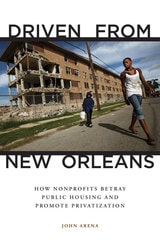
Driven from New Orleans
How Nonprofits Betray Public Housing and Promote PrivatizationJohn Arena
University of Minnesota Press, 2012
In the early 1980s the tenant leaders of the New Orleans St. Thomas public housing development and their activist allies were militant, uncompromising defenders of the city’s public housing communities. Yet ten years later these same leaders became actively involved in a planning effort to privatize and downsize their community—an effort that would drastically reduce the number of affordable apartments. What happened? John Arena—a longtime community and labor activist in New Orleans—explores this drastic change in Driven from New Orleans, exposing the social disaster visited on the city’s black urban poor long before the natural disaster of Katrina magnified their plight.
Arena argues that the key to understanding New Orleans’s public housing transformation from public to private is the co-optation of grassroots activists into a government and foundation-funded nonprofit complex. He shows how the nonprofit model created new political allegiances and financial benefits for activists, moving them into a strategy of insider negotiations that put the profit-making agenda of real estate interests above the material needs of black public housing residents. In their turn, white developers and the city’s black political elite embraced this newfound political “realism” because it legitimized the regressive policies of removing poor people and massively downsizing public housing, all in the guise of creating a new racially integrated, “mixed-income” community.
In tracing how this shift occurred, Driven from New Orleans reveals the true nature, and the true cost, of reforms promoted by an alliance of a neoliberal government, nonprofits, community activists, and powerful real estate interests.