Results by title
283 books match the query 'Phenomenology' and 8 start with d
Derrida and Differance
David Wood and Robert Bernasconi
Northwestern University Press, 1988
Destined for Liberty
The Human Person in the Philosophy of Karol Wojtyla/John Paul IIJaroslaw Kupczak, O.P.
Catholic University of America Press, 2000
Dialectic and Dialogue
Plato's Practice of Philosophical InquiryFrancisco J. Gonzalez
Northwestern University Press, 1998
Diminished Faculties
A Political Phenomenology of ImpairmentJonathan Sterne
Duke University Press, 2021
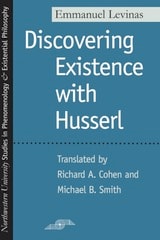
Discovering Existence with Husserl
Emmanuel Levinas
Northwestern University Press, 1997
In collecting almost all of Levinas's articles on Husserlian phenomenology, this volume gathers together a wealth of thoughtful exposition and interpretation by one of the most important European philosophers of the twentieth century. Levinas's thought is relevant to a broad variety of disciplines and concerns. This volume serves as a reliable introduction for the beginning student, as well as satisfying the expert's more demanding and critical desire for insight into the complexities of Levinas's thought.
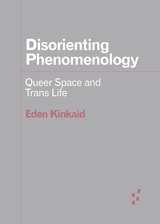
Disorienting Phenomenology
Queer Space and Trans LifeEden Kinkaid
University of Minnesota Press, 2026
Rethinking space from the ground up through trans theory, philosophy, and radical possibility
Disorienting Phenomenology takes as its point of departure the trans mundane: entering a public restroom, moving through airport security, navigating professional spaces. These ordinary yet unsettling encounters become portals into urgent philosophical questions about space, embodiment, perception, power, and violence. Attending closely to how trans people experience everyday life, Eden Kinkaid shows that space is never neutral. It is felt, negotiated, and contested at the level of the body, shaping one’s capacities, safety, and sense of self.
Weaving together philosophy, queer and trans studies, geography, and personal narrative, Kinkaid develops an intersectional theory of space grounded in lived experience. They bring the foundational spatial theories of Henri Lefebvre together with critical phenomenologies of gender, race, and disability to demonstrate how systems of oppression are built into the environments we inhabit, configuring movement and constraining possibility for minoritized people. Bold and interdisciplinary, Disorienting Phenomenology offers vital conceptual tools for understanding—and transforming—the worlds we move through each day.
Retail e-book files for this title are screen-reader friendly.
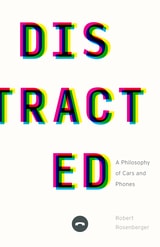
Distracted
A Philosophy of Cars and PhonesRobert Rosenberger
University of Minnesota Press, 2024
Applying insights from philosophy and cognitive science to address the urgent issue of smartphone-induced distracted driving
Although the dangers of texting while driving are widely known, many people resist the idea that phone usage will impair their driving. And connectivity features in new cars have only made using technology behind the wheel more tempting. What will it take to change people’s minds and behavior? Robert Rosenberger contends that a better understanding of why this combination of technologies is so dangerous could effectively adjust both habits and laws.
Rosenberger brings together ideas from philosophy and cognitive science to leverage a postphenomenological perspective that reveals how our smartphones make us such bad drivers. Reviewing decades of empirical studies in cognitive science, he shows that we have developed habits of perception regarding our compulsive technology use—habits that may wrest our attention away from the road.
Distracted develops innovative concepts for understanding technology-related habits and the ways that our relationships to our devices influence how we perceive the world. In turn, these ideas can help drivers be more cognizant of the effect that smartphone usage has on their perceptions, better inform efforts to enact stricter regulations, and help us all to be more reflective about the technologies that shape our lives.
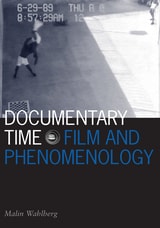
Documentary Time
Film and PhenomenologyMalin Wahlberg
University of Minnesota Press, 2008
Finding the theoretical space where cinema and philosophy meet, Malin Wahlberg’s sophisticated approach to the experience of documentary film aligns with attempts to reconsider the premises of existential phenomenology. The configuration of time is crucial in organizing the sensory affects of film in general but, as Wahlberg adroitly demonstrates, in nonfiction films the problem of managing time is writ large by the moving image’s interaction with social memory and historical figures.
Wahlberg discusses a thought-provoking corpus of classical and recent experiments in film and video (including Andy Warhol’s films) in which creative approaches to the time of the image and the potential archive memory of filmic representation illuminates meanings of temporality and time experience. She also offers a methodological account of film and brings Deleuze and Ricoeur into dialogue with Bazin and Mitry on the subject of cinema and phenomenology.
Drawing attention to the cultural significance of the images’ imprint as a trace of the past, Documentary Time brings to bear phenomenological inquiry on nonfiction film while at the same time reconsidering the existential dimensions of time that have always puzzled humans.
Malin Wahlberg is a research fellow in cinema studies at Stockholm University.