Results by title
56 books match the query 'Philadelphia (Pa.)' and 2 start with d
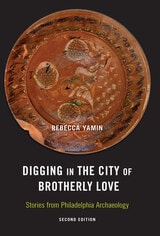
Digging in the City of Brotherly Love
Stories from Philadelphia ArchaeologyYamin, Rebecca
Temple University Press, 2023
Historic Philadelphia has long yielded archaeological treasures from its past. Excavations required by the National Historic Preservation Act have recovered pottery shards, pots, plates, coins, bones, and other artifacts relating to early life in the city. This updated edition of Digging in the City of Brotherly Love continues to use archaeology to learn about and understand people from the past.
Rebecca Yamin adds three new chapters that showcase several major discoveries from recent finds including unmarked early eighteenth-century burial grounds, one of which associated with the first African Methodist Episcopal (AME) Church, in the oldest part of the city; a nineteenth-century working-class neighborhood built along the path of what is now Route I-95 and was once home to Native American life; and the remains of two taverns found on the site of the current Museum of the American Revolution.
Yamin describes the research and state-of-the-art techniques used to study these exciting discoveries. In chronicling the value of looking into a city’s past, Digging in the City of Brotherly Love brings to life the people who lived in the early city and the people in the present who study them.
[more]
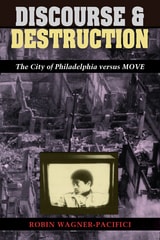
Discourse and Destruction
The City of Philadelphia versus MOVERobin Wagner-Pacifici
University of Chicago Press, 1993
In the early 1980s the radical group MOVE settled into a rowhouse in a predominantly African-American neighborhood of west Philadelphia, beginning years of confrontations with neighbors and police over its anti-establishment ways and militant stance against all social and political institutions. On May 13, 1985, following a period of increased MOVE activity and threats by neighbors to take matters into their own hands, the city moved from bureaucratic involvement to violent intervention. Police bullhorned arrest warrants, hosed down the rowhouse, sprayed tear gas through its walls, and dropped explosives from a helicopter. By the end of the day, eleven MOVE members were dead, an entire block of the neighborhood was destroyed, and Mayor Wilson Goode was calling for an investigation.
How did this struggle between the city and MOVE go from memos and meetings to tear gas and bombs? And how does the mandate to defend public order become a destructive force? Sifting through the hearings that followed the deadly encounter, Robin Wagner-Pacifici reconstructs the conflict between MOVE and the city of Philadelphia. Against this richly nuanced account, in which the participants—from the mayor and the police officers to members of MOVE and their neighbors—offer opposing versions of their aims, assumptions, and strategies, Wagner-Pacifici develops a compelling analysis of the relation between definition and action, between language and violence.
Was MOVE simply a radical, black separatist group with an alternative way of life? Or was it a terrorist cult that held a neighborhood and politicians hostage to its offensive language and bizarre behavior? Wagner-Pacifici shows how competing definitions of MOVE led to different strategies for managing the conflict. In light of the shockingly similar, and even more deadly, 1993 Branch Davidian disaster in Waco, Texas, such an analysis becomes imperative. Indeed, for those who hope to understand—and, finally, to forestall—the moment when language and violence are inexorably drawn together, this book demands attention.
[more]