Results by title
130 books match the query 'Philosophers' and 4 start with d
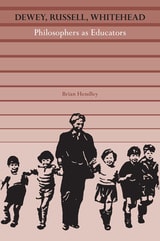
Dewey, Russell, Whitehead
Philosophers as EducatorsBrian Patrick Hendley
Southern Illinois University Press, 1986
In Philosophers as Educators Brian Patrick Hendley argues that philosophers of education should reject their preoccupation with defining terms and analyzing concepts and embrace the philosophical task of constructing general theories of education. Hendley discusses in detail the educational philosophies of John Dewey, Bertrand Russell, and Alfred North Whitehead. He sees in these men excellent role models that contemporary philosophers might well follow. Hendley believes that, like these mentors, philosophers should take a more active, practical role in education. Dewey and Russell ran their own schools, and Whitehead served as a university administrator and as a member of many committees created to study education.
Diary of a Philosophy Student
Volume 1, 1926-27Simone de Beauvoir; Translation by Barbara Klaw; Edited by Barbara Klaw, Sylvie Le Bon de Beauvoir, and Margaret Simons, with the assistance of Marybeth Timmerman
University of Illinois Press, 2021
Presented for the first time in translation, this fully annotated first volume of the Diary includes essays from Barbara Klaw and Margaret A. Simons that address its philosophical, historical, and literary significance. It remains an invaluable resource for tracing the development of Beauvoir’s independent thinking and her influence on philosophy, feminism, and the world.
Diary of a Philosophy Student
Volume 2, 1928-29Simone de Beauvoir; Translation by Barbara Klaw; Edited by Barbara Klaw, Sylvie Le Bon de Beauvoir, Margaret A. Simons, and Marybeth Timmermann
University of Illinois Press, 2021
Presented for the first time in translation, this fully annotated first volume of the Diary includes essays from Barbara Klaw and Margaret A. Simons that address its philosophical, historical, and literary significance. It remains an invaluable resource for tracing the development of Beauvoir’s independent thinking and her influence on philosophy, feminism, and the world.
Diary of a Philosophy Student
Volume 3, 1926-30Simone de Beauvoir. Translation by Barbara Klaw. Edited by Barbara Klaw, Sylvie Le Bon de Beauvoir, and Margaret A. Simons with Marybeth Timmermann. Foreword by Sylvie Le Bon de Beauvoir
University of Illinois Press, 2024
In addition, the editors include a wealth of important supplementary material. Barbara Klaw provides a detailed consideration of the Diary’s role in the development of Beauvoir’s writing style by exploring her use of metanarrative and other literary techniques, part of a process of literary creation that saw Beauvoir use the notebooks to cultivate her talent. Margaret A. Simons’s essay places the assault by Sartre within an appraisal of Beauvoir’s complicated legacy for #MeToo while suggesting readers engage with the diary through the lens of trauma.