Results by title
597 books match the query 'Psychological aspects' and 27 start with d

Dancing Desires
Choreographing Sexualities On And Off The StageJane C. Desmond
University of Wisconsin Press, 2001
What happens to the writing of dance history when issues of sexuality and sexual identity are made central? What happens to queer theory, and to other theoretical constructs of gender and sexuality, when a dancing body takes center stage? Dancing Desires asks these questions, exploring the relationship between dancing bodies and sexual identity on the concert stage, in nightclubs, in film, in the courts, and on the streets. From Nijinsky’s balletic prowess to Charlie Chaplin's lightfooted "Little Tramp," from lesbian go-go dancers to the swans of Swan Lake, from the postmodern works of Bill T. Jones to the dangers of same-sex social dancing at Disneyland and the ecstatic Mardi Gras dance parties of Sydney, Australia, this book tracks the intersections of dance and human sexuality in the twentieth century as the definition of each has shifted and expanded.
The contributors come from a number of fields (literature, history, theater, dance, film studies, legal studies, critical race studies) and employ methodologies ranging from textual analysis and film theory to ethnography. By embracing dance, and bodily movement more generally, as a crucial focus for investigation, together they initiate a new agenda for tracking the historical kinesthetics of sexuality.
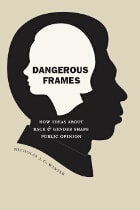
Dangerous Frames
How Ideas about Race and Gender Shape Public OpinionNicholas J. G. Winter
University of Chicago Press, 2008

Dark Continents
Psychoanalysis and ColonialismRanjana Khanna
Duke University Press, 2003
bringing psychoanalysis, colonialism, and women together can become the starting point of a postcolonial feminist theory. Psychoanalysis brings to light, Khanna argues, how nation-statehood for the former colonies of Europe institutes the violence of European imperialist history. Far from rejecting psychoanalysis, Dark Continents reveals its importance as a reading practice that makes visible the psychical strife of colonial and
postcolonial modernity. Assessing the merits of various models of nationalism, psychoanalysis, and colonialism, it refashions colonial melancholy as a transnational feminist ethics.
Khanna traces the colonial backgrounds of psychoanalysis from its beginnings in the late nineteenth century up to the present. Illuminating Freud’s debt to the languages of archaeology and anthropology throughout his career, Khanna describes how Freud altered his theories of the ego as his own political status shifted from Habsburg loyalist to Nazi victim. Dark Continents explores how psychoanalytic theory was taken up in Europe and its colonies in the period of decolonization following World War II, focusing on its use by a range of writers including Jean-Paul Sartre, Simone de Beauvoir, Octave Mannoni, Aimé and Suzanne Césaire, René Ménil, Frantz Fanon, Albert Memmi, Wulf Sachs, and Ellen Hellman. Given the multiple gendered and colonial contexts of many of these writings, Khanna argues for the necessity of a postcolonial, feminist critique of
decolonization and postcoloniality.

Dark Lens
Imaging Germany, 1945Françoise Meltzer
University of Chicago Press, 2019
The ruins of war have long held the power to stupefy and appall. Can such ruins ever be persuasively depicted and comprehended? Can images of ruins force us to identify with the suffering of the enemy and raise uncomfortable questions about forgiveness and revenge?
Françoise Meltzer explores these questions in Dark Lens, which uses the images of war ruins in Nazi Germany to investigate problems of aestheticization and the representation of catastrophe. Through texts that give accounts of bombed-out towns in Germany in the last years of the war, painters’ attempts to depict the destruction, and her own mother’s photographs taken in 1945, Meltzer asks if any medium offers a direct experience of war ruins for the viewer. Refreshingly accessible and deeply personal, Dark Lens is a compelling look at the role images play in constructing memory.

Dead Subjects
Toward a Politics of Loss in Latino StudiesAntonio Viego
Duke University Press, 2007
Viego argues that the repeated themes of wholeness, completeness, and transparency with respect to ethnic and racialized subjectivity are fundamentally problematic as these themes ultimately lend themselves to the project of managing and controlling ethnic and racialized subjects by positing them as fully knowable, calculable sums: as dead subjects. He asserts that the refusal of critical race and ethnic studies scholars to read ethnic and racialized subjects in a Lacanian framework—as divided subjects, split in language—contributes to a racist discourse. Focusing on theoretical, historical, and literary work in Latino studies, he mines the implicit connection between Latino studies’ theory of the “border subject” and Lacan’s theory of the “barred subject” in language to argue that Latino studies is poised to craft a critical multiculturalist, anti-racist Lacanian account of subjectivity while adding historical texture and specificity to Lacanian theory.

Deaf Adolescents
Inner Lives and Lifeworld DevelopmentMartha Sheridan
Gallaudet University Press, 2008
In her landmark book Inner Lives of Deaf Children: Interviews and Analysis, Martha A. Sheridan explored the lifeworlds — the individual and collective elements and realities that are present within the participants’ existential experiences, their relationships, and their truths — of seven deaf and hard of hearing children between the ages of seven and ten. What she discovered were deaf children with strengths, positive experiences, and positive relationships. Sheridan’s new book Deaf Adolescents: Inner Lives and Lifeworld Development returns to these seven individuals, now between the ages of 13 and 17, to see how their lives have progressed since their first interviews.
Establishing an identity is said to be a primary and necessary task of adolescence. Deaf Adolescents reveals how these young adults all have begun to deal with tasks and situations that lead them to rely more on themselves and others outside of their families. Many of them talk about the athletic challenges that they face, and how their success depends upon their own efforts. They also think about the future while biding their time, taking “a break” from the furious growth that they are experiencing and also enjoying time spent with other deaf friends.
In this volume, Sheridan examines the similarities and differences that these deaf young adults reveal in their views at two developmental points in their lives. Her renewed study has advanced the quest to determine what pathways and spaces can foster productive, healthy, satisfying, actualized deaf lives.
Deaf Epistemologies
Multiple Perspectives on the Acquisition of KnowledgePeter V. Paul
Gallaudet University Press, 2012
Epistemology is the study of how “knowledge” is formed. Standard epistemology isolates the “known” from the “knowers,” thereby defining “knowledge” as objectively constant. Multiple epistemologies suggest that individuals learn in different ways shaped by life factors such as education, family, ethnicity, history, and regional beliefs. In this groundbreaking volume, editors Peter V. Paul and Donald F. Moores call on ten other noted scholars and researchers to join them in examining the many ways that deaf people see and acquire deaf knowledge.
This collection considers three major groups of deaf knowledge perspectives: sociological and anthropological, historical/psychological and literary, and educational and philosophical. The first explores the adoption of a naturalized, critical epistemological stance in evaluating research; the epistemology of a positive deaf identity; how personal epistemologies can help form deaf education policies; and valuing deaf indigenous knowledge in research. The next part considers dueling epistemologies in educating deaf learners; reforms in deaf education; the role of deaf children of hearing parents in creating Deaf epistemologies; and the benefit of reading literature with deaf characters for all students. The final part explores the application of the Qualitative-Similarity Hypothesis to deaf students’ acquisition of knowledge; a metaparadigm for literacy instruction in bilingual-bicultural education; collaborative knowledge-building to access academia; and examination of the benefits and disadvantages of being deaf.

Deaf Identities in the Making
Local Lives, Transnational ConnectionsJan-Kåre Breivik
Gallaudet University Press, 2005
The ten stories in Deaf Identities in the Making reveal deaf people who would like a stronger link to the Deaf world. Each story sheds different light on the overriding, empowering master narrative that has become an integral feature of the deaf community. Like success stories from other minorities, the Deaf life story reinforces the collective empowerment process in a Deaf social milieu. Because of these revelations, Breivik’s findings easily reverberate globally in conjunction to the striking similarities of deaf lives around the world, particularly those connected with the experiences of being translocal signers who have struggled for identity in an overwhelmingly hearing context.
Deaf People Around the World
Educational and Social PerspectivesDonald F. Moores
Gallaudet University Press, 2009
In Deaf People Around the World: Educational and Social Perspectives, the leading researchers in 30 nations describe the shared developmental, social, and educational issues facing deaf people filtered through the prism of unique national, regional, ethnic, and racial realities. Editors Donald F. Moores and Margery S. Miller have organized this remarkable collection in five major sections: Asia/Pacific, the Middle East and Africa, Europe, North and South America, and International Developments, which includes the International Committee on Sports for the Deaf and the World Federation of the Deaf.
More than 50 internationally recognized scholars provide a historical view of the education and treatment of deaf people in their respective countries. They examine a wide range of issues, including current academic placement; communication modes used in schools; the recognition of sign languages; the curricula of the deaf schools versus that of regular schools; for secondary and postsecondary opportunities; the status of deaf adults; deaf teachers; special laws if any; the preparation of teachers, psychologists, therapists, and other special personnel who work with deaf clients; and current trends and developments in their countries.
Deaf People Around the World reveals that deaf people generally have gained a sense of confidence, empowerment, and global awareness of their shared experience. Many have seen significant improvement in their lives from greater educational and professional opportunities. Finally, more deaf leaders argue that the pathological model of deafness must be abandoned to continue this marked progress for deaf people around the world.

Deep Travel
In Thoreau's Wake on the Concord and MerrimackDavid K. Leff
University of Iowa Press, 2009
How we see depends on where we are in our lives and with whom we travel. Leff chose his companions wisely. In consecutive journeys his neighbor and friend Alan, a veteran city planner; his son Josh, an energetic eleven-year-old; and his sweetheart Pamela, a compassionate professional caregiver, added their perspectives to Leff’s own experiences as a government official in natural resources policy. Not so much sight seeing as sight seeking, together they explored a geography of the imagination as well as the rich natural and human histories of the rivers and their communities.
The heightened awareness of deep travel demands that we immerse ourselves fully in places and realize that they exist in time as well as space. Its mindfulness enriches the experience and makes the voyager worthy of the journey. Leff’s intriguing, contemplative deep travel along these historic rivers presents a methodology for exploration that will enrich any trip.
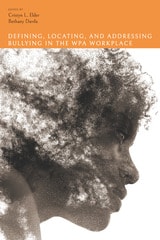
Defining, Locating, and Addressing Bullying in the WPA Workplace
Cristyn L. Elder
Utah State University Press, 2018
Contributors of varying status in different types of programs across many kinds of institutions describe various forms of bullying, including microaggressions, incivility, mobbing, and emotional abuse. They define bullying as institutional racism, “academic systemic incivility,” a crisis of insularity, and faculty fundamentalism. They locate bullying in institutional contexts, including research institutions, small liberal arts colleges, community colleges, and writing programs and writing centers. These locations are used as points of departure to further theorize bullying and to provide clear advice about agentive responses.
A culture of silence discourages discussions of this behavior, making it difficult to address abuse. This silence also normalizes patterns and cultivates the perception that bullying arises naturally. Defining, Locating, and Addressing Bullying in the WPA Workplace helps the field to name these patterns of behaviors as bullying and resist ideologies of normalcy, encouraging and empowering readers to take an active role in defining, locating, and addressing bullying in their own workplaces.
Contributors: Sarah Allen, Andrea Dardello, Harry Denny, Dawn Fels, Bre Garrett, W. Gary Griswold, Amy C. Heckathorn, Aurora Matzke, Staci Perryman-Clark, Sherry Rankins-Robertson, Erec Smith
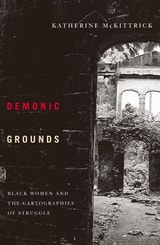
Demonic Grounds
Black Women And The Cartographies Of StruggleKatherine McKittrick
University of Minnesota Press, 2006
Demonic Grounds moves between past and present, archives and fiction, theory and everyday, to focus on places negotiated by black women during and after the transatlantic slave trade. Specifically, the author addresses the geographic implications of slave auction blocks, Harriet Jacobs’s attic, black Canada and New France, as well as the conceptual spaces of feminism and Sylvia Wynter’s philosophies.
Central to McKittrick’s argument are the ways in which black women are not passive recipients of their surroundings and how a sense of place relates to the struggle against domination. Ultimately, McKittrick argues, these complex black geographies are alterable and may provide the opportunity for social and cultural change.
Katherine McKittrick is assistant professor of women’s studies at Queen’s University.

Depression
A Public FeelingAnn Cvetkovich
Duke University Press, 2012
Cvetkovich draws on an unusual archive, including accounts of early Christian acedia and spiritual despair, texts connecting the histories of slavery and colonialism with their violent present-day legacies, and utopian spaces created from lesbian feminist practices of crafting. She herself seeks to craft a queer cultural analysis that accounts for depression as a historical category, a felt experience, and a point of entry into discussions about theory, contemporary culture, and everyday life. Depression: A Public Feeling suggests that utopian visions can reside in daily habits and practices, such as writing and yoga, and it highlights the centrality of somatic and felt experience to political activism and social transformation.
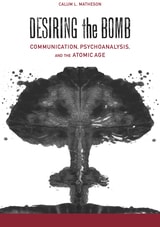
Desiring the Bomb
Communication, Psychoanalysis, and the Atomic AgeCalum L. Matheson
University of Alabama Press, 2019
Every culture throughout history has obsessed over various “end of the world” scenarios. The dawn of the Atomic Age marked a new twist in this tale. For the first time, our species became aware of its capacity to deliberately destroy itself. Since that time the Bomb has served as an organizing metaphor, a symbol of human annihilation, a stand-in for the unspeakable void of extinction, and a discursive construct that challenges the limits of communication itself. The parallel fascination with and abhorrence of nuclear weapons has metastasized into a host of other end-of-the-world scenarios, from global pandemics and climate change to zombie uprisings and asteroid collisions.
Desiring the Bomb: Communication, Psychoanalysis, and the Atomic Age explores these world-ending fantasies through the lens of psychoanalysis to reveal their implications for both contemporary apocalyptic culture and the operations of language itself. What accounts for the enduring power of the Bomb as a symbol? What does the prospect of annihilation suggest about language and its limits? Thoroughly researched and accessibly written, this study expands on the theories of Kenneth Burke, Jacques Lacan, Sigmund Freud, and many others from a variety of disciplines to arrive at some answers to these questions.
Calum L. Matheson undertakes a series of case studies—including the Trinity test site, nuclear war games, urban shelter schemes, and contemporary survivalism—and argues that contending with the anxieties (individual, social, cultural, and political) born of the Atomic Age depends on rhetorical conceptions of the “real,” an order of experience that cannot be easily negotiated in language. Using aspects of media studies, rhetorical theory, and psychoanalysis, the author deftly engages the topics of Atomic Age survival, extinction, religion, and fantasy, along with their enduring cultural legacies, to develop an account of the Bomb as a signifier and to explore why some Americans have become fascinated with fantasies of nuclear warfare and narratives of postapocalyptic rebirth.
Developing Educators for The Digital Age
A Framework for Capturing Knowledge in ActionPaul Breen
University of Westminster Press, 2018
Evaluating skills and knowledge capture lies at the cutting edge of contemporary higher education where there is a drive towards increasing evaluation of classroom performance and use of digital technologies in pedagogy. Developing Educators for the Digital Age is a book that provides a narrative account of teacher development geared towards the further usage of technologies (including iPads, MOOCs and whiteboards) in the classroom presented via the histories and observation of a diverse group of teachers engaged in the multiple dimensions of their profession.
Drawing on the insights of a variety of educational theories and approaches (including TPACK) it presents a practical framework for capturing knowledge in action of these English language teachers – in their own voices – indicating how such methods, processes and experiences shed light more widely on related contexts within HE and may be transferable to other situations.
This book will be of interest to the growing body of scholars interested in TPACK theory, or communities of practice theory and more widely anyone concerned with how new pedagogical skills and knowledge with technology may be incorporated in better practice and concrete instances of teaching.

Diary of Our Fatal Illness
Charles Bardes
University of Chicago Press, 2017

Diary of a Detour
Lesley Stern
Duke University Press, 2020
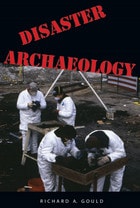
Disaster Archaeology
Richard A Gould
University of Utah Press, 2007
This methodology involves a humanitarian element that often motivates archaeologists to perform this emotionally difficult work, and it requires a commitment to scientifically controlled field recovery and documentation of human remains, personal effects, and other physical evidence. First-hand experiences are described from the World Trade Center, 'The Station' nightclub fire in Rhode Island, and from Hurricane Katrina.
Disaster archaeology involves the meticulous, empirical use of archaeological science as well as emotional sensitivity toward victims and victims’ family and friends. By combining standards of forensic science with state-of-the-art field techniques, archaeologists can decisively affect the outcome of post-disaster investigations and recoveries.
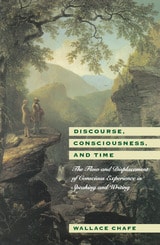
Discourse, Consciousness, and Time
The Flow and Displacement of Conscious Experience in Speaking and WritingWallace Chafe
University of Chicago Press, 1994
Chafe draws on several decades of research to demonstrate that understanding the nature of consciousness is essential to understanding many linguistic phenomena, such as pronouns, tense, clause structure, and intonation, as well as stylistic usages, such as the historical present and the free indirect style. While the book focuses on English, there are also discussions of the North American Indian language Seneca and the music of Mozart and of the Seneca people.
This work offers a comprehensive picture of the dynamic natures of language and consciousness that will interest linguists, psychologists, literary scholars, computer scientists, anthropologists, and philosophers.

Disorder in the Court
Morality, Myth, and the Insanity DefenseAndrea L. Alden
University of Alabama Press, 2018
The first book-length rhetorical history and analysis of the legal and moral questions behind the insanity defense.
The insanity defense is considered one of the most controversial, most misunderstood, and least straightforward subjects in the American legal system. Disorder in the Court: Morality, Myth, and the Insanity Defense traces the US legal standards for the insanity defense as they have evolved from 1843, when they were first codified in England, to 1984, when the US government attempted to revise them through the Insanity Defense Reform Act. Throughout this period “insanity” existed primarily as a legal term rather than a medical one; yet the testimony of psychiatric experts is required in cases in which an insanity defense is raised.
The adjudication of such cases by courtroom practice is caught between two different but overlapping discourses, the legal and the medical, both of which have historically sought to assert and maintain firm disciplinary boundaries. Both expert and lay audiences have struggled to understand and apply commonplace definitions of sanity, and the portrayal of the insanity defense in popular culture has only served to further frustrate such understandings.
Andrea L. Alden argues that the problems with understanding the insanity defense are, at their foundation, rhetorical. The legal concept of what constitutes insanity and, therefore, an abdication of responsibility for one’s actions does not map neatly onto the mental health professions’ understandings of mental illness and how that affects an individual’s ability to understand or control his or her actions. Additionally, there are multiple layers of persuasion involved in any effort to convince a judge, jury—or a public, for that matter—that a defendant is or is not responsible for his or her actions at a particular moment in time.
Alden examines landmark court cases such as the trial of Daniel McNaughtan, Durham v. United States, and the trial of John Hinckley Jr. that signal the major shifts in the legal definitions of the insanity defense. Combining archival, textual, and rhetorical analysis, Alden offers a close reading of texts including trial transcripts, appellate court opinions, and relevant medical literature from the time period. She contextualizes these analyses through popular texts—for example, newspaper articles and editorials—showing that while all societies have maintained some version of mental illness as a mitigating factor in their penal systems, the insanity defense has always been fraught with controversy.

Distracted
A Philosophy of Cars and PhonesRobert Rosenberger
University of Minnesota Press, 2024
Applying insights from philosophy and cognitive science to address the urgent issue of smartphone-induced distracted driving
Although the dangers of texting while driving are widely known, many people resist the idea that phone usage will impair their driving. And connectivity features in new cars have only made using technology behind the wheel more tempting. What will it take to change people’s minds and behavior? Robert Rosenberger contends that a better understanding of why this combination of technologies is so dangerous could effectively adjust both habits and laws.
Rosenberger brings together ideas from philosophy and cognitive science to leverage a postphenomenological perspective that reveals how our smartphones make us such bad drivers. Reviewing decades of empirical studies in cognitive science, he shows that we have developed habits of perception regarding our compulsive technology use—habits that may wrest our attention away from the road.
Distracted develops innovative concepts for understanding technology-related habits and the ways that our relationships to our devices influence how we perceive the world. In turn, these ideas can help drivers be more cognizant of the effect that smartphone usage has on their perceptions, better inform efforts to enact stricter regulations, and help us all to be more reflective about the technologies that shape our lives.
Divided Bodies
Lyme Disease, Contested Illness, and Evidence-Based MedicineAbigail A. Dumes
Duke University Press, 2020

Don't Look, Don't Touch, Don't Eat
The Science Behind RevulsionValerie Curtis
University of Chicago Press, 2013

Dramatizing Dementia
Madness In The Plays Of Tennessee WilliamsJacqueline O'Connor
University of Wisconsin Press, 1997

Dreaming in Dark Times
Six Exercises in Political ThoughtSharon Sliwinski
University of Minnesota Press, 2017
What do dreams manage to say—or indeed, show—about human experience that is not legible otherwise? Can the disclosure of our dream-life be understood as a form of political avowal? To what does a dream attest? And to whom?
Blending psychoanalytic theory with the work of such political thinkers as Hannah Arendt and Michel Foucault, Sharon Sliwinski explores how the disclosure of dream-life represents a special kind of communicative gesture—a form of unconscious thinking that can serve as a potent brand of political intervention and a means for resisting sovereign power. Each chapter centers on a specific dream plucked from the historical record, slowly unwinding the significance of this extraordinary disclosure. From Wilfred Owen and Lee Miller to Frantz Fanon and Nelson Mandela, Sliwinski shows how each of these figures grappled with dream-life as a means to conjure up the courage to speak about dark times. Here dreaming is defined as an integral political exercise—a vehicle for otherwise unthinkable thoughts and a wellspring for the freedom of expression.
Dreaming in Dark Times defends the idea that dream-life matters—that attending to this thought-landscape is vital to the life of the individual but also vital to our shared social and political worlds.
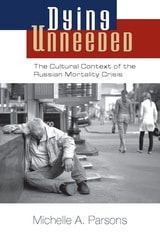
Dying Unneeded
The Cultural Context of the Russian Mortality CrisisMichelle A. Parsons
Vanderbilt University Press, 2014
Middle-aged Muscovites talk about being unneeded (ne nuzhny), or having little to give others. Considering this concept of "being unneeded" reveals how political economic transformation undermined the logic of social relations whereby individuals used their position within the Soviet state to give things to other people. Being unneeded is also gendered--while women are still needed by their families, men are often unneeded by state or family. Western literature on the mortality crisis focuses on a lack of social capital, often assuming that what individuals receive is most important, but being needed is more about what individuals give. Social connections--and their influence on health--are culturally specific.
In Soviet times, needed people helped friends and acquaintances push against the limits of the state, crafting a sense of space and freedom. When the state collapsed, this sense of bounded freedom was compromised, and another freedom became deadly.
This book is a recipient of the annual Norman L. and Roselea J. Goldberg Prize for the best project in the area of medicine.

Dying in Character
Memoirs on the End of LifeJeffrey Berman
University of Massachusetts Press, 2012
Examining the works cited above, as well as memoirs by Mitch Albom, Roland Barthes, Jean-Dominique Bauby, Art Buchwald, Randy Pausch, David Rieff, Philip Roth, and Morrie Schwartz, Jeffrey Berman's analysis of this growing genre yields some surprising insights. While the authors have much to say about the loneliness and pain of dying, many also convey joy, fulfillment, and gratitude. Harold Brodkey is willing to die as long as his writings survive. Art Buchwald and Randy Pausch both use the word fun to describe their dying experiences. Dying was not fun for Morrie Schwartz and Tony Judt, but they reveal courage, satisfaction, and fearlessness during the final stage of their lives, when they are nearly paralyzed by their illnesses.
It is hard to imagine that these writers could feel so upbeat in their situations, but their memoirs are authentically affirmative. They see death coming, yet they remain stalwart and focused on their writing. Berman concludes that the contemporary end-of-life memoir can thus be understood as a new form of death ritual, "a secular example of the long tradition of ars moriendi, the art of dying."