54 books match the query 'Reader' and 2 start with d
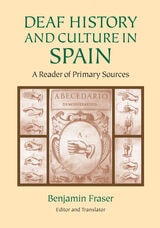
cover of Deaf History and Culture in Spain: A Reader of Primary Documents

Deaf History and Culture in Spain

A Reader of Primary Documents

Benjamin Fraser

Gallaudet University Press, 2009

In this landmark reader, Benjamin Fraser offers in five parts 44 Spanish documents dating from 1417 to the present, translated for the first time to trace the turbulent history of Deaf culture in Spain. Part I: The Birth of Oralism and Deafness as Metaphor illustrates the predominant impression of deafness as isolation, exemplified by Teresa de Cartagena writings in 1455-60 about deafness as an island. Part II: The Return to Deaf Education highlights writers who wished to restore “the Spanish ‘Art’” of educating deaf students. Lorenzo Hervás y Panduro wrote The Spanish School of Deafmutes, or Method of Teaching Them to Write and Speak the Spanish Language in 1795. Yet, Madrid’s Royal School for Deaf-Mutes, which opened in 1805, taught deaf students using methodical signs adopted from France’s Abbé de l’Epée.

Readings in Part III :The Contemporary Deaf Experience reveal considerations from the 1970s to the ‘90s of Deaf culture and linguistics similar to those in the United States, typified by the works of Inés Polo and Félix-Jesús Pinedo Peydró. The fourth part, The Recognition of Deaf Language and Culture, marks the expansion of academic research in Spain. María Angeles Rodríguez González spearheaded Spanish Sign Language (LSE) linguistics in 1992 with her publication Sign Language. The final part, A Selection of Deaf Poetry, concludes these documents with verse  in Spanish spoken dialects rather than LSE, indicating that the evolution of the Deaf experience in Spain continues on its own path today.
[more]
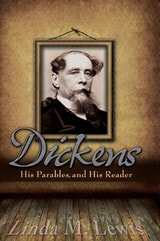
cover of Dickens, His Parables, and His Reader

Dickens, His Parables, and His Reader

Linda M. Lewis

University of Missouri Press, 2011

 
Charles Dickens once commented that in each of his Christmas stories there is “an express text preached on . . . always taken from the lips of Christ.” This preaching, Linda M. Lewis contends, does not end with his Christmas stories but extends throughout the body of his work. In Dickens, His Parables, and His Reader, Lewis examines parable and allegory in nine of Dickens’s novels as an entry into understanding the complexities of the relationship between Dickens and his reader.
Through the combination of rhetorical analysis of religious allegory and cohesive study of various New Testament parables upon which Dickens based the themes of his novels, Lewis provides new interpretations of the allegory in his novels while illuminating Dickens’s religious beliefs. Specifically, she alleges that Dickens saw himself as valued friend and moral teacher to lead his “dear reader” to religious truth.
Dickens’s personal gospel was that behavior is far more important than strict allegiance to any set of beliefs, and it is upon this foundation that we see allegory activated in Dickens’s characters. Oliver Twist and The Old Curiosity Shop exemplify the Victorian “cult of childhood” and blend two allegorical texts: Jesus’s Good Samaritan parable and John Bunyan’s ThePilgrim’s Progress. In Dombey and Son,Dickens chooses Jesus’s parable of the Wise and Foolish Builders. In the autobiographical David Copperfield, Dickens engages his reader through an Old Testament myth and a New Testament parable: the expulsion from Eden and the Prodigal Son, respectively.
Led by his belief in and desire to preach his social gospel and broad church Christianity, Dickens had no hesitation in manipulating biblical stories and sermons to suit his purposes. Bleak House is Dickens’s apocalyptic parable about the Day of Judgment, while Little Dorrit   echoes the line “Forgive us our debts as we forgive our debtors” from the Lord’s Prayer, illustrating through his characters that only through grace can all debt be erased. The allegory of the martyred savior is considered in Hard Times and A Tale of Two Cities. Dickens’s final completed novel, Our Mutual Friend, blends the parable of the Good and Faithful Servant with several versions of the Heir Claimant parable.
While some recent scholarship debunks the sincerity of Dickens’s religious belief, Lewis clearly demonstrates that Dickens’s novels challenge the reader to investigate and develop an understanding of New Testament doctrine. Dickens saw his relationship with his reader as a crucial part of his storytelling, and through his use and manipulation of allegory and parables, he hoped to influence the faith and morality of that reader.
[more]