Results by title
95 books match the query 'Rivers' and 4 start with d
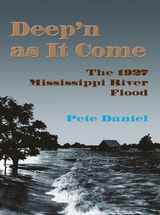
Deep'n as It Come
The 1927 Mississippi River FloodPete Daniel
University of Arkansas Press, 1998
In the spring and summer of 1927, the Mississippi River and its tributaries flooded from Cairo, Illinois to New Orleans, Louisiana, and the Gulf of Mexico, tearing through seven states, sometimes spreading out to nearly one hundred miles across. Pete Daniel’s Deep’n as It Come, available again in a new format, chronicles the worst flood in the history of the South and re-creates, with extraordinary immediacy, the Mississippi River’s devastating assault on property and lives.
Daniel weaves his narrative with newspaper and firsthand accounts, interviews and survivors, official reports, and over 140 contemporary photographs. The story of the common refugee who suffered most of the effects of the flood emerges alongside the details of the massive rescue and relief operation—one of the largest ever mounted in the United States. The title, Deep’n as It Come, is a phrase from Cora Lee Campbell’s early description of he approaching water, which, Daniel writes, “moved at a pace of some fourteen miles per day,” and in its movement and sound, “had the eeriness of a full eclipse of t he sun, unsettling, chilling.”
“The contradictions of sorrow and humor. . . death and salvation, despair and hope, calm and panic—all reveal the human dimension” in this compassionate and unforgettable portrait of common people confronting a great natural disaster.
[more]
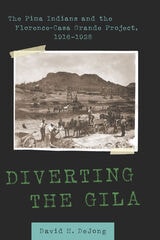
Diverting the Gila
The Pima Indians and the Florence-Casa Grande Project, 1916–1928David H. DeJong
University of Arizona Press, 2021
In the late nineteenth and early twentieth centuries, Americans assumed the land and water resources of the West were endless. Water was as vital to newcomers to Arizona’s Florence and Casa Grande valleys as it had always been to the Pima Indians, who had been successfully growing crops along the Gila River for generations when the white settlers moved in.
Diverting the Gila explores the complex web of tension, distrust, and political maneuvering to divide and divert the scarce waters of the Gila River. Residents of Florence, Casa Grande, and the Pima Reservation fought for vital access to water rights. Into this political foray stepped Arizona’s freshman congressman Carl Hayden, who not only united the farming communities but also used Pima water deprivation to the advantage of Florence-Casa Grande and Upper Gila Valley growers. The result was the federal Florence-Casa Grande Project that, as legislated, was intended to benefit Pima growers on the Gila River Indian Reservation first and foremost. As was often the case in the West, well-heeled, nontribal political interests manipulated the laws at the expense of the Indigenous community.
Diverting the Gila is the sequel to David H. DeJong’s 2009 Stealing the Gila, and it continues to tell the story of the forerunner to the San Carlos Irrigation Project and the Gila River Indian Community’s struggle to regain access to their water.
[more]
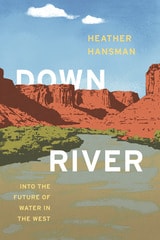
Downriver
Into the Future of Water in the WestHeather Hansman
University of Chicago Press, 2019
Award-winning journalist rafts down the Green River, revealing a multifaceted look at the present and future of water in the American West.
The Green River, the most significant tributary of the Colorado River, runs 730 miles from the glaciers of Wyoming to the desert canyons of Utah. Over its course, it meanders through ranches, cities, national parks, endangered fish habitats, and some of the most significant natural gas fields in the country, as it provides water for 33 million people. Stopped up by dams, slaked off by irrigation, and dried up by cities, the Green is crucial, overused, and at-risk, now more than ever.
Fights over the river’s water, and what’s going to happen to it in the future, are longstanding, intractable, and only getting worse as the West gets hotter and drier and more people depend on the river with each passing year. As a former raft guide and an environmental reporter, Heather Hansman knew these fights were happening, but she felt driven to see them from a different perspective—from the river itself. So she set out on a journey, in a one-person inflatable pack raft, to paddle the river from source to confluence and see what the experience might teach her. Mixing lyrical accounts of quiet paddling through breathtaking beauty with nights spent camping solo and lively discussions with farmers, city officials, and other people met along the way, Downriver is the story of that journey, a foray into the present—and future—of water in the West.
[more]
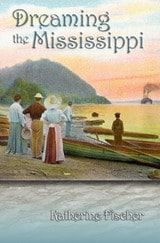
Dreaming the Mississippi
Katherine Fischer
University of Missouri Press, 2006
Offering a fresh perspective on the river’s environment, industry, and recreation, Dreaming the Mississippi challenges old stereotypes through the experiences of modern Americans who work the barges, rope-swing into muddy bottoms, struggle against hurricane floodwaters, and otherwise find new meaning on this great watery corridor. In an engaging voice, earnest and energetic, Katherine Fischer describes how the river’s natural and human histories overlap and interweave as she tells of her own gradual immersion in its life—which led her to buy a house so close to its banks that each spring she must open her basement doors to accept its inevitable floods.
Fischer blends stories of people living along the river with accounts of national and global consequence. She weaves humorous accounts of river rats and towboat pilots with stories of sandbagging against a flood tide that refuses to be contained. She tells of river hangouts—“joints” that literally join segments of humanity along the river—as she revels in the colorful clientele of her favorite waterfront taverns. Some chapters connect the wildness of this mythical river to outside regions such as the Great Salt Lake and Florida, taking the lure of the mighty Mississippi as far as Japan. Another chapter, about the river’s mouth, “Gulf,” considers the gulf between engineers and naturalists—and between America’s haves and have-nots—as it offers heartfelt reflections on Katrina’s wrath.
Through compelling words and photographs, Dreaming the Mississippi invites readers to taste life on today’s Mississippi, as sweet, tangy, and wildly cantankerous as it gets. In conveying her understanding of contemporary life along the river’s length, Katherine Fischer has much to teach us not only about reverence for this glorious American waterway but also about our eternal connections to the natural world.
[more]