Results by title

8 books match the query 'Computation'
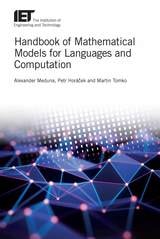
cover of Handbook of Mathematical Models for Languages and Computation

Handbook of Mathematical Models for Languages and Computation

Alexander Meduna

The Institution of Engineering and Technology, 2020
The theory of computation is used to address challenges arising in many computer science areas such as artificial intelligence, language processors, compiler writing, information and coding systems, programming language design, computer architecture and more. To grasp topics concerning this theory readers need to familiarize themselves with its computational and language models, based on concepts of discrete mathematics including sets, relations, functions, graphs and logic.
[more]
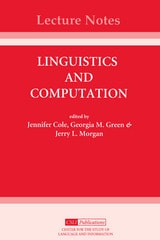
cover of Linguistics and Computation

Linguistics and Computation

Edited by Jennifer S. Cole, Georgia M. Green, and Jerry L. Morgan

CSLI, 1995
This volume is a collection covering the diverse areas of psycholinguistics, syntax, computational linguistics and phonology. Abney's paper on Chunks provides an interesting new approach to phrase structure, motivated by psycholinguist data, something that is rarely done. Berwick and Fong provide a history of computational implementations of (Chomskyan) Transformational Grammar. Cole's phonology paper, arguing from Chamorro and English stress that cyclicity is not needed in phonology, is also preceded by a one-and-a-half-page introduction on why this is relevant to computation. Coleman's contribution summarises work on computational phonology and describes the York Talk speech synthesis system. Hirschberg and Sproat's paper describes a system they have written to assign pitch accent to unrestricted text in an RT&T text-to-speech system. This is very much applied natural language processing, but their system represents a more thorough-going attempt at doing this well than has been previously attempted, and this appears to be the first write-up of this work. Johnson and Moss introduce Stratified Feature Grammar, a formal model of language, inspired by Relational Grammar but formalised by using and extending tools developed in the unification grammar community. Finally, Nakazawa extends further Tomita's work so that computer science LR parsing methods can be applied to natural language grammars, here feature-based grammars.
[more]
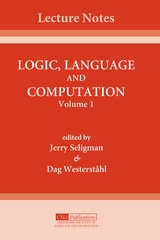
cover of Logic, Language and Computation

Logic, Language and Computation

Edited by Jerry Seligman and Dag Westerståhl

CSLI, 1996
Subject: Linguistics; Logic; Computational Linguistics
[more]
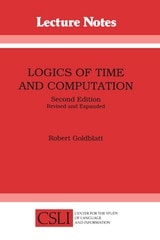
cover of Logics of Time and Computation

Logics of Time and Computation

Robert Goldblatt

CSLI, 1992
"This is a short but excellent introduction to modal, temporal, and dynamic logic....It manages to cover, in highly readable style, the basic completeness, decidability, and expressability results in a variety of logics of the three kinds considered." -Rohit Parikh, reviewing the first edition in the Journal of Symbolic Logic. Now revised and significantly expanded, this textbook introduces modal logic and examines the relevance of modal systems for theoretical computer science. Golblatt sets out a basic theory of normal modal and temporal propositional logics, including issues such as completeness proofs, decidability, first-order defiability, and canonicity. The basic theory is then applied to logics of discrete, dense, and continuous time; to the temporal logic of concurrent programs involving the connectives henceforth, next , anduntil; and to the dynamic logic of regular programs. New material for the second edition extends the temporal logic of concurrency to branching time, studying a system of Computational Tree Logic that formalizes reasoning about behavior. Dynamic logic is also extended to the case of concurrency, intorducing a connective for the parallel execution of commands. A seperate section is devoted to the quantificational dynamic logic. Numerous excercises are included for use in the classroom. Robert Goldblatt is a professor of pure mathematics at the Victoria University of Wellington, New Zealand. Center for the Study of Language and Information- Lecture Notes, Number 7
[more]
cover of On Posthuman War: Computation and Military Violence

On Posthuman War

Computation and Military Violence

Mike Hill

University of Minnesota Press, 2022

Tracing war’s expansion beyond the battlefield to the concept of the human being itself
 

As military and other forms of political violence become the planetary norm, On Posthuman War traces the expansion of war beyond traditional theaters of battle. Drawing on counterinsurgency field manuals, tactical manifestos, data-driven military theory, and asymmetrical-war archives, Mike Hill delineates new “Areas of Operation” within a concept of the human being as not only a social and biological entity but also a technical one.

Delving into three human-focused disciplines newly turned against humanity, OnPosthuman War reveals how demography, anthropology, and neuroscience have intertwined since 9/11 amid the “Revolution in Military Affairs.”  Beginning with the author’s personal experience training with U.S. Marine recruits at Parris Island, Hill gleans insights from realist philosophy, the new materialism, and computational theory to show how the human being, per se, has been reconstituted from neutral citizen to unwitting combatant. As evident in the call for “bullets, beans, and data,” whatever can be parted out, counted, and reassembled can become war materiel. Hill shows how visible and invisible wars within identity, community, and cognition shift public-sphere activities, like racial identification, group organization, and even thought itself, in the direction of war. This shift has weaponized social activities against the very notion of society. 

On Posthuman War delivers insights on the latest war technologies, strategies, and tactics while engaging in questions poised to overturn the foundations of modern political thought.
[more]
cover of Perspectives in Computation

Perspectives in Computation

Robert Geroch

University of Chicago Press, 2009
Computation is the process of applying a procedure or algorithm to the solution of a mathematical problem. Mathematicians and physicists have been occupied for many decades pondering which problems can be solved by which procedures, and, for those that can be solved, how this can most efficiently be done. In recent years, quantum mechanics has augmented our understanding of the process of computation and of its limitations.

Perspectives in Computation covers three broad topics: the computation process and its limitations, the search for computational efficiency, and the role of quantum mechanics in computation. The emphasis is theoretical; Robert Geroch asks what can be done, and what, in principle, are the limitations on what can be done? Geroch guides readers through these topics by combining general discussions of broader issues with precise mathematical formulations—as well as through examples of how computation works.

Requiring little technical knowledge of mathematics or physics, Perspectives in Computation will serve both advanced undergraduates and graduate students in mathematics and physics, as well as other scientists working in adjacent fields.
[more]
cover of Quantifying Life: A Symbiosis of Computation, Mathematics, and Biology

Quantifying Life

A Symbiosis of Computation, Mathematics, and Biology

Dmitry A. Kondrashov

University of Chicago Press, 2016

Since the time of Isaac Newton, physicists have used mathematics to describe the behavior of matter of all sizes, from subatomic particles to galaxies. In the past three decades, as advances in molecular biology have produced an avalanche of data, computational and mathematical techniques have also become necessary tools in the arsenal of biologists. But while quantitative approaches are now providing fundamental insights into biological systems, the college curriculum for biologists has not caught up, and most biology majors are never exposed to the computational and probabilistic mathematical approaches that dominate in biological research.

With Quantifying Life, Dmitry A. Kondrashov offers an accessible introduction to the breadth of mathematical modeling used in biology today. Assuming only a foundation in high school mathematics, Quantifying Life takes an innovative computational approach to developing mathematical skills and intuition. Through lessons illustrated with copious examples, mathematical and programming exercises, literature discussion questions, and computational projects of various degrees of difficulty, students build and analyze models based on current research papers and learn to implement them in the R programming language. This interplay of mathematical ideas, systematically developed programming skills, and a broad selection of biological research topics makes Quantifying Life an invaluable guide for seasoned life scientists and the next generation of biologists alike.
[more]
cover of The Tbilisi Symposium on Logic, Language and Computation: Selected Papers

The Tbilisi Symposium on Logic, Language and Computation

Selected Papers

Edited by Jonathan Ginzburg, Zurab Khasidashvili, Carl Vogel, Jean-Jacques Lévy,

CSLI, 1998

This volume brings together papers from linguists, logicians, and computer scientists from thirteen countries (Armenia, Denmark, France, Georgia, Germany, Israel, Italy, Japan, Poland, Spain, Sweden, UK, and USA). This collection aims to serve as a catalyst for new interdisciplinary developments in language, logic and computation and to introduce new ideas from the expanded European academic community. Spanning a wide range of disciplines, the papers cover such topics as formal semantics of natural language, dynamic semantics, channel theory, formal syntax of natural language, formal language theory, corpus-based methods in computational linguistics, computational semantics, syntactic and semantic aspects of l-calculus, non-classical logics, and a fundamental problem in predicate logic.
[more]