Results by title
424 books match the query 'Russian & Soviet' and 21 start with d

Daniil Kharms
Writing and the EventBy Branislav Jakovljevic
Northwestern University Press, 2009
The book follows Kharms’s development as a creative thinker, inquiring into the nature of Kharmsian nonsense, the ontological status of the OBERIU object, writing as performance, Kharms’s gestural language, his "language machines," and his ideas of order, number, infinity, and chance. Reading every paper trace (as well as extant memories) of Kharms’s activities as part of a large project of world creation, Branislav Jakovljevic situates him in a twentieth-century effort—exemplified by Kafka, Beckett, Artaud, Malevich, and Khelbnikov, among others—to go beyond an interpretation of meaning circumscribed by rational and logical thought. Examining texts that could conceivably be called "literary" as well as sketches, diagrams, hieroglyphs, photographs, and unclassifiable others, Jakovljevic’s study is the first to provide a properly broad perspective on this creative thinker’s farranging, far-reaching, and finally comprehensive achievement.

Developments in Russian Politics 10
Henry E. Hale, Juliet Johnson, and Tomila V. Lankina, editors
Duke University Press, 0
Developments in Russian Politics 9
Richard Sakwa, Henry E. Hale, and Stephen White, editors
Duke University Press, 2019
Contributors. Samuel Charap, Valentina Feklyunina, Henry E. Hale, Philip Hanson, Kathryn Hendley, Marlene Laruelle, Ellen Mickiewicz, Ben Noble, Thomas F. Remington, Bettina Renz, Ora John Reuter, Graeme Robertson, Richard Sakwa, Darrell Slider, Stephen White, John P. Willerton

Dialogics of the Oppressed
Peter Hitchcock
University of Minnesota Press, 1992
Dialogics of the Oppressed was first published in 1992. Minnesota Archive Editions uses digital technology to make long-unavailable books once again accessible, and are published unaltered from the original University of Minnesota Press editions.
Formulated within and against the context of Russian formalism that became the backbone of semiotics, Mikhail Bakhtin's work has enabled contemporary critical theories to return to specific sociopolitical and historical moments that had been closed off by formalist abstractions. In Dialogics of the Oppressed, Peter Hitchcock looks through the lens of Bakhtin's theory of dialogism for an analysis of subaltern writing. Rather than assume an integral "subaltern subject" as the object of analysis, Hitchcock - in case studies of four global feminists, Nawal el Saadawi, Pat Barker, Zhang Jie, and Agnes Smedley - emphasizes the cultural agency of the subaltern and shows the political implications this agency might have for literary analysis in general and cultural studies in particular.
"Presents a provocative set of readings-through the Bakhtinian model of dialogism-of texts by four women writers of the twentieth century. . . instructive and compelling." Barbara Harlow, University of Texas
Dialogics of the Oppressed argues from an internationalistic perspective to underline that the heterogeneity of dialogic feminism itself constitutes a significant array of discursive resistance to the hegemony of disciplines and so-called area studies operative in the metropolitan First World academy. Hitchcock demonstrates through dialogic analyses of the writings of these four feminists that a form of multicultural materialism can itself disrupt the restrictive logics and practices of literary studies in the Western academy, and that indeed, there is a counterlogic in the culture of the subaltern. Hitchcock's underlying objective is the development of a powerful critique of the epistemological bases of the academy that marginalize and devalorize certain cultural productions and subjects, as well as a cognitive mapping of the politics of pedagogy in current transformations of disciplinarity.
Peter Hitchcock is professor of English at Baruch College of the City University of New York. He is the author of Working-Class Fiction in Theory and Practice and has published essays on radical writing, multiculturalism, film, and Third World fiction.

Dialogues/Dialogi
Literary and Cultural Exchanges Between (Ex)Soviet and American WomenSusan Hardy Aiken, Adele Barker, Maya Koreneva, and Ekaterina Stetsenko
Duke University Press, 1993
Dialogues/Dialogi pairs stories by Tillie Olsen, Toni Cade Bambara, Jayne Anne Phillips, and Leslie Marmon Silko (reprinted here in full) with Russian stories by I. Grekova, Liudmila Petrushevskaya, Elena Makarova, and Anna Nerkagi, many of them appearing here for the first time in English. Exquisite in their stylistic and thematic variety, suggestive of the range of women's experience and fiction in both countries, each story is the subject of paired interpretive essays by an American and an (ex)Soviet critic from among the book's authors.
A colloquy of diverse voices speaking together in multiple, mutually illuminating exchanges, Dialogues/Dialogi testifies to the possibility of evolving relationships among women across borders once considered impassable.
Dialogues
Ilya Kabakov and Viktor Pivovarov, Stories about OurselvesKsenia Nouril
Rutgers University Press, 2020
This exhibition catalog brings together Kabakov and Pivovarov’s key works for the first time, putting the two artists in dialogue and recreating their artistic community. It not only includes nearly hundred pages of full-color illustrations, but also provides complete English translations of the Russian texts that appear in the volume, plus new interviews with each artist. Taken together, they give viewers a new appreciation of the different aesthetic strategies each artist used to depict the absurdities of everyday life in the Soviet era. Published in partnership with the Zimmerli Museum.
Dimitry's Shade
A Reading of Alexander Pushkin's Boris GodunovJ. Douglas Clayton
Northwestern University Press, 2004
In an ambitious reinterpretation of the premier work of Russia's national poet, J. Douglas Clayton reads Boris Godunov as the expression of Alexander Pushkin's thinking about the Russian state, especially the Russian state of his own time (some two hundred years distant from the events of the play), and even his own place within that state. Here we see how the play marks a sharp break with the Decembrists and Pushkin's own youthful liberalism, signaling its author's emergence as a Russian conservative. Boris Godunov, Clayton argues, can be best understood as an ideologically conservative defense of autocracy.
Sure to shock readers even as it persuades them, Dimitry's Shade reveals, incarnated in Boris Godunov, those three elements that were to become the slogan of Nicholas's Russia in the 1830s: autocracy, orthodoxy, and nationality.
Discovering Sexuality in Dostoevsky
Susanne Fusso
Northwestern University Press, 2008
Some of the topics Fusso considers are Dostoevsky's search for an appropriate artistic language for sexuality, a young narrator's experimentation with homoerotic desire and unconventional narrative in A Raw Youth; and Dostoevsky's approach to a young man's sexual development in A Raw Youth and The Brothers Karamazov. She also explores his complex treatment of a child's secret sexuality in his account of the Kroneberg child abuse case in A Writer's Diary; and his conception of the ideal family, a type of family that appears in his works mainly by negative example. Focusing mainly on sexual practices considered "deviant" in Dostoevsky's time--both because these are the practices that his young characters confront and because they offer the most intriguing interpretive problems--Fusso decodes the author's texts and their social contexts. In doing so, she highlights one thread in the intricate thematic weave of Dostoevsky's novels and newly illuminates his artistic process.
Distance Manipulation
The Russian Modernist Search for a New DramaJoanna Kot
Northwestern University Press, 1999
Kot studies experimental dramas by Gippius, Sologub, Blok, and Ivanov, but the centerpiece of the book is Chekhov's Cherry Orchard his last and greatest play. Kot argues that it presents a subtle balance of distancing and emotive techniques.
An invaluable guide to the often bewildering nature of so-called "innovative" twentieth-century works, this book will appeal to anyone interested in modern theater.
Dostoevsky and Romantic Realism
A Study of Dostoevsky in Relation to Balzac, Dickens, and GogolDonald Fanger
Northwestern University Press, 1998
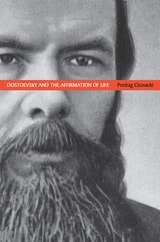
Dostoevsky and the Affirmation of Life
Predrag Cicovacki
St. Augustine's Press, 2008
Dostoevsky and the Catholic Underground
Elizabeth A. Blake
Northwestern University Press, 2019
While Dostoevsky’s relation to religion is well-trod ground, there exists no comprehensive study of Dostoevsky and Catholicism. Elizabeth Blake’s ambitious and learned Dostoevsky and the Catholic Underground fills this glaring omission in the scholarship. Previous commentators have traced a wide-ranging hostility in Dostoevsky’s understanding of Catholicism to his Slavophilism. Blake depicts a far more nuanced picture. Her close reading demonstrates that he is repelled and fascinated by Catholicism in all its medieval, Reformation, and modern manifestations. Dostoevsky saw in Catholicism not just an inspirational source for the Grand Inquisitor but a political force, an ideological wellspring, a unique mode of intellectual inquiry, and a source of cultural production. Blake’s insightful textual analysis is accompanied by an equally penetrating analysis of nineteenth-century European revolutionary history, from Paris to Siberia, that undoubtedly influenced the evolution of Dostoevsky’s thought.
Dostoevsky and the Ethics of Narrative Form
Suspense, Closure, Minor CharactersGreta Matzner-Gore
Northwestern University Press, 2020
Dostoevsky and the Riddle of the Self
Yuri Corrigan
Northwestern University Press, 2017
Dostoevsky was hostile to the notion of individual autonomy, and yet, throughout his life and work, he vigorously advocated the freedom and inviolability of the self. This ambivalence has animated his diverse and often self-contradictory legacy: as precursor of psychoanalysis, forefather of existentialism, postmodernist avant la lettre, religious traditionalist, and Romantic mystic.
Dostoevsky and the Riddle of the Self charts a unifying path through Dostoevsky's artistic journey to solve the “mystery” of the human being. Starting from the unusual forms of intimacy shown by characters seeking to lose themselves within larger collective selves, Yuri Corrigan approaches the fictional works as a continuous experimental canvas on which Dostoevsky explored the problem of selfhood through recurring symbolic and narrative paradigms. Presenting new readings of such works as The Idiot, Demons, and The Brothers Karamazov, Corrigan tells the story of Dostoevsky’s career-long journey to overcome the pathology of collectivism by discovering a passage into the wounded, embattled, forbidding, revelatory landscape of the psyche.
Corrigan’s argument offers a fundamental shift in theories about Dostoevsky's work and will be of great interest to scholars of Russian literature, as well as to readers interested in the prehistory of psychoanalysis and trauma studies and in theories of selfhood and their cultural sources.
Dostoevsky's "The Devils"
A Critical CompanionWilliam Leatherbarrow
Northwestern University Press, 1999
Dostoevsky's "The Idiot"
A Critical CompanionLiza Knapp
Northwestern University Press, 1998
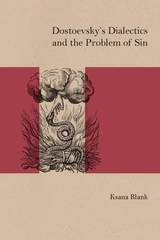
Dostoevsky's Dialectics and the Problem of Sin
Ksana Blank
Northwestern University Press, 2019
In Dostoevsky’s Dialectics and the Problem of Sin, Ksana Blank borrows from ancient Greek, Chinese, and Christian dialectical traditions to formulate a dynamic image of Dostoevsky’s dialectics—distinct from Hegelian dialectics—as a philosophy of “compatible contradictions.” Expanding on the classical triad of Goodness, Beauty, and Truth, Blank guides us through Dostoevsky’s most difficult paradoxes: goodness that begets evil, beautiful personalities that bring about grief, and criminality that brings about salvation.
Dostoevsky’s philosophy of contradictions, this book demonstrates, contributes to the development of antinomian thought in the writings of early twentieth-century Russian religious thinkers and to the development of Bakhtin’s dialogism. Dostoevsky’s Dialectics and the Problem of Sin marks an important and original intervention into the enduring debate over Dostoevsky’s spiritual philosophy.
Dostoevsky's Idiot
Dialogue and the Spiritually Good LifeBruce A. French
Northwestern University Press, 2001
In three chapters, French takes up in turn the narrator and narrative points of view, the author’s use of inserted narratives, and three modes of interaction French calls Monologue, Dialogue, and Dialogical Living.
Dostoevsky's Secrets
Reading Against the GrainCarol Apollonio
Northwestern University Press, 2009
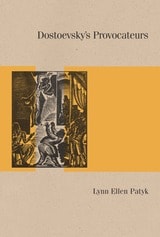
Dostoevsky’s Provocateurs
Lynn Ellen Patyk
Northwestern University Press, 2023
Confronting Bakhtin’s formative reading of Dostoevsky to recover the ways the novelist stokes conflict and engages readers—and to explore the reasons behind his adversarial approach
Like so many other elements of his work, Fyodor Dostoevsky’s deliberate deployment of provocation was both prescient and precocious. In this book, Lynn Ellen Patyk singles out these forms of incitement as a communicative strategy that drives his paradoxical art. Challenging, revising, and expanding on Mikhail Bakhtin’s foundational analysis in Problems of Dostoevsky’s Poetics, Patyk demonstrates that provocation is the moving mover of Dostoevsky’s poetics of conflict, and she identifies the literary devices he uses to propel plot conflict and capture our attention. Yet the full scope of Dostoevsky’s provocative authorial activity can only be grasped alongside an understanding of his key themes, which both probed and exploited the most divisive conflicts of his era. The ultimate stakes of such friction are, for him, nothing less than moral responsibility and the truth of identity.
Sober and strikingly original, compassionate but not uncritical, Dostoevsky’s Provocateurs exposes the charged current in the wiring of our modern selves. In an economy of attention and its spoils, provocation is an inexhaustibly renewable and often toxic resource.
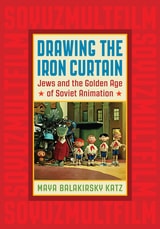
Drawing the Iron Curtain
Jews and the Golden Age of Soviet AnimationMaya Balakirsky Katz
Rutgers University Press, 2016