Results by title
94 books match the query 'Services for' and 5 start with d
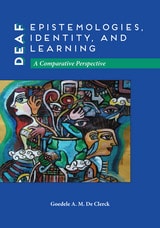
Deaf Epistemologies, Identity, and Learning
A Comparative PerspectiveGoedele A. M. De Clerck
Gallaudet University Press, 2016
Goedele A. M. De Clerck presents cross-cultural comparative research that examines and documents where deaf flourishing occurs and how it can be advanced. She spotlights collective and dynamic resources of knowledge and learning; the coexistence of lived differences; social, linguistic, cultural, and psychological capital; and human potential and creativity.
Deaf Epistemologies, Identity, and Learning argues for an inclusive approach to the intrinsic human diversity in society, education, and scholarship, and shows how emotions of hope, frustration, and humiliation contribute to the construction of identity and community. De Clerck also considers global to local dynamics in deaf identity, deaf culture, deaf education, and deaf empowerment. She presents empirical research through case studies of the emancipation processes for deaf people in Flanders (a region of Belgium), the United States (specifically, at Gallaudet University in Washington, DC), and the West African nation of Cameroon. These three settings illuminate different phases of emancipation in different contexts, and the research findings are integrated into a broader literature review and subjected to theoretical reflection.
De Clerck’s anthropology of deaf flourishing draws from her critical application of the empowerment paradigm in settings of daily life, research, leadership, and community work, as she explores identity and well-being through an interdisciplinary lens. This work is centered around practices of signed storytelling and posits learning as the primary access and pathway to culture, identity, values, and change. Change driven by the learning process is considered an awakening—and through this awakening, the deaf community can gain hope, empowerment, and full citizenship. In this way, deaf people are allowed to shape their histories, and the result is the elevation of all aspects of deaf lives around the world.
[more]
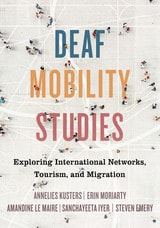
Deaf Mobility Studies
Exploring International Networks, Tourism, and MigrationAnnelies Kusters
Gallaudet University Press, 2024
Deaf Mobility Studies revolutionizes how we think about deaf people’s international experiences. Equipped with a common theoretical framework, a team of five deaf ethnographers journeyed alongside their participants to delve into a rich array of experiences — ranging from career advancements and marriages to tourism and the challenges faced by deaf refugees. The authors present their findings within the framework of Deaf Mobility Studies, which brings together the transdisciplinary fields of Deaf Studies and Mobility Studies. Far from taking 'deaf cosmopolitanism' as a given, this work scrutinizes it as a multifaceted phenomenon to be both affirmed and questioned. Themes that emerge include how deaf people seek spaces of belonging, engage in languaging, expand their networks, and experience immobility.
The text is augmented by direct links to clips in nine ethnographic films, analysis of selected film excerpts and screenshots, and compelling data visualizations. QR codes throughout the book link to the film clips to create this dual narrative experience. Deaf Mobility Studies is an expansive odyssey through the complexities and opportunities inherent in deaf international mobility.
Deaf Mobility Studies: Exploring International Networks, Tourism, and Migration © 2024 by Gallaudet University is licensed under CC BY-NC-ND 4.0.
[more]
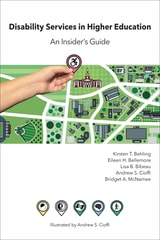
Disability Services in Higher Education
An Insider's GuideKirsten T. Behling, Eileen H. Bellemore, Lisa B. Bibeau, Andrew S. Cioffi, and Bridget A. McNamee
Temple University Press, 2023
Disability Services in Higher Education is the first comprehensive guide for people working in the field of ADA compliance in higher education. The authors examine how disabilities are supported to ensure students receive appropriate accommodations throughout their collegiate experience as well as provide guidance on overall campus accessibility.
This volume provides an overview of the responsibilities of a Disabilities Service professional through an examination of relevant literature, laws and regulatory language, case law, and narrative on established practices. It also offers resources that current professionals can modify for use in their day-to-day practice immediately. The authors explore the complexities of accessibility, paying careful attention to the nuances of disability evaluation, accommodation decisions, management of a disability service office, advocating for resources and collaboration within and outside of higher education institutions.
This practitioner-friendly book will help newcomers and seasoned professionals explore and evaluate best practices in the field through questions, examples, and functional job aids available for immediate use.
[more]
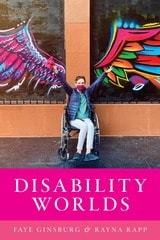
Disability Worlds
Faye Ginsburg and Rayna Rapp
Duke University Press, 2024
In Disability Worlds, Faye Ginsburg and Rayna Rapp chronicle and theorize two decades of immersion in New York City’s wide-ranging disability worlds as parents, activists, anthropologists, and disability studies scholars. They situate their disabled children’s lives among the experiences of advocates, families, experts, activists, and artists in larger struggles for recognition and rights. Disability consciousness, they show, emerges in everyday politics, practices, and frictions. Chapters consider dilemmas of genetic testing and neuroscientific research, reimagining kinship and community, the challenges of “special education,” and the perils of transitioning from high school. They also highlight the vitality of neurodiversity activism, disability arts, politics, and public culture. Disability Worlds reflects the authors’ anthropological commitments to recognizing the significance of this fundamental form of human difference. Ginsburg and Rapp’s conversations with diverse New Yorkers reveal the bureaucratic constraints and paradoxes established in response to the disability rights movement, as well as the remarkable creativity of disabled people and their allies who are opening pathways into both disability justice and disability futures.
[more]
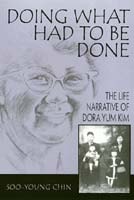
Doing What Had To Be Done
Soo-Young Chin
Temple University Press, 1999
The first biography of an American-born Korean woman, Doing What Had to Be Done is, on the surface, the life story of Dora Yum Kim. But telling more than one woman's story, author Soo-Young Chin offers more than an unusual glimpse at the shaping of a remarkable community activist. In addition -- as she questions her subject, introduces each chapter, and reflects on how Dora's story relates to her own experience as a Korean American who immigrate to this country as an adult -- she carves around Dora's compelling story and courageous life story a story of her own and one of all Korean Americans.
Born in 1921, Dora, as she tells Chin her story, chronicles the shifting salience of gendered ethnic identity as she journeys through her life. Traveling through time and place, she moves from San Francisco's Chinatown -- where Koreans were a minority within a minority -- to suburban Dewey Boulevard where Dora and her family attempt to integrate into mainstream America, and where she becomes a social worker in the California State Department of Employment. As the Korean immigrant community grows in the late 1960s, Dora becomes deeply involved in community service. She remembers teaching English to senior citizens and preparing them for their naturalization exams, finding jobs for the younger Koreans, and founding a community center and meals program for seniors.
A detailed and inspiring lens through which to view Korean American history, Dora's life journey echoes the changing spaces of the American social landscape. And the grace and ease with which Dora just "does what has to be done" shows us the importance of everyday acts in making a difference.
[more]