Results by title
143 books match the query 'Sexuality' and 9 start with d
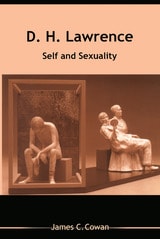
D H LAWRENCE
SELF AND SEXUALITYJames C. Cowan
The Ohio State University Press, 2003
D. H. Lawrence: Self and Sexuality is a psychoanalytic study of D. H. Lawrence’s life and writings. James Cowan relies most notably the methods of Heinz Kohut, psychoanalytic “self psychology,” and employs as well the object relation theories of D. W. Winnicott and others. This work also examines sexual issues in Lawrence’s work from a literary and critical perspective, employing authoritative medical and psychoanalytic sources in human sexuality. Lawrence’s work, which was early read in traditional Freudian terms, has only recently been considered from other psychoanalytic perspectives. In this self psychological study, Cowan provides a new and path-breaking analysis of Lawrence.
Turning to several problematic issues of sexuality in Lawrence, the author first discusses a number of Lawrence’s sexual fallacies, and personal and cultural issues. Cowan also considers contrasting idealized and negative presentations of Mellors and Sir Clifford Chatterley in Lady Chatterley’s Lover, and the theme of the “loss of desire” sequence of poems in Pansies.
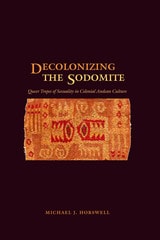
Decolonizing the Sodomite
Queer Tropes of Sexuality in Colonial Andean CultureBy Michael J. Horswell
University of Texas Press, 2006
Early Andean historiography reveals a subaltern history of indigenous gender and sexuality that saw masculinity and femininity not as essential absolutes. Third-gender ritualists, Ipas, mediated between the masculine and feminine spheres of culture in important ceremonies and were recorded in fragments of myths and transcribed oral accounts. Ritual performance by cross-dressed men symbolically created a third space of mediation that invoked the mythic androgyne of the pre-Hispanic Andes. The missionaries and civil authorities colonizing the Andes deemed these performances transgressive and sodomitical.
In this book, Michael J. Horswell examines alternative gender and sexuality in the colonial Andean world, and uses the concept of the third gender to reconsider some fundamental paradigms of Andean culture. By deconstructing what literary tropes of sexuality reveal about Andean pre-Hispanic and colonial indigenous culture, he provides an alternative history and interpretation of the much-maligned aboriginal subjects the Spanish often referred to as "sodomites." Horswell traces the origin of the dominant tropes of masculinist sexuality from canonical medieval texts to early modern Spanish secular and moralist literature produced in the context of material persecution of effeminates and sodomites in Spain. These values traveled to the Andes and were used as powerful rhetorical weapons in the struggle to justify the conquest of the Incas.
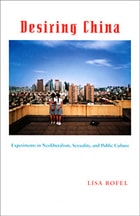
Desiring China
Experiments in Neoliberalism, Sexuality, and Public CultureLisa Rofel
Duke University Press, 2007
Drawing on her research over the past two decades among urban residents and rural migrants in Hangzhou and Beijing, Rofel analyzes the meanings that individuals attach to various public cultural phenomena and what their interpretations say about their understandings of post-socialist China and their roles within it. She locates the first broad-based public debate about post-Mao social changes in the passionate dialogues about the popular 1991 television soap opera Yearnings. She describes how the emergence of gay identities and practices in China reveals connections to a transnational network of lesbians and gay men at the same time that it brings urban/rural and class divisions to the fore. The 1999–2001 negotiations over China’s entry into the World Trade Organization; a controversial women’s museum; the ways that young single women portray their longings in relation to the privations they imagine their mothers experienced; adjudications of the limits of self-interest in court cases related to homoerotic desire, intellectual property, and consumer fraud—Rofel reveals all of these as sites where desiring subjects come into being.
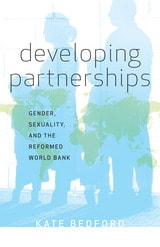
Developing Partnerships
Gender, Sexuality, and the Reformed World BankKate Bedford
University of Minnesota Press, 2009
A nuanced critique of how the World Bank encourages gender norms through its policies, Developing Partnerships argues that financial institutions are key players in the global enforcement of gender and family expectations.
By combining analysis of documents produced and sponsored by the World Bank with interviews of World Bank staffers and case studies, Kate Bedford presents a detailed examination of gender and sexuality in the policies of the world's largest and most influential development institution. Looking concurrently at economic and gender policy, Bedford connects reform of markets to reform of masculinities, loan agreements for export promotion to pamphlets for indigenous adolescents advising daily genital bathing, and attempts to strengthen institutions after the Washington Consensus to efforts to promote loving couplehood in response to economic crisis. In doing so, she reveals the shifting relationships between development and sexuality and the ways in which gender policy impacts debates about the future of neoliberalism.
Providing a multilayered account of how gender-aware policies are conceived and implemented by the World Bank, Developing Partnerships demonstrates as well how institutional practices shape development.
Diagnosing Desire
Biopolitics and Femininity into the Twenty-First CenturyAlyson K. Spurgas
The Ohio State University Press, 2020
In Diagnosing Desire: Biopolitics and Femininity into the Twenty-First Century, Alyson K. Spurgas examines the “new science of female sexuality” from a critical, sociological perspective, considering how today’s feminist-identified sex researchers study and manage women with low desire. Diagnosing Desire investigates experimental sex research that measures the disconnect between subjective and genital female arousal, contemporary psychiatric diagnoses for low female desire, new models for understanding women’s sexual response, and cutting-edge treatments for low desire in women—including from the realms of mindfulness and alternative healing.
Spurgas makes the case that, together, all of these technologies create a “feminized responsive desire framework” for understanding women’s sexuality, and that this, in fact, produces women’s sexuality as a complex problem to be solved. The biggest problem, Spurgas argues, is that gendered and sexualized trauma—including as it is produced within technoscientific medicine itself—is too often ignored in contemporary renderings. Through incisive textual analysis and in-depth qualitative research based on interviews with women with low desire, Spurgas argues for a more radical and communal form of care for feminized—and traumatized—populations, in opposition to biopolitical mandates to individualize and neoliberalize forms of self-care. Ultimately, this is a book not just about a specific diagnosis or dysfunction but about the material-discursive regimes that produce and regulate femininity.
Discourses of Sexuality
From Aristotle to AIDSDonna C. Stanton, Editor
University of Michigan Press, 1993
Disorders Of Desire Rev
Sexuality And Gender In Modern American SexologyJanice Irvine
Temple University Press, 2005
This revised and expanded edition features new chapters addressing:
•The diagnosis of "sex addiction"in the 1970s and its social and political implications.
•New developments within the field of sexology, including the "Viagra Revolution" that began in the 1990s.
•The pharmaceutical industry's role in the development of sexual enhancements and the search for the female equivalent of Viagra.
Disturbing Practices
History, Sexuality, and Women's Experience of Modern WarLaura Doan
University of Chicago Press, 2013
Documenting Intimate Matters
Primary Sources for a History of Sexuality in AmericaEdited by Thomas A. Foster
University of Chicago Press, 2012