Results by title
862 books match the query 'Social History' and 33 start with d
Daily Life in Portugal in the Late Middle Ages
A.H. de Oliviera Marques; Translated by S.S. Wyatt
University of Wisconsin Press, 1971
Damned for Their Difference
The Cultural Construction of Deaf People as DisabledJan Branson
Gallaudet University Press, 2002
Until the recent recognition of Deaf culture and the legitimacy of signed languages, majority societies around the world have classified Deaf people as “disabled,” a term that separates all persons so designated from the mainstream in a disparaging way. Damned for Their Difference offers a well-founded explanation of how this discrimination came to be through a discursive exploration of the cultural, social, and historical contexts of these attitudes and behavior toward deaf people, especially in Great Britain.
Authors Jan Branson and Don Miller examine the orientation toward and treatment of deaf people as it developed from the 17th century through the 20th century. Their wide-ranging study explores the varied constructions of the definition of “disabled,” a term whose meaning hinges upon constant negotiation between parties, ensuring that no finite meaning is ever established. Damned for Their Difference provides a sociological understanding of disabling practices in a way that has never been seen before.
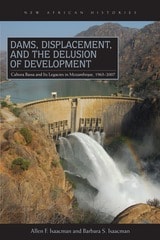
Dams, Displacement, and the Delusion of Development
Cahora Bassa and Its Legacies in Mozambique, 1965–2007Allen F. Isaacman
Ohio University Press, 2013
Cahora Bassa Dam on the Zambezi River, built in the early 1970s during the final years of Portuguese rule, was the last major infrastructure project constructed in Africa during the turbulent era of decolonization. Engineers and hydrologists praised the dam for its technical complexity and the skills required to construct what was then the world’s fifth-largest mega-dam. Portuguese colonial officials cited benefits they expected from the dam—from expansion of irrigated farming and European settlement, to improved transportation throughout the Zambezi River Valley, to reduced flooding in this area of unpredictable rainfall. “The project, however, actually resulted in cascading layers of human displacement, violence, and environmental destruction. Its electricity benefited few Mozambicans, even after the former guerrillas of FRELIMO (Frente de Libertação de Moçambique) came to power; instead, it fed industrialization in apartheid South Africa.” (Richard Roberts)
This in-depth study of the region examines the dominant developmentalist narrative that has surrounded the dam, chronicles the continual violence that has accompanied its existence, and gives voice to previously unheard narratives of forced labor, displacement, and historical and contemporary life in the dam’s shadow.
Dancing the Fairy Tale
Producing and Performing The Sleeping BeautyLaura Katz Rizzo
Temple University Press, 2015
Using extensive archival research, dance analysis, and American feminist theory, Dancing the Fairy Tale places women at the center of a historical narrative to reveal how the production and performance of The Sleeping Beauty in the years between 1937 and 2002 made significant contributions to the development and establishment of an American classical ballet. Katz Rizzo highlights not only what women have done not only behind the scenes, as administrators, producers, or directors of ballet companies and schools, but also as active interpreters embodying the ballet's title role.
In the process, Katz Rizzo also emphasizes the importance of regional sites outside of locations traditionally understood as central to the development of ballet in the United States.

Dangerous Friendship
Stanley Levison, Martin Luther King Jr., and the Kennedy BrothersBen Kamin
Michigan State University Press, 2014

Dangerous Speech
A Social History of Blasphemy in Colonial MexicoJavier Villa-Flores
University of Arizona Press, 2006
Why then, asks Villa-Flores, did Spaniards dare to blaspheme? Having mined the period’s moral literature—philosophical works as well as royal decrees and Inquisition treatises and trial records in Spanish, Mexican, and U.S. archives and research libraries—Villa-Flores deftly interweaves images of daily life in colonial Mexico with vivid descriptions of human interactions to illustrate the complexity of a culture profoundly influenced by the Catholic Church. In entertaining and sometimes horrifying vignettes, the reader comes face to face with individuals who used language to assert or manipulate their identities within that repressive society.
Villa-Flores offers an innovative interpretation of the social uses of blasphemous speech by focusing on specific groups—conquistadors, Spanish settlers, Spanish women, and slaves of both genders—as a lens to examine race, class, and gender relations in colonial Mexico. He finds that multiple motivations led people to resort to blasphemy through a gamut of practices ranging from catharsis and gender self-fashioning to religious rejection and active resistance.
Dangerous Speech is a valuable resource for students and scholars of colonialism, the social history of language, Mexican history, and the changing relations of gender, class, and ethnicity in colonial Latin America.

Dardanelle and the Bottoms
Environment, Agriculture, and Economy in an Arkansas River Community, 1819-1970Mildred D. Gleason
University of Arkansas Press, 2017
A reciprocal relationship between the town and the Bottoms formed the economic backbone on which the area’s well-being was balanced. The country people came to town on Saturdays to buy their groceries and supplies, to shop and take in a movie or visit the pool halls or barbershops. Merchants relied heavily on this country trade and had a long history of extending credit, keeping prices reasonable, and offering respect and appreciation to their customers.
This interdependence, stable for decades, began to unravel in the late 1940s with changes in farming, particularly the cotton industry. In Dardanelle and the Bottoms, Mildred Diane Gleason explores this complex rural/town dichotomy, revealing and analyzing key components of each area, including aspects of race, education, the cotton economy and its demise, the devastation of floods and droughts, leisure, crime, and the impact of the Great Depression.

Deaf Empowerment
Emergence, Struggle, and RhetoricKathy Jankowski
Gallaudet University Press, 1997
Central to Deaf Empowerment is the struggle between the dominant hearing society and Deaf people over the best means of communication, with the educational setting as the constant battleground. This evocative work first tracks the history of interaction between these two factions, highlighting the speaking majority’s desire to compel Deaf people to conform to “the human sciences” conventionality by learning speech. Then, it sharply focuses on the development of the Deaf social movement's ideology to seek general recognition of sign language as a valid cultural variation. Also, the influence of social movements of the 60s and 70s is examined in relation to the changing context and perception of the Deaf movement, as well as to its rhetorical refinement.
Deaf Empowerment delineates the apex of effective Deaf rhetoric in describing the success of the Deaf President Now! protest at Gallaudet University in 1988, its aftermath, and ensuing strategies. It concludes with an assessment of the goal of a multicultural society and offers suggestions for community building through a new humanitarianism. Scholars of social movements and Deaf studies will find it to be a uniquely provocative addition to their libraries and classrooms.
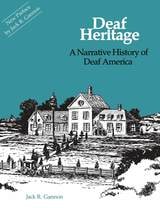
Deaf Heritage
A Narrative History of Deaf AmericaJack R. Gannon
Gallaudet University Press, 2012
Now, Jack R. Gannon’s original groundbreaking volume on Deaf history and culture is available once again. In Deaf Heritage: A Narrative History of Deaf America, Gannon brought together for the first time the story of the Deaf experience in America from a Deaf perspective. Recognizing the need to document the multifaceted history of this unique minority with its distinctive visual culture, he painstakingly gathered as much material as he could on Deaf American life. The result is a 17-chapter montage of artifacts and information that forms an utterly fascinating record from the early nineteenth century to the time of its original publication in 1981.
Deaf Heritage tracks the development of the Deaf community both chronologically and by significant subjects. The initial chapter treats the critical topics of early attempts at deaf education, the impact of Deaf and Black deaf teachers, the establishment of schools for the deaf, and the founding of Gallaudet College. Individual chapters cover the 1880s through the 1970s, mixing milestones such as the birth of the National Association of the Deaf and the work of important figures, Deaf and hearing, with anecdotes about day-to-day deaf life. Other chapters single out important facets of Deaf culture: American Sign Language, Deaf Sports, Deaf artists, Deaf humor, and Deaf publications. The overall effect of this remarkable record, replete with archival photographs, tables, and lists of Deaf people’s accomplishments, reveals the growth of a vibrant legacy singular in American history.

Deaf History Unveiled
Interpretations from the New ScholarshipJohn Vickrey Van Cleve
Gallaudet University Press, 1999
Other studies track societal paternalism toward deaf people in Italy, Hungary, and the United States. Adding to its intrigue, the new research in this milestone study provides evidence for previously uncredited self-determination of Deaf people in establishing education, employment, and social structures common throughout the Northern Hemisphere. Historians, teachers, and students alike will prize Deaf History Unveiled as a singular collection of insights that will change historical perspectives on the Deaf experience worldwide.
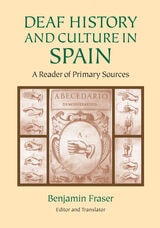
Deaf History and Culture in Spain
A Reader of Primary DocumentsBenjamin Fraser
Gallaudet University Press, 2009
In this landmark reader, Benjamin Fraser offers in five parts 44 Spanish documents dating from 1417 to the present, translated for the first time to trace the turbulent history of Deaf culture in Spain. Part I: The Birth of Oralism and Deafness as Metaphor illustrates the predominant impression of deafness as isolation, exemplified by Teresa de Cartagena writings in 1455-60 about deafness as an island. Part II: The Return to Deaf Education highlights writers who wished to restore “the Spanish ‘Art’” of educating deaf students. Lorenzo Hervás y Panduro wrote The Spanish School of Deafmutes, or Method of Teaching Them to Write and Speak the Spanish Language in 1795. Yet, Madrid’s Royal School for Deaf-Mutes, which opened in 1805, taught deaf students using methodical signs adopted from France’s Abbé de l’Epée.
Readings in Part III :The Contemporary Deaf Experience reveal considerations from the 1970s to the ‘90s of Deaf culture and linguistics similar to those in the United States, typified by the works of Inés Polo and Félix-Jesús Pinedo Peydró. The fourth part, The Recognition of Deaf Language and Culture, marks the expansion of academic research in Spain. María Angeles Rodríguez González spearheaded Spanish Sign Language (LSE) linguistics in 1992 with her publication Sign Language. The final part, A Selection of Deaf Poetry, concludes these documents with verse in Spanish spoken dialects rather than LSE, indicating that the evolution of the Deaf experience in Spain continues on its own path today.
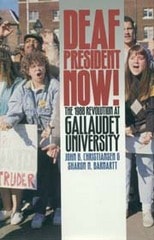
Deaf President Now!
The 1988 Revolution at Gallaudet UniversityJohn B. Christiansen
Gallaudet University Press, 1995
Deaf President Now! reveals the groundswell leading up to the history-making week in 1988 when the students at Gallaudet University seized the campus and closed it down until their demands were met. To research this probing study, the authors interviewed in-depth more than 50 of the principal players.
This telling book reveals the critical role played by a little-known group called the "Ducks," a tight-knit band of six alumni determined to see a deaf president at Gallaudet. Deaf President Now! details how they urged the student leaders to ultimate success, including an analysis of the reasons for their achievement in light of the failure of many other student movements. This fascinating study also scrutinizes the lasting effects of this remarkable episode in "the civil rights movement of the deaf." Deaf President Now! tells the full story of the insurrection at Gallaudet University, an exciting study of how deaf people won social change for themselves and all disabled people everywhere through a peaceful revolution.

Deep Are the Roots
Memoirs of a Black ExpatriateGordon Heath
University of Massachusetts Press, 1992
Descent Into Discourse
The Reification of Language and the Writing of Social HistoryBryan Palmer
Temple University Press, 1990
"Critical theory is no substitute for historical materialism; language is not life." With this statement, Bryan Palmer enters the debate that is now transforming and disrupting a number of academic disciplines, including political science, women’s studies, and history. Focusing on the ways in which literary or critical theory is being promoted within the field of social history, he argues forcefully that the current reliance on poststructuralism—with its reification of discourse and avoidance of the structures of oppression and struggles of resistance—obscures the origins, meanings, and consequences of historical events and processes.
Palmer is concerned with the emergence of "language" as a central focus of intellectual work in the twentieth century. He locates the implosion of theory that moved structuralism in the direction of poststructuralism and deconstruction in what he calls the descent into discourse. Few historians who champion poststructuralist thought, according to Palmer, appreciate historical materialism’s capacity to address discourse meaningfully. Nor do many of the advocates of language within the field of social history have an adequate grounding in the theoretical making of the project they champion so ardently. Palmer roots his polemical challenge in an effort to "introduce historians more fully to the theoretical writing that many are alluding to and drawing from rather cavalierly."
Descent into Discourse counters current intellectual fashion with an eloquent argument for the necessity to analyze and appreciate lived experience and the structures of subordination and power in any quest for historical meaning.

Desert Rose
The Life and Legacy of Coretta Scott KingEdythe Scott Bagley with Joe Hilley
University of Alabama Press, 2012
An intimate biography illuminating the life, leadership, and legacy of Coretta Scott King within the American Civil Rights Movement.
Coretta Scott King—noted author, human rights activist, and wife and partner of famed Civil Rights Movement leader Martin Luther King Jr.—grew up in the rural Alabama Black Belt with her older sister, Edythe Scott Bagley. Bagley chronicles the sisters’ early education together at the Crossroads School and later at the progressive Lincoln School in Marion. She describes Coretta’s burgeoning talent for singing and her devotion to musical studies, and the sisters’ experiences matriculating at Antioch College, an all-white college far from the rural South. Bagley provides vivid insights into Coretta’s early passion for racial and economic justice, which lead to her involvement in the Peace Movement and the National Association for the Advancement of Colored People.
As Coretta’s older sister, Edythe shared in almost all of Coretta’s many trials and tribulations. Desert Rose charts Coretta’s hesitance about her romance with Martin Luther King and the prospect of having to sacrifice her dream of a career in music to become a minister’s wife. Ultimately, Coretta chose to utilize her artistic gifts and singing voice for the Movement through the development and performance of Freedom Concerts. This book also charts Coretta’s own commitment and dedication, in the years that followed King’s death, to the causes of international civil rights, the antiapartheid movement, and the establishment of the King Center in Atlanta and the national King Holiday. Coretta’s devotion to activism, motherhood, and the movement led by her husband, and her courageous assumption of the legacy left in the wake of King’s untimely assassination, are wonderfully detailed in this intimate biography.
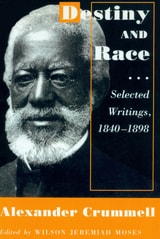
Destiny and Race
Selected Writings, 1840-1898Alexander Crummell
University of Massachusetts Press, 1992
A major reformer and intellectual, Alexander Crummell (1819–1898) was the first black American to graduate from Cambridge University. From 1858 to 1872, he lived in Liberia, where he worked as a farmer, educator, and Episcopal missionary. Returning to America, he established St. Luke’s Episcopal Church in Washington D.C., serving as its pastor until 1894. In 1897 he founded the American Negro Academy, which he intended as a challenge to the accommodationist philosophy of Booker T. Washington.
A prolific writer, Crummell produced pioneering works on black nationalism, black self-determination, and Pan Africanism that influenced W.E.B. Du Bois and other African-American leaders of the time. His surviving papers include over four hundred sermons and political essays and a voluminous correspondence.
Yet despite his importance to American and African-American history, Crummell is little known today, and there have been virtually no modern printings of his writing. This volume is intended to restore Crummell’s voice and to prompt a reevaluation of his work.

Detroit
Race Riots, Racial Conflicts, and Efforts to Bridge the Racial DivideJoe T. Darden and Richard Thomas
Michigan State University Press, 2013
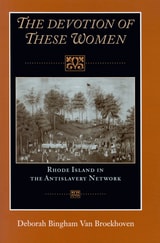
Devotion of These Women
Rhode Island in the Antislavery NetworkDeborah B. Van Broekhoven
University of Massachusetts Press, 2009
Despite the efforts of these groups, by 1842 the antislavery movement in Rhode Island was nearly moribund, the unified hopes of earlier years having fallen victim to political wrangling. A year later the largest auxiliary in the state, the Providence Antislavery Society, turned its funds over to Amarancy Paine, who in concert with other women not only revived the abolitionist movement in the state but kept it running for another ten years.
This detailed study explores how and why women like Paine emerged from the background to resuscitate and lead the antislavery cause in Rhode Island. It suggests that women more than men were accustomed to working behind the scenes, informally and without much public recognition.
The crumbling of the male-centered organization revealed a previously invisible female-based structure of personal ties on which leaders were able to build the Rhode Island State Anti-Slavery Society. Because these informal ties crossed traditional racial, geographic, and gender-role boundaries, they were often tenuous and fragile. Nevertheless, by developing this network among themselves and then extending it to national leaders, a few dedicated women managed to continue a program of antislavery petitioning, meetings, and literature circulation.
Diamonds in the Rough
A History of Alabama's Cahaba Coal FieldJames Sanders Day
University of Alabama Press, 2013
Winner of the 2014 Clinton Jackson Coley Award for Best Work on Alabama Local History from the Alabama Historical Association
Diasporic Intimacies
Queer Filipinos and Canadian ImaginariesEdited by Robert Diaz, Marissa Largo, and Fritz Pino
Northwestern University Press, 2018
Addressing a wide range of issues beyond the academy, the authors present a rich and under-studied archive of personal reflections, in-depth interviews, creative works, and scholarly essays. Their trandsdisciplinary approach highlights the need for queer, transgressive, and utopian practices that render visible histories of migration, empire building, settler colonialism, and globalization.
Timely, urgent, and fascinating, Diasporic Intimacies offers an accessible entry point for readers who seek to pursue critically engaged community work, arts education, curatorial practice, and socially inflected research on sexuality, gender, and race in this ever-changing world.

Dining Out in Boston
A Culinary HistoryJames C. O'Connell
University Press of New England, 2016

Disability and Passing
Blurring the Lines of IdentityJeffrey A Brune
Temple University Press, 2013
Passing—an act usually associated with disguising race—also relates to disability. Whether a person classified as mentally ill struggles to suppress aberrant behavior to appear "normal" or a person falsely claims a disability to gain some advantage, passing is a pervasive and much discussed phenomenon. Nevertheless, Disability and Passing is the first anthology to examine this issue.
The editors and contributors to this volume explore the intersections of disability, race, gender, and sexuality as these various aspects of identity influence each other and make identity fluid. They argue that the line between disability and normality is blurred, discussing disability as an individual identity and as a social category. And they discuss the role of stigma in decisions about whether or not to pass.
Focusing on the United States from the nineteenth century to the present, the essays in Disability and Passing speak to the complexity of individual decisions about passing and open the conversation for broader discussion.
Contributors include: Dea Boster, Allison Carey, Peta Cox, Kristen Harmon, David Linton, Michael Rembis, and the editors.

Discourse, Knowledge, and Power in Apuleius’ Metamorphoses
Evelyn Adkins
University of Michigan Press, 2022
In ancient Rome, where literacy was limited and speech was the main medium used to communicate status and identity face-to-face in daily life, an education in rhetoric was a valuable form of cultural capital and a key signifier of elite male identity. To lose the ability to speak would have caused one to be viewed as no longer elite, no longer a man, and perhaps even no longer human. We see such a fantasy horror story played out in the Metamorphoses or The Golden Ass, written by Roman North African author, orator, and philosopher Apuleius of Madauros—the only novel in Latin to survive in its entirety from antiquity. In the novel’s first-person narrative as well as its famous inset tales such as the Tale of Cupid and Psyche, the Metamorphoses is invested in questions of power and powerlessness, truth and knowledge, and communication and interpretation within the pluralistic but hierarchical world of the High Roman Empire (ca. 100–200 CE).
Discourse, Knowledge, and Power presents a new approach to the Metamorphoses: it is the first in-depth investigation of the use of speech and discourse as tools of characterization in Apuleius’ novel. It argues that discourse, broadly defined to include speech, silence, written text, and nonverbal communication, is the primary tool for negotiating identity, status, and power in the Metamorphoses. Although it takes as its starting point the role of discourse in the characterization of literary figures, it contends that the process we see in the Metamorphoses reflects the real world of the second century CE Roman Empire. Previous scholarship on Apuleius’ novel has read it as either a literary puzzle or a source-text for social, philosophical, or religious history. In contrast, this book uses a framework of discourse analysis, an umbrella term for various methods of studying the social political functions of discourse, to bring Latin literary studies into dialogue with Roman rhetoric, social and cultural history, religion, and philosophy as well as approaches to language and power from the fields of sociology, linguistics, and linguistic anthropology. Discourse, Knowledge, and Power argues that a fictional account of a man who becomes an animal has much to tell us not only about ancient Roman society and culture, but also about the dynamics of human and gendered communication, the anxieties of the privileged, and their implications for swiftly shifting configurations of status and power whether in the second or twenty-first centuries.

Diversity
Gender, Color, and CulturePhilomena Essed
University of Massachusetts Press, 1996
Essed examines these problems in a series of interrelated essays, urging us throughout the book to create a society in which diversity is accepted, encouraged, and made central to everyday life.
Diversity
The History of a Wandering ValueLorraine Daston
Central European University Press, 2026

Divide, Provide and Rule
An Integrative History of Poverty Policy, Social Reform, and Social Policy in Hungary under the Habsburg MonarchySusan Zimmermann
Central European University Press, 2011

Dixie's Great War
World War I and the American SouthEdited by John M. Giggie and Andrew J. Huebner
University of Alabama Press, 2021
Examining the First World War through the lens of the American South
How did World War I affect the American South? Did southerners experience the war in a particular way? How did regional considerations and, more generally, southern values and culture impact the wider war effort? Was there a distinctive southern experience of WWI?
Scholars considered these questions during “Dixie’s Great War,” a symposium held at the University of Alabama in October 2017 to commemorate the centenary of the American intervention in the war. With the explicit intent of exploring iterations of the Great War as experienced in the American South and by its people, organizers John M. Giggie and Andrew J. Huebner also sought to use historical discourse as a form of civic engagement designed to facilitate a community conversation about the meanings of the war.
Giggie and Huebner structured the panels thematically around military, social, and political approaches to the war to encourage discussion and exchanges between panelists and the public alike. Drawn from transcriptions of the day’s discussions and lightly edited to preserve the conversational tone and mix of professional and public voices, Dixie’s Great War: World War I and the American South captures the process of historians at work with the public, pushing and probing general understandings of the past, uncovering and reflecting on the deeper truths and lessons of the Great War—this time, through the lens of the South.
This volume also includes an introduction featuring a survey of recent literature dealing with regional aspects of WWI and a discussion of the centenary commemorations of the war. An afterword by noted historian Jay Winter places “Dixie’s Great War”—the symposium and this book—within the larger framework of commemoration, emphasizing the vital role such forums perform in creating space and opportunity for scholars and the public alike to assess and understand the shifting ground between cultural memory and the historical record.

Doing Emotions History
Edited by Susan Matt and Peter N. Stearns
University of Illinois Press, 2013

Domestic Violence and the Law in Colonial and Postcolonial Africa
Emily S. Burrill
Ohio University Press, 2010
Domestic Violence and the Law in Colonial and Postcolonial Africa reveals the ways in which domestic space and domestic relationships take on different meanings in African contexts that extend the boundaries of family obligation, kinship, and dependency. The term domestic violence encompasses kin-based violence, marriage-based violence, gender-based violence, as well as violence between patrons and clients who shared the same domestic space. As a lived experience and as a social and historical unit of analysis, domestic violence in colonial and postcolonial Africa is complex.
Using evidence drawn from Sub-saharan Africa, the chapters explore the range of domestic violence in Africa’s colonial past and its present, including taxation and the insertion of the household into the broader structure of colonial domination.
African histories of domestic violence demand that scholars and activists refine the terms and analyses and pay attention to the historical legacies of contemporary problems. This collection brings into conversation historical, anthropological, legal, and activist perspectives on domestic violence in Africa and fosters a deeper understanding of the problem of domestic violence, the limits of international human rights conventions, and local and regional efforts to address the issue.

Dragging Wyatt Earp
A Personal History of Dodge CityRobert Rebein
Ohio University Press, 2013
In Dragging Wyatt Earp essayist Robert Rebein explores what it means to grow up in, leave, and ultimately return to the iconic Western town of Dodge City, Kansas. In chapters ranging from memoir to reportage to revisionist history, Rebein contrasts his hometown’s Old West heritage with a New West reality that includes salvage yards, beefpacking plants, and bored teenagers cruising up and down Wyatt Earp Boulevard.
Along the way, Rebein covers a vast expanse of place and time and revisits a number of Western myths, including those surrounding Francisco Vasquez de Coronado, the Cheyenne chief Black Kettle, George Armstrong Custer, and of course Wyatt Earp himself. Rebein rides a bronc in a rodeo, spends a day as a pen rider at a local feedlot, and attempts to “buck the tiger” at Dodge City’s new Boot Hill Casino and Resort.
Funny and incisive, Dragging Wyatt Earp is an exciting new entry in what is sometimes called the nonfiction of place. It is a must- read for anyone interested in Western history, contemporary memoir, or the collision of Old and New West on the High Plains of Kansas.
Duties, Pleasures, and Conflicts
Essays in StruggleMichael M. Thelwell
University of Massachusetts Press, 1987
This powerful collection of essays and short stories provides a unique perspective on the black civil rights movement over the past twenty-five years. A long-time activist, Michael Thelwell was a member of the Student Non-Violent Coordinating Committee (SNCC) and the Mississippi Freedom Democratic Party in the early 1960s, a founder of the W.E.B. Du Bois Department of Afro-American Studies at the University of Massachusetts in 1970, author of the widely praised novel The Harder They Come published in 1980, and an organizer for Jesse Jackson's presidential campaign in 1984. Thelwell is a writer of rare grace, integrity, and strong political convictions.
The collection begins with three stories. Set in the Mississippi Delta in the 1960s, the stories explore how individuals manage to preserve their dignity in a world of racism and violence. The next six essays, also written in the 1960s, are historical and journalistic. They discuss the March on Washington for Jobs and Freedom, the situation in the South as seen by SNCC workers, the political challenges in Mississippi, the articulation of the Black Power movement, the causes of the black student revolt at Cornell, and the need for Black Studies as the intellectual offensive in the struggle for black liberation.
The section that follows is composed of literary pieces: two appreciative essays on James Baldwin, two critical reviews of William Styron and his treatment of Nat Turner, an excoriating assessment of V. S. Naipaul, a profile of Amos Tutuola, and a thoughtful analysis of the social responsibility of the black writer.
The final essay examines the history of Jesse Jackson's presidential campaign and comments on the political climate of the 1980s.

Dynamics of Class and Stratification in Poland
1945–2015Irina Tomescu-Dubrow
Central European University Press, 2018
Dürer's Coats
Renaissance Men and Material Cultures of Social RecognitionUlinka Rublack
Central European University Press, 2025