Results by title
95 books match the query 'Social media' and 5 start with d

Devotion in Motion
Pilgrimage in Modern MexicoEdward Wright-Ríos
University of Chicago Press, 2025
For many, pilgrimage conjures ideas about ancient traditions and somber journeys of self-discovery—an escape from modern life. In Devotion in Motion, Edward Wright-Ríos argues that we misunderstand pilgrimage (past and present) if we ignore its dynamic relationship with the rhythms of daily life and community.
Through the story of a centuries-old, ever-changing Catholic shrine to Our Lady of Juquila in Oaxaca, Mexico, Wright-Ríos reveals how tradition, innovation, marketing, and devotion coexist and interact in pilgrimage. Devotees, he shows, are not dissuaded by the embeddedness of the sacred site in the complexities, hierarchies, or conflicts of their lives. In fact, the truckers, accountants, and health-care workers we meet in this book actively seek new resources (including social media) to aid and share their devotion. Part microhistory, part ethnography, Devotion in Motion is a celebration of pilgrimage as a living experience in every generation.

Digital Legend and Belief
The Slender Man, Folklore, and the MediaAndrew Peck
University of Wisconsin Press, 2023
Peck argues that the story of the Slender Man is really a story about the changing nature of belief in the age of the internet. Widely adopted digital technologies, from smartphones to social media, offer vast potential for extending traditional and expressive social behaviors in new ways. As such, understanding the online landscape of contemporary folklore is crucial for grasping the formation and circulation of belief in the digital age. Ultimately, Peck argues that advancing our comprehension of legends online can help us better understand how similar belief genres—like fake news, conspiracy theories, hoaxes, rumors, meme culture, and anti-expert movements—are enabled by digital media.
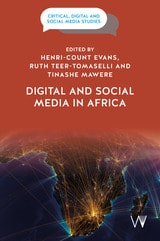
Digital and Social Media in Africa
Edited by Henri-Count Evans, Ruth Teer-Tomaselli, and Tinashe Mawere
University of Westminster Press, 2025
Further, the book examines the human rights challenges posed by state control and monitoring of digital and social media forms of communication. In the context of a digital surveillance state, it questions how digital and social media can possibly enhance the democratisation of both the communicative and political spaces.
The book focuses on questions of censorship and control of digital and social media in ‘supposedly’ democratic societies. It discusses regulation and how governments have imposed their state power by ‘switching off’ the internet and blocking social media sites under the guise of national security and order maintenance.

Disconnect
Facebook's Affective BondsTero Karppi
University of Minnesota Press, 2018
An urgent examination of the threat posed to social media by user disconnection, and the measures websites will take to prevent it
No matter how pervasive and powerful social media websites become, users always have the option of disconnecting—right? Not exactly, as Tero Karppi reveals in this disquieting book. Pointing out that platforms like Facebook see disconnection as an existential threat—and have undertaken wide-ranging efforts to eliminate it—Karppi argues that users’ ability to control their digital lives is gradually dissipating.
Taking a nonhumancentric approach, Karppi explores how modern social media platforms produce and position users within a system of coded relations and mechanisms of power. For Facebook, disconnection is an intense affective force. It is a problem of how to keep users engaged with the platform, but also one of keeping value, attention, and desires within the system. Karppi uses Facebook’s financial documents as a map to navigate how the platform sees its users. Facebook’s plans to connect the entire globe through satellites and drones illustrates the material webs woven to keep us connected. Karppi analyzes how Facebook’s interface limits the opportunity to opt-out—even continuing to engage users after their physical death. Showing how users have fought to take back their digital lives, Karppi chronicles responses like Web2.0 Suicide Machine, an art project dedicated to committing digital suicide.
For Karppi, understanding social media connectivity comes from unbinding the bonds that stop people from leaving these platforms. Disconnection brings us to the limit of user policies, algorithmic control, and platform politics. Ultimately, Karppi’s focus on the difficulty of disconnection, rather than the ease of connection, reveals how social media has come to dominate human relations.

Doing Social Media So It Matters
A Librarian's GuideLaura Solomon
American Library Association, 2011