Results by title
370 books match the query 'Spain' and 14 start with d
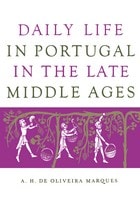
Daily Life in Portugal in the Late Middle Ages
A.H. de Oliviera Marques; Translated by S.S. Wyatt
University of Wisconsin Press, 1971
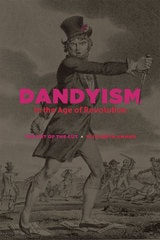
Dandyism in the Age of Revolution
The Art of the CutElizabeth Amann
University of Chicago Press, 2014
In Dandyism in the Age of Revolution, Elizabeth Amann shows that in France, England, and Spain, daring dress became a way of taking a stance toward the social and political upheaval of the period. France is the centerpiece of the story, not just because of the significance of the Revolution but also because of the speed with which its politics and fashions shifted. Dandyism in France represented an attempt to recover a political center after the extremism of the Terror, while in England and Spain it offered a way to reflect upon the turmoil across the Channel and Pyrenees. From the Hair Powder Act, which required users of the product to purchase a permit, to the political implications of the feather in Yankee Doodle’s hat, Amann aims to revise our understanding of the origins of modern dandyism and to recover the political context from which it emerged.
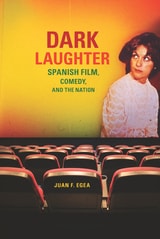
Dark Laughter
Spanish Film, Comedy, and the NationJuan F. Egea
University of Wisconsin Press, 2013
Egea begins his analysis with General Franco's dictatorship in the 1960s—a regime that opened the country to new economic forces while maintaining its repressive nature—exploring key works by Luis García Berlanga, Marco Ferreri, Fernando Fernán-Gómez, and Luis Buñuel. Dark Laughter then moves to the first films of Pedro Almodóvar in the early 1980s during the Spanish political transition to democracy before examining Alex de la Iglesia and the new dark comedies of the 1990s. Analyzing this younger generation of filmmakers, Egea traces dark comedy to Spain's displays of ultramodernity such as the Universal Exposition in Seville and the Barcelona Olympic Games.
At its core, Dark Laughter is a substantial inquiry into the epistemology of comedy, the intricacies of visual modernity, and the relationship between cinema and a wider framework of representational practices.
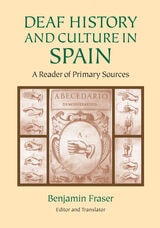
Deaf History and Culture in Spain
A Reader of Primary DocumentsBenjamin Fraser
Gallaudet University Press, 2009
In this landmark reader, Benjamin Fraser offers in five parts 44 Spanish documents dating from 1417 to the present, translated for the first time to trace the turbulent history of Deaf culture in Spain. Part I: The Birth of Oralism and Deafness as Metaphor illustrates the predominant impression of deafness as isolation, exemplified by Teresa de Cartagena writings in 1455-60 about deafness as an island. Part II: The Return to Deaf Education highlights writers who wished to restore “the Spanish ‘Art’” of educating deaf students. Lorenzo Hervás y Panduro wrote The Spanish School of Deafmutes, or Method of Teaching Them to Write and Speak the Spanish Language in 1795. Yet, Madrid’s Royal School for Deaf-Mutes, which opened in 1805, taught deaf students using methodical signs adopted from France’s Abbé de l’Epée.
Readings in Part III :The Contemporary Deaf Experience reveal considerations from the 1970s to the ‘90s of Deaf culture and linguistics similar to those in the United States, typified by the works of Inés Polo and Félix-Jesús Pinedo Peydró. The fourth part, The Recognition of Deaf Language and Culture, marks the expansion of academic research in Spain. María Angeles Rodríguez González spearheaded Spanish Sign Language (LSE) linguistics in 1992 with her publication Sign Language. The final part, A Selection of Deaf Poetry, concludes these documents with verse in Spanish spoken dialects rather than LSE, indicating that the evolution of the Deaf experience in Spain continues on its own path today.
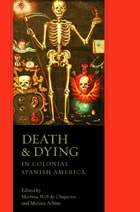
Death and Dying in Colonial Spanish America
Edited by Martina Will de Chaparro and Miruna Achim
University of Arizona Press, 2011
The variety of sources uncovered in the authors’ original archival research suggests the wide diversity of topics and approaches they employ: Nahua annals, Spanish chronicles, Inquisition case records, documents on land disputes, sermons, images, and death registers. Geographically, the range of research focuses on the viceroyalties of New Spain, Peru, and New Granada.
The resulting records—both documentary and archaeological—offer us a variety of vantage points from which to view each of these cultural groups as they came into contact with others. Much less tied to modern national boundaries or old imperial ones, the many facets of the new historical research exploring the topic of death demonstrate that no attitudes or practices can be considered either “Western” or universal.
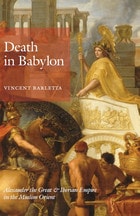
Death in Babylon
Alexander the Great and Iberian Empire in the Muslim OrientVincent Barletta
University of Chicago Press, 2010
Though Alexander the Great lived more than seventeen centuries before the onset of Iberian expansion into Muslim Africa and Asia, he loomed large in the literature of late medieval and early modern Portugal and Spain. Exploring little-studied chronicles, chivalric romances, novels, travelogues, and crypto-Muslim texts, Vincent Barletta shows that the story of Alexander not only sowed the seeds of Iberian empire but foreshadowed the decline of Portuguese and Spanish influence in the centuries to come.
Death in Babylon depicts Alexander as a complex symbol of Western domination, immortality, dissolution, heroism, villainy, and death. But Barletta also shows that texts ostensibly celebrating the conqueror were haunted by failure. Examining literary and historical works in Aljamiado, Castilian, Catalan, Greek, Latin, and Portuguese, Death in Babylon develops a view of empire and modernity informed by the ethical metaphysics of French phenomenologist Emmanuel Levinas. A novel contribution to the literature of empire building, Death in Babylon provides a frame for the deep mortal anxiety that has infused and given shape to the spread of imperial Europe from its very beginning.
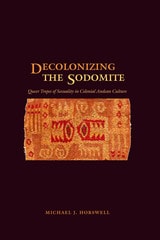
Decolonizing the Sodomite
Queer Tropes of Sexuality in Colonial Andean CultureBy Michael J. Horswell
University of Texas Press, 2006
Early Andean historiography reveals a subaltern history of indigenous gender and sexuality that saw masculinity and femininity not as essential absolutes. Third-gender ritualists, Ipas, mediated between the masculine and feminine spheres of culture in important ceremonies and were recorded in fragments of myths and transcribed oral accounts. Ritual performance by cross-dressed men symbolically created a third space of mediation that invoked the mythic androgyne of the pre-Hispanic Andes. The missionaries and civil authorities colonizing the Andes deemed these performances transgressive and sodomitical.
In this book, Michael J. Horswell examines alternative gender and sexuality in the colonial Andean world, and uses the concept of the third gender to reconsider some fundamental paradigms of Andean culture. By deconstructing what literary tropes of sexuality reveal about Andean pre-Hispanic and colonial indigenous culture, he provides an alternative history and interpretation of the much-maligned aboriginal subjects the Spanish often referred to as "sodomites." Horswell traces the origin of the dominant tropes of masculinist sexuality from canonical medieval texts to early modern Spanish secular and moralist literature produced in the context of material persecution of effeminates and sodomites in Spain. These values traveled to the Andes and were used as powerful rhetorical weapons in the struggle to justify the conquest of the Incas.
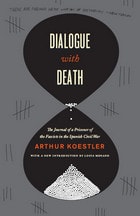
Dialogue with Death
The Journal of a Prisoner of the Fascists in the Spanish Civil WarArthur Koestler
University of Chicago Press, 2011
In 1937 during the Spanish Civil War, Arthur Koestler, a German exile writing for a British newspaper, was arrested by Nationalist forces in Málaga. He was then sentenced to execution and spent every day awaiting death—only to be released three months later under pressure from the British government. Out of this experience, Koestler wrote Darkness at Noon, his most acclaimed work in the United States, about a man arrested and executed in a Communist prison.
Dialogue with Death is Koestler’s riveting account of the fall of Málaga to rebel forces, his surreal arrest, and his three months facing death from a prison cell. Despite the harrowing circumstances, Koestler manages to convey the stress of uncertainty, fear, and deprivation of human contact with the keen eye of a reporter.
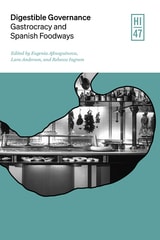
Digestible Governance
Gastrocracy and Spanish FoodwaysEdited by Eugenia Afinoguénova, Lara Anderson, and Rebecca Ingram
Vanderbilt University Press, 2024
Eliciting wide public participation, co-opted for political purposes, regarded as a factor of economic development on any scale, and integrated into every so-called banal nationalism, the production, distribution, and consumption of food are highly relevant for historical analysis. Seeking to encourage a broader discussion about Peninsular gastrocracies, this book brings together an interdisciplinary group of scholars from different sides of the Atlantic and the Pacific who have spearheaded research on gastronomy and governance in Spain.

Directory of World Cinema
SpainEdited by Lorenzo J. Torres Hortelano
Intellect Books, 2011
Though loved by moviegoers worldwide, Spanish cinema has thus far suffered from a relative lack of critical attention. Focusing on the vast corpus of films that have left their marks on generations of spectators, Directory of World Cinema: Spain returns the national cinema of Spain rightfully to the forefront with numerous full-color stills and essays establishing the key players and genres in their sociopolitical context, including civil war films, romances, comedies, and the cinema of the transition. From the award-winning big-budget productions of Pedro Almodóvar in Madrid to Pere Portabella’s experimental documentaries and the influential Barcelona School, reviews cover individual titles in considerable depth. Essential reading for aficionados of Spanish cinema at all levels, this volume provides an accessible overview of the main trends and issues in Spanish film.
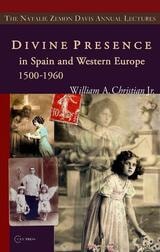
Divine Presence in Spain and Western Europe 1500–1960
Visions, Religious Images and PhotographsWilliam A. Christian Jr.
Central European University Press, 2012
Domesticating Empire
Enlightenment in Spanish AmericaKaren Stolley
Vanderbilt University Press, 2013
Through the work of five authors--Jose de Oviedo y Banos, Juan Ignacio Molina, Felix de Azara, Catalina de Jesus Herrera, and Felix de Arrate--Domesticating Empire explores the Ibero-American Enlightenment as a project that reflects both key Enlightenment concerns and the particular preoccupations of Bourbon Spain and its territories in the Americas. At a crucial moment in Spain's imperial trajectory, these authors domesticate topics central to empire--conquest, Indians, nature, God, and gold--by making them familiar and utilitarian. As a result, their works later proved resistant to overarching schemes of Latin American literary history and have been largely forgotten. Nevertheless, eighteenth-century Ibero-American writing complicates narratives about both the Enlightenment and Latin American cultural identity.
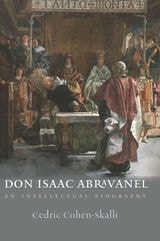
Don Isaac Abravanel
An Intellectual BiographyCedric Cohen-Skalli
Brandeis University Press, 2020
Don Isaac Abravanel (1437–1508) was one of the great inventors of Jewish modernity. A merchant, banker, and court financier, a scholar versed in both Jewish and Christian writings, a preacher and exegete, a prominent political actor in royal entourages and Jewish communities, Abravanel was one of the greatest leaders and thinkers of Iberian Jewry in the aftermath of the expulsion of 1492. This book, the first new intellectual biography of Abravanel in twenty years, depicts his life in three cultural milieus—Portugal, Castile, and post-expulsion Italy—and analyzes his major literary accomplishments in each period. Abravanel was a traditionalist with innovative ideas, a man with one foot in the Middle Ages and the other in the Renaissance. An erudite scholar, author of a monumental exegetical opus that is still studied today, and an avid book collector, he was a transitional figure, defined by an age of contradictions. Yet, it is these very contradictions that make him such an important personality for understanding the dawn of Jewish modernity.
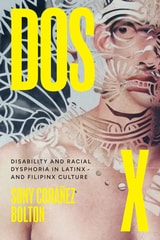
Dos X
Disability and Racial Dysphoria in Latinx and Filipinx CultureSony Coráñez Bolton
University of Texas Press, 2025
An examination of the interconnectedness of brown-racialized people across multiple identities, told through case studies of television, literature, and writing.
As a Filipinx immigrant to the United States, Sony Coráñez Bolton has frequently been mistaken as Mexican. Dos X theorizes such misrecognition. What does it mean to exist in this liminal state, which Coráñez Bolton dubs the “racial uncanny”? What generative possibilities emerge from the presumed interchangeability of Latinx and Filipinx bodies—and from the in-betweenness of brownness as such?
Dos X tracks misrecognition through cultural products like the TV series Undone, Brian Ascalon Roley’s American Son, and the nonfiction work of Jose Antonio Vargas. Misrecognition, Coráñez Bolton argues, produces moments of uncanniness in which subjects experience dysphoric attachments to identities that aren’t supposed to be theirs. In the context of racial capitalism, racial dysphoria is a disability because it undermines certainty about what one’s body is and therefore what role one is meant to play as a laborer. But racial dysphoria can also be revealing. Coráñez Bolton identifies vast potential in this supposed disability, which compels its “sufferers” to confront their shared position within the social, political, and economic organization of capital’s empire, opening new avenues for liberatory solidarity.