Results by title
660 books match the query 'Texas' and 25 start with d

DJ Screw
A Life in Slow RevolutionLance Scott Walker
University of Texas Press, 2022
DJ Screw, a.k.a. Robert Earl Davis Jr., changed rap and hip-hop forever. In the 1990s, in a spare room of his Houston home, he developed a revolutionary mixing technique known as chopped and screwed. Spinning two copies of a record, Screw would “chop” in new rhythms, bring in local rappers to freestyle over the tracks, and slow the recording down on tape. Soon Houstonians were lining up to buy his cassettes—he could sell thousands in a single day. Fans drove around town blasting his music, a sound that came to define the city’s burgeoning and innovative rap culture. June 27 has become an unofficial city holiday, inspired by a legendary mix Screw made on that date.
Lance Scott Walker has interviewed nearly everyone who knew Screw, from childhood friends to collaborators to aficionados who evangelized Screw’s tapes—millions of which made their way around the globe—as well as the New York rap moguls who honored him. Walker brings these voices together with captivating details of Screw’s craft and his world. More than the story of one man, DJ Screw is a history of the Houston scene as it came of age, full of vibrant moments and characters. But none can top Screw himself, a pioneer whose mystique has only grown in the two decades since his death.
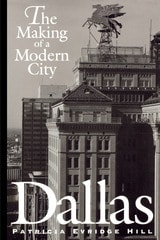
Dallas
The Making of a Modern CityBy Patricia Evridge Hill
University of Texas Press, 1996
From the ruthless deals of the Ewing clan on TV's "Dallas" to the impeccable customer service of Neiman-Marcus, doing business has long been the hallmark of Dallas. Beginning in the 1920s and 1930s, Dallas business leaders amassed unprecedented political power and civic influence, which remained largely unchallenged until the 1970s.
In this innovative history, Patricia Evridge Hill explores the building of Dallas in the years before business interests rose to such prominence (1880 to 1940) and discovers that many groups contributed to the development of the modern city. In particular, she looks at the activities of organized labor, women's groups, racial minorities, Populist and socialist radicals, and progressive reformers—all of whom competed and compromised with local business leaders in the decades before the Great Depression.
This research challenges the popular view that business interests have always run Dallas and offers a historically accurate picture of the city's development. The legacy of pluralism that Hill uncovers shows that Dallas can accommodate dissent and conflict as it moves toward a more inclusive public life. Dallas will be fascinating and important reading for all Texans, as well as for all students of urban development.
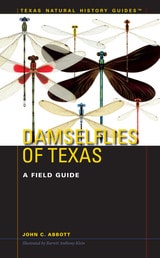
Damselflies of Texas
A Field GuideBy John C. Abbott
University of Texas Press, 2011
On any warm summer day, you can easily observe damselflies around a vegetated pond or the rocks along the banks of a stream. Like the more familiar dragonfly, damselflies are among the most remarkably distinctive insects in their appearance and biology, and they have become one of the most popular creatures sought by avocational naturalists.
Damselflies of Texas is the first field guide dedicated specifically to the species found in Texas. It covers 77 of the 138 species of damselflies known in North America, making it a very useful guide for the entire United States. Each species account includes:
- illustrations of as many forms (male, female, juvenile, mature, and color morphs) as possible
- common and scientific names, with pronunciation
- distribution map
- key features
- identifying characteristics
- discussion of similar species
- status in Texas
- habitat, seasonality, and general comments
In addition to photographing damselflies in the wild, the author and illustrator have developed a new process for illustrating each species by scanning preserved specimens and digitally painting them. The resulting illustrations show detail that is not visible in photographs. The book also contains chapters on damselfly anatomy, life history, conservation, names, and photography, as well as a list of species that may eventually be discovered in Texas, state and global conservation rankings, seasonality of all species in chronological order, and additional resources and publications on the identification of damselflies.
Dance a Little Longer
The Third Novel in a TrilogyJane Roberts Wood
University of North Texas Press, 2000
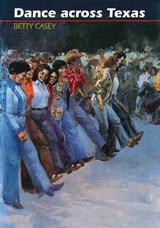
Dance across Texas
By Betty Casey
University of Texas Press, 1985
Generations of Texans have believed that “to dance is to live.” At rustic “play parties” and elegant cotillions, in tiny family dance halls and expansive urban honky-tonks, from historic beginnings to next Saturday night, Texans have waltzed, polkaed, schottisched, and shuffled their way across the state.
In Dance across Texas, internationally known dance instructor and writer Betty Casey takes an informal look at the history of Texas dancing and, in clear diagrams, photos, and detailed instructions, tells “how to” do more than twenty Texas dances.
Previously, little had been recorded about the history of dancing on the frontier. Journal and diary entries, letters, and newspaper clippings preserve enticing, if sketchy, descriptions of the types of dances that were popular. Casey uses a variety of sources, including interviews and previously unpublished historical materials, such as dance cards, invitations, and photographs, to give us a delightful look at the social context of dance. The importance of dance to early Texans is documented through colorful descriptions of clothing worn to the dances, of the various locations where dances were held, ranging from a formal hall to a wagon sheet spread on the ground, and of the hardships endured to get to a dance.
Also included in the historical section of Dance across Texas are notes on the “morality” of dance, the influence of country music on modern dance forms, and the popularity of such Texas dance halls and clubs as Crider’s and Gilley’s.
The instruction section of the book diagrams twenty-two Texas dances, including standard waltzes and two-steps as well as the Cotton-Eyed Joe, Put Your Little Foot, Herr Schmidt, the Western Schottische, and such “whistle’” or mixer dances as Paul Jones, Popcorn, and Snowball. Clear and detailed directions for each dance, along with suggested musical selections, accompany the diagrams and photos. Dance and physical education teachers and students will find this section invaluable, and aspiring urban cowboys can follow the easy-to-read diagrammed footsteps to a satisfying spin around the honky-tonk floor. Anyone interested in dance or in the history of social customs in Texas will find much to enjoy in this refreshing and often amusing look at a Texas “national” pastime.
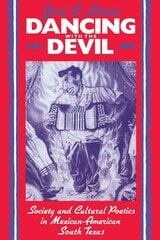
Dancing with the Devil
Society and Cultural Poetics in Mexican-American South TexasJose Limon
University of Wisconsin Press, 1994
Combining shrewd applications of current cultural theory with compelling autobiography and elegant prose, José E. Limón works at the intersection of anthropology, folklore, popular culture, history, and literary criticism. A native of South Texas, he renders a historical and ethnographic account of its rich Mexican-American folk culture. This folk culture, he shows—whether expressed through male joking rituals, ballroom polka dances, folk healing, or eating and drinking traditions—metaphorically dances with the devil, both resisting and accommodating the dominant culture of Texas.
Critiquing the work of his precursors— John Gregory Bourke, J. Frank Dobie, Jovita Gonzalez, and Americo Paredes—Limón deftly demonstrates that their accounts of Mexican-Americans in South Texas contain race, class, and gender contradictions, revealed most clearly in their accounts of the folkloric figure of the devil. Limón's own field-based ethnography follows, and again the devil appears as a recurrent motif, signaling the ideological contradictions of folk practices in a South Texas on the verge of postmodernity.

Danger All Around
Waste Storage Crisis on the Texas and Louisiana Gulf CoastBy Joel B. Goldsteen
University of Texas Press, 1993
The problem of where to store waste has grabbed a lot of headlines, but people have been slow to realize that the environmental damage caused by storage sites is an even greater menace. This book makes the danger clear, as Joel Goldsteen offers the first comprehensive look at the selection and environmental impact of municipal and petrochemical waste storage sites along the Texas and Louisiana coasts.
Goldsteen has distilled a large landfill-worth of data into a highly readable account of the creation and regulation of waste disposal sites, the health issues that surround them, and the human and natural factors that affect how safe or dangerous they become. Chapters that describe industrial development along the Gulf Coast and the concurrent challenges of wastewater treatment, solid waste management, and hazardous waste control are followed by in-depth descriptions of nine Texas and four Louisiana sites, all representative of problems far beyond the Texas-Louisiana coast.
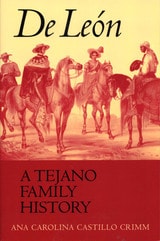
De León, a Tejano Family History
By Ana Carolina Castillo Crimm
University of Texas Press, 2003
Winner, Presidio La Bahia Award, 2004
San Antonio Conservation Society Citation, 2005
La familia de León was one of the foundation stones on which Texas was built. Martín de León and his wife Patricia de la Garza left a comfortable life in Mexico for the hardships and uncertainties of the Texas frontier in 1801. Together, they established family ranches in South Texas and, in 1824, the town of Victoria and the de León colony on the Guadalupe River (along with Stephen F. Austin's colony, the only completely successful colonization effort in Texas). They and their descendents survived and prospered under four governments, as the society in which they lived evolved from autocratic to republican and the economy from which they drew their livelihood changed from one of mercantile control to one characterized by capitalistic investments.
Combining the storytelling flair of a novelist with a scholar's concern for the facts, Ana Carolina Castillo Crimm here recounts the history of three generations of the de León family. She follows Martín and Patricia from their beginnings in Mexico through the establishment of the family ranches in Texas and the founding of the de León colony and the town of Victoria. Then she details how, after Martín's death in 1834, Patricia and her children endured the Texas Revolution, exile in New Orleans and Mexico, expropriation of their lands, and, after returning to Texas, years of legal battles to regain their property. Representative of the experiences of many Tejanos whose stories have yet to be written, the history of the de León family is the story of the Tejano settlers of Texas.

Dear Dirt Doctor
Questions Answered the Natural WayBy Howard Garrett
University of Texas Press, 2003
Howard Garrett has converted gardeners throughout Texas and beyond to gardening the natural way without chemical fertilizers and toxic pesticides. In this revised and updated edition of The Dirt Doctor's Guide to Organic Gardening, he uses a question-and-answer format to present a wealth of new information on organic gardening, landscaping, pest control, and natural living. The book also incorporates valuable feedback and suggestions from gardeners who've successfully used Howard's methods.
Death Lore
Texas Rituals, Superstitions, and Legends of the HereafterKenneth L. Untiedt
University of North Texas Press, 2008

Death of a Department Chair
A NovelLynn C. Miller
University of Wisconsin Press, 2006

Death on Base
The Fort Hood MassacreAnita Belles Porterfield
University of North Texas Press, 2015
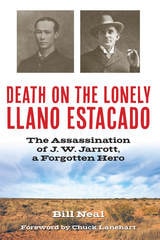
Death on the Lonely Llano Estacado
The Assassination of J. W. Jarrott, a Forgotten HeroBill Neal
University of North Texas Press, 2017

Deciding To Be Legal
A Maya Community in HoustonJacqueline Hagan
Temple University Press, 1994
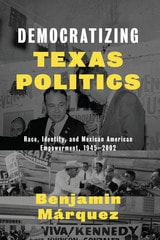
Democratizing Texas Politics
Race, Identity, and Mexican American Empowerment, 1945-2002By Benjamin Márquez
University of Texas Press, 2014
Winner, Outstanding Book Award, NACCS Tejas Foco Award for Non-Fiction, National Association for Chicana and Chicano Studies Tejas, 2015
By the beginning of the twenty-first century, Texas led the nation in the number of Latino officeholders, despite the state’s violent history of racial conflict. Exploring this and other seemingly contradictory realities of Texas’s political landscape since World War II, Democratizing Texas Politics captures powerful, interrelated forces that drive intriguing legislative dynamics. These factors include the long history of Mexican American activism; population growth among Mexican American citizens of voting age; increased participation among women and minorities at state and national levels in the Democratic Party, beginning in the 1960s; the emergence of the Republican Party as a viable alternative for Southern conservatives; civil rights legislation; and the transition to a more representative two-party system thanks to liberal coalitions.
Culling extensive archival research, including party records and those of both Latino activists and Anglo elected officials, as well as numerous interviews with leading figures and collected letters of some of Texas’s most prominent voices, Benjamin Márquez traces the slow and difficult departure from a racially uniform political class to a diverse one. As Texas transitioned to a more representative two-party system, the threat of racial tension and political exclusion spurred Mexican Americans to launch remarkably successful movements to ensure their incorporation. The resulting success and dilemmas of racially based electoral mobilization, embodied in pivotal leaders such as Henry B. Gonzalez and Tony Sanchez, is vividly explored in Democratizing Texas Politics.
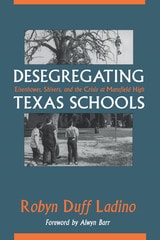
Desegregating Texas Schools
Eisenhower, Shivers, and the Crisis at Mansfield HighBy Robyn Duff Ladino
University of Texas Press, 1996
In the famous Brown v. the Board of Education decisions of 1954 and 1955, the United States Supreme Court ruled that "separate but equal" schools for black and white students were unconstitutional. Yet history records that it took more than a decade of legal battles, civil rights protests, and, tragically, violent confrontations before black students gained full access to previously white schools.
Mansfield, Texas, a small community southeast of Fort Worth, was the scene of an early school integration attempt. In this book, Robyn Duff Ladino draws on interviews with surviving participants, media reports, and archival research to provide the first full account of the Mansfield school integration crisis of 1956.
Ladino explores how power politics at the local, state, and federal levels ultimately prevented the integration of Mansfield High School in 1956. Her research sheds new light on the actions of Governor Allan Shivers—who, in the eyes of the segregationists, actually validated their cause by his political actions—and it underscores President Dwight Eisenhower's public passivity toward civil rights during his first term of office.
Despite the short-term failure, however, the Mansfield school integration crisis helped pave the way for the successful integration of Central High School in Little Rock, Arkansas, in 1957. Thus, it deserves a permanent place in the history of the civil rights movement, which this book amply provides.

Desire to Serve
The Autobiography of Congresswoman Eddie Bernice JohnsonCheryl Wattley
University of North Texas Press, 2024
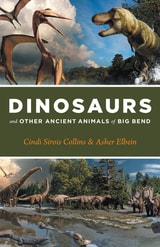
Dinosaurs and Other Ancient Animals of Big Bend
Cindi Sirois Collins and Asher Elbein
University of Texas Press, 2023
A time-traveling field guide to the ancient version of Big Bend National Park.
The sheer beauty of Big Bend National Park, along the shores of the Rio Grande in west Texas, never fails to astonish. Yet what lies beneath this natural treasure may be even more extraordinary than what meets the eye. Hidden in the rocks of Big Bend are the remains of giants: toothy sea lizards, enormous flying reptiles, and dinosaurs.
Dinosaurs and Other Ancient Animals of Big Bend is a field guide to what once was. Inspired by the latest research, Cindi Sirois Collins and Asher Elbein imagine what it was like to walk among the plants and animals whose fossil remains tell the story of evolution and geological transformation in this singular landscape. We glimpse the drama of Big Bend’s rugged landscape in creation—the desert’s emergence from retreating oceans and volcanic eruptions. Immersive vignettes introduce dinosaurs, giant fish, and saber-toothed cats. And the history of discovery in the park proves a gripping tale, as paleontologists sifted major scientific insights from the soils, rocks, and riverbeds. Complete with vivid illustrations, this is a wholly original sensory and narrative experience that will deepen any reader’s knowledge and sense of wonder.
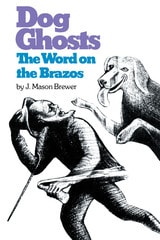
Dog Ghosts and The Word on the Brazos
Negro Preacher Tales from the Brazos Bottoms of TexasBy J. Mason Brewer
University of Texas Press, 1976
This book contains two volumes of African American folk tales collected by J. Mason Brewer.
The stories included in Dog Ghosts are as varied as the Texas landscape, as full of contrasts as Texas weather. Among them are tales that have their roots deeply imbedded in African, Irish, and Welsh mythology; others have parallels in pre-Columbian Mexican tradition, and a few have versions that can be traced back to Chaucer's England. All make delightful reading. The title Dog Ghosts is drawn from the unique stories of dog spirits which Dr. Brewer collected in the Red River bottoms and elsewhere in Texas.
The Word on the Brazos is a delightful collection of "preacher tales" from the Brazos River bottom in Texas. J. Mason Brewer worked side by side with field hands in the Brazos bottoms; he lived in their homes, worshipped in their churches, and shared the moments of relaxation in which laughter held full sway.
Many of the tales these people told were related to religion—both "good religion" and "bad religion." Some of them concerned preachers and their families, while others were stories told in pulpits. Mr. Brewer has set all of these stories down in authentic yet easily readable dialect. They will delight all who are interested in the historic culture of rural African-American Texans, as well as those who simply enjoy fine humorous stories skillfully told.
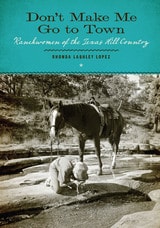
Don’t Make Me Go to Town
Ranchwomen of the Texas Hill CountryBy Rhonda Lashley Lopez
University of Texas Press, 2011
Many people dream of "someday buying a small quaint place in the country, to own two cows and watch the birds," in the words of Texas ranchwoman Amanda Spenrath Geistweidt. But only a few are cut out for the unrelenting work that makes a family ranching operation successful. Don't Make Me Go to Town presents an eloquent photo-documentary of eight women who have chosen to make ranching in the Texas Hill Country their way of life. Ranging from young mothers to elderly grandmothers, these women offer vivid accounts of raising livestock in a rugged land, cut off from amenities and amusements that most people take for granted, and loving the hard lives they've chosen.
Rhonda Lashley Lopez began making photographic portraits of Texas Hill Country ranchwomen in 1993 and has followed their lives through the intervening years. She presents their stories through her images and the women's own words, listening in as the ranchwomen describe the pleasures and difficulties of raising sheep, Angora goats, and cattle on the Edwards Plateau west of Austin and north of San Antonio. Their stories record the struggles that all ranchers face—vagaries of weather and livestock markets, among them—as well as the extra challenges of being women raising families and keeping things going on the home front while also riding the range. Yet, to a woman, they all passionately embrace family ranching as a way of life and describe their efforts to pass it on to future generations.

Dragonflies of Texas
A Field GuideBy John C. Abbott
University of Texas Press, 2015
Dragonflies and damselflies (together known as Odonata) are among the most remarkably distinctive insects in their appearance and biology, and they have become some of the most popular creatures sought by avocational naturalists. Texas hosts 160 species of dragonflies, nearly half of the 327 species known in North America, making the state a particularly good place to observe dragonflies in their natural habitats.
Dragonflies of Texas is the definitive field guide to these insects. It covers all 160 species with in situ photographs and detailed anatomical images as needed. Each species is given a two-page spread that includes photographs of both sexes and known variations when possible, key features, a distribution map, identification, discussion of similar species, status in Texas, habitat, seasonality, and general comments. Many of the groups also have comparative plates that show anatomically distinctive characteristics. In addition to the species accounts, John Abbott discusses dragonfly anatomy, life history, conservation, names, and photography. He also provides information on species that may eventually be discovered in Texas, state and global conservation rankings, seasonality of all species in chronological order, and additional resources and publications on the identification of dragonflies.
Dreams and Ideas
The Artistry of Costume Designer Winn MortonMyra Walker
University of North Texas Press, 2026

Drug War Zone
Frontline Dispatches from the Streets of El Paso and JuárezBy Howard Campbell
University of Texas Press, 2009
Winner, Southwest Book Award, Border Regional Library Association, 2011
Thousands of people die in drug-related violence every year in Mexico. Ciudad Juárez, Chihuahua, adjacent to El Paso, Texas, has become the most violent city in the Mexican drug war. Much of the cocaine, marijuana, and methamphetamine consumed in the United States is imported across the Mexican border, making El Paso/Juárez one of the major drug-trafficking venues in the world.
In this anthropological study of drug trafficking and anti-drug law enforcement efforts on the U.S.-Mexico border, Howard Campbell uses an ethnographic perspective to chronicle the recent Mexican drug war, focusing especially on people and events in the El Paso/Juárez area. It is the first social science study of the violent drug war that is tearing Mexico apart.
Based on deep access to the drug-smuggling world, this study presents the drug war through the eyes and lives of direct participants. Half of the book consists of oral histories from drug traffickers, and the other half from law enforcement officials. There is much journalistic coverage of the drug war, but very seldom are the lived experiences of traffickers and "narcs" presented in such vivid detail. In addition to providing an up-close, personal view of the drug-trafficking world, Campbell explains and analyzes the functioning of drug cartels, the corruption that facilitates drug trafficking, the strategies of smugglers and anti-narcotics officials, and the perilous culture of drug trafficking that Campbell refers to as the "Drug War Zone."

Duchess of Palms
A MemoirBy Nadine Eckhardt
University of Texas Press, 2009
A “fifties girl” tells the fascinating story of her marriages to novelist Billy Lee Brammer and Congressman Bob Eckhardt, and how these relationships propelled her into the multifaceted life she led on her own terms.
Child of the Great Depression, teenage "Duchess of Palms" beauty queen, wife of an acclaimed novelist and later of a brilliant U.S. congressman, and ultimately a successful single working woman and mother, Nadine Eckhardt has lived a fascinating life. In this unique, funny, and honest memoir, she recounts her journey from being a "fifties girl" who lived through the men in her life to becoming a woman in her own right, working toward her own goals.
Eckhardt's first marriage to writer Billy Lee Brammer gave her entrée to liberal political and literary circles in Austin and Washington, where she and Brammer both worked for Senator Lyndon B. Johnson. She describes the heady excitement of LBJ's world—a milieu that Brammer vividly captured in his novel The Gay Place. She next recalls her second marriage to Bob Eckhardt, whom she helped get elected to the U.S. House of Representatives, as well as her growing involvement with the counterculture of social protest, sexual revolution, and drug use. Eckhardt honestly recounts how the changing times changed her perception of herself, recalling that "I didn't know how to achieve for myself, only for others, and I felt ripped off and empty." This painful realization opened the door to a new life for Eckhardt. Her memoir concludes with a joyful description of her multifaceted later life as a restaurateur, assistant to Molly Ivins, writer, and center of a wide circle of friends.
Duval County Tejanos
An Epic narrative of Liberty and DemocracyAlfredo Cardenas
University of North Texas Press, 2024