80 books match the query 'Transition' and 5 start with d

cover of Dale L. Morgan: Mormon and Western Histories in Transition

Dale L. Morgan

Mormon and Western Histories in Transition

Richard L. Saunders

University of Utah Press, 2023

This is the first biography of Dale L. Morgan, preeminent Western historian of the fur trade, historic trails, and the Latter Day Saint movement. The book explores how, despite personal struggles, Morgan committed his life to tracking down sources and interpreting the past on the strength of documentary evidence. Connecting Morgan’s life with some of the broad cultural changes that shaped his experiences, this book engages with methodological shifts in the historical profession, the mid-twentieth-century collision of interpretations within Latter Day Saint history, and the development of a descriptive, scholarly approach to that history.
 
Morgan’s body of work and commitment to serious scholarship signaled the start of new ways of understanding, studying, and retelling history, and he motivated a generation of historians from the 1930s to the 1970s to transform their historical approaches. Sounding board, mentor, and close friend to Nels Anderson, Fawn Brodie, Juanita Brooks, Bernard DeVoto, Wallace Stegner, and Leonard Arrington, Dale Morgan is the common factor linking this influential generation of mid-twentieth-century historians of western America.
[more]
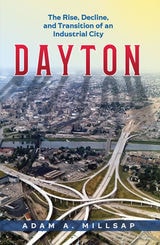
cover of Dayton: The Rise, Decline, and Transition of an Industrial City

Dayton

The Rise, Decline, and Transition of an Industrial City

Adam A. Millsap

The Ohio State University Press, 2019

The Rust Belt was once the crown of American manufacturing, a symbol of the country’s economic prowess. But now it is named for what it has become: a deteriorating stretch of industrial cities left behind by a post-industrial world. In Dayton: The Rise, Decline, and Transition of an Industrial City, Adam A. Millsap turns his focus to his hometown, an archetypal Rust Belt city, to examine its history and discuss its future.
Thoroughly researched and engagingly written, Millsap’s book explores the economic background of the region made famous by J. D. Vance’s Hillbilly Elegy. From early twentieth-century optimism, through the Great Depression and post-WWII manufacturing decline, to Dayton now, with its labor-force problems and opioid crisis, Millsap tracks the underlying forces driving the city’s trajectory. Race relations, interstates, suburbanization, climate, crime, geography, and government policies all come into play as Millsap develops a picture of the city, past and present. By examining the past, Millsap proposes a plan for the future, claiming that there is hope for Dayton to thrive again. And if Dayton can rise from its industrial ashes, then perhaps the Rust Belt can shed its stigma and once again become the backbone of American innovation.
 
[more]
cover of Dead Ends of Transition: Rentier Economies and Protectorates

Dead Ends of Transition

Rentier Economies and Protectorates

Edited by Michael Dauderstädt and Arne Schildberg

Campus Verlag, 2006

After war, many countries, such as Bosnia, Kosovo, Afghanistan, or Iraq, the transition to a democratic market economy extremely difficult. This failure to thrive, Dead Ends of Transition demonstrates, is often the result of national reliance on foreign aid. Rentier states, the contributors to this study argue, have few incentives to respond to the needs of their societies. Taking a closer look at the policies of rentier economies, this book further identifies new ways in which these countries and their international partners could work together to ease the critical transition to democracy.
[more]
cover of Deficit and Debt in Transition: The Political Economy of Public Finances in Central and Eastern Europe

Deficit and Debt in Transition

The Political Economy of Public Finances in Central and Eastern Europe

Istvan Benczes

Central European University Press, 2014
The adjustment problems of public finance in countries of Central and Eastern Europe (CEE) are often misunderstood and misinterpreted by western scholars. This book contributes to the bridging of the gap between what is being thought by external observers and what the actual public finance reality is, as described by competent local scholars. Popular political economy research has remained biased towards advanced countries and has neglected developing and transition economies. Publications on CEE countries' public finances seem to be reluctant to apply the conceptual framework of standard political economy to these countries because of the assumption that CEE economies are different from their Western peers. But is this really the case? Are CEE economies so much different that none of the well-known "Western" political economy concepts or models can be applied to the analysis of fiscal performance in the region? Benczes demonstrates that they can be safely applied in the context of CEE economies as well. He sees no need to develop a separate or unique theory designed for the study and understanding of (one-time) transition economies.
[more]
cover of Defusing Democracy: Central Bank Autonomy and the Transition from Authoritarian Rule

Defusing Democracy

Central Bank Autonomy and the Transition from Authoritarian Rule

Delia M. Boylan

University of Michigan Press, 2001

Many of today's new democracies are constrained by institutional forms designed by previous authoritarian rulers. In this timely and provocative study, Delia M. Boylan traces the emergence of these vestigial governance structures to strategic behavior by outgoing elites seeking to protect their interests from the vicissitudes of democratic rule.
One important outgrowth of this political insulation strategy--and the empirical centerpiece of Boylan's analysis--is the existence of new, highly independent central banks in countries throughout the developing world. This represents a striking transformation, for not only does central bank autonomy remove a key aspect of economic decision making from democratic control; in practice it has also kept many of the would-be expansionist governments that hold power today from overturning the neoliberal policies favored by authoritarian predecessors.
To illustrate these points, Defusing Democracy takes a fresh look at two transitional polities in Latin America--Chile and Mexico--where variation in the proximity of the democratic "threat" correspondingly yielded different levels of central bank autonomy.
Boylan concludes by extending her analysis to institutional contexts beyond Latin America and to insulation strategies other than central bank autonomy. Defusing Democracy will be of interest to anyone--political scientists, economists, and policymakers alike--concerned about the genesis and consolidation of democracy around the globe.
Delia M. Boylan is Assistant Professor, Harris Graduate School of Public Policy Studies, University of Chicago.
[more]