Results by title
147 books match the query 'Urban & Land Use Planning' and 8 start with d
Data as Infrastructure for Smart Cities
Larissa Suzuki
The Institution of Engineering and Technology, 2019
Dayton
The Rise, Decline, and Transition of an Industrial CityAdam A. Millsap
The Ohio State University Press, 2019
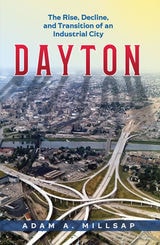
Thoroughly researched and engagingly written, Millsap’s book explores the economic background of the region made famous by J. D. Vance’s Hillbilly Elegy. From early twentieth-century optimism, through the Great Depression and post-WWII manufacturing decline, to Dayton now, with its labor-force problems and opioid crisis, Millsap tracks the underlying forces driving the city’s trajectory. Race relations, interstates, suburbanization, climate, crime, geography, and government policies all come into play as Millsap develops a picture of the city, past and present. By examining the past, Millsap proposes a plan for the future, claiming that there is hope for Dayton to thrive again. And if Dayton can rise from its industrial ashes, then perhaps the Rust Belt can shed its stigma and once again become the backbone of American innovation.
Deconstructing the High Line
Postindustrial Urbanism and the Rise of the Elevated ParkLindner, Christoph
Rutgers University Press, 2017
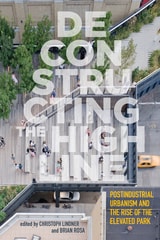
The High Line, an innovative promenade created on a disused elevated railway in Manhattan, is one of the world’s most iconic new urban landmarks. Since the opening of its first section in 2009, this unique greenway has exceeded all expectations in terms of attracting visitors, investment, and property development to Manhattan’s West Side. Frequently celebrated as a monument to community-led activism, adaptive re-use of urban infrastructure, and innovative ecological design, the High Line is being used as a model for numerous urban redevelopment plans proliferating worldwide.
Deconstructing the High Line is the first book to analyze the High Line from multiple perspectives, critically assessing its aesthetic, economic, ecological, symbolic, and social impacts. Including several essays by planners and architects directly involved in the High Line’s design, this volume also brings together a diverse range of scholars from the fields of urban studies, geography, anthropology, sociology, and cultural studies. Together, they offer insights into the project’s remarkable success, while also giving serious consideration to the critical charge that the High Line is “Disney World on the Hudson,” a project that has merely greened, sanitized, and gentrified an urban neighborhood while displacing longstanding residents and businesses.
Deconstructing the High Line is not just for New Yorkers, but for anyone interested in larger issues of public space, neoliberal redevelopment, creative design practice, and urban renewal.
Design for London
Experiments in Urban ThinkingEdited by Peter Bishop and Lesley Williams
University College London, 2020
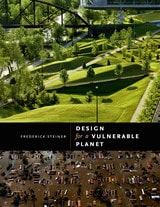
Design for a Vulnerable Planet
By Frederick Steiner
University of Texas Press, 2011
We inhabit a vulnerable planet. The devastation caused by natural disasters such as the southern Asian tsunami, Hurricanes Katrina and Ike, and the earthquakes in China's Sichuan province, Haiti, and Chile—as well as the ongoing depletion and degradation of the world's natural resources caused by a burgeoning human population—have made it clear that "business as usual" is no longer sustainable. We need to find ways to improve how we live on this planet while minimizing our impact on it. Design for a Vulnerable Planet sounds a call for designers and planners to go beyond traditional concepts of sustainability toward innovative new design that fosters regeneration and resilience.
Drawing on his own and others' experiences across three continents, Frederick Steiner advocates design practice grounded in ecology and democracy and informed by critical regionalism and reflection. He begins by establishing the foundation for a more ecological approach to planning and design, adopting a broad view of ecology as encompassing human and natural, urban and wild environments. Steiner explores precedents for human ecological design provided by architect Paul Cret, landscape architect Ian McHarg, and developer George Mitchell while discussing their planning for the University of Texas campus, the Lake Austin watershed, and The Woodlands. Steiner then focuses on emerging Texas urbanism and extends his discussion to broader considerations beyond the Lone Star State, including regionalism, urbanism, and landscape in China and Italy. He also examines the lessons to be learned from human and natural disasters such as 9/11, Hurricane Katrina, and the BP oil spill. Finally, Steiner offers a blueprint for designing with nature to help heal the planet's vulnerabilities.
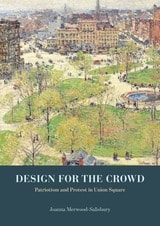
Design for the Crowd
Patriotism and Protest in Union SquareJoanna Merwood-Salisbury
University of Chicago Press, 2019
In this sweeping history of an iconic urban square, Merwood-Salisbury gives us a review of American political activism, philosophies of urban design, and the many ways in which a seemingly stable landmark can change through public engagement and design.
Published with the support of Furthermore: a program of the J. M. Kaplan Fund.
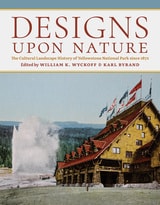
Designs upon Nature
The Cultural Landscape History of Yellowstone National Park since 1872William K. Wyckoff
University of Wyoming Press, 2025
Chapters in the book follow the park’s traditional “Grand Tour,” which often began for visitors at park headquarters at Mammoth Hot Springs and then moved on to Old Faithful and the Upper Geyser Basin, the glistening waters of Yellowstone Lake, the unforgettable waterfalls of the Yellowstone River’s Grand Canyon, and the western hospitality found at Roosevelt Lodge near Tower Falls. Authors consider how visitor experiences and cultural landscapes within the park have changed dramatically since 1872. Early horseback trips were replaced by an era of railroad tourism and grand hotels. The later arrival of automobiles invited a more casual visitor experience among rustic lodges and campgrounds. Travel accommodations for the twenty-first-century visitor continue to affect cultural landscapes through larger parking lots and further road improvements. The result is indeed a “design upon nature,” an engineered imprint upon a wild place that has forever shaped and changed its character.
Designs upon Nature is a rich and nuanced narrative that encourages us to see the park in a way we never have before. It is a significant addition to our understanding of Yellowstone and the evolution of the national park idea as seen there—how experiencing wild nature is made possible by human designs upon the land.
Dialectic II
Shundana The School of Architecture Univ of Utah
University of Utah Press, 2014
The second issue of Dialectic, “Architecture between Boom and Bust,” is dedicated to the question of economy. While the boom of the 1990s and 2000s made architects and media designers the epitome of the urban creative class, the credit crunch and economic downturn of 2008 dramatically shrunk the profession. With the collapse of the U.S. housing market arguably the trigger for global financial and economic crisis, the building industry became a primary victim. All this has directly affected architects, whose fees are linked to building costs and built volume.
Dramatic economic turns, while involving individual hardship, are nevertheless great indices for making visible the immanent connections of the discipline to the marketplace. They challenge our understanding of what it means “to architect.” The history of the architecture profession in the twentieth century bears witness to the attempts of the Modern Movement to bring the elite cultural products to the ordinary person. Architects in the 1960s critiqued the paternalism of their disciplinary forebears and interrogated the role of an architect both as a social engineer and as a moderator of participatory design. The accompanying post-modern turn to semiotics and imagery moved the discipline to the opposite position of “art for art’s sake.” The public learned to expect extravagant signature buildings, formal experiments and endless artistic ingenuity. With this, they traded the role of the architect as a keeper of a common good for a celebrity figure who would bring global fame and tourists to their communities. Now, following the economic downturn in 2008, what may we expect from the next calibration of architecture to society?