Results by title
331 books match the query 'World Literature' and 9 start with d

Dare the Sea
StoriesAli Hosseini
Northwestern University Press, 2023
Debut short-story collection in English from acclaimed fiction writer Ali Hosseini, named a Favorite Short Story Collection of 2023 by the Chicago Review of Books
The stories in Dare the Sea explore Iran’s landscape, culture, and the undercurrent of change affecting its people—both in Iran and the United States. The stories in the first half of the collection are set in Iran in the time before and just after the Iranian Revolution of 1979. Each tale discloses the obstacles rural Iranians lived with on a daily basis and the exigencies of survival: petty theft, corruption, drug trafficking, religion, and love. Stories in the second half take place in exile, where characters are seemingly dropped into American locales like the Midwest or Hawaii, taking in their situation with only the survival skills they’ve learned in their own land and enduring the hardships of being strangers in a new country.
Loosely interconnected by reappearing characters, the stories in Dare the Sea are strongly linked by the country of Iran, its landscape, its history, and its hold on its people.
[more]
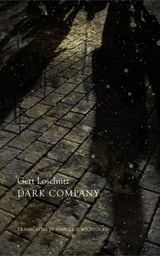
Dark Company
A Novel in Ten Rainy NightsGert Loschütz
Seagull Books, 2012
Over ten rainy nights, Thomas, an ex-bargeman who used to be skipper of his own boat, walks the muddy fields of the landlocked German interior and remembers the events that lost him his home, his boat, and his livelihood: his apprenticeship in the cold halls of the Royal Naval College in London; the dangers of the mean streets and waterfront of New York in the 1970s, and Poland under martial law; Germany after the reunification, when for a year or so it seemed that the whole country drifted rudderless, drawn by the current of history to who knows where. Thomas remembers childhood, his first love, and the warnings of his grandfather: Beware the dark company! This mysterious band of men and women dressed in black cast a shadow over his story, as he wrestles with the secrets, the unplumbed depths of his soul, the hazards lurking below a seemingly placid surface, and throughout it all, the rain, falling night after night. Dark Company is a superb example of a distinctly German tradition in weird fiction which claims its roots in Kafka and Herbert Rosendorfer.
[more]

Death and the Dervish
Mesa Selimovic
Northwestern University Press, 1996
Death and the Dervish is an acclaimed novel by Bosnian writer Mesa Selimovic. It recounts the story of Sheikh Nuruddin, a dervish residing in an Islamic monastery in Sarajevo in the eighteenth century during the Ottoman Turk hegemony over the Balkans. When his brother is arrested, he must descend into the Kafkaesque world of the Ottoman authorities in his search to discover what happened to him. He narrates his story in the form of an elaborate suicide note, regularly misquoting the Koran. In time, he begins to question his relations with society as a whole and, eventually, his life choices in general.
Hugely successful when published in the 1960s, Death and the Dervish is an enduring classic made into a feature length film in 1974.
Hugely successful when published in the 1960s, Death and the Dervish is an enduring classic made into a feature length film in 1974.
[more]

Dialogues in Paradise
Can Xue
Northwestern University Press, 1989
The thirteen stories of Dialogues in Paradise are eloquent in a way the West associates with both the modern and the ancient: the dark oracles of Aeschylus and Sophocles, the paranoid mystery of Kafka, the moving stream of Woolf. The work of Can Xue (a pseudonym of Changsa writer Deng Xiao-hua) renews our consciousness of the long tradition of the irrational in our literature, where dreams and reality constitute one territory, its borders open, the passage back and forth barely discernible. She fuses lyrical purity with the darkest visions of the grotesque and the result is a unique literary experience.
[more]

Disoriented Disciplines
China, Latin America, and the Shape of World LiteratureRosario Hubert
Northwestern University Press, 2024
An urgent call to think on the edges, surfaces, and turns of the literary artifact when it crosses cultural boundaries
In the absence of specialized programs of study, abstract discussions of China in Latin America took shape in contingent critical infrastructures built at the crossroads of the literary market, cultural diplomacy, and commerce. As Rosario Hubert reveals, modernism flourishes comparatively, in contexts where cultural criticism is a creative and cosmopolitan practice.
Disoriented Disciplines: China, Latin America, and the Shape of World Literature understands translation as a material act of transfer, decentering the authority of the text and connecting seemingly untranslatable cultural traditions. In this book, chinoiserie, “coolie” testimonies, Maoist prints, visual poetry, and Cold War memoirs compose a massive archive of primary sources that cannot be read or deciphered with the conventional tools of literary criticism. As Hubert demonstrates, even canonical Latin American authors, including Jorge Luis Borges, Octavio Paz, and Haroldo de Campos, write about China from the edges of philology, mediating the concrete as well as the sensorial.
Advocating for indiscipline as a core method of comparative literary studies, Disoriented Disciplines challenges us to interrogate the traditional contours of the archives and approaches that define the geopolitics of knowledge.
[more]
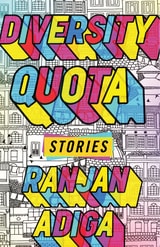
Diversity Quota
Ranjan Adiga
University of Wisconsin Press, 2024
Complicating the idea of a single immigrant narrative, the stories in Diversity Quota move from the US to Nepal and back again, showing how displacement can lead to suffering or hope—sometimes simultaneously. In Kathmandu, Nepalis are frequently caught up in battles between tradition and progress; in the United States, their cultural dislocation is often emblematic of the larger predicaments immigrants face. Ranjan Adiga navigates these larger problems of racism, inequity, and gender roles, while simultaneously centering the humanity of his characters, flaws and all.
In these stories, the lines between “winners” and “losers” in a rapidly globalizing world become frayed and warped. A Nepali migrant’s worst fears materialize in “Leech.” A couple in “Denver” tries to acclimate to a new social class. A middle-aged man is attracted to his barber in “Haircut and Massage.” A Nepali professor is captivated by a white American student in “The Diversity Committee.” In often unexpected ways, Adiga captures moments of survival amid worlds colored by precarity.
In these stories, the lines between “winners” and “losers” in a rapidly globalizing world become frayed and warped. A Nepali migrant’s worst fears materialize in “Leech.” A couple in “Denver” tries to acclimate to a new social class. A middle-aged man is attracted to his barber in “Haircut and Massage.” A Nepali professor is captivated by a white American student in “The Diversity Committee.” In often unexpected ways, Adiga captures moments of survival amid worlds colored by precarity.
[more]
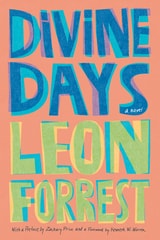
Divine Days
A NovelLeon Forrest; Foreword by Kenneth W. Warren, Preface by Zachary Price
Northwestern University Press, 2023
A virtuosic epic applauded by Stanley Crouch as “an adventurous masterwork that provides our literature with a signal moment,” back in print in a definitive new edition
“I have an awful memory for faces, but an excellent one for voices,” muses Joubert Jones, the aspiring playwright at the center of Divine Days. A kaleidoscopic whorl of characters, language, music, and Black experience, this saga follows Jones for one week in 1966 as he pursues the lore and legends of fictional Forest County, a place resembling Chicago’s South Side. Joubert is a veteran, recently returned to the city, who works for his aunt Eloise’s newspaper and pours drinks at her Night Light Lounge. He wants to write a play about Sugar-Groove, a drifter, “eternal wunderkind,” and local folk hero who seems to have passed away. Sugar-Groove’s disappearance recalls the subject of one of Joubert’s earlier writing attempts—W. A. D. Ford, a protean, diabolical preacher who led a religious sect known as “Divine Days.” Joubert takes notes as he learns about both tricksters, trying to understand their significance.
Divine Days introduces readers to a score of indelible characters: Imani, Joubert’s girlfriend, an artist and social worker searching for her lost siblings and struggling to reconcile middle class life with her values and Black identity; Eloise, who raised Joubert and whose influence is at odds with his writerly ambitions; (Oscar) Williemain, a local barber, storyteller, and founder of the Royal Rites and Righteous Ramblings Club; and the Night Light’s many patrons. With a structure inspired by James Joyce and jazz, Leon Forrest folds references to African American literature and cinema, Shakespeare, the Bible, and classical mythology into a heady quest that embraces life in all its tumult and adventure.
This edition brings Forrest’s masterpiece back into print, incorporating hundreds of editorial changes that the author had requested from W. W. Norton, but were not made for their editions in 1993 and 1994. Much of the inventory from the original printing of the book by Another Chicago Press in 1992 had been destroyed in a disastrous warehouse fire.
[more]
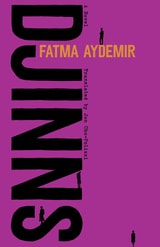
Djinns
Fatma Aydemir, Translated by Jon Cho-Polizzi
University of Wisconsin Press, 2024
After laboring in Germany for thirty years, Hüseyin uses his hard-earned savings to purchase a sunny and spacious flat in Istanbul, envisioning the joys of retirement in his home country with his wife, Emine, by his side. But in a cruel twist of fate, he dies of a heart attack on the day he moves in. As Hüseyin’s children and wife travel to Turkey for his funeral, the novel explores their lives and dreams: a teenage son struggling to embrace his sexuality; a college-educated daughter desperate to align conflicting facets of her identity; a first-born son racialized and profiled all his life, forced to perform a role he could not choose for himself; a lonely daughter left behind in rural Turkey who dreams of recapturing her family’s love after joining them in Germany as a teenager; and a mother unable to break free from the cycles of violence that have defined her.
In this epic tale, Fatma Aydemir explores the lives of characters who could not be more different from one another—except in their insatiable desires to be understood. Rather than a seamless narrative, the novel circles around suppressed memories, unspoken trauma, and buried pasts. Turning expectations and stereotypes of the immigrant experience on their side, Aydemir shows how we all grapple with power and beauty, the holes in our lives, and the demons that hover just out of sight.
In this epic tale, Fatma Aydemir explores the lives of characters who could not be more different from one another—except in their insatiable desires to be understood. Rather than a seamless narrative, the novel circles around suppressed memories, unspoken trauma, and buried pasts. Turning expectations and stereotypes of the immigrant experience on their side, Aydemir shows how we all grapple with power and beauty, the holes in our lives, and the demons that hover just out of sight.
[more]
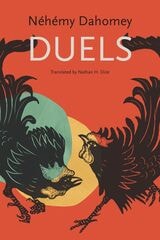
Duels
Néhémy Dahomey
Seagull Books, 2025
A gripping tale of education, violence, and hope, in which one man's dream for a better future collides with a community on the edge of transformation.
Set in 1842, this novel foregrounds a Haiti that is grappling with the weight of an onerous debt imposed by France, forcing its citizens to pay reparations to French colonists in exchange for diplomatic recognition of the first Black republic of the Americas. In the town of Boën, a prosperous notary, Ludovic Possible, decides to take a bold step to secure the future of his community. He opens a schoolhouse where local children can learn both artisanal skills and the essential ability to read and write. For Ludovic, education represents the best chance for the people of Boën to rise above their hardships and build a prosperous future—especially for Aïda, a quiet and enigmatic girl whose mother’s marvelous stories captivate him.
The tranquility of Boën is soon shattered, however, by a series of duels that pit families, neighbors, and even animals against each other. As tensions rise, Ludovic’s vision for a better future is threatened by the escalating violence. In Duels, Néhémy Pierre-Dahomey introduces readers to a rich and unforgettable cast of characters—Aïda, Ludovic, Balthazar Possible, Pépé the Tempest, and many others—who find themselves at the crossroads of a nation on the brink of transformative change.
[more]