Results by title
991 books match the query 'Writing' and 33 start with d
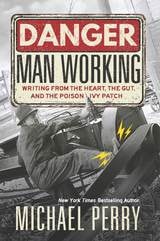
Danger, Man Working
Writing from the Heart, the Gut, and the Poison Ivy PatchArenas
Wisconsin Historical Society Press, 2017
"Every writer has advice for aspiring writers. Mine is predicated on formative years spent cleaning my father’s calf pens: Just keep shoveling until you’ve got a pile so big, someone has to notice. The fact that I cast my life’s work as slung manure simply proves that I recognize an apt metaphor when I accidentally stick it with a pitchfork. . . . Poetry was my first love, my gateway drug—still the poets are my favorites—but I quickly realized I lacked the chops or insights to survive on verse alone. But I wanted to write. Every day. And so I read everything I could about freelancing, and started shoveling."
The pieces gathered within this book draw on fifteen years of what Michael Perry calls "shovel time"—a writer going to work as the work is offered. The range of subjects is wide, from musky fishing, puking, and mountain-climbing Iraq War veterans to the frozen head of Ted Williams. Some assignments lead to self-examination of an alarming magnitude (as Perry notes, "It quickly becomes obvious that I am a self-absorbed hypochondriac forever resolving to do better nutritionally and fitness-wise but my follow-through is laughable.") But his favorites are those that allow him to turn the lens outward: "My greatest privilege," he says, "lies not in telling my own story; it lies in being trusted to tell the story of another."
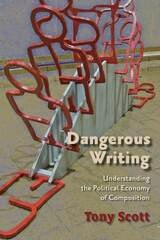
Dangerous Writing
Understanding the Political Economy of CompositionTony Scott
Utah State University Press, 2009
Since the 1980s and the “social turn” in composition studies and other disciplines, scholars in this field have conceived writing in college as explicitly embedded in socio-rhetorical situations beyond the classroom. From this conviction develops a commitment to teach writing with an emphasis on analyzing the social and political dimensions of rhetoric.
Ironically, though a leftist himself, Tony Scott’s analysis finds the academic left complicit with the forces in American culture that tend, in his view, to compromise education. By focusing on the structures of labor and of institutions that enforce those structures, Scott finds teachers and administrators are too easily swept along with the inertia of a hyper-commodified society in which students---especially working class students---are often positioned as commodities, themselves. Dangerous Writing, then, is a critique of the field as much as it is a critique of capitalism. Ultimately, Scott’s eye is on the institution and its structures, and it is these that he finds most in need of transformation.

Daniil Kharms
Writing and the EventBy Branislav Jakovljevic
Northwestern University Press, 2009
The book follows Kharms’s development as a creative thinker, inquiring into the nature of Kharmsian nonsense, the ontological status of the OBERIU object, writing as performance, Kharms’s gestural language, his "language machines," and his ideas of order, number, infinity, and chance. Reading every paper trace (as well as extant memories) of Kharms’s activities as part of a large project of world creation, Branislav Jakovljevic situates him in a twentieth-century effort—exemplified by Kafka, Beckett, Artaud, Malevich, and Khelbnikov, among others—to go beyond an interpretation of meaning circumscribed by rational and logical thought. Examining texts that could conceivably be called "literary" as well as sketches, diagrams, hieroglyphs, photographs, and unclassifiable others, Jakovljevic’s study is the first to provide a properly broad perspective on this creative thinker’s farranging, far-reaching, and finally comprehensive achievement.
Dark Alphabet
Jennifer Maier
Southern Illinois University Press, 2006
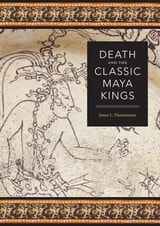
Death and the Classic Maya Kings
By James L. Fitzsimmons
University of Texas Press, 2009
Like their regal counterparts in societies around the globe, ancient Maya rulers departed this world with elaborate burial ceremonies and lavish grave goods, which often included ceramics, red pigments, earflares, stingray spines, jades, pearls, obsidian blades, and mosaics. Archaeological investigation of these burials, as well as the decipherment of inscriptions that record Maya rulers' funerary rites, have opened a fascinating window on how the ancient Maya envisaged the ruler's passage from the world of the living to the realm of the ancestors.
Focusing on the Classic Period (AD 250-900), James Fitzsimmons examines and compares textual and archaeological evidence for rites of death and burial in the Maya lowlands, from which he creates models of royal Maya funerary behavior. Exploring ancient Maya attitudes toward death expressed at well-known sites such as Tikal, Guatemala, and Copan, Honduras, as well as less-explored archaeological locations, Fitzsimmons reconstructs royal mortuary rites and expands our understanding of key Maya concepts including the afterlife and ancestor veneration.
Decisions, Agency, and Advising
Key Issues in the Placement of Multilingual Writers into First-Year Composition CoursesTanita Saenkhum
Utah State University Press, 2016
Tanita Saenkhum follows eleven multilingual students who made their decisions about placement into first-year composition courses during one academic year at a large public university. She identifies the need for the process of making placement decisions to be understood more clearly, describes how to use that knowledge to improve placement practices for these students—particularly in advising—and offers hands-on recommendations for writing programs.
Decisions, Agency, and Advising is a significant contribution to the field and particularly valuable to writing program administrators, academic advisors, writing teachers, researchers investigating second language writing and writing program administration, composition and second language writing scholars, and graduate students.
Decolonial Conversations in Posthuman and New Material Rhetorics
Edited by Jennifer Clary-Lemon and David M. Grant
The Ohio State University Press, 2022
Deconstruction Machines
Writing in the Age of CyberwarJustin Joque
University of Minnesota Press, 2018
A bold new theory of cyberwar argues that militarized hacking is best understood as a form of deconstruction
From shadowy attempts to steal state secrets to the explosive destruction of Iranian centrifuges, cyberwar has been a vital part of statecraft for nearly thirty years. But although computer-based warfare has been with us for decades, it has changed dramatically since its emergence in the 1990s, and the pace of change is accelerating.
In Deconstruction Machines, Justin Joque inquires into the fundamental nature of cyberwar through a detailed investigation of what happens at the crisis points when cybersecurity systems break down and reveal their internal contradictions. He concludes that cyberwar is best envisioned as a series of networks whose constantly shifting connections shape its very possibilities. He ultimately envisions cyberwar as a form of writing, advancing the innovative thesis that cyber attacks should be seen as a militarized form of deconstruction in which computer programs are systems that operate within the broader world of texts.
Throughout, Joque addresses hot-button subjects such as technological social control and cyber-resistance entities like Anonymous and Wikileaks while also providing a rich, detailed history of cyberwar. Deconstruction Machines provides a necessary new interpretation of deconstruction and timely analysis of media, war, and technology.
Defining, Locating, and Addressing Bullying in the WPA Workplace
Cristyn L. Elder
Utah State University Press, 2018
Contributors of varying status in different types of programs across many kinds of institutions describe various forms of bullying, including microaggressions, incivility, mobbing, and emotional abuse. They define bullying as institutional racism, “academic systemic incivility,” a crisis of insularity, and faculty fundamentalism. They locate bullying in institutional contexts, including research institutions, small liberal arts colleges, community colleges, and writing programs and writing centers. These locations are used as points of departure to further theorize bullying and to provide clear advice about agentive responses.
A culture of silence discourages discussions of this behavior, making it difficult to address abuse. This silence also normalizes patterns and cultivates the perception that bullying arises naturally. Defining, Locating, and Addressing Bullying in the WPA Workplace helps the field to name these patterns of behaviors as bullying and resist ideologies of normalcy, encouraging and empowering readers to take an active role in defining, locating, and addressing bullying in their own workplaces.
Contributors: Sarah Allen, Andrea Dardello, Harry Denny, Dawn Fels, Bre Garrett, W. Gary Griswold, Amy C. Heckathorn, Aurora Matzke, Staci Perryman-Clark, Sherry Rankins-Robertson, Erec Smith
Deliberate Conflict
Argument, Political Theory, and Composition ClassesPatricia Roberts-Miller
Southern Illinois University Press, 2004
In Deliberate Conflict: Argument, Political Theory, and Composition Classes, Patricia Roberts-Miller argues that much current discourse about argument pedagogy is hampered by fundamental unspoken disagreements over what democratic public discourse should look like. The book’s pivotal question is, In what kind of public discourse do we want our students to engage? To answer this, the text provides a taxonomy, discussion, and evaluation of political theories that underpin democratic discourse, highlighting the relationship between various models of the public sphere and rhetorical theory.
Deliberate Conflict cogently advocates reintegrating instruction in argumentation with the composition curriculum. By linking effective argumentation in the public sphere with the ability to effect social change, Roberts-Miller pushes compositionists beyond a simplistic Aristotelian conception of how argumentation works and offers a means by which to prepare students for active participation in public discourse.
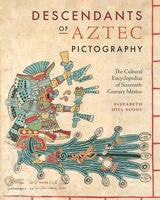
Descendants of Aztec Pictography
The Cultural Encyclopedias of Sixteenth-Century MexicoBy Elizabeth Hill Boone
University of Texas Press, 2021
In the aftermath of the sixteenth-century Spanish conquest of Mexico, Spanish friars and authorities partnered with indigenous rulers and savants to gather detailed information on Aztec history, religious beliefs, and culture. The pictorial books they created served the Spanish as aids to evangelization and governance, but their content came from the native intellectuals, painters, and writers who helped to create them. Examining the nine major surviving texts, preeminent Latin American art historian Elizabeth Hill Boone explores how indigenous artists and writers documented their ancestral culture.
Analyzing the texts as one distinct corpus, Boone shows how they combined European and indigenous traditions of documentation and considers questions of motive, authorship, and audience. For Spanish authorities, she shows, the books revealed Aztec ideology and practice, while for the indigenous community, they preserved venerated ways of pictorial expression as well as rhetorical and linguistic features of ancient discourses. The first comparative analysis of these encyclopedias, Descendants of Aztec Pictography analyzes how the painted compilations embraced artistic traditions from both sides of the Atlantic.
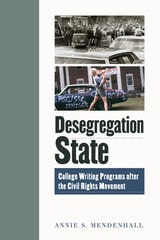
Desegregation State
College Writing Programs after the Civil Rights MovementAnnie S. Mendenhall
Utah State University Press, 2021
Formerly segregated state university systems crafted desegregation plans that gave them more control over policies for admissions, remediation, and retention. These plans created literacy requirements—admissions and graduation tests, remedial classes, and even writing centers and writing across the curriculum programs—that reshaped the landscape of college writing instruction and denied the demands of Black students, civil rights activists, and historically Black colleges and universities for major changes to university systems. This history details the profound influence of desegregation—and resistance to desegregation—on the ways that writing is taught and assessed in colleges today.
Desegregation State provides WPAs and writing teachers with a disciplinary history for understanding racism in writing assessment and writing programs. Mendenhall brings emerging scholarship on the racialization of institutions into the field, showing why writing studies must pay more attention to how writing programs have institutionalized racist literacy ideologies through arguments about student placement, individualized writing instruction, and writing assessment.
Dialectical Rhetoric
Bruce Mccomiskey
Utah State University Press, 2015
In Dialectical Rhetoric, Bruce McComiskey argues that the historical conflict between rhetoric and dialectic can be overcome in ways useful to both composition theory and the composition classroom.
Historically, dialectic has taken two forms in relation to rhetoric. First, it has been the logical development of linear propositions leading to necessary conclusions, a one-dimensional form that was the counterpart of rhetorics in which philosophical, metaphysical, and scientific truths were conveyed with as little cognitive interference from language as possible. Second, dialectic has been the topical development of opposed arguments on controversial issues and the judgment of their relative strengths and weaknesses, usually in political and legal contexts, a two-dimensional form that was the counterpart of rhetorics in which verbal battles over competing probabilities in public institutions revealed distinct winners and losers.
The discipline of writing studies is on the brink of developing a new relationship between dialectic and rhetoric, one in which dialectics and rhetorics mediate and negotiate different arguments and orientations that are engaged in any rhetorical situation. This new relationship consists of a three-dimensional hybrid art called “dialectical rhetoric,” whose method is based on five topoi: deconstruction, dialogue, identification, critique, and juxtaposition. Three-dimensional dialectical rhetorics function effectively in a wide variety of discursive contexts, including digital environments, since they can invoke contrasts in stagnant contexts and promote associations in chaotic contexts. Dialectical Rhetoric focuses more attention on three-dimensional rhetorics from the rhetoric and composition community.
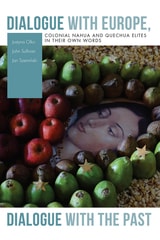
Dialogue with Europe, Dialogue with the Past
Colonial Nahua and Quechua Elites in Their Own WordsJustyna Olko
University Press of Colorado, 2018
In each chapter a particular document is transcribed exactly as it appears in the original manuscript or colonial printed document, with the editor placing it in historical context and considering the degree of European influence. These texts show the nobility through documents they themselves produced or caused to be produced—such as wills, land deeds, and petitions—and prioritize indigenous ways of expression, perspectives, and concepts. Together, the chapters demonstrate that native elites were independent actors as well as agents of social change and indigenous sustainability in colonial society. Additionally, the volume diversifies the commonly homogenous term “cacique” and recognizes the differences in elites throughout Mesoamerica and the Andes.
Showcasing important and varied colonial genres of indigenous writing, Dialogue with Europe, Dialogue with the Past reveals some of the realities, needs, strategies, behaviors, and attitudes associated with the lives of the elites. Each document and its accompanying commentary provide additional insight into how the nobility negotiated everyday life. The book will be of great interest to students and researchers of Mesoamerican and Andean history, as well as those interested in indigenous colonial societies in the Spanish Empire.
Contributors: Agnieszka Brylak, Maria Castañeda de la Paz, Katarzyna Granicka, Gregory Haimovich, Anastasia Kalyuta, Julia Madajczak, Patrycja Prządka-Giersz
Dialogue, Dialectic and Conversation
A Social Perspective on the Function of WritingGregory Clark. Foreword by Robert J. Connors
Southern Illinois University Press, 1990
This book articulates an ethics for reading that places primary responsibility for the social influences of a text on the response of its readers.
We write and read as participants in a process through which we negotiate with others whom we must live or work with and with whom we share values, beliefs, and actions. Clark draws on current literary theory, rhetoric, philosophy, communication theory, and composition studies as he builds on this argument.
Because reading and writing are public actions that address and direct matters of shared belief, values, and action, reading and writing should be taught as public discourse. We should teach not writing or reading so much as the larger practice of public discourse—a discourse that sustains the many important communities of which students are and will be active members.
Diary of a Detour
Lesley Stern
Duke University Press, 2020
Digital Griots
African American Rhetoric in a Multimedia AgeAdam J. Banks
Southern Illinois University Press, 2011
DJs are models of rhetorical excellence; canon makers; time binders who link past, present, and future in the groove and mix; and intellectuals continuously interpreting the history and current realities of their communities in real time. Banks uses the DJ's practices of the mix, remix, and mixtape as tropes for reimagining writing instruction and the study of rhetoric. He combines many of the debates and tensions that mark black rhetorical traditions and points to ways for scholars and students to embrace those tensions rather than minimize them. This commitment to both honoring traditions and embracing futuristic visions makes this text unique, as do the sites of study included in the examination: mixtape culture, black theology as an activist movement, everyday narratives, and discussions of community engagement. Banks makes explicit these connections, rarely found in African American rhetoric scholarship, to illustrate how competing ideologies, vernacular and academic writing, sacred and secular texts, and oral, print, and digital literacies all must be brought together in the study of African American rhetoric and in the teaching of culturally relevant writing.
A remarkable addition to the study of African American rhetorical theory and composition studies, Digital Griots: African American Rhetoric in a Multimedia Age will compel scholars and students alike to think about what they know of African American rhetoric in fresh and useful ways.
Digital Paper
A Manual for Research and Writing with Library and Internet MaterialsAndrew Abbott
University of Chicago Press, 2014
Abbott tells what every senior researcher knows: that research is not a mechanical, linear process, but a thoughtful and adventurous journey through a nonlinear world. He breaks library research down into seven basic and simultaneous tasks: design, search, scanning/browsing, reading, analyzing, filing, and writing. He moves the reader through the phases of research, from confusion to organization, from vague idea to polished result. He teaches how to evaluate data and prior research; how to follow a trail to elusive treasures; how to organize a project; when to start over; when to ask for help. He shows how an understanding of scholarly values, a commitment to hard work, and the flexibility to change direction combine to enable the researcher to turn a daunting mass of found material into an effective paper or thesis.
More than a mere how-to manual, Abbott’s guidebook helps teach good habits for acquiring knowledge, the foundation of knowledge worth knowing. Those looking for ten easy steps to a perfect paper may want to look elsewhere. But serious scholars, who want their work to stand the test of time, will appreciate Abbott’s unique, forthright approach and relish every page of Digital Paper.
Digital Poetics
Hypertext, Visual-Kinetic Text and Writing in Programmable MediaLoss Pequeño Glazier
University of Alabama Press, 2001
Glazier investigates the ways in which computer technology has influenced and transformed the writing and dissemination of poetry.
In Digital Poetics, Loss Pequeño Glazier argues that the increase in computer technology and accessibility, specifically the World Wide Web, has created a new and viable place for the writing and dissemination of poetry. Glazier’s work not only introduces the reader to the current state of electronic writing but also outlines the historical and technical contexts out of which electronic poetry has emerged and demonstrates some of the possibilities of the new medium.
Glazier examines three principal forms of electronic textuality: hypertext, visual/kinetic text, and works in programmable media. He considers avant-garde poetics and its relationship to the on-line age, the relationship between web “pages” and book technology, and the way in which certain kinds of web constructions are in and of themselves a type of writing. With convincing alacrity, Glazier argues that the materiality of electronic writing has changed the idea of writing itself. He concludes that electronic space is the true home of poetry and, in the 20th century, has become the ultimate “space of poesis.”
Digital Poetics will attract a readership of scholars and students interested in contemporary creative writing and the potential of electronic media for imaginative expression.
Disciplinary Discourses, Michigan Classics Ed.
Social Interactions in Academic WritingKen Hyland
University of Michigan Press, 2004
As issues of linguistic and rhetorical expression of disciplinary conventions are becoming more central to teachers, students, and researchers, the careful analysis and straightforward style of Disciplinary Discourses make it a remarkable asset.
The Michigan Classics Edition features a new preface by the author and a new foreword by John M. Swales.
Discursive Ideologies
Reading Western RhetoricC. H. Knoblauch
Utah State University Press, 2014
In Discursive Ideologies, C. H. Knoblauch argues that European rhetorical theory comprises several distinct and fundamentally opposed traditions of discourse. Writing accessibly for the upper division student, Knoblauch resists the conventional narrative of a unified Western rhetorical tradition. He identifies deep ideological and epistemological differences that exist among strands of Western thought and that are based in divergent "grounds of meaningfulness.” These conflicts underlie and influence current discourse about vital public issues.
Knoblauch considers six "stories” about the meaning of meaning in an attempt to answer the question, what encourages us to believe that language acts are meaningful? Six distinctive ideologies of Western rhetoric emerge: magical rhetoric, ontological rhetoric, objectivist rhetoric, expressivist rhetoric, sociological rhetoric, and deconstructive rhetoric. He explores the nature of language and the important role these rhetorics play in the discourses that matter most to people, such as religion, education, public policy, science, law, and history.
Disrupting the Center
A Partnership Approach to Writing Across the UniversityRebecca Hallman Martini
Utah State University Press, 2021
Using on-site research and critical ethnographic study from one university writing center, Rebecca Hallman Martini establishes an innovative, cross-disciplinary partnership approach to writing instruction in which peer tutoring plays an integral curricular role. Case studies detail three partnerships that respond directly to existing or potential disruptive innovations in higher education and showcase important concepts: mapping mutual benefit and stakeholder engagement in an online studio/hybrid first-year writing program partnership in response to online education, creating negotiated space to work through ethical issues involved when working with a public-private partnership to develop a required extracurricular portfolio project in a business school, and building transformational partnerships through establishing a writing-in-the-professions curriculum in the College of Engineering in response to career readiness initiatives.
Disrupting the Center uses interviews, observations, focus groups, analysis of consultations, meetings, and shared documents such as annual reports, budgets, assessment data, assignments, and syllabi to generate a wide view of how systems work. Writing centers are flexible university-wide service spaces where students go for one-on-one and group writing support that can become dynamic spaces for writing pedagogy by disrupting, revitalizing, and reinventing the epistemic foundations of current rhetoric and composition landscapes and traditional approaches to writing.
Disruptive Stories
Amplifying Voices from the Writing Center MarginsElizabeth Kleinfeld
Utah State University Press, 2024
While US tenure-track writing center administrators (WCAs) do not make up the majority of those who hold WCA positions in writing centers, they are more likely to be the storytellers of the writing center grand narrative. They publish more, present more conference papers, edit more journals, and participate more in organizational leadership. This collection complicates that narrative by adding marginalized voices and experiences in three thematic categories: structural marginalization, globalization and marginalization, and embodied marginalization.
Disruptive Stories spurs further conversations about ways to improve the review process in writing center scholarship so that it more accurately reflects the growing diversity of its administrators and practitioners.
Distant Readings of Disciplinarity
Knowing and Doing in Composition/Rhetoric Dissertationsby Benjamin Miller
Utah State University Press, 2022
Writing studies has long been marked by a multitude of methods and interlocking purposes, partaking of not just humanities approaches but also social scientific ones, with data drawn from interviews and surveys alongside historical and philosophical arguments and with corpus analytics in large-scale collections jostling against small-scale case studies of individuals. These areas of study aren’t always cleanly separable; shifting modes mark the discipline as open and welcoming to many different angles of research. The field needs to embrace that vantage point and generate new degrees of familiarity with methods beyond those of any individual scholar.
Not only a training genre and not only a knowledge-making genre, the dissertation is also a discipline-producing genre. Illustrating what the field has been studying, and how, Distant Readings of Disciplinarity supports more fruitful collaborations within and across research areas and methods.
Diverse Approaches to Teaching, Learning, and Writing Across the Curriculum
IWAC at 25Lesley Erin Bartlett
University Press of Colorado, 2020
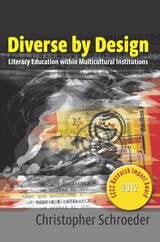
Diverse by Design
Literacy Education within Multicultural InstitutionsChristopher Schroeder
Utah State University Press, 2011
Diversity, despite what we say, disturbs us. In the U.S., we debate linguistic rights, the need for an official language, and educational policies for language minority students. On the one hand, we believe in the rights of individuals, including (at least in the academy) the right to one’s own language. On the other hand, we sponsor a single common language, monolingual and standard, for full participation and communication in both the academy and in U.S. society.
In Diverse by Design, Christopher Schroeder reports on an institutional case study conducted at an officially designated Hispanic-Serving Institution. He gives particular attention to a cohort of Latino students in a special admissions program, to document their experience of a program designed to help students surmount the “obstacle” that ethnolinguistic diversity is perceived to be.
Ultimately, Schroeder argues for reframing multilingualism and multiculturalism, not as obstacles, but as intellectual resources to exploit. While diversity might disturb us, we can overcome its challenges by a more expansive sense of social identity. In an increasingly globalized society, literacy ideologies are ever more critical to educational equity, and to human lives.
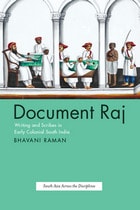
Document Raj
Writing and Scribes in Early Colonial South IndiaBhavani Raman
University of Chicago Press, 2012
Does Writing Have a Future?
Vilém Flusser
University of Minnesota Press, 2010
Confirming Flusser’s status as a theorist of new media in the same rank as Marshall McLuhan, Jean Baudrillard, Paul Virilio, and Friedrich Kittler, the balance of this book teases out the nuances of these developments. To find a common denominator among texts and practices that span millennia, Flusser looks back to the earliest forms of writing and forward to the digitization of texts now under way. For Flusser, writing—despite its limitations when compared to digital media—underpins historical consciousness, the concept of progress, and the nature of critical inquiry. While the text as a cultural form may ultimately become superfluous, he argues, the art of writing will not so much disappear but rather evolve into new kinds of thought and expression.
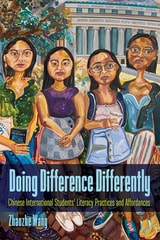
Doing Difference Differently
Chinese International Students’ Literacy Practices and AffordancesZhaozhe Wang
Utah State University Press, 2024
Doing Difference Differently provides an in-depth, nuanced understanding of the multifaceted literate lives of this often-marginalized cultural group, highlighting their diverse aspirations, personas, communities, challenges, and strategies. The book reconceptualizes the linguistic and cultural differences of Chinese international students as active processes of embracing, performing, resisting, negotiating, and redefining the identities that institutions impose on them through everyday literacy practices. Wang offers an analytical heuristic for researchers and educators to better understand these students’ backgrounds and to more effectively and ethically support and advocate for them. This case study critically engages broad and interconnected concepts that are essential to educators’ collective understanding of Generation Z students brought up in cultural and educational contexts outside of the European-American sphere.
This book appeals to scholars, researchers, teachers, and administrators working in North American higher education and English-speaking countries, particularly those in the fields of writing studies, second language studies, applied linguistics, multilingual education, literacy studies, and international education. Educators across disciplines seeking to better understand the growing population of Chinese international students in North America will likewise benefit.
Doing Time, Writing Lives
Refiguring Literacy and Higher Education in PrisonPatrick W. Berry
Southern Illinois University Press, 2018
Doing Time, Writing Lives offers a much-needed analysis of the teaching of college writing in U.S. prisons, a racialized space that—despite housing more than 2 million people—remains nearly invisible to the general public. Through the examination of a college-in-prison program that promotes the belief that higher education in prison can reduce recidivism and improve life prospects for the incarcerated and their families, author Patrick W. Berry exposes not only incarcerated students’ hopes and dreams for their futures but also their anxieties about whether education will help them.
Combining case studies and interviews with the author’s own personal experience of teaching writing in prison, this book chronicles the attempts of incarcerated students to write themselves back into a society that has erased their lived histories. It challenges polarizing rhetoric often used to describe what literacy can and cannot deliver, suggesting more nuanced and ethical ways of understanding literacy and possibility in an age of mass incarceration.
Drilled to Write
Becoming a Cadet Writer at a Senior Military Collegeby J. Michael Rifenburg
Utah State University Press, 2022
Drilled to Write offers a rich account of US Army cadets navigating the unique demands of Army writing at a senior military college. In this longitudinal case study, J. Michael Rifenburg follows one cadet, Logan Blackwell, for four years and traces how he conceptualizes Army writing and Army genres through immersion in military science classes, tactical exercises in the Appalachian Mountains, and specialized programs like Airborne School.
Drawing from research on rhetorical genre studies, writing transfer, and materiality, Drilled to Write speaks to scholars in writing studies committed to capturing how students understand their own writing development. Collectively, these chapters articulate four ways Blackwell leveraged resources through ROTC to become a cadet writer at this military college. Each chapter is dedicated to one year of his undergraduate experience with focus on curricular writing for his business management major and military science classes as well as his extracurricular writing, like his Ballroom Dance Club bylaws and a three-thousand-word short story.
In Drilled to Write, Rifenburg invites readers to see how cadets are positioned between civilian and military life—a curiously liminal space where they develop as writers. Using Army ROTC as an entry into genre theory and larger conversations about the role higher education plays in developing Army officers, he shows how writing students develop genre awareness and flexibility while forging a personal identity.
Dual Enrollment Kaleidoscope
Reconfiguring Perceptions of First-Year Writing and Composition StudiesChristine Denecker
Utah State University Press, 2022
DE disrupts long-held beliefs of who should take and who should teach college writing. Giving higher education pause about the place of writing instruction within the academy, DE force those in the field to reflect upon the purposes and value of FYC and its pedagogical approaches. Featuring seventeen chapters written by a wide and diverse range of authors, this collection includes the voices of prominent scholars in rhetoric and composition at two- and four-year public and private institutions, as well as emerging scholars in the field. It also features a variety of methodologies, including archival research, quantitative and qualitative data collection, and autoethnography.
Few texts have been published on dual enrollment writing in rhetoric and composition studies. The Dual Enrollment Kaleidoscope should be mandatory reading for anyone interested in or tasked with doing the work of DE writing instruction, administration, mentoring, or assessment.
Contributors: Dominic Ashby, Anna Bogen, Tyler Branson, Melanie Burdick, Scott Campbell, Christine R. Farris, David Gehler, Leigh Graziano, Jane Greer, Jennifer Hadley, Jacquelyn Hoermann-Elliott, Joseph Jones, Nancy Knowles, Amy Lueck, Miles McCrimmon, Katie McWain, Annie S. Mendenhall, Keith Miller, Brice Nordquist, Cornelia Paraskevas, Jill Parrot, Shirley K Rose, Barbara Schneider, Erin Scott-Stewart
During the Dissertation
A Textual Mentor for Doctoral Students in the Process of WritingChristine Pearson Casanave
University of Michigan Press, 2020
This volume is a sequel to Casanave’s popular Before the Dissertation. Like that volume, this book is designed as a companion for doctoral dissertation writers of qualitative or mixed methods work in fields related to language education. It could also benefit those writing master’s theses and those writing in other social science fields. It is meant to be consulted once the writing has begun—once students have settled on a topic, designed the project, or collected the data—because this is the time when they are analyzing, drafting, revising, polishing, and probably fretting, deleting, reconstructing, and even losing sleep. Also, like its predecessor, it is not designed to teach anyone how to write a dissertation as there are plenty of those available elsewhere.
For most doctoral students, writing will happen at different stages of the project. Strategies for timing of these kinds of writing differ across students, and also across supervisors and advisers. If dissertation writers do not know by the time they start writing which strategies and issues pertain to them, this book can help them craft some approaches to suit their own personalities, preferred practices, and individual goals and visions, as well as help them figure out how dissertation writing might fit into the real-life intrusions of work and family.
Issues covered in the book are: starting to write, envisioning the project as a whole, relationships with supervisors, perfectionism and other maladies, health, low- and high-IQ days, loneliness and isolation, distractions and interruptions, revising, and knowing when to stop.