Results by title
3576 books match the query 'American' and 110 start with d
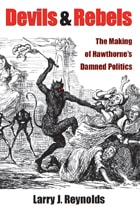
Devils and Rebels
The Making of Hawthorne's Damned PoliticsLarry J. Reynolds
University of Michigan Press, 2010
"An outstanding combination of literary interpretation and cultural and historical context that will be an important addition to the critical literature on Hawthorne."
---Nina Baym, University of Illinois
"It is difficult to imagine a more timely book than Devils and Rebels. Examining the role of the public intellectual and writer during a time of political conflict and war, Reynolds takes up his charges with great precision and historical finesse. What particularly distinguishes this book is its attention to the ways in which one of this country's most important authors struggled to resist the waves of political extremism and patriotic hysteria that swept around him."
---Jeffrey Steele, University of Wisconsin—Madison
Widely condemned even in his own time, Nathaniel Hawthorne's views on abolitionism and slavery are today frequently characterized by scholars as morally reprehensible. Devils and Rebels explores the historical and biographical record to reveal striking evidence of the author's true political values---values grounded in pacifism and resistant to the kind of binary thinking that could lead to violence and war.
The book offers fresh readings of not only Hawthorne's four major romances but also some of his less familiar works like "Legends of the Province House," The Whole History of Grandfather's Chair, Journal of an African Cruiser, The Life of Franklin Pierce, and "Septimius Felton." Reynolds argues that Hawthorne---whether in his politics or his art---drew upon racialized imagery from America's past revolution and war on witchcraft to create a politics of quiet imagination, alert to the ways in which New England righteousness could become totalitarian by imposing its narrow view of the world on others.
Meticulously researched and cogently argued, this groundbreaking work demonstrates the need to examine perspectives and values from beyond the New England region when studying the literary history of the American Renaissance and illuminates the difficulties faced by public intellectuals during times of political strife---an issue as relevant today as it was some one hundred and fifty years ago.
Larry J. Reynolds is Thomas Franklin Mayo Professor of Liberal Arts and Professor of English at Texas A&M University. His previous books include A Historical Guide to Nathaniel Hawthorne, National Imaginaries, American Identities: The Cultural Work of American Iconography, and European Revolutions and the American Literary Renaissance as well as an edition of the European writings of Margaret Fuller.
Devotions
Bruce Smith
University of Chicago Press, 2011
In the hands of Bruce Smith, devotions are momentary stops to listen to the motor of history. They are meditations and provocations. They are messages received from the chatter of the street and from transmissions as distant as Memphis and al-Mansur. Bulletins and interruptions come from brutal elsewheres and from the interior where music puts electrodes on the body to take an EKG. These poems visit high schools, laundromats, motels, films, and dreams in order to measure the American hunger and thirst. They are interested in the things we profess to hold most dear as well as what’s unspoken and unbidden. While we’re driving, while riding a bus, while receiving a call, while passing through an X-ray machine, the personal is intersected—sometimes violently, sometimes tenderly—with the hum and buzz of the culture. The culture, whether New York or Tuscaloosa, Seattle or Philadelphia, past or present, carries the burden of race and “someone’s idea of beauty.” The poems fluctuate between the two poles of “lullaby and homicide” before taking a vow to remain on earth, to look right and left, to wait and to witness.
Dialectical Imaginaries
Materialist Approaches to U.S. Latino/a Literature in the Age of NeoliberalismMarcial González and Carlos Gallego, editors
University of Michigan Press, 2018
Diary of Our Fatal Illness
Charles Bardes
University of Chicago Press, 2017
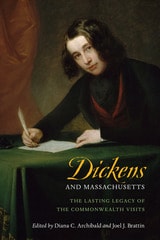
Dickens and Massachusetts
The Lasting Legacy of the Commonwealth VisitsDiana C. Archibald
University of Massachusetts Press, 2015
Charles Dickens traveled to North America twice, in 1842 and twenty-five years later in 1867–68, and on both trips Massachusetts was part of his itinerary. Although many aspects of his U.S. travels disappointed him, Massachusetts was the one state that met and even exceeded Dickens's expectations for “the republic of [his] imagination.” From the mills of Lowell to the Perkins School for the Blind, it offered an alternate vision of America that influenced his future writings, while the deep and lasting friendships he formed with Bostonians gave him enduring ties to the commonwealth.
This volume provides insight from leading scholars who have begun to reassess the significance of Massachusetts in the author's life and work. The collection begins with a broad biographical and historical overview taken from the full-length narrative of the award-winning exhibition Dickens and Massachusetts: A Tale of Power and Transformation, which attracted thousands of visitors while on display in Lowell. Abundant images from the exhibition, many of them difficult to find elsewhere, enhance the story of Dickens's relationship with the vibrant cultural and intellectual life of Massachusetts. The second section includes essays that consider the importance of Dickens's many connections to the commonwealth.
In addition to the volume editors, contributors include Chelsea Bray, Iain Crawford, Andre DeCuir, Natalie McKnight, Lillian Nayder, and Kit Polga.
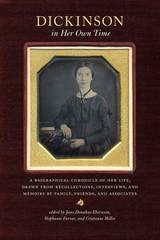
Dickinson in Her Own Time
A Biographical Chronicle of Her Life, Drawn from Recollections, Interviews, and Memoirs by Family, Friends, and AssociatesJane Donahue Eberwein, Stephanie Farrar, and Cristanne Miller
University of Iowa Press, 2015
In addition, promotional items, reviews, and correspondence relating to early publications are included, as well as some later documents that reveal the changing assessments of Dickinson’s poetry in response to evolving critical standards. These documents provide evidence that counters many popular conceptions of her life and reception, such as the belief that the writer best known for poems focused on loss, death, and immortality was herself a morose soul. In fact, those who knew her found her humorous, playful, and interested in other people.
Dickinson maintained literary and personal correspondence with major representatives of the national literary scene, developing a reputation as a remarkable writer even as she maintained extreme levels of privacy. Evidence compiled here also demonstrates that she herself made considerable provision for the survival of her poems and laid the groundwork for their eventual publication. Dickinson in Her Own Time reveals the poet as her contemporaries knew her, before her legend took hold.
Dirty Work
Domestic Service in Progressive-Era Women’s FictionAnn Mattis
University of Michigan Press, 2019
Disaffected
The Cultural Politics of Unfeeling in Nineteenth-Century AmericaXine Yao
Duke University Press, 2021
Duke University Press Scholars of Color First Book Award recipient
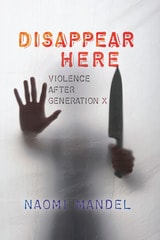
Disappear Here
Violence after Generation XNaomi Mandel
The Ohio State University Press, 2015
Examining developments in media, philosophy, literature, and politics in the years Xers were coming of age, Mandel demonstrates that Generation X’s unique attitude toward violence was formed by developments in home media, personal computing, and reality TV. This attitude, Mandel contends, is key to understanding our current world of media ubiquity, online activism, simulated sensation, and jihad. With chapters addressing both fictional and filmic representations of violence, Mandel studies the work of Bret Easton Ellis, Chuck Palahniuk, Claire Messud, Jess Walter, and Jonathan Safran Foer. A critical and conceptual tour de force, Disappear Here sets forth a new, and necessary, approach to violence, the real, and real violence for the twenty-first century.
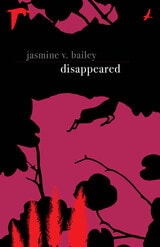
Disappeared
Jasmine V. Bailey
Carnegie Mellon University Press, 2017

Disarming the Nation
Women's Writing and the American Civil WarElizabeth Young
University of Chicago Press, 1999
Combining literary analysis, cultural history, and feminist theory, Disarming the Nation argues that the Civil War functioned in women's writings to connect female bodies with the body politic. Women writers used the idea of "civil war" as a metaphor to represent struggles between and within women—including struggles against the cultural prescriptions of "civility." At the same time, these writers also reimagined the nation itself, foregrounding women in their visions of America at war and in peace. In a substantial afterword, Young shows how contemporary black and white women—including those who crossdress in Civil War reenactments—continue to reshape the meanings of the war in ways startlingly similar to their nineteenth-century counterparts.
Learned, witty, and accessible, Disarming the Nation provides fresh and compelling perspectives on the Civil War, women's writing, and the many unresolved "civil wars" within American culture today.
Discourse and the Other
The Production of the Afro-American TextW. Lawrence Hogue
Duke University Press, 1986
Hogue presents an illuminating discussion of the publication and review history of "major" and neglected texts. He illustrates the acceptance of texts as exotica, as sociological documents, or as carriers of sufficient literary conventions to receive approbation. Although the sixties movement allowed the text to move to the periphery of the dominant ideology, providing some new myths about the Afro-American historical past, this marginal position was subsequently sabotaged, co-opted, or appropriated (Afros became a fad; presidents gave the soul handshake; the hip-talking black was dressing one style and talking another.)
This study includes extended discussion of four works; Ernest J. Gaines's The Autobiography of Miss Jane Pittman, Alice Walker's The Third Life of Grange Copeland, Albert Murray's Train Whistle Guitar, and Toni Morrison's Sula. Hogue assesses the informing worldviews of each and the extent and nature of their acceptance by the dominant American cultural apparatus.
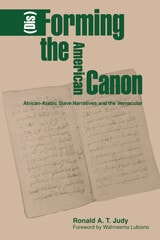
Disforming The American Canon
African-Arabic Slave Narratives and the VernacularRonald A.T. Judy
University of Minnesota Press, 1993
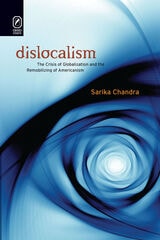
Dislocalism
The Crisis of Globalization and the Remobilizing of AmericanismSarika Chandra
The Ohio State University Press, 2011
Notwithstanding its now extensive, trans-disciplinary bibliography, the full reality of globalization remains less well understood than commonly thought. As an objective, secular phenomenon, globalization has continued to be obscured by ideological and rhetorical strategies that travel under the same name but posit it as simply the abstract-universal other of the local. Dislocalism: The Crisis of Globalization and the Remobilizing of Americanism makes such strategies and the global/local binary they reinforce into objects of critical analysis.
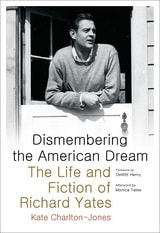
Dismembering the American Dream
The Life and Fiction of Richard YatesKate Charlton-Jones
University of Alabama Press, 2014
Since his death in Alabama in 1992, the work of American writer Richard Yates has enjoyed a renaissance, culminating in director Sam Mendes’s adaption of the novel Revolutionary Road (starring Leonardo DiCaprio and Kate Winslet). Dismembering the American Dream is the first book-length critical study of Yates’s fiction.
Kate Charlton-Jones argues that to read Yates’s tales of disordered lives is to uncover not misery, though the lives he describes are sad ones, but a profound, enriching, and humorous understanding of human weakness and vulnerability. Yates’s narratives absorb his readers so entirely, mirroring their own emotional highs and lows with such skill, that reading becomes recognition. Yates demonstrates his ability to tease powerful human drama out of the most ordinary, quotidian moments. At the same time, Yates’s fiction displays an object lesson in the art of fine prose writing, so it is no surprise that many early fans of Yates were also established writers.
Charlton-Jones explores how Yates extends the realist form and investigates three main recurring themes of his fiction: observations about performative behavior, which are at the heart of all his fictions; his conception of the writer’s role in society; and how he envisages the development of social and sexual relationships. Furthermore, Charlton-Jones illustrates how Yates incorporates some of the concerns and methods of postmodernist writers but how, nevertheless, he resists their ontological challenges.
Drawing on the author’s personal papers and with a foreword by DeWitt Henry and an afterword by Richard Yates’s daughter Monica, Dismembering the American Dream provides an extended critical examination of the often neglected but important work of this gifted and accomplished author.
Disorder
Vanesha Pravin
University of Chicago Press, 2015
Cambridge, MA, 2008
Midsummer. Finally, you are used to disappointment.
A baby touches phlox. Many failures, many botched attempts,
A little success in unexpected forms. This is how the rest will go:
The gravel raked, bricks ashen, bees fattened–honey not for babes.
All at once, a rustling, whole trees in shudder, clouds pulled
Westward. You are neither here nor there, neither right nor
Wrong. The world is indifferent, tired of your insistence.
Garter snakes swallow frogs. The earthworms coil.
On your fingers, the residue of red pistils. What have you made?
What have you kept alive? Green, a secret, occult,
Grass veining the hands. Someone’s baby toddling.
And the phlox white. For now. Midsummer.
A remarkable first book, Disorder tells the story, by turns poignant and outrageous, of a family’s dislocation over four continents during the course of a hundred years. In short lyrics and longer narrative poems, Vanesha Pravin takes readers on a kaleidoscopic trek, from Bombay to Uganda, from England to Massachusetts and North Carolina, tracing the path of familial love, obsession, and the passage of time as filtered through the perceptions of family members and a host of supporting characters, including ubiquitous paparazzi, amorous vicars, and a dubious polygamist. We experience throughout a speaker forged by a deep awareness of intergenerational, multicontinental consciousness. At once global and personal, crossing ethnic, linguistic, and national boundaries in ways that few books of poetry do, Disorder bristles with quiet authority backed by a skeptical intelligence.
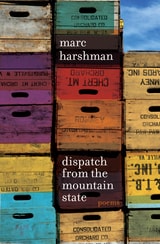
Dispatch from the Mountain State
PoemsMarc Harshman
West Virginia University Press, 2025
This collection of over forty poems sings with a fluid voice and dazzles with imagery that surprises and rings true, often underlain by and intertwined with the darker threads of our common living and dying as contemporary Appalachians. It is rare to find a poet like Harshman, who is deeply connected to the life of rural America and yet writes poetry untouched by any sentiment for the old ways found there.
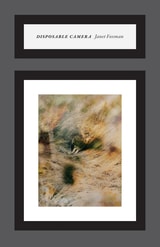
Disposable Camera
Janet Foxman
University of Chicago Press, 2012
Although Disposable Camera is Janet Foxman’s first book-length collection, one would not know it given the wry sophistication of the poems found within. The notion of the disposable camera permeates the entire book, where Foxman considers the instabilities in even our deepest attachments. Here gulfs expand, for instance, between twins, between the musician and his instrument, between the recluse and his inconsolable solitude. Whether a hermit; a twin; a filmgoer utterly taken with Triumph of the Will; or Masaccio, just after he’s painted the Expulsion—the poems’ speakers share a nagging anxiety that satisfaction may not exist outside the effort to imagine it, and that efforts at art and making, however compulsory to their executor, are probably regrettable from the start. A formally inventive and daring book, and one that displays a sophistication well beyond the poet’s years, Disposable Camera will be a valuable addition to American poetry.
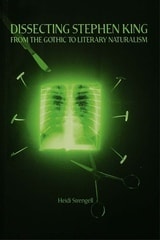
Dissecting Stephen King
From the Gothic to Literary NaturalismHeidi Strengell
University of Wisconsin Press, 2005
Ultimately, Strengell shows how King shatters our illusions of safety and control: "King places his decent and basically good characters at the mercy of indifferent forces, survival depending on their moral strength and the responsibility they may take for their fellow men."
Dissent
Poems and PiecesAustin Allen
Ohio University Press, 2027
Winner of the Hollis Summers Poetry Prize, selected by Michael Prior
Dissent, the third book of poems by Austin Allen, explores division, resistance, and exile in a variety of settings, from nineteenth-century New England to distant solar systems. Here readers will find snapshots of warring planets and pandemic-era France, revelations from government servers and Frank Capra’s Bedford Falls, and a testimonial from a fringe religious sect in the New Mexico desert.
The poems capture the dignity of eccentricity and the uncertainties of protest (“I speak out. I feel that I must. / I hear my own spiel with disgust”). Featured along the way are many lively dissenters and outsiders: Yoko Ono, a reclusive mathematician, a brain in a jar. Futuristic scenarios mingle with personal elegies and love lyrics—efforts to preserve bonds and memories threatened by an age of schisms.
Avoiding allegiance to any one school or style, the collection serves up apocalyptic limericks, a “high-octane blockbuster sonnet,” a catalog of items cleared out of a parent’s home, and instruction pieces in the style of Ono’s Grapefruit. Whether depicting a visionary mailman or happy thieves on Christmas, Dissent probes the unorthodox corners of a world where poetry itself can feel heretical.
Dissonance
Kristin Dykstra
University of Chicago Press, 2025
In Dissonance, translator Kristin Dykstra’s first book of original poetry, the author leads us to inner worlds shaped partly by the New England countryside, tracking shifts in the region’s nature, infrastructure, and people, while sharing observations on borders and climate catastrophe that reverberate globally. Dykstra condenses signs of urban expansion, economic division, and battles over democracy into an innovative meditation. With a dynamic approach to form, musicality, and scope, Dissonance explores ways of experiencing regional landscapes and imagined communities in the twenty-first century.
Through her extended sequence of prose poems, photographs, and lyric fragments, Dykstra merges clips from documents and dialogues with observations drawn from two local libraries and her daily walks down a dirt road through Vermont’s foothills. As she moves down this public road, which lies within the nation’s federally designated hundred-mile border zone, she finds a daily convergence of tensions. Dissonance asks how poetry can unsettle impressions of a place, and how that process, in turn, disturbs impressions of self, of others, and of time itself.
Dissonance is the recipient of the third annual Phoenix Emerging Poet Book Prize.
Dissonant Voices
Race, Jazz, and Innovative Poetics in Midcentury AmericaJoseph Pizza
University of Iowa Press, 2023
Distancing English
A Chapter in the History of the InexpressiblePage Richards
The Ohio State University Press, 2009
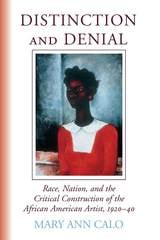
Distinction and Denial
Race, Nation, and the Critical Construction of the African American Artist, 1920-40Mary Ann Calo
University of Michigan Press, 2007
Distinctionand Denial challenges conventional theories of race and art by examining the role early twentieth-century art critics played in marginalizing African American artists. Mary Ann Calo dispels the myth of a unified African American artistic tradition through an engaging study of the germinal writing of Alain Locke and other significant critics of the era, who argued that African American artists were both a diverse group and a constituent element of America’s cultural center. By documenting the effects of the “Negro aesthetic” on African American artists working in the interwar years, Distinctionand Denial shows that black artistic production existed between the claims of a distinctly African American tradition and full inclusion into American modernist culture—never fully inside or outside the mainstream.
“A major contribution to the scholarship of African American artists in the inter-war period. With scrupulous research and probing analyses, Calo’s study enables scholars, students, and those interested in the Harlem Renaissance to grasp the intellectual debates, institutional support, and art world promotion that advanced an emerging cohort of African American artists.”
—Patricia Hills, Boston University
“A careful, thorough, historically grounded study that builds a new and significant argument challenging conventional histories of African American art. Sure to become indispensable to any scholarly discussion of American art or African American cultural studies.”
—Helen Langa, American University
Mary Ann Calo is Professor of Art History and Director of the Institute for the Creative and Performing Arts at Colgate University. She is author of Bernard Berenson and the Twentieth Century and editor of Critical Issues in American Art: A Book of Readings.

Ditch Memory
New and Selected PoemsTodd Davis
Michigan State University Press, 2024

Diva
Rafael Campo
Duke University Press, 1999
At once relishing and resisting the poetic traditions of formal English verse, Diva showcases Campo moving deftly between received forms and free verse. In each poem the sound of words is transformed into the highest of arts, the act of performance into the exercise of power, and the most profound abjection into the sweet promise of divinity. Culminating with his new and daring translations of Federico García Lorca's sonetos—the great Spanish poet's most homoerotically explicit and formally accomplished poems—Campo's music instills in the reader an exalted understanding of beauty, suffering, and, ultimately, the human capacity for empathy.
From reviews of Campo's previous poetry:
“Extraordinary meditations on illness and the healing power of words.”—Lambda Literary Foundation
“Read Campo to enter the bloodstream of a man who, with a haunting clarity of vision, shares his memories, his anguish, his healing love.”—Cortney Davis, Literature and Medicine
“Riveting, provocative, and refreshing—[this volume] is a gift to the clinician who is trying to re-invoke in his or her students the humility, compassion, and deep caring that brought us all into medicine in the first place.”—Dr. Sandra L. Bertman, Annals of Internal Medicine
“[Campo] listens to the sounds the body makes, but what he hears is poetry.”—Zoë Ingalls, Chronicle of Higher Education
“Powerful and accessible.”—Jonathan Jackson, Washington Blade
“Bemused, indelible, and heartbreaking.”—Marilyn Hacker, Out
“[Campo’s] private corral of disparate words twist, torque, collide with gorgeous creative imperative.”—Nomi Eve, Independent Weekly
Divergent Trajectories
Interviews with Innovative Fiction WritersFlore Chevaillier
The Ohio State University Press, 2017
Including interviews with R. M. Berry, Debra Di Blasi, Percival Everett, Thalia Field, Renee Gladman, Bhanu Kapil, Lance Olsen, Michael Martone, Carole Maso, Joseph McElroy, Christina Milletti, Alan Singer, and Steve Tomasula, Divergent Trajectories provides a framework that allows innovative authors to discuss in some depth their works, backgrounds, formal research, thematic preferences, genre treatment, aesthetic philosophies, dominant linguistic expressions, cultural trends, and the literary canon. Through an examination of these concepts, writers ask what “traditional” and “innovative” writing is, and most of all, what fiction is today.
Divers
Samuel Amadon
Omnidawn, 2026
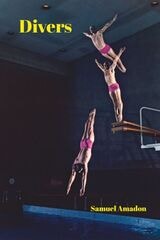
Marking a formal reinvention for the poet, this collection addresses the strangeness of time, blending writers and images from the past with contemporary scenes.
This book-length sequence of turbulent sonnets follows their speaker's impulses and imagination through the seasons of their composition. Written between 2016 and 2022, Divers is a collection shaped by contradiction and marks a new period of lyric experimentation for poet Sam Amadon. These poems are rigorously constrained while also making space for improvisation. They hold to a decasyllabic line while moving in and out of meter. They sing of time, and struggle to understand it. They find words for our moment in the pages of old books. Lines from great writers of the past—including Gerard Manley Hopkins, Thomas Wyatt, and Michael Drayton—echo through Amadon's poems of contemporary menace and wonder. Here we see both the owls lining our fences and the black SUVs rolling down our streets. Out of these conflicts, Amadon’s sonnets step up, lift off, and dive into themselves.
Divided We Stand
Watertown, Massachusetts, 1630-1680Roger Thompson
University of Massachusetts Press, 2001
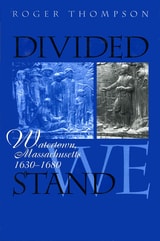
Thompson describes Watertown's early government, its relations with Native Americans and neighboring communities, its religious and economic affairs, and the day-to-day experiences of its people. Conflict occurred over a wide variety of issues: land allocation, administrative accountability, religious orthodoxy and exclusivity, generational and gender differences, livestock and fencing, haves and have-nots.
Thompson brings these disputes to life through a series of vivid case studies drawn from the unpublished Middlesex County Court Records. Among others, we meet John Sawin, who despite his best efforts at subterfuge was convicted of stealing and selling a neighbor's horse; Susanna Woodward, whose pregnancy resulted in a fiercely contested paternity case; and Edward Sanders, whose punishment for child abuse was both a whipping and a ruling that when in public he must "wear a rope round his neck openly to be seen hanging down two feet."
Throughout the book, the same themes reappear: continuity and change, the persistent conflicts of the first two generations, and the countervailing forces of communal cohesion.
Divine Days
A NovelLeon Forrest; Foreword by Kenneth W. Warren, Preface by Zachary Price
Northwestern University Press, 2023
“I have an awful memory for faces, but an excellent one for voices,” muses Joubert Jones, the aspiring playwright at the center of Divine Days. A kaleidoscopic whorl of characters, language, music, and Black experience, this saga follows Jones for one week in 1966 as he pursues the lore and legends of fictional Forest County, a place resembling Chicago’s South Side. Joubert is a veteran, recently returned to the city, who works for his aunt Eloise’s newspaper and pours drinks at her Night Light Lounge. He wants to write a play about Sugar-Groove, a drifter, “eternal wunderkind,” and local folk hero who seems to have passed away. Sugar-Groove’s disappearance recalls the subject of one of Joubert’s earlier writing attempts—W. A. D. Ford, a protean, diabolical preacher who led a religious sect known as “Divine Days.” Joubert takes notes as he learns about both tricksters, trying to understand their significance.
Divine Days introduces readers to a score of indelible characters: Imani, Joubert’s girlfriend, an artist and social worker searching for her lost siblings and struggling to reconcile middle class life with her values and Black identity; Eloise, who raised Joubert and whose influence is at odds with his writerly ambitions; (Oscar) Williemain, a local barber, storyteller, and founder of the Royal Rites and Righteous Ramblings Club; and the Night Light’s many patrons. With a structure inspired by James Joyce and jazz, Leon Forrest folds references to African American literature and cinema, Shakespeare, the Bible, and classical mythology into a heady quest that embraces life in all its tumult and adventure.
This edition brings Forrest’s masterpiece back into print, incorporating hundreds of editorial changes that the author had requested from W. W. Norton, but were not made for their editions in 1993 and 1994. Much of the inventory from the original printing of the book by Another Chicago Press in 1992 had been destroyed in a disastrous warehouse fire.
Do the Americas Have a Common Literature?
Gustavo Pérez Firmat, ed.
Duke University Press, 1990
The essays here place the literature of the Americas in a hemispheric context by drawing on approaches derived from various schools of contemporary critical thought—Marxism, feminism, culture studies, semiotics, reception aesthetics, and poststructuralism. As part of their search for a distinctly New World literary idiom, the contributors engage not only the major North American and Spanish American writers, but also such “marginal” or “minor” literatures as Chicano, African American, Brazilian, and Québecois. In identifying areas of agreement and confluence, this work lays the groundwork for finding historical, ideological, and cultural homogeneity in the imaginative writing of the Americas.
Contributors. Lois Parkinson Zamora, David T. Haberly, José David Saldívar, Antonio Benítez-Rojo, José Piedra, Doris Sommer, Enrico Mario Santí, Eduardo González, John Irwin, Wendy B. Faris, René Prieto, Jonathan Monroe, Gustavo Pérez Firmat
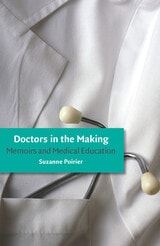
Doctors in the Making
Memoirs and Medical EducationSuzanne Poirier
University of Iowa Press, 2009
Through close readings of these accounts, Poirier draws attention to the complex nature of power in medicine, the rewards and hazards of professional and interpersonal relationships in all aspects of physicians’ lives, and the benefits to and threats from the vulnerability that medical students and residents experience.
Although most students emerge from medical education as well-trained, well-prepared professionals, few of them will claim that they survived the process unscathed. The authors of these accounts document—for better or for worse—the ways in which they have been changed. Based on their stories, Poirier recommends that medical education should make room for the central importance of personal relationships, the profound sense of isolation and powerlessness that can threaten the wellbeing of patients and physicians alike, and the physical and moral vulnerability that are part of every physician’s life.
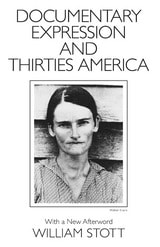
Documentary Expression and Thirties America
William Stott
University of Chicago Press, 1986
"[Scott] might be called the Aristotle of documentary. No one before him has so comprehensively surveyed the achievement of the 1930s, suggesting what should be admired, what condemned, and why; no one else has so persuasively furnished an aesthetic for judging the form."—Times Literary Supplement
Documents of American Realism and Naturalism
Donald Pizer
Southern Illinois University Press, 1998
Donald Pizer presents the major critical discussions of American realism and naturalism from the beginnings of the movement in the 1870s to the present. He includes the most often cited discussions ranging from William Dean Howells, Henry James, and Frank Norris in the late nineteenth century to those by V. L. Parrington, Malcolm Cowley, and Lionel Trilling in the early twentieth century. To provide the full context for the effort to interpret the nature and significance of realism and naturalism during the periods when the movements were live issues on the critical scene, however, he also includes many uncollected essays. His selections since World War II reflect the major recent tendencies in academic criticism of the movements.
Through introductions to each of the three sections, Pizer provides background, delineating the underlying issues motivating attempts to attack, defend, or describe American realism and naturalism. In particular, Pizer attempts to reveal the close ties between criticism of the two movements and significant cultural concerns of the period in which the criticism appeared. Before each selection, Pizer provides a brief biographical note and establishes the cultural milieu in which the essay was originally published. He closes his anthology with a bibliography of twentieth-century academic criticism of American realism and naturalism.
Dodging
Charles Bernstein
University of Chicago Press, 0
A new, expansive collection by one of the most provocative and inventive poets of our time.
In Dodging, Charles Bernstein pushes his poetics toward new kinds of formal and tonal attentions. This multifaceted work brings together comic velocity, pointed political critique, and passages of lyric intensity. Bernstein calls these poems “too late”: written late in life as irreversibility presses against reflection, regret, and renewed resistance—a situation in which dodging is not evasion but survival, a way of moving through political catastrophe and personal loss without being silenced by either.
The collection unfolds in three interrelated “fits”—a term suggesting bursts of composition, rhythmic surges, and formal groupings—titled “Dodging,” “Struggle,” and “Reflection.” These sections move from a series of flashes and fragments, then to assembled riffs and collaborations with poet Tracie Morris, and finally turn to refractions and aphorisms that embrace active contradiction. Together they trace a shifting field of contrasts: between satire and elegy, volatility and concentration, comedy and grief.
Both fundamentally true to Bernstein’s voice and radically radiant in its range, Dodging is a work that moves restlessly across forms and tones—by turns sly, searching, and unguarded, where humor and grief occupy the same ground.
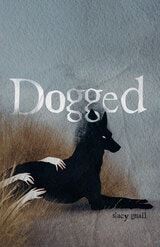
Dogged
Stacy Gnall
University of Massachusetts Press, 2022
Looking to a wide range of high and low visual media, from Steven Spielberg’s Jaws and Animal Planet’s Fatal Attractions to Peter Paul Rubens’s painting of Hercules’s dog discovering Tyrian purple, Stacy Gnall ponders human-animal connections and divisions, exploring those moments when human voices blend with “silent” beasts to exceed the limits of language. In Dogged, animals emerge as the highest aspiration of poetry.
Around the bend it was reckoned
we would never grow old
because there were no words for it.
I placed my arms soft
around the neck of a fawn
and she felt no alarm. Speech
is where we went wrong.
(From “The Wood in Which Things Have No Name”)

Domestic Broils
Shakers, Antebellum Marriage, and the Narratives of Mary and Joseph DyerElizabeth De Wolfe
University of Massachusetts Press, 2010

Don Gummer
Don Gummer
The Artist Book Foundation, 2021
The trajectory of Don Gummer's career as a sculptor began in New York City in the late 1970s with his wall reliefs of painted wood, carefully layered geometric works exhibiting a strong architectural influence. Moving beyond wood to stone, bronze, stainless steel, aluminum, and glass as his primary materials, his artworks evolved into subtly inventive freestanding sculptures, often of monumental scale, that exhibit his unfailing attention to craftsmanship and detail.
In a 2001 interview with Peter Plagens, American artist and art critic, Gummer described his interest in sculpture as "the recontextualization of natural phenomena, of unaltered things brought into aesthetic balance by choosing and placing." Using balance, proportion, and his unique sense of harmony, the artist is able to make durable materials seem almost buoyant. Negative space becomes an intrinsic element in his work, imparting a sense that his exquisite, seemingly permanent forms are ultimately as fleeting as any of nature's creations would be. The Artist Book Foundation is delighted to present Don Gummer, a new monograph on the artist and his highly acclaimed body of work.
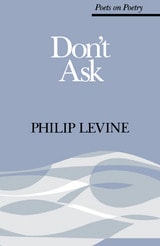
Don't Ask
Philip Levine
University of Michigan Press, 1981
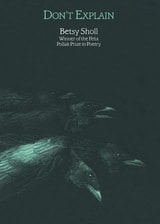
Don't Explain
Betsy Sholl
University of Wisconsin Press, 1997
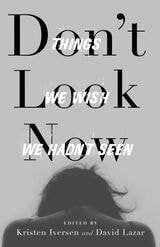
Don't Look Now
Things We Wish We Hadn't SeenEdited by Kristen Iversen and David Lazar
The Ohio State University Press, 2020
Featuring essays by Jericho Parms, XU XI, Jerald Walker, José Orduña, Kristen Iversen, Nicole Walker, Mary Cappello, Lina Ferreira, Colleen O’Connor, Sonya Huber, Paul Crenshaw, Alyce Miller, Patrick Madden, Amelia María de la Luz Montes, Yalie Kamara, Emily Heiden, Lee Martin, and David Lazar,
this collection bares all. The authors invite readers into a dream that resurrects a departed mother each night, only to lose her again each morning upon waking; the post-mortem newspaper photos of a former student; kaleidoscope childhood memories of the mundane mixed up together with the traumatic; an unplanned pregnancy; a bullfight and a spouse’s mortality; a teen witnessing the suicide of her father; a parent trying to shield his children from witnessing a violent death. What these writers are after, though, is not the melancholic/grotesque/violent moment itself, but the process of remembering—and trying to forget. They examine the way these memories take hold, resurface, and never leave, and what it means for a life lived long after these moments have passed. These scenes, slowly enfolding us like bad dreams or flying by like trains on elevated platforms, demand we reach some kind of accommodation with them—make peace or make sense or make amends. The one thing they insist with certainty is this: they cannot—will not—be unseen.
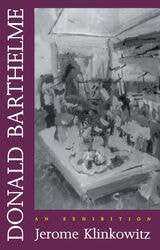
Donald Barthelme
An ExhibitionJerome Klinkowitz
Duke University Press, 1991
Klinkowitz argues that the central piece in the Barthelme canon, and the key to his artistic method, is his widely acknowledged masterpiece, The Dead Father. In turning to this pivotal work, as well as to Barthelme’s short stories and other novels, Klinkowitz explores the way in which Barthelme reinvented the tools of narration, characterization, and thematics at a time when fictive techniques were largely believed to be exhausted.
Klinkowitz, who was one of the first scholars to study Barthelme’s work and became its definitive bibliographer, situates Barthelme’s life and work within a broad spectrum of influences and affinities. A consideration of developments in painting and sculpture, for example, as well as those of contemporaneous fiction, contribute to Klinkowitz’s analysis. This astute reading will provide great insight for readers, writers, and critics of contemporary American fiction seeking explanations and justifications of Barthelme’s critical importance in the literature of our times.
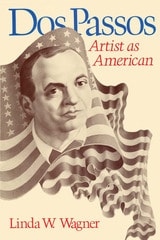
Dos Passos
Artist as AmericanBy Linda W. Wagner
University of Texas Press, 1979
In most of his half century of writing, John Dos Passos consistently tried to capture and define the American character. The complete range of his work builds to Dos Passos' concept of "contemporary chronicle," his own name for his fiction. In this first study of all Dos Passos' writing, Linda W. Wagner examines his fiction, poetry, drama, travel essays, and history—a body of work that evokes a vivid image of America meant to be neither judgmental nor moralistic.
From Manhattan Transfer to U. S. A. to District of Columbia to The Thirteenth Chronicle and Mid-century, Wagner illuminates Dos Passos' work with fresh readings and new interpretations. She makes extensive use of unpublished manuscript material so that this is a casebook of Dos Passos' interest in craft and method as well as a thematic study. In addition, this volume chronicles the years during which Dos Passos wrote—the immediate post-World War I period through the twenties and thirties and well into the fifties. This is an important book both in literary criticism and in American social history.
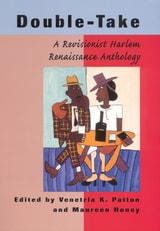
Double-Take
A Revisionist Harlem Renaissance AnthologyPatton, Venetria K
Rutgers University Press, 2001
The editors have included works from a wide variety of genres-poetry, short stories, drama, and essays-allowing readers to understand the true interdisciplinary quality of this cultural movement. Biographical sketches of the authors are provided and most of the pieces are included in their entirety. Double-Take also includes artwork and illustrations, many of which are from original journals and have never before been reprinted. Significantly, Double-Take is the first Harlem Renaissance title to include song lyrics to illustrate the interrelation of various art forms.
Doubles
Robert Polito
University of Chicago Press, 1995
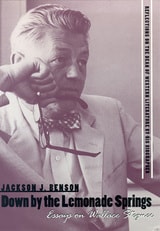
Down By The Lemonade Springs
Essays On Wallace StegnerJackson J. Benson
University of Nevada Press, 2001
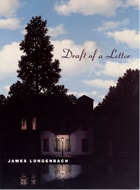
Draft of a Letter
James Longenbach
University of Chicago Press, 2007
From Second Draft:
What other people learn
From birth,
Betrayal,
I learned late.
My soul perched
On an olive branch
Combing itself,
Waving its plumes. I said
Being mortal,
I aspire to
Mortal things.
I need you,
Said my soul,
If you’re telling the truth.
Draft of a Letter is a book about belief—not belief in the unknowable but belief in what seems bewilderingly plain. Pondering the bodies we inhabit, the words we speak, these poems discover infinitude in the most familiar places. The revelation is disorienting and, as a result, these poems talk to themselves, revise themselves, fashioning a dialogue between self and soul that opens outward to include other voices, lovers, children, angels, and ghosts. For James Longenbach, great distance makes the messages we send sweeter. To be divided from ourselves is never to be alone. “If the kingdom is in the sky,” says the body to the soul, “Birds will get there before you.” “In time,” says the awakening soul, “I liked my second / Body better / Than the first.” To live, these poems insist, is to arise every day to the strange magnificence of the people and places we thought we knew best. Draft of a Letter is an unsettled and radiant paradiso, imagined in the death-shadowed, birth-haunted middle of a long life.
Praise for Fleet River
“A sensibility this cogent, this subtle and austere is rare; even rarer is its proof that poetry still flows through all things and transforms all things in the process.”—Carol Muske-Dukes, Los Angeles Times Book Review
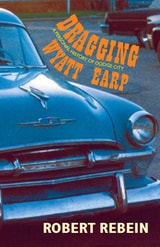
Dragging Wyatt Earp
A Personal History of Dodge CityRobert Rebein
Ohio University Press, 2013
In Dragging Wyatt Earp essayist Robert Rebein explores what it means to grow up in, leave, and ultimately return to the iconic Western town of Dodge City, Kansas. In chapters ranging from memoir to reportage to revisionist history, Rebein contrasts his hometown’s Old West heritage with a New West reality that includes salvage yards, beefpacking plants, and bored teenagers cruising up and down Wyatt Earp Boulevard.
Along the way, Rebein covers a vast expanse of place and time and revisits a number of Western myths, including those surrounding Francisco Vasquez de Coronado, the Cheyenne chief Black Kettle, George Armstrong Custer, and of course Wyatt Earp himself. Rebein rides a bronc in a rodeo, spends a day as a pen rider at a local feedlot, and attempts to “buck the tiger” at Dodge City’s new Boot Hill Casino and Resort.
Funny and incisive, Dragging Wyatt Earp is an exciting new entry in what is sometimes called the nonfiction of place. It is a must- read for anyone interested in Western history, contemporary memoir, or the collision of Old and New West on the High Plains of Kansas.

Dreaming Revolution
Transgression in the Development of American RomanceScott Bradfield
University of Iowa Press, 1993
Dreaming Revolution usefully employs current critical theory to address how the European novel of class revolt was transformed into the American novel of imperial expansion. Bradfield shows that early American romantic fiction—including works by William Godwin, Charles Brockden Brown, James Fenimore Cooper, and Edgar Allan Poe—can and should be considered as part of a genre too often limited to the nineteenth-century European novel. In a spirited discussion of the works from these four authors, Bradfield argues that Americans take the class dynamics of the European psychological novel and apply them to the American landscape, reimagining psychological spaces as geographical ones.
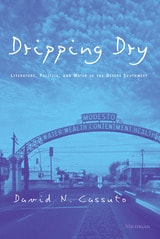
Dripping Dry
Literature, Politics and Water in the Desert SouthwestDavid N. Cassuto
University of Michigan Press, 2001
The four works selected (Animal Dreams, The Monkey Wrench Gang, The Grapes of Wrath, and The Ford) present a composite portrait of reclamation, which the author argues is one of the most important cultural and ecological phenomena in the nation's history. The tensions and contradictions presented by the novels underscore the compelling need for an ecocritique of the relationship between literature and politics. David N. Cassuto deciphers the myths of reclamation and restoration and presents a third alternative--sustainability--in their stead. The challenge is a large one, because of the size and complexity of the region and because nature continues to evolve and create itself, a process involving language, ideology, and the land.
The book is designed to be an interdisciplinary contribution both to the emerging field of literature and the environment, as well as to environmental studies. It will be welcomed by scholars as well as general readers interested in new approaches to literature and environmental issues, and by those interested in the geography and literature of the western United States.
David N. Cassuto, formerly of the English Department of the University of Missouri-Rolla, is a practicing attorney in San Francisco, specializing in environmental issues.