Results by title
2728 books match the query 'Education' and 139 start with d
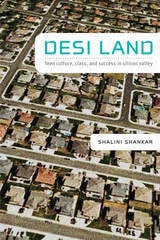
Desi Land
Teen Culture, Class, and Success in Silicon ValleyShalini Shankar
Duke University Press, 2008
Whether discussing instant messaging or arranged marriages, Desi bling or the pressures of the model minority myth, Shankar foregrounds the teens’ voices, perspectives, and stories. She investigates how Desi teens interact with dialogue and songs from Bollywood films as well as how they use their heritage language in ways that inform local meanings of ethnicity while they also connect to a broader South Asian diasporic consciousness. She analyzes how teens negotiate rules about dating and reconcile them with their longer-term desire to become adult members of their communities. In Desi Land Shankar not only shows how Desi teens of different socioeconomic backgrounds are differently able to succeed in Silicon Valley schools and economies but also how such variance affects meanings of race, class, and community for South Asian Americans.
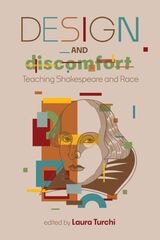
Design and Discomfort
Teaching Shakespeare and RaceEdited by Laura B. Turchi
Arizona Center for Medieval and Renaissance Studies, 2025
Design and Discomfort confronts the complexities of teaching Shakespeare in today’s classrooms, where discussions of race, bias, and historical legacies can provoke discomfort—but also transformation. Edited by Laura B. Turchi, this collection brings together educators and teaching artists who share innovative strategies for rethinking Shakespeare’s role in education.
Rather than treating Shakespeare as an untouchable authority, the contributors explore how his works can be a springboard for broader conversations about identity and justice. They advocate for performance-based and student-driven approaches that help students see themselves—their communities, their families, and their lived experiences—in the complex and seemingly distant world of Shakespeare.
This open-access volume provides both conceptual essays and practical lesson designs for educators navigating the intersections of Shakespeare and race. By embracing discomfort as part of the learning process, Design and Discomfort reframes how Shakespeare should be taught in classrooms today.
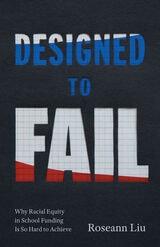
Designed to Fail
Why Racial Equity in School Funding Is So Hard to AchieveRoseann Liu
University of Chicago Press, 2024
For people who care about urban school districts like Philadelphia’s, addressing the challenges that these schools face often boils down to the need for more money. But why are urban districts that serve Black and Brown students still so perennially underfunded compared to majority-white ones? Why is racial equity in school funding so hard to achieve?
In Designed to Fail, Roseann Liu provides an inside look at the Pennsylvania state legislature and campaigns for fair funding to show how those responsible for the distribution of school funding work to maintain the privileges of majority-white school districts. Liu analyzes how colorblind policies, political structures, and the maintenance of the status quo by people in power perpetuate wide and deepening racial disparities in education funding. Taking a lesson from community organizers fighting for a racially equitable school funding system, Liu’s work is a bold call to address structural racism at the root and organize from a place of abundant justice.
Designing Experiments in Education and the Social Sciences
Larry V. Hedges
Russell Sage Foundation, 2026
Randomized experiments—often referred to as the gold standard of research design—are generally accepted as the type of studies that provide the strongest evidence about cause and effect. There has been a wide adoption of experimental methods in agriculture, medicine, industrial design, and laboratory social sciences, such as experimental psychology, where conditions can be controlled. Since then, there has been an increase in the use of field experiments to provide evidence of cause and effect beyond the laboratory. However, the social settings in which these studies take place complicate the design and evaluation of experiments because their social contexts must be taken into account in order for the experiment to provide useful and unambiguous results. In Designing Experiments in Education and the Social Sciences, statistician Larry V. Hedges details how to design educational and social science field experiments that are sensitive enough to provide clear-cut evidence on the effects of social interventions.
Hedges draws on one hundred years of statistical theory and classic experimental design in Designing Experiments in Education and the Social Sciences. Highlighting the social-structural information embedded in field experiments, he links this history with contemporary statistical methods in the social sciences to explain how to design social experiments that are adequately sensitive to determine the influence of an intervention. He covers the four basic research designs—and 39 elaborations of those designs—that are used most often in social experiments while also introducing additional, more complex, designs. He brings together, in the same notation, work on experimental design, design sensitivity, and optimal design of experiments for the most frequently used research designs in education and the social sciences, emphasizing their conceptual consistency. Hedges also discusses the practical problems of how to recruit and maintain a sample throughout the duration of an experiment.
Designing Experiments in Education and the Social Sciences is an essential resource for researchers planning educational and social field experiments and graduate students.

Designing and Conducting Practice-Based Research Projects
A Practical Guide for Arts Student ResearchersR. Lyle Skains
Intellect Books, 2024
This book offers definitions and a brief background to practice-based research in the arts, contextualization of practice-based methods, a step-by-step approach to designing research projects, chapter summaries, examples of practice-related research, exercises for progressing methods design and evaluating research approach, and lists for further reading. This textbook can serve as the foundation for a wider, online “living” textbook for practice-related research in the arts.
Developing Educators for The Digital Age
A Framework for Capturing Knowledge in ActionPaul Breen
University of Westminster Press, 2018
Evaluating skills and knowledge capture lies at the cutting edge of contemporary higher education where there is a drive towards increasing evaluation of classroom performance and use of digital technologies in pedagogy. Developing Educators for the Digital Age is a book that provides a narrative account of teacher development geared towards the further usage of technologies (including iPads, MOOCs and whiteboards) in the classroom presented via the histories and observation of a diverse group of teachers engaged in the multiple dimensions of their profession.
Drawing on the insights of a variety of educational theories and approaches (including TPACK) it presents a practical framework for capturing knowledge in action of these English language teachers – in their own voices – indicating how such methods, processes and experiences shed light more widely on related contexts within HE and may be transferable to other situations.
This book will be of interest to the growing body of scholars interested in TPACK theory, or communities of practice theory and more widely anyone concerned with how new pedagogical skills and knowledge with technology may be incorporated in better practice and concrete instances of teaching.
Developing Faculty in Liberal Arts Colleges
Aligning Individual Needs and Organizational GoalsBaker, Vicki L.
Rutgers University Press, 2017
Drawing on research conducted at the thirteen institutions of the Great Lakes Colleges Association, Vicki L. Baker, Laura Gail Lunsford, and Meghan J. Pifer propose a compelling Alignment Framework for Faculty Development in Liberal Arts Colleges to show how these colleges succeed—or sometimes fail—in providing their faculties with the right support to be successful.
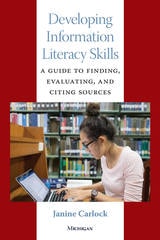
Developing Information Literacy Skills
A Guide to Finding, Evaluating, and Citing SourcesJanine Carlock
University of Michigan Press, 2020
This text has been structured around the six critical elements of the ACRL Framework for Information Literacy in Higher Education, contextualizing these elements by fitting them into the research and writing process. The book focuses on providing students with the critical-thinking and problem-solving skills needed to: (1) identify the conversation that exists around a topic, (2) clarify their own perspective on that topic, and (3) efficiently and effectively read and evaluate what others have said that can inform their perspective and research. The critical-thinking and problem-solving skills practiced here are good preparation for what students will encounter in their academic and professional lives.
As an experienced writing instructor, the author has evaluated the final written products of hundreds of students who were trained through one-shot workshops and first-year introductory courses. She has applied that knowledge to create the tasks in this book so that students have the skills to successfully find, evaluate, and use sources and then produce a paper that incorporates valid research responsibly and effectively.
Developing Writers in Higher Education
A Longitudinal StudyAnne Ruggles Gere, editor
University of Michigan Press, 2019
This volume draws on an in-depth study of the writing and experiences of 169 University of Michigan undergraduates, using statistical analysis of 322 surveys, qualitative analysis of 131 interviews, use of corpus linguistics on 94 electronic portfolios and 2,406 pieces of student writing, and case studies of individual students to trace the multiple paths taken by student writers. Topics include student writers’ interaction with feedback; perceptions of genre; the role of disciplinary writing; generality and certainty in student writing; students’ concepts of voice and style; students’ understanding of multimodal and digital writing; high school’s influence on college writers; and writing development after college. The digital edition offers samples of student writing, electronic portfolios produced by student writers, transcripts of interviews with students, and explanations of some of the analysis conducted by the contributors.
This is an important book for researchers and graduate students in multiple fields. Those in writing studies get an overview of other longitudinal studies as well as key questions currently circulating. For linguists, it demonstrates how corpus linguistics can inform writing studies. Scholars in higher education will gain a new perspective on college student development. The book also adds to current understandings of sociocultural theories of literacy and offers prospective teachers insights into how students learn to write. Finally, for high school teachers, this volume will answer questions about college writing.
Companion Website
Click here to access the Developing Writers project and its findings at the interactive companion website.
Project Data
Access the data from the project through this tutorial.
Developing the Higher Education Curriculum
Research-Based Education in PracticeEdited by Brent Carnell and Dilly Fung
University College London, 2017

Developing the Teacher Workforce
Edited by Mark A. Smylie and Debra Miretzky
University of Chicago Press, 2004
The authors argue that current ways of thinking are inadequate for the nature of the work and future demands because of the neglect of the context, the lack of understanding of teacher career stages, and disregard of the "ripple effect" of educational policy. A coherent, cohesive approach must replace the fragmented and autonomous efforts that predominate today. The volume's authors demonstrate that until a more seamless and comprehensive human resource system is employed, widespread improvements in teacher quality are unlikely and the quality of learning will itself remain compromised.
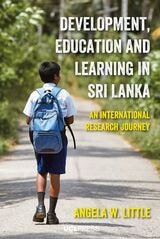
Development, Education and Learning in Sri Lanka
An International Research JourneyAngela W. Little
University College London, 2024
Sri Lanka’s early achievements in education and literacy became well-known among the international development community in the middle of the last century and were often used to benchmark progress elsewhere. Development, Education and Learning in Sri Lanka presents an illuminating narrative of changing education fortunes and inequalities, based on half a century of research conducted by Angela W. Little. This journey was undertaken in collaboration with Sri Lankan researchers island-wide in myriad communities, schools, classrooms, and education offices, through conversations with countless parents, teachers, students, community members, trade union officers, politicians, and members of local, national, and international development agencies, as well as through extensive documentary analysis.
The book delineates the distinctive and changing features of the Sri Lankan education system and compares it with systems elsewhere, to offer in-depth analyses of myriad issues and challenges in a single country over an extended period, framed by shifting international discourses and comparisons with education systems elsewhere. These analyses are framed by themes in the international development discourse on education and development–some of which have been influenced by the Sri Lankan story–ranging from modernization to basic needs to sustainable development. The book promotes a message about the need to understand education and development on a country’s own terms and to place learning at the heart of education policy, situating it within broader conceptions of the purpose, values, and means of development.
Developmental Programming for Infants and Young Children
Volume 1. Assessment and ApplicationD. Sue Schafer and Martha S. Moersch, Editors
University of Michigan Press, 1981
Developmental Programming for Infants and Young Children: Volume 1 provides detailed instructions for the use of Volume 2: Early Intervention Developmental Profile, including administration and evaluation techniques, scoring and interpretation of results, validity and reliability of findings, and complete item descriptions. To be used with children functioning in the 0-to-36-month developmental age range. Volume 1 includes the scoring sheet (Volume 2).
Developmental Programming for Infants and Young Children has proven to be an invaluable tool for teachers, therapists, and other professionals who assess and facilitate the development of children functioning primarily in the 0-to-60 month range. The authors address six areas of development: perceptual/fine motor, cognition, language, social/emotional, self-care, and gross motor. Volumes 1, 2, and 3 are designed for use with children functioning in the 0-to-36-month developmental age range, while Volumes 4 and 5 extend assessment and programming guidelines to 5-year (preschool) levels.
Carefully designed and tested by the University of Michigan's Institute for the Study of Mental Retardation and Related Disabilities, all volumes bridge the gap between assessment and program implementation.
Developmental Programming for Infants and Young Children
Volume 3. Stimulation ActivitiesD. Sue Schafer and Martha S. Moersch, Editors
University of Michigan Press, 1981
Developmental Programming for Infants and Young Children: Volume 3 provides a reservoir of ideas for carrying out planned program objectives. Each developmental area contains sequenced develop mental behaviors that would be expected in a normal child, with adaptations for specific handicapping conditions noted. This volume describes ways to handle, stimulate, and interact with a young child functioning in the developmental age range 0-to-36 months. It can be used by parents for at-home activities.
This volume is available as a set in combination with Volumes 1 and 2.
Developmental Programming for Infants and Young Children has proven to be an invaluable tool for teachers, therapists, and other professionals who assess and facilitate the development of children functioning primarily in the 0-to-60 month range. The authors address six areas of development: perceptual/fine motor, cognition, language, social/emotional, self-care, and gross motor. Volumes 1, 2, and 3 are designed for use with children functioning in the 0-to-36-month developmental age range, while Volumes 4 and 5 extend assessment and programming guidelines to 5-year (preschool) levels.
Carefully designed and tested by the University of Michigan's Institute for the Study of Mental Retardation and Related Disabilities, all volumes bridge the gap between assessment and program implementation.
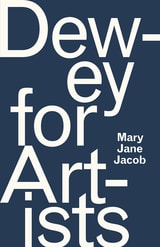
Dewey for Artists
Mary Jane Jacob
University of Chicago Press, 2018
Dewey argued that there is strong social value to be found in art, and it is artists who often most challenge our preconceived notions. Dewey for Artists shows us how Dewey advocated for an “art of democracy.” Identifying the audience as co-creator of a work of art by virtue of their experience, he made space for public participation. Moreover, he believed that societies only become—and remain—truly democratic if its citizens embrace democracy itself as a creative act, and in this he advocated for the social participation of artists.
Throughout the book, Mary Jane Jacob draws on the experiences of contemporary artists who have modeled Dewey’s principles within their practices. We see how their work springs from deeply held values. We see, too, how carefully considered curatorial practice can address the manifold ways in which aesthetic experience happens and, thus, enable viewers to find greater meaning and purpose. And it is this potential of art for self and social realization, Jacob helps us understand, that further ensures Dewey’s legacy—and the culture we live in.
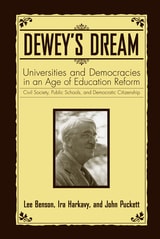
Dewey's Dream
Universities and Democracies in an Age of Education ReformLee Benson
Temple University Press, 2007
This timely, persuasive, and hopeful book reexamines John Dewey's idea of schools, specifically community schools, as the best places to grow a democratic society that is based on racial, social, and economic justice. The authors assert that American colleges and universities bear a responsibility for-and would benefit substantially from-working with schools to develop democratic schools and communities.
Dewey's Dream opens with a reappraisal of Dewey's philosophy and an argument for its continued relevance today. The authors-all well-known in education circles-use illustrations from over 20 years of experience working with public schools in the University of Pennsylvania's local ecological community of West Philadelphia, to demonstrate how their ideas can be put into action. By emphasizing problem-solving as the foundation of education, their work has awakened university students to their social responsibilities. And while the project is still young, it demonstrates that Dewey's "Utopian ends" of creating optimally participatory democratic societies can lead to practical, constructive school, higher education and community change, development, and improvement.
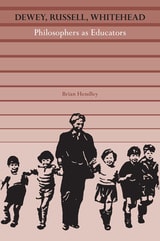
Dewey, Russell, Whitehead
Philosophers as EducatorsBrian Patrick Hendley
Southern Illinois University Press, 1986
In Philosophers as Educators Brian Patrick Hendley argues that philosophers of education should reject their preoccupation with defining terms and analyzing concepts and embrace the philosophical task of constructing general theories of education. Hendley discusses in detail the educational philosophies of John Dewey, Bertrand Russell, and Alfred North Whitehead. He sees in these men excellent role models that contemporary philosophers might well follow. Hendley believes that, like these mentors, philosophers should take a more active, practical role in education. Dewey and Russell ran their own schools, and Whitehead served as a university administrator and as a member of many committees created to study education.
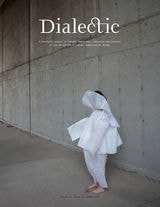
Dialectic
A Scholarly Journal of Thought Leadership, Education and Practice in the Discipline of Visual Communication Design - Volume II, Issue II - Summer 2019Michael R. Gibson
Michigan Publishing Services, 2019
Dialectic
A Scholarly Journal of Thought Leadership, Education and Practice in the Discipline of Visual Communication Design Volume I, Issue I - Winter 2016-17Keith M Owens and Michael Gibson
Michigan Publishing Services, 2017
examination of issues that affect design education, research,
and inquiry into their effects on the practice of design. Michigan
Publishing, the hub of scholarly publishing at the University of Michigan,
publishes Dialectic on behalf of the AIGA (American Institute of
Graphic Arts) Design Educators Community (DEC).
Dialectic
A Scholarly Journal of Thought Leadership, Education and Practice in the Discipline of Visual Communication Design Volume I, Issue II - Fall 2017Michael R. Gibson and Keith M. Owens (Editors)
Michigan Publishing Services, 2017
examination of issues that affect design education, research,
and inquiry into their effects on the practice of design. Michigan
Publishing, the hub of scholarly publishing at the University of Michigan,
publishes Dialectic on behalf of the AIGA (American Institute of
Graphic Arts) Design Educators Community (DEC).
Dialectic
A scholarly journal of thought leadership, education and practice in the discipline of visual communication design - Volume II, Issue I - Summer 2018Michael R. Gibson
Michigan Publishing Services, 2018
Dialectic seeks to publish scholarship, analytical study and criticism that will enlighten and inform a diverse audience of design educators engaged not only in classroom teaching experiences but also in differing forms of research and professional practice. The journal's advisory and editorial boards recognize that design education, along with design research and professional practice, exist in relationships that are now broadly informed by theoretical frameworks and applications of knowledge derived from the social and applied sciences, the humanities, and other professions such as business, education, information technology and media studies. The outcomes of these synergies often result in the invention, discovery, understanding, and dissemination of new knowledge, innovation, and best practices.
Dialogic Education
Conversation About Ideas and Between PersonsRonald C. Arnett
Southern Illinois University Press, 1993
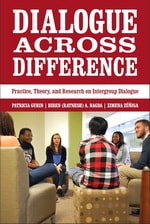
Dialogue Across Difference
Practice, Theory, and Research on Intergroup DialoguePatricia Gurin
Russell Sage Foundation, 2013

Dialogue
Proceedings of the AIGA Design Educators Community Conferences: Decipher, Vol. 1Written by AIGA DEC, Edited by Kelly M. Murdoch-Kitt and Omar Sosa-Tzec
Michigan Publishing Services, 2019
Hosted by the Penny W. Stamps School of Art & Design at the
University of Michigan, Decipher:
- Connected emerging and experienced design researchers in academia and beyond
- Gathered and shared best practices, resources, tools, and exemplary research matter
- Helped participants hone research plans and writing skills
- Created opportunities for dialogues to foster mentorship and collaborative connections
Dialogue
Proceedings of the AIGA Design Educators Community Conferences: Decipher, Vol. 2Written by AIGA DEC, Edited by Kelly M. Murdoch-Kitt and Omar Sosa-Tzec
Michigan Publishing Services, 2019
Hosted by the Penny W. Stamps School of Art & Design at the University of Michigan, Decipher:
- Connected emerging and experienced design researchers in academia and beyond
- Gathered and shared best practices, resources, tools, and exemplary research matter
- Helped participants hone research plans and writing skills
- Created opportunities for dialogues to foster mentorship and collaborative connections
Dialogue
Proceedings of the AIGA Design Educators Community Conferences: MAKEWritten by AIGA DEC, Edited by Pamela Napier and Aaron Ganci
Michigan Publishing Services, 2019
Dialogue
Proceedings of the AIGA Design Educators Community Conferences: SHIFTWritten by AIGA DEC, Edited by Liese Zahabi
Michigan Publishing Services, 2022
Dialogue is the ongoing series of fully open access proceedings of the conferences and national symposia of the AIGA Design Educators Committee.
Although each conference varies in theme, issues of Dialogue contain papers from DEC conferences which focus on topics that affect design education, research, and professional practice.
Michigan Publishing, the hub of scholarly publishing at the University of Michigan, publishes Dialogue on behalf of the AIGA DEC.
Dialogue
Proceedings of the AIGA Design Educators Community Conferences: SHIFT{ED}Liese AIGA Design Educators Community (DEC)
Michigan Publishing Services, 2024
Although each conference varies in theme, issues of Dialogue contain papers from DEC conferences which focus on topics that affect design education, research, and professional practice. Michigan Publishing, the hub of scholarly publishing at the University of Michigan, publishes Dialogue on behalf of the AIGA DEC.
Dialogue
Proceedings of the AIGA Design Educators Community Conferences: WEAVEWritten by AIGA DEC, Edited by Zack Tucker & Yvette Shen
Michigan Publishing Services, 2026
Dialogue is the ongoing series of fully open access proceedings of the conferences and national symposia of the AIGA Design Educators Committee.
Although each conference varies in theme, issues of Dialogue contain papers from DEC conferences which focus on topics that affect design education, research, and professional practice. Michigan Publishing, the hub of scholarly publishing at the University of Michigan, publishes Dialogue on behalf of the AIGA DEC.

Dialogues and Addresses
Madame de Maintenon
University of Chicago Press, 2004
Denounced by her contemporaries as a political schemer and religious fanatic, Maintenon has long been criticized as an opponent of gender equality. The writings in this volume faithfully reflect Maintenon's respect for social hierarchy and her stoic call for women to accept the duties of their state in life. But the writings also echo Maintenon's more feminist concerns: the need to redefine the virtues in the light of women's experience, the importance of naming the constraints on women's freedom, and the urgent need to remedy the scandalous neglect of the education of women.
In her writings as well as in her own model school at Saint-Cyr, Maintenon embodies the demand for educational reform as the key to the empowerment of women at the dawn of modernity.

Dictators and the Higher Education Dilemma
State Power and the University in Modern IranSaeid Golkar
Rutgers University Press, 0
Dictators and the Higher Education Dilemma explores a powerful contradiction at the heart of modern authoritarian regimes: While universities are essential for producing skilled labor and projecting national progress, they also cultivate critical thinkers who can challenge state power. Drawing on Iran’s modern history, from the Pahlavi monarchy to the Islamic Republic, Saeid Golkar shows how dictators use universities not only to train technocrats and showcase development but also as tools for shaping ideology, suppressing dissent, and co-opting academics. In authoritarian systems, education becomes a double-edged sword, essential for growth yet dangerous when it empowers independent thought. Golkar reveals how regimes manipulate admissions, censor curricula, and reward loyalty to create compliant intellectuals and loyal elites. Blending personal experience with rich historical and political analysis, this book exposes the tactics used to turn universities into instruments of social control. It speaks to a growing trend worldwide, offering vital insights into the clash between authoritarian power and academic freedom from Iran to China, Russia, and beyond.

Dido's Daughters
Literacy, Gender, and Empire in Early Modern England and FranceMargaret W. Ferguson
University of Chicago Press, 2003
Our common definition of literacy is the ability to read and write in one language. But as Margaret Ferguson reveals in Dido's Daughters, this description is inadequate, because it fails to help us understand heated conflicts over literacy during the emergence of print culture. The fifteenth through seventeenth centuries, she shows, were a contentious era of transition from Latin and other clerical modes of literacy toward more vernacular forms of speech and writing.
Fegurson's aim in this long-awaited work is twofold: to show that what counted as more valuable among these competing literacies had much to do with notions of gender, and to demonstrate how debates about female literacy were critical to the emergence of imperial nations. Looking at writers whom she dubs the figurative daughters of the mythological figure Dido—builder of an empire that threatened to rival Rome—Ferguson traces debates about literacy and empire in the works of Marguerite de Navarre, Christine de Pizan, Elizabeth Cary, and Aphra Behn, as well as male writers such as Shakespeare, Rabelais, and Wyatt. The result is a study that sheds new light on the crucial roles that gender and women played in the modernization of England and France.
Digging and Discovery, 2nd edition
Wisconsin ArchaeologyDiane Holliday
Wisconsin Historical Society Press, 2006
Digital Divisions
How Schools Create Inequality in the Tech EraMatthew H. Rafalow
University of Chicago Press, 2020
While teachers praise affluent White students for being “innovative” when they bring preexisting and sometimes disruptive tech skills into their classrooms, less affluent students of color do not receive such recognition for the same behavior. Digital skills exhibited by middle class, Asian American students render them “hackers,” while the creative digital skills of working-class, Latinx students are either ignored or earn them labels troublemakers. Rafalow finds in his study of three California middle schools that students of all backgrounds use digital technology with sophistication and creativity, but only the teachers in the school serving predominantly White, affluent students help translate the digital skills students develop through their digital play into educational capital. Digital Divisions provides an in-depth look at how teachers operate as gatekeepers for students’ potential, reacting differently according to the race and class of their student body. As a result, Rafalow shows us that the digital divide is much more than a matter of access: it’s about how schools perceive the value of digital technology and then use them day-to-day.
Digital Futures of Graduate Study in the Humanities
Gabriel Hankins
University of Minnesota Press, 2024
A resource for planning, reimagining, and participating in the digital transformation of graduate study in the humanities
How are the humanities adapting to the rise of digital technologies, and what are some of the tried and tested ways that postsecondary institutions are proving the importance of humanities training at the graduate level? Bringing together a diverse group of scholars and students, Digital Futures of Graduate Study in the Humanities invites a reimagining of current models of graduate education to address ongoing challenges to the humanities and to create sustainable and humane pedagogies, classes, and institutions.
The essays cover a wide range of topics, including the skills required to learn and practice digital methods, the resources needed to support students and faculty in this enterprise, the lack of meaningful credit for undertaking this time-intensive work, and the diminished employment possibilities within academia for graduate students who emerge with these skills. Mapping the broad terrain through which to address and intervene in these particular issues and beyond, this book offers deep insights into the digital futures of graduate studies in the humanities.
Contributors: Maria José Afanador-Llach, U de los Andes, Bogotá; Maria K. Alberto, U of Utah; Agnieszka Backman; Travis M. Bartley, CUNY Graduate Center; Peggy Bockwinkel, U Stuttgart; Alison Booth, U of Virginia; Donna Alfano Bussell, U of Illinois Springfield; Joshua Casmir Catalano, Clemson U; Laura Crossley, George Mason U; Quinn Dombrowski, Stanford U; Stuart Dunn, King’s College London; Jennifer Edmond, Trinity College Dublin; Natalia Ermolaev, Princeton U; Laura Estill, St. Francis Xavier U; Malte Gäckle-Heckelen; Vicky Garnett, Trinity College Dublin; Daniel Gorman Jr., U of Rochester; Sabrina T. Grimberg, Stanford U; Tena L. Helton, U of Illinois Springfield; Jeanelle Horcasitas; Melissa A. Hosek, Stanford U; Hoyeol Kim; Brady Krien, U of Iowa; Benjamin Charles Germain Lee, U of Washington; Pamela E. Mack, Clemson U; Meredith Martin, Princeton U; Germán Camilo Martínez Peñaloza, U de los Andes, Bogotá; E. L. Meszaros, Brown U; Sara Mohr, Hamilton College; Sethunya Mokoko, U of Virginia; Rebecca Munson; Erin Francisco Opalich; Olivia Quintanilla, MiraCosta College; Cecily Raynor, McGill U; Amanda E. Regan, Clemson U; Heather Richards-Rissetto, U of Nebraska–Lincoln; Jacob D. Richter, George Washington U; Stephen Robertson, George Mason U; Katina L. Rogers; Claus-Michael Schlesinger, Humboldt U Berlin; Douglas Seefeldt, Clemson U; Kayla Shipp, Yale Digital Humanities Lab; Serenity Sutherland, SUNY Oswego; Toma Tasovac, Belgrade Center for Digital Humanities; Hannah Taylor, Duke U; Manfred Thaller, U of Cologne; Madeline Ullrich, U of Rochester; Ted Underwood, U of Illinois Urbana-Champaign; Gabriel Viehhauser, U Stuttgart; Brandon Walsh, U of Virginia Library; Sean Weidman, Lycoming College; Alex Wermer-Colan, Temple U; Adrian S. Wisnicki, U of Nebraska–Lincoln; Alexander J. Zawacki, U Göttingen.
Retail e-book files for this title are screen-reader friendly with images accompanied by short alt text and/or extended descriptions.
Digital Me
Trans Students Exploring Future Possible Selves OnlineZ Nicolazzo
Rutgers University Press, 2023
Digital Pedagogy in Early Modern Studies
Method and PraxisEdited by Andie Silva and Scott Schofield
Iter Press, 2023
This collection of essays focuses on teaching at the intersection of early modern literature, book history, and digital media. It considers how teaching different fields and methods of study can be enhanced and facilitated by digital technologies. The volume provides a snapshot of current thinking on digital pedagogy as practiced by leading scholars in the field and offers a series of models that may be adapted, personalized, and repurposed by future teachers seeking to bring digital methodologies to their classrooms. Supplementary materials for this title are available on the Iter Press website (iterpress.org): see under Books/Supplementary Materials.
Digital Sound Studies
Mary Caton Lingold, Darren Mueller, and Whitney Trettien, editors
Duke University Press, 2018
Contributors. Myron M. Beasley, Regina N. Bradley, Steph Ceraso, Tanya Clement, Rebecca Dowd Geoffroy-Schwinden, W. F. Umi Hsu, Michael J. Kramer, Mary Caton Lingold, Darren Mueller, Richard Cullen Rath, Liana M. Silva, Jonathan Sterne, Jennifer Stoever, Jonathan W. Stone, Joanna Swafford, Aaron Trammell, Whitney Trettien
Digital Tools in Urban Schools
Mediating a Remix of LearningJabari Mahiri
University of Michigan Press, 2011
"Today there is massive interest in how digital tools and popular culture are transforming learning out of school and lots of dismay at how digitally lost our schools are. Jabari Mahiri works his usual magic and here shows us how to cross this divide in a solidly grounded and beautifully written book."
---James Paul Gee, Fulton Presidential Professor of Literacy Studies, Arizona State University
"Digital Tools in Urban Schools is a profoundly sobering yet inspiring depiction of the potential for committed educators to change the lives of urban youth, with the assistance of a new set of technical capabilities."
---Mimi Ito, Professor in Residence and MacArthur Foundation Chair in Digital Media and Learning, Departments of Informatics and Anthropology, University of California, Irvine
"An uplifting book that addresses a critical gap in existing literature by providing rich and important insights into ways teachers, administrators, and members of the wider community can work together with students previously alienated---even excluded---from formal education to enhance classroom learning with appropriate digital tools and achieve inspiring results under challenging circumstances."
---Colin Lankshear, James Cook University, and Michele Knobel, Montclair State University
Digital Tools in Urban Schools demonstrates significant ways in which high school teachers in the complex educational setting of an urban public high school in northern California extended their own professional learning to revitalize learning in their classrooms. Through a novel research collaboration between a university and this public school, these teachers were supported and guided in developing the skills necessary to take greater advantage of new media and new information sources to increase student learning while making connections to their relevant experiences and interests. Jabari Mahiri draws on extensive qualitative data---including blogs, podcasts, and other digital media---to document, describe, and analyze how the learning of both students and teachers was dramatically transformed as they utilized digital media in their classrooms. Digital Tools in Urban Schools will interest instructional leaders and participants in teacher preparation and professional development programs, education and social science researchers and scholars, graduate and undergraduate programs and classes emphasizing literacy and learning, and those focused on urban education issues and conditions.

Diploma of Whiteness
Race and Social Policy in Brazil, 1917–1945Jerry Dávila
Duke University Press, 2003
Providing a unique historical perspective on how racial attitudes move from elite discourse into people’s lives, Diploma of Whiteness shows how public schools promoted the idea that whites were inherently fit and those of African or mixed ancestry were necessarily in need of remedial attention. Analyzing primary material—including school system records, teacher journals, photographs, private letters, and unpublished documents—Dávila traces the emergence of racially coded hiring practices and student-tracking policies as well as the development of a social and scientific philosophy of eugenics. He contends that the implementation of the various policies intended to “improve” nonwhites institutionalized subtle barriers to their equitable integration into Brazilian society.

Directing Shakespeare
A Scholar OnstageSidney Homan
Ohio University Press, 2004
An impossible question from a Chinese actor—“Why is Shakespeare eternal?”—drove Sidney Homan after fifty years in the theater to ponder just what makes Shakespeare…well, Shakespeare. The result, Directing Shakespeare, reflects the two worlds in which Homan operates—as a scholar and teacher on campus, and as a director and actor in professional and university theaters. His concern is the entire process, beginning in the lonely period when the director develops a concept, and moving into increasingly larger realms: interaction with stage designers; rehearsals; and performances in which the audience’s response further shapes the play.
Homan recounts the experience of staging King Lear accompanied by a musical score for piano, violin, and cello played live onstage. He discusses the challenge of making and trying to justify cuts in Hamlet. A casual remark from an actress leads to a feminist production of A Midsummer Night’s Dream. He describes the delicate collaboration between director and performer as he works with actors preparing for The Merchant of Venice, King Lear, and Hamlet. Other chapters treat a set designer’s bold red drapes that influenced the director’s concept for Julius Caesar, and the cross-influence of back-to-back runs of Stoppard’s Rosencrantz and Guildenstsern Are Dead and Hamlet.
In a highly personal concluding chapter, Homan tells of joyously working with a spontaneous young actor playing Puck and with an audience of unruly teenagers who wept at a performance of Lear.
Delightfully written, and filled with practical insights, Directing Shakespeare draws together scholars, critics, and those who work in the theater to bring the written word to life.

Dirty Words
The Rhetoric of Public Sex Education, 1870-1924Robin E. Jensen
University of Illinois Press, 2010
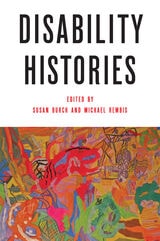
Disability Histories
Edited by Susan Burch and Michael Rembis
University of Illinois Press, 2014
Contributors delve into four critical areas of study within disability history: family, community, and daily life; cultural histories; the relationship between disabled people and the medical field; and issues of citizenship, belonging, and normalcy. As the first collection of its kind in over a decade, Disability Histories not only brings readers up to date on scholarship within the field but fosters the process of moving it beyond the U.S. and Western Europe by offering work on Africa, South America, and Asia. The result is a broad range of readings that open new vistas for investigation and study while encouraging scholars at all levels to redraw the boundaries that delineate who and what is considered of historical value.
Informed and accessible, Disability Histories is essential for classrooms engaged in all facets of disability studies within and across disciplines.
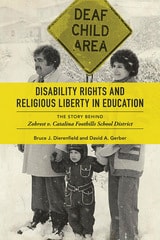
Disability Rights and Religious Liberty in Education
The Story behind Zobrest v. Catalina Foothills School DistrictBruce J. Dierenfield and David A. Gerber
University of Illinois Press, 2020
Bruce J. Dierenfield and David A. Gerber use the Zobrests' story to examine the complex history and jurisprudence of disability accommodation and educational mainstreaming. They look at the family's effort to acquire educational resources for their son starting in early childhood and the choices the Zobrests made to prepare him for life in the hearing world rather than the deaf community. Dierenfield and Gerber also analyze the thorny church-state issues and legal controversies that informed the case, its journey to the U.S. Supreme Court, and the impact of the high court's ruling on the course of disability accommodation and religious liberty.
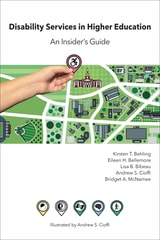
Disability Services in Higher Education
An Insider's GuideKirsten T. Behling, Eileen H. Bellemore, Lisa B. Bibeau, Andrew S. Cioffi, and Bridget A. McNamee
Temple University Press, 2023
This volume provides an overview of the responsibilities of a Disabilities Service professional through an examination of relevant literature, laws and regulatory language, case law, and narrative on established practices. It also offers resources that current professionals can modify for use in their day-to-day practice immediately. The authors explore the complexities of accessibility, paying careful attention to the nuances of disability evaluation, accommodation decisions, management of a disability service office, advocating for resources and collaboration within and outside of higher education institutions.
This practitioner-friendly book will help newcomers and seasoned professionals explore and evaluate best practices in the field through questions, examples, and functional job aids available for immediate use.
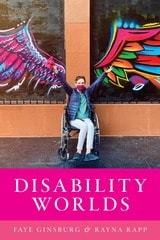
Disability Worlds
Faye Ginsburg and Rayna Rapp
Duke University Press, 2024
Disabling Pedagogy
Power, Politics, and Deaf EducationLinda Komesaroff
Gallaudet University Press, 2008
Traditionally, deaf education has been treated as the domain of special educators who strive to overcome the difficulties associated with hearing loss. Recently, the sociocultural view of deafness has prompted research and academic study of Deaf culture, sign language linguistics, and bilingual education. Linda Komesaroff exposes the power of the entrenched dominant groups and their influence on the politics of educational policy and practice in Disabling Pedagogy: Power, Politics, and Deaf Education.
Komesaroff suggests a reconstruction of deaf education based on educational and social theory. First, she establishes a deep and situated account of deaf education in Australia through interviews with teachers, Deaf leaders, parents, and other stakeholders. Komesaroff then documents a shift to bilingual education by one school community as part of her ethnographic study of language practices in deaf education. She also reports on the experiences of deaf students in teacher education. Her study provides an analytical account of legal cases and discrimination suits brought by deaf parents for lack of access to native sign language in the classroom. Komesaroff confronts the issue of cochlear implantation, locating it within the broader context of gene technology and bioethics, and advocates linguistic rights and self-determination for deaf people on the international level. Disabling Pedagogy concludes with a realistic assessment of the political challenge and the potential of the “Deaf Resurgence” movement to enfranchise deaf people in the politics of their own education.
Disciplining Feminism
From Social Activism to Academic DiscourseEllen Messer-Davidow
Duke University Press, 2002
Working within a firm theoretical framework and drawing on years of both personal involvement and fieldwork in and outside of academe, Messer-Davidow traces the metamorphosis of a once insurgent project in three steps. After illustrating how early feminists meshed their activism with institutional processes to gain footholds on campuses and in disciplinary associations, she turns to the relay between institutionalization and intellectualization, examining the way feminist studies coalesced into an academic field beginning in the mid-1970s. Without denying the successes of this feminist passage into the established system of higher learning, Messer-Davidow nonetheless insists that the process of institutionalization itself necessarily alters all new entrants—no matter how radical. Her final chapters look to the future of feminism in an increasingly conservative environment and to the possibilities for social change in general.
Disciplining Feminism’s interdisciplinary scope and cross-sector analysis will attract a broad range of readers interested in women’s studies, American higher education, and the dynamics of social transformation.
Discord And Direction
The Postmodern Writing Program Administratoredited by Sharon James McGee & Carolyn Handa
Utah State University Press, 2005
Postmodernism's central moves include questioning hierarchy, valuing paratactic associations, and rejecting grand narratives, and the work of a Writing Program Administrator, most days, includes those moves as well. The argument of this collection is that the cultural and intellectual legacies of postmodernism impinge, significantly and daily, on the practice of the Writing Program Administrator. WPAs work in spaces where they must assume responsibility for a multifaceted program, a diverse curriculum, instructors with varying pedagogies and technological expertise—and where they must position their program in relation to a university with its own conflicted mission, and a state with its unpredictable views of accountability and assessment.
The collection further argues that postmodernism offers a useful lens through which to understand the work of WPAs and to examine the discordant cultural and institutional issues that shape their work. Each chapter tackles a problem local to its author's writing program or experience as a WPA, and each responds to existing discord in creative ways that move toward rebuilding and redirection.
It is a given that accepting the role of WPA will land you squarely in the bind between modernism and postmodernism: while composition studies as a field arguably still reflects a modernist ethos, the WPA must grapple daily with postmodern habits of thought and ways of being. The effort to live in this role may or may not mean that a WPA will adopt a postmodern stance; it does mean, however, that being a WPA requires dealing with the postmodern.

Discredited
The UNC Scandal and College Athletics' Amateur IdealAndy Thomason
University of Michigan Press, 2021
In 2009, the University of North Carolina at Chapel Hill was on top of the world.
Consistently named one of the top universities in the country, it had welcomed a new phenom of a chancellor who promised to lead the public Ivy into the future. In the all-important athletic realm, the Tar Heels were the Coca-Cola of athletic brands. Resting upon the legacy of legendary basketball coach Dean Smith, UNC had carved out a reputation of excellence paired with squeaky-clean adherence to the rules. Supporters had a name for that irresistible ethos: the Carolina Way. The Tar Heels were climbing even higher. That year, they won their fifth national championship in men's basketball and looked poised to climb the ranks in football under a new, high-powered coach.
But within just a few years, it all came crashing down.
The Tar Heels' success, it turned out, was based on a foundation of deceit. Athletes were flocking to a slate of fake classes that advisers deftly used to keep them eligible to play. That revelation and others metastasized into one of the most damaging scandals ever to visit an American college. In Discredited, journalist Andy Thomason provides a gripping and authoritative retelling of the scandal through the eyes of four of its key participants: the secretary who presided over the fake classes, the professor who directed players toward them, the literacy specialist turned whistleblower who sought to expose the system, and the chancellor who found his career suddenly on the line. The heart-stopping narrative reveals the toll of a college's investment in major sports, and the amateurism myth upon which it is based. Based on dozens of original interviews and thousands of pages of documents, Discredited demonstrates just how far a university will go to preserve the athletic status quo: tolerating tarnished careers, ruined reputations, and years of scathing media criticism—all for a shot at competitive glory.