Results by title
2706 books match the query 'European' and 102 start with d

Dialogic Novels of Malcolm Bradbury and David Lodge
Robert A. Morace
Southern Illinois University Press, 1989
Morace analyzes the novels of Malcolm Bradbury and David Lodge together because they provide a dialogue of conflicting views, styles, and forms of the contemporary novel. This dialogue parallels the views of these two British novelists as critics.
Beginning as realists, as novelists of manners, as writers of campus novels, Bradbury and Lodge explore the possibilities and the limitations of realistic writing. Bradbury and Lodge, however, are not only heirs of English literary tradition. Both are also literary critics with a keen interest in recent critical theories. Morace shows us how the debate between Bradbury and Lodge over the nature and purpose of fiction and criticism has found its way into their novels. The realistic conflicts between civilian and military, English and American, pre- and post-Vatican II values gradually give way to an exploration of the semiotics behind such conflicts.
Morace finds Bradbury’s and Lodge’s works far more open-ended than the "doggedly indeterminate fictions" of many contemporary writers. Using Mikhail Bakhtin’s theory of dialogism, he identifies the ways in which language and values simultaneously compete with and support one another in their novels.
This first book-length study of Bradbury or Lodge deals with all of their novels, including Changing Places, How Far Can You Go?, and Small World by Lodge, as well as Bradbury’s The History of Man and Rates of Exchange.
Diaphanous Bodies
Ability, Disability, and Modernist Irish LiteratureJessica Colangelo
University of Michigan Press, 2021
Diaphanous Bodies: Ability, Disability, and Modernist Irish Literature examines ability, as a category of embodiment and embodied experience, and in the process opens up a new area of inquiry in the growing field of literary disability studies. It argues that the construction of ability arises through a process of exclusion and forgetting, in which the depiction of sensory information and epistemological judgment subtly (or sometimes un-subtly) elide the fact of embodied subjectivity. The result is what Colangelo calls “the myth of the diaphanous abled body,” a fiction that holds that an abled body is one which does not participate in or situate experience. The diaphanous abled body underwrites the myth that abled and disabled constitute two distinct categories of being rather than points on a constantly shifting continuum.
In any system of marginalization, the dominant identity always sets itself up as epistemologically and experientially superior to whichever group it separates itself from. Indeed, the norm is always most powerful when it is understood as an empty category or a view from nowhere. Diaphanous Bodies explores the phantom body that underwrites the artificial dichotomy between abled and disabled upon which the representation of embodied experience depends.

Diary Volume 1
Witold Gombrowicz
Northwestern University Press, 1988
Diary Volume 2
Witold Gombrowicz
Northwestern University Press, 1989

Diary Volume 3
Witold Gombrowicz
Northwestern University Press, 1993

Dickens and Thackeray
Punishment and ForgivenessJohn Robert Reed
Ohio University Press, 1996
Attitudes toward punishment and forgiveness in English society of the nineteenth century came, for the most part, out of Christianity. In actual experience the ideal was not often met, but in the literature of the time the model was important. For novelists attempting to tell exciting and dramatic stories, violent and criminal activities played an important role, and, according to convention, had to be corrected through poetic justice or human punishment. Both Dickens’ and Thackeray’s novels subscribed to the ideal, but dealt with the dilemma it presented in slightly different ways.
At a time when a great deal of attention has been directed toward economic production and consumption as the bases for value, Reed’s well-documented study reviving moral belief as a legitimate concern for the analysis of nineteenth-century English texts is particularly illuminating.

Dickens' Working Notes for His Novels
Charles Dickens
University of Chicago Press, 1987
Harry Stone, an internationally recognized Dickens scholar, provides the reader with a full account of Dickens' methods of planning and working. In a comprehensive introduction and extensive notes, he uses Dickens' written plans to illuminate the thought and technique of the novels. He examines creative concerns, such as Dickens' process of naming and visualization, and technical matters, such as his use of various pen nibs, ink colors, and papers.
By making fully available and comprehensible Dickens' own cache of in-process plans, possibilities, and alternatives for shaping his novels, Dickens' Working Notes offers unparalleled insights into the novelist's art and into the nature of the creative imagination.
Dickens's Forensic Realism
Truth, Bodies, EvidenceAndrew Mangham
The Ohio State University Press, 2017
As Mangham shows, forensic medicine grew out of a perceived need to understand things with accuracy, leaning in part on the range of objectivities that inspired the inorganic sciences. At the same time, it had the burden of assisting the law in convicting the guilty and in exonerating the innocent. Practitioners of forensic medicine were uniquely mindful of unwanted variables such as human error and the vagaries of interpretation. In readings of Oliver Twist, Our Mutual Friend, Bleak House, The Pickwick Papers, Great Expectations, and Dickens’s early journalism, Mangham demonstrates that these questions about signification, perception, and reality are central to the stylistic complexities and playful tone often associated with Dickens. Moreover, the medico-legal context of Dickens’s fiction illuminates the richness and profundity, style and impact of Dicken’s narratives.
Dickens's Hyperrealism
John R. Reed
The Ohio State University Press, 2009

Dickens's London
Peter Clark
Haus Publishing, 2012
In five walks through central London, Peter Clark explores “The First Suburbs”—Camden Town, Chelsea, Greenwich, Hampstead, Highgate and Limehouse—as they feature in Dickens’s writing and illuminates the settings of Dickens’s life and his greatest works of journalism and fiction. Describing these storied spaces of today’s central London in intimate detail, Clark invites us to experience the city as it was known to Dickens and his characters. These walks take us through the locations and buildings that he interacted with and wrote about, creating an imaginative reconstruction of the Dickensian world that has been lost to time.

Dickens, His Parables, and His Reader
Linda M. Lewis
University of Missouri Press, 2011

Dicta and Contradicta
Karl Kraus. Translated from the German by Jonathan McVity
University of Illinois Press, 2001
"The mission of the press is to spread culture while destroying the attention span."
"Art serves to rinse out our eyes."
Uniquely combining humor with profundity and venom with compassion, Dicta and Contradicta is a bonanza of scandalous wit from Vienna's answer to Oscar Wilde.
From the decadent turn of the century to the Third Reich, the acerbic satirist Karl Kraus was one of the most famous–and feared–intellectuals in Europe. Through the polemical and satirical magazine Die Fackel (The torch), which he founded in 1899, Kraus launched wicked but unrelentingly witty attacks on literary and media corruption, sexual repression and militarism, and the social hypocrisy of fin-de-siècle Vienna.
Kraus's barbed aphorisms were an essential part of his running commentary on Viennese culture. These miniature gems, as sharp as diamonds, demonstrate Kraus's highly cultivated wit and his unerring eye for human weakness, flaccidity, and hypocrisy. Kraus shies away from nothing; the salient issues of the day are lined up side by side, as before a firing squad, with such perennial concerns as sexuality, religion, politics, art, war, and literature. By turns antagonistic, pacifistic, realistic, and maddeningly misogynistic, Kraus's aphorisms provide the sting that precedes healing.
For Dicta and Contradicta, originally published in 1909 (with the title Spruche und Widerspruche) and revised in 1923, Kraus selected nearly 1,000 of the scathing aphorisms that had appeared in Die Fackel. In this new translation, Jonathan McVity masterfully renders Kraus's multilayered meanings, preserving the clever wordplay of the German in readable colloquial English. He also provides an introductory essay on Kraus's life and milieu and annotations that clarify many of Kraus's literary and sociohistorical allusions.
Didactic Poetries
Philippe Beck
University of Minnesota Press, 2016
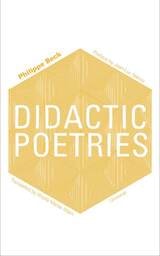
Complex, haunting, imaginative and profoundly literary, Didactic Poetries is Beck’s response to Schiller’s statement: “We are still waiting for a didactic poem where thought itself would be and would remain poetic,” and Hegel’s claim that, “strictly speaking, didactic poetry isn’t poetry.”
For the acclaimed French poet, Philippe Beck, Schiller’s task of attempting a didactic poetry remains as vital today as it was for Schiller’s time. Is there a way to construct a poetry built and chiseled, hammered and stitched, from out of past narratives and poetries, condensed in such a manner as to make new poetic verses sing new truths? Forging a singular attempt to echo the poets and tales of a bygone age, Beck’s didactic poetries perhaps carve out the path for renewing a poetic thought as a quasi-musical atmosphere where the reader can glimpse “A small country “sculpted” as spiritual, supposed to be so at home in the Bygone Country. Alluvial layers so light, that weather disappeared, weary of variety a priori.” Beck’s deftly textured poems interweave contemporary commentary with cultural, historical, literary, and philosophical allusions, drawing the reader into a world of lived poetic experience.
Difficult Rhythm
Music and the Word in E.M. ForsterMichelle Fillion
University of Illinois Press, 2013
Directing Beckett
Lois Oppenheim
University of Michigan Press, 1997
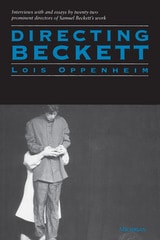
In exploring this key figure in the history of theater, Oppenheim's interviews--with such directors as JoAnne Akalaitis, Edward Albee, Herbert Blau, Joseph Chaikin, and Carey Perloff--also address many of the complexities of the director's role, such as the meaning of directorial integrity and fidelity to the playwright's vision--an issue of particular relevance to a playwright whose exactitude, with respect to stage directions, is well documented. Additional highlights include photographs from many of the productions; the unpublished text of a lecture by the late Alan Schneider, Beckett's most accomplished American director; and an interview with the late Roger Blin, the very first director of Beckett's work.
"Directing Beckett is a rare thing--a book both pleasant to read and useful to have . . . it is like listening to the ideal panel, everyone who should be there there and all at their articulate best." --Toby Silverman Zinman, Theatre Journal
"Anyone intending to direct or act in a work by Beckett, or to write about his work, must read this book." --Choice
Lois Oppenheim is Professor of French, Montclair State University
Disability Disruptions
Gender, Family, and Care in Post-1989 PolandNatalia Pamula
University of Illinois Press, 2026
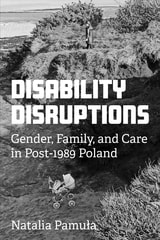
Polish politicians regularly idealize the family. But, as Pamula illustrates such rhetoric coerces people into a state of violent intimacy that forces the burden of care onto family members bound by love, dependence, and responsibility. As the narratives show, disability destabilizes national myths, challenges heteronormative and patriarchal family ideals, and exposes continuities between socialist and capitalist regimes in their treatment of disabled citizens.
A rich blend of activism and analysis, Disability Disruptions ventures outside Anglophone notions of disability to highlight how Poland’s disabled people and caregivers overcome lack of recognition, resist social death, and rewrite public memory.

Discourse on the Origins of Inequality (Second Discourse), Polemics, and Political Economy
Jean-Jacques Rousseau
Dartmouth College Press, 1993
Discourse on the Sciences and Arts (First Discourse) and Polemics
Jean-Jacques Rousseau
Dartmouth College Press, 1992
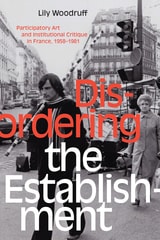
Disordering the Establishment
Participatory Art and Institutional Critique in France, 1958–1981Lily Woodruff
Duke University Press, 2020
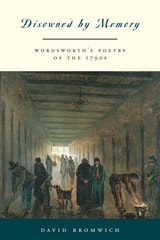
Disowned by Memory
Wordsworth's Poetry of the 1790sDavid Bromwich
University of Chicago Press, 1998
"This very Wordsworthian combination of apparently low subjects with extraordinary 'high argument' makes for very rewarding, though often challenging reading."—Kenneth R. Johnston, Washington Times
"Wordsworth emerges from this short and finely written book as even stranger than we had thought, and even more urgently our contemporary."—Grevel Lindop, Times Literary Supplement
"[Bromwich's] critical interpretations of the poetry itself offer readers unusual insights into Wordworth's life and work."—Library Journal
"An added benefit of this book is that it restores our faith that criticism can actually speak to our needs. Bromwich is a rigorous critic, but he is a general one whose insights are broadly applicable. It's an intellectual pleasure to rise to his complexities."—Vijay Seshadri, New York Times Book Review
Dissemination
Jacques Derrida
University of Chicago Press, 1981
Dissemination
Jacques Derrida
University of Chicago Press, 1981
Distantly
Nicole Brossard
Omnidawn, 2022
This bilingual edition of Nicole Brossard’s lyrical poetry is a sequence of lush, taut cityscapes. Known for her elliptical and materially grounded poetics, Brossard creates an intimate series of poems drawn loosely from urban experience. The poems comprise an evocative distillation of postmodern urban life with a sharp sense of cultural and gendered histories of violence and beauty and struggles for survival and intimacy. The poems capture the emotional and ecological surroundings of each city and its people. The cities in Brossard’s poems feel surreal and in them dwell survivors of “misfortunes,” living in urban landscapes with their “gleaming debris” and “bridges, ghats, / rivers in a time of peace and torture.” These poems gesture toward a transmuted social context and toward a quest “to meet the horizon the day after the horizon.”

Disturbers of the Twentieth Century
Catholic Social Critics in Modern BritainAdam Schwartz
Catholic University of America Press, 2026
Doctoring the Novel
Medicine and Quackery from Shelley to DoyleSylvia A. Pamboukian
Ohio University Press, 2012
Doctoring the Novel explores the ways in which language constructs and stabilizes these slippery terms by examining medical quackery and orthodoxy in works such as Mary Shelley’s Frankenstein, Charles Dickens’s Bleak House and Little Dorrit, Charlotte Brontë’s Villette, Wilkie Collins’s Armadale, and Arthur Conan Doyle’s Stark Munro Letters. Contextualized in both medical and popular publishing, literary analysis reveals that even supposedly medico-scientific concepts such as orthodoxy and quackery evolve not in elite laboratories and bourgeois medical societies but in the rough-and-tumble of the public sphere, a view that acknowledges the considerable, and often underrated, influence of language on medical practices.
Documents in Medieval Latin
John Thorley
University of Michigan Press, 1998
Documents in Medieval Latin will be useful to students of medieval history, literature, and philosophy and those interested in reading more about the Middle Ages. Thorley's cheerful approach, the lively and representative selections of tests, and the documentary and epigraphic focus will prove valuable for those wishing to explore these vital original sources.
John Thorley teaches medieval Latin at Lancaster University.
Domestic Georgic
Labors of Preservation from Rabelais to MiltonKatie Kadue
University of Chicago Press, 2021
When is literary production more menial than inspired, more like housework than heroics of the mind? In this revisionist study, Katie Kadue shows that some of the authors we credit with groundbreaking literary feats—including Michel de Montaigne and John Milton—conceived of their writing in surprisingly modest and domestic terms. In contrast to the monumental ambitions associated with the literature of the age, and picking up an undercurrent of Virgil’s Georgics, poetic labor of the Renaissance emerges here as often aligned with so-called women’s work. Kadue reveals how male authors’ engagements with a feminized georgic mode became central to their conceptions of what literature is and could be. This other georgic strain in literature shared the same primary concern as housekeeping: the necessity of constant, almost invisible labor to keep the things of the world intact. Domestic Georgic brings into focus a conception of literary—as well as scholarly and critical—labor not as a striving for originality and fame but as a form of maintenance work that aims at preserving individual and collective life.
Domesticity, Imperialism, and Emigration in the Victorian Novel
Diana C. Archibald
University of Missouri Press, 2002
Don Álvaro, or, The Force of Fate
Ángel de Saavedra
Catholic University of America Press, 2005
Don't Forget to Live
Goethe and the Tradition of Spiritual ExercisesPierre Hadot
University of Chicago Press, 2023
With a foreword by Arnold I. Davidson and Daniele Lorenzini.
In his final book, renowned philosopher Pierre Hadot explores Goethe’s relationship with ancient spiritual exercises—transformative acts of intellect, imagination, or will. Goethe sought both an intense experience of the present moment as well as a kind of cosmic consciousness, both of which are rooted in ancient philosophical practices. These practices shaped Goethe’s audacious contrast to the traditional maxim memento mori (Don’t forget that you will die) with the aim of transforming our ordinary consciousness. Ultimately, Hadot reveals how Goethe cultivated a deep love for life that brings to the forefront a new maxim: Don’t forget to live.
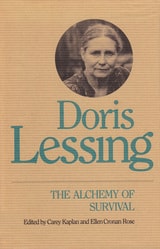
Doris Lessing
The Alchemy of SurvivalCarey Kaplan
Ohio University Press, 1988
Long neglected by the academic world because of her rejection of belletristic values and resistance to convenient literary taxonomy, Doris Lessing has nonetheless built an international following of serious, dedicated readers. Acknowledging the difficulties posed by the multiple dimensions of Lessing’s work, Kaplan and Rose have gathered eleven essays that address her artistic, philosophical, political, and psychological complexity, and so provide a welcome introduction to the extraordinary depth and diversity of this important contemporary novelist.
Lessing has been described as an “alchemical” writer, in that her work is directed toward changing people’s lives and perceptions rather than simply recording experience. Accordingly, the contributors examine her various postures and tactics for the purpose of discovering how the alchemical elements inform her various personae. Frederick C. Stern discusses Lessing’s commitment to radical humanist thought, while Carey Kaplan examines how Lessing’s imperialist past has shaped her futuristic fiction. Elizabeth Abel offers a feminist interpretation of the pattern of brother-sister incest in Lessing’s work, showing how Lessing has established Antigone as a female alternative to the Oedipal myth of male incest. Particularly insightful is Eve Bertelsen’s report of her interview with Lessing, demonstrating how Lessing’s often evasive style of adversarial dialogue works in concert with her refusal to be conveniently pigeonholed by academic analysis.
For those readers new to her work, Doris Lessing: The Alchemy of Survival will serve as a useful introduction to Lessing’s concerns and techniques. Those who have long admired her writing will find in this collection new keys to understanding Lessing’s philosophical, political, and psychological complexity.
Doris Lessing
The Poetics of ChangeGayle Greene
University of Michigan Press, 1997
Doris Lessing has been a chronicler of our age for nearly half a century, and a study of her writing career does not yield easy generalizations. Difficult though she is to categorize, she is always concerned with change, with a search for "something new" against "the nightmare repetition" of history. The feminist quest she articulated in The Children of Violence and The Golden Notebook entered the culture with the force of a new myth: these books changed lives. The Golden Notebook--together with such works as The Second Sex and The Feminine Mystique--raised the consciousness of a generation of women readers and played a major part in making the second wave of feminism. It is the power of Lessing's novels to change people's lives, the effect she had raising the consciousness of a generation of women and the effect she continues to have on young readers, that is the subject of this book.
Gayle Greene employs an eclectic range of approaches (psychoanalytic, Marxist, biographical, historical, intertextual, formalist, feminist) to shed new light on Lessing's remarkable achievement. She sees Lessing as a feminist writer, not in offering strong female role models who climb top the top of existing social structures, but in envisioning, and indeed helping to bring about, a transformation of those structures. Lessing critiques Western values of individualism, competition, and materialism in terms similar to those developed by feminism; and, in getting us to view our culture from without, in teaching us to read cultural constructs as systems, her novels perform the deconstructing and demystifying work of feminism.
Dorothy Dunnett’s Lymond Chronicles
The Enigma of Francis CrawfordScott Richardson
University of Missouri Press, 2016
Dostoevsky and the Affirmation of Life
Predrag Cicovacki
St. Augustine's Press, 2008
Dostoevsky's Dialectics and the Problem of Sin
Ksana Blank
Northwestern University Press, 2019
In Dostoevsky’s Dialectics and the Problem of Sin, Ksana Blank borrows from ancient Greek, Chinese, and Christian dialectical traditions to formulate a dynamic image of Dostoevsky’s dialectics—distinct from Hegelian dialectics—as a philosophy of “compatible contradictions.” Expanding on the classical triad of Goodness, Beauty, and Truth, Blank guides us through Dostoevsky’s most difficult paradoxes: goodness that begets evil, beautiful personalities that bring about grief, and criminality that brings about salvation.
Dostoevsky’s philosophy of contradictions, this book demonstrates, contributes to the development of antinomian thought in the writings of early twentieth-century Russian religious thinkers and to the development of Bakhtin’s dialogism. Dostoevsky’s Dialectics and the Problem of Sin marks an important and original intervention into the enduring debate over Dostoevsky’s spiritual philosophy.
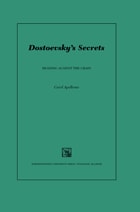
Dostoevsky's Secrets
Reading Against the GrainCarol Apollonio
Northwestern University Press, 2009
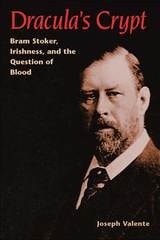
Dracula's Crypt
Bram Stoker, Irishness, and the Question of BloodJoseph Valente
University of Illinois Press, 2001
An ingenious reappraisal of a classic text, Dracula's Crypt presents Stoker's novel as a subtly ironic commentary on England's preoccupation with racial purity. Probing psychobiographical, political, and cultural elements of Stoker's background and milieu, Joseph Valente distinguishes Stoker's viewpoint from that of his virulently racist, hypermasculine vampire hunters, showing how the author's dual Anglo-Celtic heritage and uncertain status as an Irish parvenu among London's theatrical elite led him to espouse a progressive racial ideology at odds with the dominant Anglo-Saxon supremacism. In the light of Stoker's experience, the shabby-genteel Count Dracula can be seen as a doppelgänger, an ambiguous figure who is at once the blood-conscious landed aristocrat and the bloodthirsty foreign invader.
Stoker also confronts gender ideals and their implications, exposing the "inner vampire" in men like Jonathan Harker who dominate and absorb the women who become their wives. Ultimately, Valente argues, the novel celebrates a feminine heroism, personified by Mina Harker, that upholds an ethos of social connectivity against the prevailing obsession with blood as a vehicle of identity.
Revealing a profound and heretofore unrecognized ethical and political message, Dracula's Crypt maintains that the real threat delineated in Dracula is not racial degeneration but the destructive force of racialized anxiety itself. Stoker's novel emerges as a powerful critique of the very anxieties it has previously been taken to express: anxieties concerning the decline of the British empire, the deterioration of Anglo-Saxon culture, and the contamination of the Anglo-Saxon race.
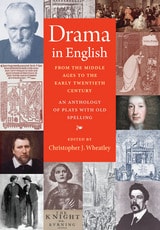
Drama in English From the Middle Ages to the Early Twentieth Century
Christopher J. Wheatley
Catholic University of America Press, 2016
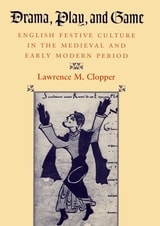
Drama, Play, and Game
English Festive Culture in the Medieval and Early Modern PeriodLawrence M. Clopper
University of Chicago Press, 2001
Drama, Play, and Game demonstrates that the theatrum repudiated by medieval clerics was not "theater" as we understand the term today. Clopper contends that critics have misrepresented Western stage history because they have assumed that theatrum designates a place where drama is performed. While theatrum was thought of as a site of spectacle during the Middle Ages, the term was more closely connected with immodest behavior and lurid forms of festive culture. Clerics were not opposed to liturgical representations in churches, but they strove ardently to suppress May games, ludi, festivals, and liturgical parodies. Medieval drama, then, stemmed from a more vernacular tradition than previously acknowledged-one developed by England's laity outside the boundaries of clerical rule.
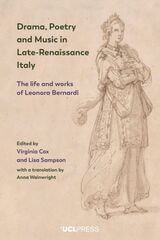
Drama, Poetry and Music in Late-Renaissance Italy
The Life and Works of Leonora BernardiVirginia Cox and Lisa Sampson
University College London, 2023
Leonora Bernardi (1559–1616), a gentlewoman of Lucca, was a highly regarded poet, dramatist, and singer. She was active in the brilliant courts of Ferrara and Florence at a time when creative women enjoyed exceptional visibility in Italy. Like many such figures, she has since suffered historical neglect. Drama, Poetry and Music in Late-Renaissance Italy presents the first-ever study of Bernardi’s life along with a modern edition of her recently discovered literary corpus, which mostly exists in manuscripts. Her writings are presented in the original Italian with new English translations, scholarly notes, and critical essays. Based on new archival research, the substantial opening section reconstructs Bernardi’s unusually colorful life. The second major section presents her pastoral tragicomedy Clorilli, one of the earliest secular dramatic works by a woman. The third section presents Bernardi’s secular and religious verse, which engaged with new trends in lyric and poetry for music, and was set by various key composers across Italy. The volume thus firmly positions Leonora Bernardi as a distinctive voice and dynamic player in the extraordinarily rich social, cultural, and geo-political networks of late-Renaissance Italy.
Dramatic Extracts in Seventeenth-Century English Manuscripts
Watching, Reading, Changing PlaysLaura Estill
University of Delaware Press, 2015
Throughout the seventeenth century, early modern play readers and playgoers copied dramatic extracts (selections from plays and masques) into their commonplace books, verse miscellanies, diaries, and songbooks. Dramatic Extracts in Seventeenth-Century English Manuscripts: Watching, Reading, Changing Plays is the first to examine these often overlooked texts, which reveal what early modern audiences and readers took, literally and figuratively, from plays. As this under-examined archival evidence shows, play readers and playgoers viewed plays as malleable and modular texts to be altered, appropriated, and, most importantly, used. These records provide information that is not available in other forms about the popularity and importance of early modern plays, the reasons plays appealed to their audiences, and the ideas in plays that most interested audiences.
Tracing the course of dramatic extracting from the earliest stages in the 1590s, through the prolific manuscript circulation at the universities, to the closure and reopening of the theatres, Estill gathers these microhistories to create a comprehensive overview of seventeenth-century dramatic extracts and the culture of extracting from plays. Dramatic Extracts in Seventeenth-Century English Manuscripts: Watching, Reading, Changing Plays explores new archival evidence (from John Milton’s signature to unpublished university plays) while also analyzing the popularity of perennial favorites such as Shakespeare’s The Tempest. The study of dramatic extracts is the study of particulars: particular readers, particular manuscripts, particular plays or masques, particular historic moments. As D. F. McKenzie puts it, “different readers [bring] the text to life in different ways.” By providing careful analyses of these rich source texts, this book shows how active play-viewing and play-reading (that is, extracting) ultimately led to changing the plays themselves, both through selecting and manipulating the extracts and positioning the plays in new contexts.
Published by University of Delaware Press. Distributed worldwide by Rutgers University Press.
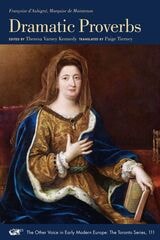
Dramatic Proverbs
Françoise d’Aubigné, Marquise de Maintenon
Iter Press, 2025
Madame de Maintenon’s Dramatic Proverbs provides unprecedented access to an important transitional marker between the society games of the salon and the education theater of the eighteenth century. Composed for the impoverished female pupils at the boarding school she and King Louis XIV founded at Saint-Cyr, Maintenon’s dramatic proverbs crucially reveal the values emphasized in female education at the end of the seventeenth century—a period plagued by economic crisis and growing aristocratic poverty. Some of the first to exclusively express a woman’s point of view, Maintenon’s dramatic proverbs challenged traditional female education and promoted improved conditions for women. The proverbs contributed uniquely to improvisational educational theater, inaugurating a tradition that continued well into the eighteenth century.
This edition of the plays aims to privilege accessibility and accuracy so that twenty-first-century students can act out, interpret, and discuss these historical texts.
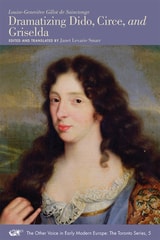
Dramatizing Dido, Circe, and Griselda
Louise-Geneviève Gillot de Sainctonge
Iter Press, 2010
—Perry Gethner
Norris Professor of French, Oklahoma State University
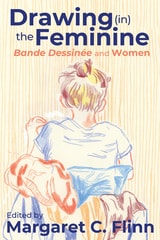
Drawing (in) the Feminine
Bande Dessinée and WomenEdited by Margaret C. Flinn
The Ohio State University Press, 2024
Winner, Eisner Award for Best Academic/Scholarly Work 2025
Finalist, Comics Studies Society Edited Book Prize 2025
Drawing (in) the Feminine celebrates and examines the richness of contemporary women's production in French and Francophone comics art and considers the history of representations made by both dominant and marginalized creators. Bridging historical and contemporary comics output, these essays illuminate the interfaces among genre, gender, and cultural history. Contributors from both sides of the Atlantic, and across a variety of methodologies and disciplinary orientations, challenge prevailing claims about the absence of women creators, characters, and readers in bande dessinée, arguing that women have always been part of its history. While still far from achieving parity with their male counterparts, female creators are occupying an increasingly significant portion of the French-language comics publishing industry, and creators of all genders are putting forth stories that reflect on the diversity and richness of women's and gender-nonconforming people's experiences. In the essays collected here, contributors push back against the ways in which the marginalization of women within bande dessinée history has overshadowed their significant contributions, extending avenues for further exploring the true diversity of a flourishing contemporary production.
Contributors:
Armelle Blin-Rolland, Véronique Bragard, Michelle Bumatay, Benoît Crucifix, Isabelle Delorme, Jacques Dürrenmatt, Margaret C. Flinn, Alexandra Gueydan-Turek, Jennifer Howell, Jessica Kohn, Sylvain Lesage, Catriona MacLeod, Mark McKinney
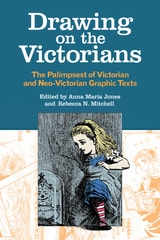
Drawing on the Victorians
The Palimpsest of Victorian and Neo-Victorian Graphic TextsAnna Maria Jones
Ohio University Press, 2017
Late nineteenth-century Britain experienced an unprecedented explosion of visual print culture and a simultaneous rise in literacy across social classes. New printing technologies facilitated quick and cheap dissemination of images—illustrated books, periodicals, cartoons, comics, and ephemera—to a mass readership. This Victorian visual turn prefigured the present-day impact of the Internet on how images are produced and shared, both driving and reflecting the visual culture of its time.
From this starting point, Drawing on the Victorians sets out to explore the relationship between Victorian graphic texts and today’s steampunk, manga, and other neo-Victorian genres that emulate and reinterpret their predecessors. Neo-Victorianism is a flourishing worldwide phenomenon, but one whose relationship with the texts from which it takes its inspiration remains underexplored.
In this collection, scholars from literary studies, cultural studies, and art history consider contemporary works—Alan Moore’s League of Extraordinary Gentlemen, Moto Naoko’s Lady Victorian, and Edward Gorey’s Gashlycrumb Tinies, among others—alongside their antecedents, from Punch’s 1897 Jubilee issue to Alice in Wonderland and more. They build on previous work on neo-Victorianism to affirm that the past not only influences but converses with the present.
Contributors: Christine Ferguson, Kate Flint, Anna Maria Jones, Linda K. Hughes, Heidi Kaufman, Brian Maidment, Rebecca N. Mitchell, Jennifer Phegley, Monika Pietrzak-Franger, Peter W. Sinnema, Jessica Straley

Dreaming in Books
The Making of the Bibliographic Imagination in the Romantic AgeAndrew Piper
University of Chicago Press, 2009
At the turn of the nineteenth century, publishing houses in London, New York, Paris, Stuttgart, and Berlin produced books in ever greater numbers. But it was not just the advent of mass printing that created the era’s “bookish” culture. According to Andrew Piper, romantic writing and romantic writers played a crucial role in adjusting readers to this increasingly international and overflowing literary environment. Learning how to use and to want books occurred through more than the technological, commercial, or legal conditions that made the growing proliferation of books possible; the making of such bibliographic fantasies was importantly a product of the symbolic operations contained within books as well.
Examining novels, critical editions, gift books, translations, and illustrated books, as well as the communities who made them, Dreaming in Books tells a wide-ranging story of the book’s identity at the turn of the nineteenth century. In so doing, it shows how many of the most pressing modern communicative concerns are not unique to the digital age but emerged with a particular sense of urgency during the bookish upheavals of the romantic era. In revisiting the book’s rise through the prism of romantic literature, Piper aims to revise our assumptions about romanticism, the medium of the printed book, and, ultimately, the future of the book in our so-called digital age.
Dreams of Waking
An Anthology of Iberian Lyric Poetry, 1400-1700Edited and Translated by Vincent Barletta, Mark L. Bajus, and Cici Malik
University of Chicago Press, 2013
In this anthology, Vincent Barletta, Mark L. Bajus, and Cici Malik treat the Iberian lyric in the late Middle Ages and early modernity as a deeply multilingual, transnational genre that needs to break away from the old essentialist ideas about language, geography, and identity in order to be understood properly. More and more, scholars and students are recognizing the limitations of single-language, nationalist, and period-bound canons and are looking for different ways to approach the study of literature. The Iberian Peninsula is an excellent site for this approach, where the history and politics of the region, along with its creative literature, need to be read and studied together with the way the works were composed by poets and eventually consumed by readers.
With a generous selection of more than one hundred poems from thirty-three poets, Dreams of Waking is unique in its coverage of the three main languages—Catalan, Portuguese, and Spanish—and lyrical styles employed by peninsular poets. It contains new translations of canonical poems but also translations of many poems that have never before been edited or translated. Brief headnotes provide essential details of the poets’ lives, and a general introduction by the volume editors shows how the poems and languages fruitfully intersect. With helpful annotations to the poetry, as well as a selected bibliography containing the most important editions and translations from all three of the main Iberian languages, this volume will be an indispensable tool for both specialists and students in comparative literature.
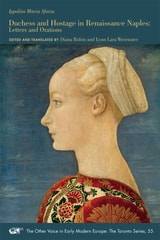
Duchess and Hostage in Renaissance Naples
Letters and OrationsIppolita Maria Sforza
Iter Press, 2017
Duino Elegies
A Bilingual EditionRainer Maria Rilke
Northwestern University Press, 1998
Dying to Know
Scientific Epistemology and Narrative in Victorian EnglandGeorge Levine
University of Chicago Press, 2002
In Dying to Know, eminent critic George Levine makes a landmark contribution to the history and theory of scientific knowledge. This long-awaited book explores the paradoxes of our modern ideal of objectivity, in particular its emphasis on the impersonality and disinterestedness of truth. How, asks Levine, did this idea of selfless knowledge come to be established and moralized in the nineteenth century?
Levine shows that for nineteenth-century scientists, novelists, poets, and philosophers, access to the truth depended on conditions of such profound self-abnegation that pursuit of it might be taken as tantamount to the pursuit of death. The Victorians, he argues, were dying to know in the sense that they could imagine achieving pure knowledge only in a condition where the body ceases to make its claims: to achieve enlightenment, virtue, and salvation, one must die.
Dying to Know is ultimately a study of this moral ideal of epistemology. But it is also something much more: a spirited defense of the difficult pursuit of objectivity, the ethical significance of sacrifice, and the importance of finding a shareable form of knowledge.