Results by title
4030 books match the query 'Language Arts & Disciplines' and 161 start with d
Descriptive Typology and Linguistic Theory
A Study in the Morphology of Relative ClausesFarrell Ackerman and Irina Nikolaeva
CSLI, 2003
Desegregation State
College Writing Programs after the Civil Rights MovementAnnie S. Mendenhall
Utah State University Press, 2021
Formerly segregated state university systems crafted desegregation plans that gave them more control over policies for admissions, remediation, and retention. These plans created literacy requirements—admissions and graduation tests, remedial classes, and even writing centers and writing across the curriculum programs—that reshaped the landscape of college writing instruction and denied the demands of Black students, civil rights activists, and historically Black colleges and universities for major changes to university systems. This history details the profound influence of desegregation—and resistance to desegregation—on the ways that writing is taught and assessed in colleges today.
Desegregation State provides WPAs and writing teachers with a disciplinary history for understanding racism in writing assessment and writing programs. Mendenhall brings emerging scholarship on the racialization of institutions into the field, showing why writing studies must pay more attention to how writing programs have institutionalized racist literacy ideologies through arguments about student placement, individualized writing instruction, and writing assessment.
Deserted
Life Without Local News in Rural AmericaNick Mathews
University of Illinois Press, 2026
The devastation of local news organizations has left rural areas of the US marooned in information deserts. Nick Mathews offers a boots-on-the-ground examination of the human toll of local news’s erosion by the winds of de-localization and corporate indifference.
It is no secret that ownership transfers, corporate mergers, and hedge fund takeovers have relentlessly consolidated and closed local news organizations. Mathews exposes the impact of that process on journalism, journalists, and news consumers hungry for outlets that tell their stories. A fundamental breakdown within journalism itself, the abandonment of community news has left disgruntled and disconnected locals to piece together news and information themselves. Mathews draws on the personal experiences of news gatherers and consumers to illuminate why local news cannot be scaled. Mass-produced content inevitably severs ties to communities while distant ownership is indifferent to local concerns.
Nuanced and sympathetic, <i>Deserted</i> provides a vivid portrait of the people and places forsaken by journalism’s corporate owners.

Design Thinking
Rachel Ivy Clarke
American Library Association, 2020
Designing Multilingual Experiences in Technical Communication
Laura Gonzales
Utah State University Press, 2022
Through grounded case studies of multilingual technical communication projects in the US, Mexico, and Nepal, Laura Gonzales illustrates the multiple tensions at play in transnational research and demonstrates how technical communicators can leverage contemporary translation practices and methodologies to engage in research with multilingual communities that is justice-driven, participatory, and reciprocal.
Designing Multilingual Experiences in Technical Communication is of value to researchers and students across fields who are interested in designing projects alongside multilingual communities from historically marginalized backgrounds.

Designing Space for Children and Teens in Libraries and Public Places
Sandra Feinberg
American Library Association, 2010
Designing a School Library Media Center for the Future
Rolf Erikson
American Library Association, 2007

Desiring the Bomb
Communication, Psychoanalysis, and the Atomic AgeCalum L. Matheson
University of Alabama Press, 2019
Every culture throughout history has obsessed over various “end of the world” scenarios. The dawn of the Atomic Age marked a new twist in this tale. For the first time, our species became aware of its capacity to deliberately destroy itself. Since that time the Bomb has served as an organizing metaphor, a symbol of human annihilation, a stand-in for the unspeakable void of extinction, and a discursive construct that challenges the limits of communication itself. The parallel fascination with and abhorrence of nuclear weapons has metastasized into a host of other end-of-the-world scenarios, from global pandemics and climate change to zombie uprisings and asteroid collisions.
Desiring the Bomb: Communication, Psychoanalysis, and the Atomic Age explores these world-ending fantasies through the lens of psychoanalysis to reveal their implications for both contemporary apocalyptic culture and the operations of language itself. What accounts for the enduring power of the Bomb as a symbol? What does the prospect of annihilation suggest about language and its limits? Thoroughly researched and accessibly written, this study expands on the theories of Kenneth Burke, Jacques Lacan, Sigmund Freud, and many others from a variety of disciplines to arrive at some answers to these questions.
Calum L. Matheson undertakes a series of case studies—including the Trinity test site, nuclear war games, urban shelter schemes, and contemporary survivalism—and argues that contending with the anxieties (individual, social, cultural, and political) born of the Atomic Age depends on rhetorical conceptions of the “real,” an order of experience that cannot be easily negotiated in language. Using aspects of media studies, rhetorical theory, and psychoanalysis, the author deftly engages the topics of Atomic Age survival, extinction, religion, and fantasy, along with their enduring cultural legacies, to develop an account of the Bomb as a signifier and to explore why some Americans have become fascinated with fantasies of nuclear warfare and narratives of postapocalyptic rebirth.

Desk and Beyond
Next Generation Reference ServicesSarah K. American Library Association
Assoc of College & Research Libraries, 2011
Desk and Beyond
Next Generation Reference ServicesSarah K. Steiner
Assoc of College & Research Libraries, 2011
Developing 21st Century Literacies
A K-12 School Library Curriculum Blueprint with Sample LessonsBeth E. Tumbleson
American Library Association, 2011
Developing Library Leaders
American Library Association, 2010
Developing The Next Gen Library Leaders
ACRL Pub In LibrarianLori Birrell
Assoc of College & Research Libraries, 2020
Developing an Outstanding Core Collection
A Guide for LibrariesCarol Alabaster
American Library Association, 2010
Developing and Maintaining Practical Archives
A How-To-Do-It ManualGregory S. Hunter
American Library Association, 2020
- a history of archives, including the roles of historical societies and local history collections in libraries;
- new sections on community archives, diversity, and inclusion;
- conducting a survey and starting an archival program;
- selection, appraisal, acquisition, accessioning, and deaccessioning;
- important points of copyright, privacy, and ethics;
- arrangement of archival collections, with a discussion of new theories;
- description, including DACS, EAD, and tools such as ArchivesSpace;
- access, reference, and outreach, with a look at how recent innovations in finding aids can help researchers;
- preservation, including guidance on how to handle rare books, maps, architectural records, and artifacts;
- digital records, addressing new and popular methods of storage and preservation of email, social media, image files, webpages, Word documents, spreadsheets, databases, and media files;
- disaster planning, security, and theft prevention;
- metrics, assessment, establishing employee procedures and policies, working with interns and volunteers, and other managerial duties;
- public relations and marketing, from social media and the Web to advocacy; and
- professional guidelines and codes, such as the newly developed SAA Statement of Core Values of Archivists.
Developing and Managing Electronic Collections
The EssentialsPeggy Johnson
American Library Association, 2013

Development as Communication
A Perspective on IndiaUma Narula
Southern Illinois University Press, 1986
This book applies a systematic communication theory to the 30-plus years of development experience in India.
Never before has development been treated from a communication perspective. This perspective demonstrates that the role of communication in development is not limited to the technology of satellites or to the economics of mass media; it is a way of thinking about the interaction among all agents involved.
The empirical data describe patterns of social realities, actions, and communication networks among planners, contact agents, and the masses in two Indian communities. The result is an analytical review of development theories and practice in India.
This study is practical as well as theoretical. The authors show how the theory of the “coordinated management of meaning” applies to large-scale social interactions. They also offer specific recommendations for Indian development planners.
Developmental Editing, Second Edition
A Handbook for Freelancers, Authors, and PublishersScott Norton
University of Chicago Press, 2023
Developmental editing—transforming a manuscript into a book that edifies, inspires, and sells—is a special skill, and Scott Norton is one of the best at it. With more than three decades of experience in the field, Norton offers his expert advice on how to approach the task of diagnosing and fixing structural problems with book manuscripts in consultation with authors and publishers. He illustrates these principles through a series of detailed case studies featuring before-and-after tables of contents, samples of edited text, and other materials to make an otherwise invisible process tangible.
This revised edition for the first time includes exercises that allow readers to edit sample materials and compare their work with that of an experienced professional as well as a new chapter on the unique challenges of editing fiction. In addition, it features expanded coverage of freelance business arrangements, self-published authors, e-books, content marketing, and more.
Whether you are an aspiring or experienced developmental editor or an author who works alongside one, you will benefit from Norton’s accessible, collaborative, and realistic approach and guidance. This handbook offers the concrete and essential tools it takes to help books to find their voice and their audience.
Developmental Editing
A Handbook for Freelancers, Authors, and PublishersScott Norton
University of Chicago Press, 2009
Editing is a tricky business. It requires analytical flair and creative panache, the patience of a saint and the vision of a writer. Transforming a manuscript into a book that edifies, inspires, and sells? That’s the job of the developmental editor, whose desk is the first stop for many manuscripts on the road to bookdom—a route ably mapped out in the pages of Developmental Editing.
Author Scott Norton has worked with a diverse range of authors, editors, and publishers, and his handbook provides an approach to developmental editing that is logical, collaborative, humorous, and realistic. He starts with the core tasks of shaping the proposal, finding the hook, and building the narrative or argument, and then turns to the hard work of executing the plan and establishing a style.
Developmental Editing includes detailed case studies featuring a variety of nonfiction books—election-year polemic, popular science, memoir, travel guide—and authors ranging from first-timer to veteran, journalist to scholar. Handy sidebars offer advice on how to become a developmental editor, create effective illustration programs, and adapt sophisticated fiction techniques (such as point of view, suspense, plotting, character, and setting) to nonfiction writing.
Norton’s book also provides freelance copyeditors with a way to earn higher fees while introducing more creativity into their work lives. It gives acquisitions, marketing, and production staff a vocabulary for diagnosing a manuscript’s flaws and techniques for transforming it into a bestseller. And perhaps most importantly, Developmental Editing equips authors with the concrete tools they need to reach their audiences.
Dialect and Dichotomy
Literary Representations of African American SpeechLisa Cohen Minnick
University of Alabama Press, 2007
Applies linguistics methods for a richer understanding of literary texts and spoken language.
Dialect and Dichotomy outlines the history of dialect writing in English and its influence on linguistic variation. It also surveys American dialect writing and its relationship to literary, linguistic, political, and cultural trends, with emphasis on African American voices in literature.
Furthermore, this book introduces and critiques canonical works in literary dialect analysis and covers recent, innovative applications of linguistic analysis of literature. Next, it proposes theoretical principles and specific methods that can be implemented in order to analyze literary dialect for either linguistic or literary purposes, or both. Finally, the proposed methods are applied in four original analyses of African American speech as represented in major works of fiction of the American South—Mark Twain's Adventures of Huckleberry Finn, Charles W. Chesnutt's The Conjure Woman, William Faulkner's The Sound and the Fury, and Zora Neale Hurston's Their Eyes Were Watching God.
Dialect and Dichotomy is designed to be accessible to audiences with a variety of linguistic and literary backgrounds. It is an ideal research resource and course text for students and scholars interested in areas including American, African American, and southern literature and culture; linguistic applications to literature; language in the African American community; ethnicity and representation; literary dialect analysis and/or computational linguistics; dialect writing as genre; and American English.

Dialectic
A Scholarly Journal of Thought Leadership, Education and Practice in the Discipline of Visual Communication Design Volume I, Issue I - Winter 2016-17Keith M Owens and Michael Gibson
Michigan Publishing Services, 2017
examination of issues that affect design education, research,
and inquiry into their effects on the practice of design. Michigan
Publishing, the hub of scholarly publishing at the University of Michigan,
publishes Dialectic on behalf of the AIGA (American Institute of
Graphic Arts) Design Educators Community (DEC).
Dialectic
A Scholarly Journal of Thought Leadership, Education and Practice in the Discipline of Visual Communication Design Volume I, Issue II - Fall 2017Michael R. Gibson and Keith M. Owens (Editors)
Michigan Publishing Services, 2017
examination of issues that affect design education, research,
and inquiry into their effects on the practice of design. Michigan
Publishing, the hub of scholarly publishing at the University of Michigan,
publishes Dialectic on behalf of the AIGA (American Institute of
Graphic Arts) Design Educators Community (DEC).
Dialectical Rhetoric
Bruce Mccomiskey
Utah State University Press, 2015
In Dialectical Rhetoric, Bruce McComiskey argues that the historical conflict between rhetoric and dialectic can be overcome in ways useful to both composition theory and the composition classroom.
Historically, dialectic has taken two forms in relation to rhetoric. First, it has been the logical development of linear propositions leading to necessary conclusions, a one-dimensional form that was the counterpart of rhetorics in which philosophical, metaphysical, and scientific truths were conveyed with as little cognitive interference from language as possible. Second, dialectic has been the topical development of opposed arguments on controversial issues and the judgment of their relative strengths and weaknesses, usually in political and legal contexts, a two-dimensional form that was the counterpart of rhetorics in which verbal battles over competing probabilities in public institutions revealed distinct winners and losers.
The discipline of writing studies is on the brink of developing a new relationship between dialectic and rhetoric, one in which dialectics and rhetorics mediate and negotiate different arguments and orientations that are engaged in any rhetorical situation. This new relationship consists of a three-dimensional hybrid art called “dialectical rhetoric,” whose method is based on five topoi: deconstruction, dialogue, identification, critique, and juxtaposition. Three-dimensional dialectical rhetorics function effectively in a wide variety of discursive contexts, including digital environments, since they can invoke contrasts in stagnant contexts and promote associations in chaotic contexts. Dialectical Rhetoric focuses more attention on three-dimensional rhetorics from the rhetoric and composition community.
Dialogic Confession
Bonhoeffer's Rhetoric of ResponsibilityRonald C. Arnett. Foreword by Clifford Christians
Southern Illinois University Press, 2005
In this landmark volume of contemporary communication theory, Ronald C. Arnett applies the metaphor of dialogic confession—which enables historical moments to be addressed from a confessed standpoint and through a communicative lens—to the works of German theologian Dietrich Bonhoeffer, who pointed to an era of postmodern difference with his notion of "a world come of age." Arnett’s interpretations of Bonhoeffer’s life and scholarship in contention with Nazi dominance offer implications for a dialogic confession that engages the complexity of postmodern narrative contention.
Rooted in classical theory, the field of communication ethics is abstract and arguably outmoded. In Dialogic Confession: Bonhoeffer’s Rhetoric of Responsibility, Arnett locates cross-cultural and comparative anchors that not only bring legitimacy and relevance to the field but also develop a conceptual framework that will advance and inspire future scholarship.
Dialogue, Dialectic and Conversation
A Social Perspective on the Function of WritingGregory Clark. Foreword by Robert J. Connors
Southern Illinois University Press, 1990
This book articulates an ethics for reading that places primary responsibility for the social influences of a text on the response of its readers.
We write and read as participants in a process through which we negotiate with others whom we must live or work with and with whom we share values, beliefs, and actions. Clark draws on current literary theory, rhetoric, philosophy, communication theory, and composition studies as he builds on this argument.
Because reading and writing are public actions that address and direct matters of shared belief, values, and action, reading and writing should be taught as public discourse. We should teach not writing or reading so much as the larger practice of public discourse—a discourse that sustains the many important communities of which students are and will be active members.
Diary of a Detour
Lesley Stern
Duke University Press, 2020
Dictionary of Indo-European Concepts and Society
Émile Benveniste
HAU, 2016
This book has famously inspired a wealth of thinkers, including Roland Barthes, Claude Lévi-Strauss, Pierre Bourdieu, Jacques Derrida, Umberto Eco, Giorgio Agamben, François Jullien, and many others. In this new volume, Benveniste’s masterpiece on the study of language and society finds new life for a new generation of scholars. As political fictions continue to separate and reify differences between European, Middle Eastern, and South Asian societies, Benveniste reminds us just how historically deep their interconnections are and that understanding the way our institutions are evoked through the words that describe them is more necessary than ever.
Dido's Daughters
Literacy, Gender, and Empire in Early Modern England and FranceMargaret W. Ferguson
University of Chicago Press, 2003
Our common definition of literacy is the ability to read and write in one language. But as Margaret Ferguson reveals in Dido's Daughters, this description is inadequate, because it fails to help us understand heated conflicts over literacy during the emergence of print culture. The fifteenth through seventeenth centuries, she shows, were a contentious era of transition from Latin and other clerical modes of literacy toward more vernacular forms of speech and writing.
Fegurson's aim in this long-awaited work is twofold: to show that what counted as more valuable among these competing literacies had much to do with notions of gender, and to demonstrate how debates about female literacy were critical to the emergence of imperial nations. Looking at writers whom she dubs the figurative daughters of the mythological figure Dido—builder of an empire that threatened to rival Rome—Ferguson traces debates about literacy and empire in the works of Marguerite de Navarre, Christine de Pizan, Elizabeth Cary, and Aphra Behn, as well as male writers such as Shakespeare, Rabelais, and Wyatt. The result is a study that sheds new light on the crucial roles that gender and women played in the modernization of England and France.
Difficult Decisions Closing An D Merging Academic Libraries
Sara Holder
Assoc of College & Research Libraries, 2015
Difficult Decisions
Closing and Merging Academic LibrariesSara Holder
Assoc of College & Research Libraries, 2015
Digging New Jersey's Past
Historical Archaeology in the Garden StateVeit, Richard F
Rutgers University Press, 2002
Richard Veit takes readers on a well-organized guided tour through four hundred years of Garden State development as seen through archaeology in Digging New Jerseys Past. This illustrated guidebook takes readers to some of the states most interesting discoveries and tells us what has been learned or is being learned from them. The diverse array of archaeological sites, drawn from all parts of the state, includes a seventeenth-century Dutch trading post, the site of the Battle of Monmouth, the gravemarkers of freed slaves, and a 1920s railroad roundhouse, among others.
Veit begins by explaining what archaeologists do: How do they know where to dig? What sites are likely to yield important information? How do archaeologists excavate a site? How are artifacts cataloged, stored, and interpreted? He then moves through the states history, from the contact of first peoples and explorers, to colonial homesteads, Revolutionary War battlefields, cemeteries, railroads, and factories. Veit concludes with some thoughts about the future of archaeological research in New Jersey and with suggestions on ways that interested individuals can become involved in the field.
Digital Accessibility Handbook for Libraries
Carli Spina and Rebecca Albrecht Oling
American Library Association, 2025
Winner of the 2026 SUNYLA Excellence in Scholarship Award
A complicated topic encompassing many disparate facets, digital accessibility in libraries is in constant flux as new technologies emerge and design standards continue to evolve. This makes it challenging for library workers to ensure that their libraries meet legal requirements while also fostering inclusion for all their community members. Incorporating advice from a range of outside accessibility experts and practitioners, this guide is here to help. It delves into practical steps you can take to ensure that your library’s online presence is welcoming to everyone and that all your digital offerings avoid barriers that can exclude users with disabilities. No matter your level of experience or type of library, from this book you will
- come to understand what is meant by disability and why libraries have obligations to support disabled users;
- learn about a wide range of software and hardware for creating inclusive spaces and services regardless of your budget limitations or staffing levels;
- get comfortable with the overarching principles of online accessibility and how they specifically apply to library websites, digital media and files, digital communications, and emerging technologies such as augmented reality, virtual reality, and artificial intelligence (AI);
- discover how libraries can verify the accessibility of the tools they develop or subscribe to, including best practices for working with vendors to optimize the accessibility of their library products;
- be invited to reflect upon the future of digital accessibility, particularly concerning education and hiring to ensure that accessibility remains central to the work done at all libraries.
Both Spina and Oling have worked within SUNY - The State University of New York to hone skills and thinking in this area, resulting in the Library Procurement Accessibility Toolkit, an ongoing project. They currently co-chair a subcommittee reviewing the SUNY libraries' implementation of the Electronic Information Accessibility Policy.
Digital Community Engagement
Partnering Communities with the AcademyEdited by Rebecca Wingo, Jason Heppler, and Paul Schadewald
University of Minnesota Press, 2020
Digital projects can empower communities through collaboration and create new primary sources, collapse barriers, and spark new dialogue. Digital Community Engagement “lifts the hood” and presents nine examples of digital collaborations from constructing a public response to police violence, to creating digital stories of homelessness, to young activists united around local people in the Deep South to build a grassroots movement for social change.
Wingo, Heppler and Schadewald bring together cutting-edge campus-community partnerships with a focus on digital projects. The case studies, authored by academics and their community partners, explore models for digital community engagement that leverage new media through reciprocal partnerships. The contributions to this volume stand at the crossroads of digital humanities, public history, and community
Digital Critical Editions
Edited by Daniel Apollon, Claire Belisle, and Philippe Regnier
University of Illinois Press, 2014
Provocative yet sober, Digital Critical Editions examines how transitioning from print to a digital milieu deeply affects how scholars deal with the work of editing critical texts. On one hand, forces like changing technology and evolving reader expectations lead to the development of specific editorial products, while on the other hand, they threaten traditional forms of knowledge and methods of textual scholarship.
Using the experiences of philologists, text critics, text encoders, scientific editors, and media analysts, Digital Critical Editions ranges from philology in ancient Alexandria to the vision of user-supported online critical editing, from peer-directed texts distributed to a few to community-edited products shaped by the many. The authors discuss the production and accessibility of documents, the emergence of tools used in scholarly work, new editing regimes, and how the readers' expectations evolve as they navigate digital texts. The goal: exploring questions such as, What kind of text is produced? Why is it produced in this particular way?
Digital Critical Editions provides digital editors, researchers, readers, and technological actors with insights for addressing disruptions that arise from the clash of traditional and digital cultures, while also offering a practical roadmap for processing traditional texts and collections with today's state-of-the-art editing and research techniques thus addressing readers' new emerging reading habits.
Digital Curation
Gillian Oliver
American Library Association, 2016
As an in-depth explanation of the entire digital curation lifecycle, from creation to appraisal to preservation to organization/access to transformation, the first edition of this text set a benchmark for both thoroughness and clarity. Boasting the expert guidance of international authorities Oliver and Harvey, this revamped and expanded edition widens the scope to address continuing developments in the strategies, technological approaches, and activities that are part of this rapidly changing field. In addition to current practitioners, those pursuing a career as librarian, archivist, or records manager will find this definitive survey invaluable. Filled with up-to-date best practices, it covers such important topics as
- the scope and incentives of digital curation, detailing Digital Curation Centre's (DCC) lifecycle model as well as the Data Curation Continuum;
- key requirements for digital curation, from description and representation to planning and collaboration;
- the value and utility of metadata;
- considering the needs of producers and consumers when creating an appraisal and selection policy for digital objects;
- the paradigm shift by institutions towards cloud computing and its impact on costs, storage, and other key aspects of digital curation;
- the quality and security of data;
- new and emerging data curation resources, including innovative digital repository software and digital forensics tools;
- mechanisms for sharing and reusing data, with expanded sections on open access, open data, and open standards initiatives; and
- processes to ensure that data are preserved and remain usable over time.
Useful as both a teaching text and day-to-day working guide, this book outlines the essential concepts and techniques that are crucial to preserving the longevity of digital resources.
Digital Curation
A How-To-Do-It Manual for LibrariansPam Hackbart-Dean
American Library Association, 2010
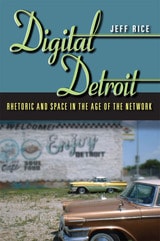
Digital Detroit
Rhetoric and Space in the Age of the NetworkJeff Rice
Southern Illinois University Press, 2012
Since the 1967 riots that ripped apart the city, Detroit has traditionally been viewed either as a place in ruins or a metropolis on the verge of rejuvenation. In Digital Detroit: Rhetoric and Space in the Age of the Network, author Jeff Rice goes beyond the notion of Detroit as simply a city of two ideas. Instead he explores the city as a web of multiple meanings which, in the digital age, come together in the city’s spaces to form a network that shapes the writing, the activity, and the very thinking of those around it.
Rice focuses his study on four of Detroit’s most iconic places—Woodward Avenue, the Maccabees Building, Michigan Central Station, and 8 Mile—covering each in a separate chapter. Each of these chapters explains one of the four features of network rhetoric: folksono(me), the affective interface, response, and decision making. As these rhetorical features connect, they form the overall network called Digital Detroit. Rice demonstrates how new media, such as podcasts, wikis, blogs, interactive maps, and the Internet in general, knit together Detroit into a digital network whose identity is fluid and ever-changing. In telling Detroit’s spatial story, Rice deftly illustrates how this new media, as a rhetorical practice, ultimately shapes understandings of space in ways that computer applications and city planning often cannot. The result is a model for a new way of thinking and interacting with space and the imagination, and for a better understanding of the challenges network rhetorics pose for writing.
Digital Griots
African American Rhetoric in a Multimedia AgeAdam J. Banks
Southern Illinois University Press, 2011
DJs are models of rhetorical excellence; canon makers; time binders who link past, present, and future in the groove and mix; and intellectuals continuously interpreting the history and current realities of their communities in real time. Banks uses the DJ's practices of the mix, remix, and mixtape as tropes for reimagining writing instruction and the study of rhetoric. He combines many of the debates and tensions that mark black rhetorical traditions and points to ways for scholars and students to embrace those tensions rather than minimize them. This commitment to both honoring traditions and embracing futuristic visions makes this text unique, as do the sites of study included in the examination: mixtape culture, black theology as an activist movement, everyday narratives, and discussions of community engagement. Banks makes explicit these connections, rarely found in African American rhetoric scholarship, to illustrate how competing ideologies, vernacular and academic writing, sacred and secular texts, and oral, print, and digital literacies all must be brought together in the study of African American rhetoric and in the teaching of culturally relevant writing.
A remarkable addition to the study of African American rhetorical theory and composition studies, Digital Griots: African American Rhetoric in a Multimedia Age will compel scholars and students alike to think about what they know of African American rhetoric in fresh and useful ways.
Digital Humanities In The Library
Challenges AndAdrianne Hartsell-Gundy
Assoc of College & Research Libraries, 2015
Digital Humanities in the Library, Second Edition
Arianne Hartsell-Gundy
Assoc of College & Research Libraries, 2024
This revised and expanded edition of 2015’s Digital Humanities in the Library includes key reprints from the first edition and new chapters that explore digital humanities and diversity, inclusion, and equity; issues of labor, precarity, and infrastructure; scholarly communication and taxonomies of credit; long-term sustainability; and library digital humanities in the age of institutional austerity.
Divided into sections on theory and practice, chapter authors work in a variety of institution types in many different roles and offer ideas and strategies for cross-institutional collaborations and new approaches to the digital humanities work being done. As Paige Morgan says in the foreword, “Any digital humanist who can enthuse about data can also tell you that computers alone cannot do the work—you need the thoughtfulness of a human expert to find the way forward. This collection can help us do that.”
Digital Humanities in the Library
Challenges and Opportunities for Subject SpecialistsArianne Hartsell-Gundy
Assoc of College & Research Libraries, 2015
Digital Library Programs for Libraries and Archives
Developing, Managing, and Sustaining Unique Digital CollectionsAaron D. Purcell
American Library Association, 2016
Digital Literacy in Public Libraries
Jenna Kammer and Lauren Hays
American Library Association, 2026
- delve into the concept of digital literacy, the ways in which it empowers individuals in digital systems of information, and how it fits in with other kinds of literacy;
- find ideas for effective digital literacy technical support, programming, services, spaces, collection development, outreach, and more;
- learn how to measure the impact of digital literacy initiatives, identify gaps within the community where the library can make an impact, and overcome challenges;
- discover guidance on building partnerships, both internal and external, and finding additional sources of funding to expand digital literacy opportunities within the scope of what is already available;
- receive practical advice from the "Ask the Expert" sidebars throughout the book, where practitioners share their knowledge and experience; and
- get adaptable tools such as sample language, an expenditure budget, an individual needs assessment, a digital literacy readiness checklist, survey instruments, and a lesson plan template that can be used for digital literacy programming.
Digital Media Labs in Libraries
Amanda L. American Library Association
American Library Association, 0
Digital Paper
A Manual for Research and Writing with Library and Internet MaterialsAndrew Abbott
University of Chicago Press, 2014
Abbott tells what every senior researcher knows: that research is not a mechanical, linear process, but a thoughtful and adventurous journey through a nonlinear world. He breaks library research down into seven basic and simultaneous tasks: design, search, scanning/browsing, reading, analyzing, filing, and writing. He moves the reader through the phases of research, from confusion to organization, from vague idea to polished result. He teaches how to evaluate data and prior research; how to follow a trail to elusive treasures; how to organize a project; when to start over; when to ask for help. He shows how an understanding of scholarly values, a commitment to hard work, and the flexibility to change direction combine to enable the researcher to turn a daunting mass of found material into an effective paper or thesis.
More than a mere how-to manual, Abbott’s guidebook helps teach good habits for acquiring knowledge, the foundation of knowledge worth knowing. Those looking for ten easy steps to a perfect paper may want to look elsewhere. But serious scholars, who want their work to stand the test of time, will appreciate Abbott’s unique, forthright approach and relish every page of Digital Paper.
Digital Platforms and Algorithmic Subjectivities
Emiliana Armano, Marco Briziarelli and Elisabetta Risi
University of Westminster Press, 2022

Digital Platforms and the Press
James Meese
Intellect Books, 2023
Platform dependence is a concept that is used to describe what happens when businesses or an entire sector become reliant on one or more digital platforms for their survival. Digital Platforms and the Press argues that we face a major risk of a platform-dependent press—a development that threatens liberal democracies across the world. As James Meese shows, the situation is occurring across the news industry, to the extent that it is difficult to imagine the production, distribution, and long-term survival of news in liberal democracies without the involvement of platforms. As governments, regulators, and citizens become increasingly concerned about platform power, Digital Platforms and the Press is the first book to highlight the long-term economic and social consequences of platform dependence for the news sector.
Digital Poetics
Hypertext, Visual-Kinetic Text and Writing in Programmable MediaLoss Pequeño Glazier
University of Alabama Press, 2001
Glazier investigates the ways in which computer technology has influenced and transformed the writing and dissemination of poetry.
In Digital Poetics, Loss Pequeño Glazier argues that the increase in computer technology and accessibility, specifically the World Wide Web, has created a new and viable place for the writing and dissemination of poetry. Glazier’s work not only introduces the reader to the current state of electronic writing but also outlines the historical and technical contexts out of which electronic poetry has emerged and demonstrates some of the possibilities of the new medium.
Glazier examines three principal forms of electronic textuality: hypertext, visual/kinetic text, and works in programmable media. He considers avant-garde poetics and its relationship to the on-line age, the relationship between web “pages” and book technology, and the way in which certain kinds of web constructions are in and of themselves a type of writing. With convincing alacrity, Glazier argues that the materiality of electronic writing has changed the idea of writing itself. He concludes that electronic space is the true home of poetry and, in the 20th century, has become the ultimate “space of poesis.”
Digital Poetics will attract a readership of scholars and students interested in contemporary creative writing and the potential of electronic media for imaginative expression.
Digital Preservation in Libraries
Preparing for a Sustainable FutureJeremy Myntti
American Library Association, 2018
Digital Rebellion
The Birth of the Cyber LeftTodd Wolfson
University of Illinois Press, 2014
Todd Wolfson reveals how aspects of the mid-1990s Zapatistas movement--network organizational structure, participatory democratic governance, and the use of communication tools as a binding agent--became essential parts of Indymedia and other Cyber Left organizations. From there he uses oral interviews and other rich ethnographic data to chart the media-based think tanks and experiments that continued the Cyber Left's evolution through the Independent Media Center's birth around the 1999 WTO protests in Seattle.
Melding virtual and traditional ethnographic practice to explore the Cyber Left's cultural logic, Wolfson maps the social, spatial and communicative structure of the Indymedia network and details its operations on the local, national and global level. He looks at the participatory democracy that governs global social movements and the ways democracy and decentralization have come into tension, and how "the switchboard of struggle" conducts stories from the hyper-local and disperses them worldwide. As he shows, understanding the intersection of Indymedia and the Global Social Justice Movement illuminates their foundational role in the Occupy struggle and other emergent movements that have re-energized radical politics.