Results by title
1993 books match the query 'Latin America' and 63 start with d
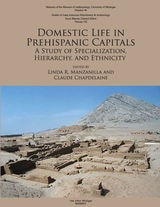
Domestic Life in Prehispanic Capitals
A Study of Specialization, Hierarchy, and EthnicityEdited by Linda R. Manzanilla and Claude Chapdelaine
University of Michigan Press, 2009
Domesticating Empire
Enlightenment in Spanish AmericaKaren Stolley
Vanderbilt University Press, 2013
Through the work of five authors--Jose de Oviedo y Banos, Juan Ignacio Molina, Felix de Azara, Catalina de Jesus Herrera, and Felix de Arrate--Domesticating Empire explores the Ibero-American Enlightenment as a project that reflects both key Enlightenment concerns and the particular preoccupations of Bourbon Spain and its territories in the Americas. At a crucial moment in Spain's imperial trajectory, these authors domesticate topics central to empire--conquest, Indians, nature, God, and gold--by making them familiar and utilitarian. As a result, their works later proved resistant to overarching schemes of Latin American literary history and have been largely forgotten. Nevertheless, eighteenth-century Ibero-American writing complicates narratives about both the Enlightenment and Latin American cultural identity.

Domesticating Organ Transplant
Familial Sacrifice and National Aspiration in MexicoMegan Crowley-Matoka
Duke University Press, 2016

Dominant Powers and Subordinate States
The United States in Latin America and the Soviet Union in Eastern EuropeJan F. Triska, ed.
Duke University Press, 1986
Domination without Dominance
Inca-Spanish Encounters in Early Colonial PeruGonzalo Lamana
Duke University Press, 2008
Lamana’s redefinition of the order of things reveals that, contrary to the conquerors’ accounts, what the Spanairds achieved was a “domination without dominance.” This conclusion undermines common ideas of Spanish (and Western) superiority. It shows that casting order as a by-product of military action rests on a pervasive fallacy: the translation of military superiority into cultural superiority. In constant dialogue with critical thinking from different disciplines and traditions, Lamana illuminates how this new interpretation of the conquest of the Incas revises current understandings of Western colonialism and the emergence of still-current global configurations.
Dominican Crossroads
H. C. C. Astwood and the Moral Politics of Race-Making in the Age of EmancipationChristina Cecelia Davidson
Duke University Press, 2024

Don’t Come Back
Lina María Ferreira Cabeza-Vanegas
The Ohio State University Press, 2017
Don’t Come Back intermixes translations of Spanish adages and adaptations of major Colombian myths with personal essays about growing up amidst violence, magic, and an unyielding Andean sun. Home is place and time and people and language and history, and none of these are ever set in stone. Attempting to reconcile the irreconcilable and translate the untranslatable—to move smoothly and cohesively between culture, language, and place—Ferreira Cabeza-Vanegas is torn between spaces, between the aunt who begs her to return to Colombia and the mother who tells her, “There’s nothing here for you, Lina. Don’t come back.” Don’t Come Back is an exploration of home and identity that constantly asks, “If you really could go back, would you?”

Down Syndrome Culture
Life Writing, Documentary, and Fiction Film in Iberian and Latin American ContextsBenjamin Fraser
University of Michigan Press, 2024
Down Syndrome Culture also pushes the traditionally Anglophone borders of disability studies by examining examples in Spanish, Catalan, and Portuguese-language texts, and incorporating the work of thinkers in Iberian and Latin American studies. Through a close analysis of life writing, documentaries, and fiction films, the book emphasizes the central role of people with Down syndrome in contemporary cultural production. Chapters discuss the autobiography of Andy Trias Trueta, the social actors of the documentary Los niños [The Grown-Ups] (2016), dancers from Danza Mobile, and a variety of fiction films, challenging ableist understandings of disability in nuanced ways. Ultimately, this book reveals the lives, cultural work, and representations of people with trisomy 21 in an international context.

Doña María's Story
Life History, Memory, and Political IdentityDaniel James
Duke University Press, 2000
Doña María’s testimony is grounded in both the local context (based on the author’s thirteen years of historical and ethnographic research in Berisso) and a broader national narrative. In this way, it differs from the dominant genre of women’s testimonial literature, and much recent ethnographic work in Latin America, which have often neglected historical and communal contextualization in order to celebrate individual agency and self-construction. James examines in particular the ways that gender influences Doña María’s representation of her story. He is careful to acknowledge that oral history challenges the historian to sort through complicated sets of motivations and desires—the historian’s own wish to uncover “the truth” of an informant’s life and the interviewee’s hope to make sense of her or his past and encode it with myths of the self. This work is thus James’s effort to present his research and his relationship with Doña María with both theoretical sophistication and recognition of their mutual affection.
While written by a historian, Doña María’s Story also engages with concerns drawn from such disciplines as anthropology, cultural studies, and literary criticism. It will be especially appreciated by those involved in oral, Latin American, and working-class history.

Dramatists in Revolt
The New Latin American TheaterEdited by Leon F. Lyday and George W. Woodyard
University of Texas Press, 1976
Dramatists in Revolt, through studies of the major playwrights, explores significant movements in Latin American theater. Playwrights discussed are those who have made outstanding contributions to Latin American theater during the post–World War II period and who have been particularly sensitive to world currents in literature and drama, while being acutely responsive to the problems of their own areas. They express concern about communication, isolation, and solitude. On a more basic level, they concern themselves with the political and socioeconomic problems that figure importantly in the Third World.
The fifteen essays deal with the playwrights Antón Arrufat and José Triana (Cuba); Emilio Carballido and Luisa Josefina Hernández (Mexico); Agustín Cuzzani, Osvaldo Dragún, Griselda Gambaro, and Carlos Gorostiza (Argentina); Jorge Díaz, Egon Wolff, and Luis Alberto Heiremans (Chile); René Marqués (Puerto Rico); and Jorge Andrade, Alfredo Dias Gomes, and Plínio Marcos (Brazil). These are dramatists in revolt, sometimes in a thematic sense, not only in protesting the indignities that various systems impose on modern man, but also in a dramatic configuration. They dare to experiment with techniques in the constant search for viable theatrical forms.
Each essay is written by a specialist familiar with the works of the playwright under consideration. In addition to the essays, the book includes a listing of source materials on Latin American theater.
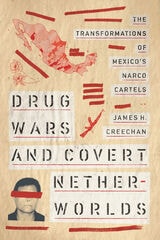
Drug Wars and Covert Netherworlds
The Transformations of Mexico's Narco CartelsJames H. Creechan
University of Arizona Press, 2021
In Drug Wars and Covert Netherworlds sociologist and criminologist James H. Creechan draws on decades of research to paint a much more nuanced picture of the transformation of Mexico’s narco cartels. Creechan details narco cartel history, focusing on the decades since Richard Nixon declared the War on Drugs. With sobering detail, Creechan unravels a web of government dependence, legitimate enterprises, covert connections, and violent infighting. He details how drug smuggling organizations have grown into powerful criminal mafias with the complicit involvement of powerful figures in civil society to create covert netherworlds.
Mexico is at a moment of change—a country on the verge of transition or perdition. It can only move forward by examining its history of narco-connections spun and re-spun over the last fifty years.
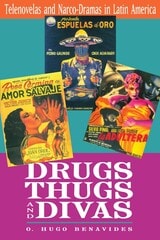
Drugs, Thugs, and Divas
Telenovelas and Narco-Dramas in Latin AmericaBy O. Hugo Benavides
University of Texas Press, 2008
Soap opera speaks a universal language, presenting characters and plots that resonate far beyond the culture that creates them. Latin American soap operas—telenovelas—have found enthusiastic audiences throughout the Americas and Europe, as well as in Egypt, Russia, and China, while Mexican narco-dramas have become highly popular among Latinos in the United States. In this first comprehensive analysis of telenovelas and narco-dramas, Hugo Benavides assesses the dynamic role of melodrama in creating meaningful cultural images to explain why these genres have become so successful while more elite cultural productions are declining in popularity.
Benavides offers close readings of the Colombian telenovelas Betty la fea (along with its Mexican and U.S. reincarnations La fea más bella and Ugly Betty), Adrián está de visita, and Pasión de gavilanes; the Brazilian historical telenovela Xica; and a variety of Mexican narco-drama films. Situating these melodramas within concrete historical developments in Latin America, he shows how telenovelas and narco-dramas serve to unite peoples of various countries and provide a voice of rebellion against often-oppressive governmental systems. Indeed, Benavides concludes that as one of the most effective and lucrative industries in Latin America, telenovelas and narco-dramas play a key role in the ongoing reconfiguration of social identities and popular culture.
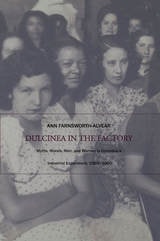
Dulcinea in the Factory
Myths, Morals, Men, and Women in Colombia's Industrial Experiment, 1905-1960Ann Farnsworth-Alvear
Duke University Press, 2000
Ann Farnsworth-Alvear’s analyses of archived personnel records, internal factory correspondence, printed regulations, and company magazines are combined with illuminating interviews with retired workers to allow a detailed reconstruction of the world behind the mill gate. In a place where the distinction between virgins and nonvirgins organized the labor market for women, the distance between chaste and unchaste behavior underlay a moral code that shaped working women’s self-perceptions. Farnsworth-Alvear challenges the reader to understand gender not as an opposition between female and male but rather as a normative field, marked by “proper” and “improper” ways of being female or male. Disputing the idea that the shift in the mills’ workforce over several decades from mainly women to almost exclusively men was based solely on economic factors, the author shows how gender and class, as social practices, converged to shape industrial development itself.
Innovative in its creative employment of subtle and complex material, Dulcinea in the Factory addresses long-standing debates within labor history about proletarianization and work culture. This book’s focus on Colombia will make it valuable to Latin Americanists, but it will also appeal to a wide readership beyond Latin American and labor studies, including historians and sociologists, as well as students of women’s studies, social movements, and anthropology.