Results by title
1488 books match the query 'Media Studies' and 80 start with d

Digital Platforms and the Press
James Meese
Intellect Books, 2023
Platform dependence is a concept that is used to describe what happens when businesses or an entire sector become reliant on one or more digital platforms for their survival. Digital Platforms and the Press argues that we face a major risk of a platform-dependent press—a development that threatens liberal democracies across the world. As James Meese shows, the situation is occurring across the news industry, to the extent that it is difficult to imagine the production, distribution, and long-term survival of news in liberal democracies without the involvement of platforms. As governments, regulators, and citizens become increasingly concerned about platform power, Digital Platforms and the Press is the first book to highlight the long-term economic and social consequences of platform dependence for the news sector.
Digital Poetics
Hypertext, Visual-Kinetic Text and Writing in Programmable MediaLoss Pequeño Glazier
University of Alabama Press, 2001
Glazier investigates the ways in which computer technology has influenced and transformed the writing and dissemination of poetry.
In Digital Poetics, Loss Pequeño Glazier argues that the increase in computer technology and accessibility, specifically the World Wide Web, has created a new and viable place for the writing and dissemination of poetry. Glazier’s work not only introduces the reader to the current state of electronic writing but also outlines the historical and technical contexts out of which electronic poetry has emerged and demonstrates some of the possibilities of the new medium.
Glazier examines three principal forms of electronic textuality: hypertext, visual/kinetic text, and works in programmable media. He considers avant-garde poetics and its relationship to the on-line age, the relationship between web “pages” and book technology, and the way in which certain kinds of web constructions are in and of themselves a type of writing. With convincing alacrity, Glazier argues that the materiality of electronic writing has changed the idea of writing itself. He concludes that electronic space is the true home of poetry and, in the 20th century, has become the ultimate “space of poesis.”
Digital Poetics will attract a readership of scholars and students interested in contemporary creative writing and the potential of electronic media for imaginative expression.
Digital Rebellion
The Birth of the Cyber LeftTodd Wolfson
University of Illinois Press, 2014
Todd Wolfson reveals how aspects of the mid-1990s Zapatistas movement--network organizational structure, participatory democratic governance, and the use of communication tools as a binding agent--became essential parts of Indymedia and other Cyber Left organizations. From there he uses oral interviews and other rich ethnographic data to chart the media-based think tanks and experiments that continued the Cyber Left's evolution through the Independent Media Center's birth around the 1999 WTO protests in Seattle.
Melding virtual and traditional ethnographic practice to explore the Cyber Left's cultural logic, Wolfson maps the social, spatial and communicative structure of the Indymedia network and details its operations on the local, national and global level. He looks at the participatory democracy that governs global social movements and the ways democracy and decentralization have come into tension, and how "the switchboard of struggle" conducts stories from the hyper-local and disperses them worldwide. As he shows, understanding the intersection of Indymedia and the Global Social Justice Movement illuminates their foundational role in the Occupy struggle and other emergent movements that have re-energized radical politics.
Digital Rhetoric
Theory, Method, PracticeDouglas Eyman
University of Michigan Press, 2015
Digital Rubbish
A Natural History of ElectronicsJennifer Gabrys
University of Michigan Press, 2013
This is a study of the material life of information and its devices; of electronic waste in its physical and electronic incarnations; a cultural and material mapping of the spaces where electronics in the form of both hardware and information accumulate, break down, or are stowed away. Electronic waste occurs not just in the form of discarded computers but also as a scatter of information devices, software, and systems that are rendered obsolete and fail. Where other studies have addressed "digital" technology through a focus on its immateriality or virtual qualities, Gabrys traces the material, spatial, cultural, and political infrastructures that enable the emergence and dissolution of these technologies. In the course of her book, she explores five interrelated "spaces" where electronics fall apart: from Silicon Valley to Nasdaq, from containers bound for China to museums and archives that preserve obsolete electronics as cultural artifacts, to the landfill as material repository. All together, these sites stack up into a sedimentary record that forms the "natural history" of this study.
Digital Rubbish: A Natural History of Electronics describes the materiality of electronics from a unique perspective, examining the multiple forms of waste that electronics create as evidence of the resources, labor, and imaginaries that are bundled into these machines. By drawing on the material analysis developed by Walter Benjamin, this natural history method allows for an inquiry into electronics that focuses neither on technological progression nor on great inventors but rather considers the ways in which electronic technologies fail and decay. Ranging across studies of media and technology, as well as environments, geography, and design, Jennifer Gabrys pulls together the far-reaching material and cultural processes that enable the making and breaking of these technologies.
Jennifer Gabrys is Senior Lecturer in Design and Convener of the Masters in Design and Environment in the Department of Design, Goldsmiths, University of London.
Jacket image: Computer dump ©iStockphoto/Lya_Cattel.
digitalculturebooks is an imprint of the University of Michigan Press and the Scholarly Publishing Office of the University of Michigan Library dedicated to publishing innovative and accessible work exploring new media and their impact on society, culture, and scholarly communication. Visit the website at www.digitalculture.org.
Digital Technology and Democratic Theory
Edited by Lucy Bernholz, Hélène Landemore, and Rob Reich
University of Chicago Press, 2021
To understand these transformations, this book brings together contributions by scholars from multiple disciplines to wrestle with the question of how digital technologies shape, reshape, and affect fundamental questions about democracy and democratic theory. As expectations have whiplashed—from Twitter optimism in the wake of the Arab Spring to Facebook pessimism in the wake of the 2016 US election—the time is ripe for a more sober and long-term assessment. How should we take stock of digital technologies and their promise and peril for reshaping democratic societies and institutions? To answer, this volume broaches the most pressing technological changes and issues facing democracy as a philosophy and an institution.
Digital Theory
M. Beatrice Fazi
University of Minnesota Press, 2025
Proposes a powerful new theoretical approach to the concept of the digital
Digital Theory argues that the digital is theoretical and should be understood not uniquely in terms of consumer electronics but rather more broadly as a form of mediation using discrete units. Building on this definition, the three essays in this volume explore digitality’s relation to thinking, signs, and difference.
M. Beatrice Fazi begins the discussion by way of three propositions on the ontological reach and epistemological scope of digital theory. Alexander R. Galloway then defines the necessary conditions for any symbolic order of the digital type, specifying a series of ten simple mathemes. Matthew Handelman and Leif Weatherby conclude by characterizing digital theory through the dialectical relation between quality and quantity. Taken together, these works expound productively and provocatively on the digital’s far-reaching theoretical potential.
Retail e-book files for this title are screen-reader friendly with image accompanied by short alt text and/or extended description.
Digital Tools in Urban Schools
Mediating a Remix of LearningJabari Mahiri
University of Michigan Press, 2011
"Today there is massive interest in how digital tools and popular culture are transforming learning out of school and lots of dismay at how digitally lost our schools are. Jabari Mahiri works his usual magic and here shows us how to cross this divide in a solidly grounded and beautifully written book."
---James Paul Gee, Fulton Presidential Professor of Literacy Studies, Arizona State University
"Digital Tools in Urban Schools is a profoundly sobering yet inspiring depiction of the potential for committed educators to change the lives of urban youth, with the assistance of a new set of technical capabilities."
---Mimi Ito, Professor in Residence and MacArthur Foundation Chair in Digital Media and Learning, Departments of Informatics and Anthropology, University of California, Irvine
"An uplifting book that addresses a critical gap in existing literature by providing rich and important insights into ways teachers, administrators, and members of the wider community can work together with students previously alienated---even excluded---from formal education to enhance classroom learning with appropriate digital tools and achieve inspiring results under challenging circumstances."
---Colin Lankshear, James Cook University, and Michele Knobel, Montclair State University
Digital Tools in Urban Schools demonstrates significant ways in which high school teachers in the complex educational setting of an urban public high school in northern California extended their own professional learning to revitalize learning in their classrooms. Through a novel research collaboration between a university and this public school, these teachers were supported and guided in developing the skills necessary to take greater advantage of new media and new information sources to increase student learning while making connections to their relevant experiences and interests. Jabari Mahiri draws on extensive qualitative data---including blogs, podcasts, and other digital media---to document, describe, and analyze how the learning of both students and teachers was dramatically transformed as they utilized digital media in their classrooms. Digital Tools in Urban Schools will interest instructional leaders and participants in teacher preparation and professional development programs, education and social science researchers and scholars, graduate and undergraduate programs and classes emphasizing literacy and learning, and those focused on urban education issues and conditions.
Digital Visual Effects in Cinema
The Seduction of RealityPrince, Stephen
Rutgers University Press, 2012
Avatar. Inception. Jurassic Park. Lord of the Rings. Ratatouille. Not only are these some of the highest-grossing films of all time, they are also prime examples of how digital visual effects have transformed Hollywood filmmaking. Some critics, however, fear that this digital revolution marks a radical break with cinematic tradition, heralding the death of serious realistic movies in favor of computer-generated pure spectacle.
Digital Visual Effects in Cinema counters this alarmist reading, by showing how digital effects–driven films should be understood as a continuation of the narrative and stylistic traditions that have defined American cinema for decades. Stephen Prince argues for an understanding of digital technologies as an expanded toolbox, available to enhance both realist films and cinematic fantasies. He offers a detailed exploration of each of these tools, from lighting technologies to image capture to stereoscopic 3D. Integrating aesthetic, historical, and theoretical analyses of digital visual effects, Digital Visual Effects in Cinema is an essential guide for understanding movie-making today.
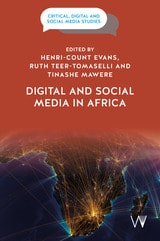
Digital and Social Media in Africa
Edited by Henri-Count Evans, Ruth Teer-Tomaselli, and Tinashe Mawere
University of Westminster Press, 2025
Further, the book examines the human rights challenges posed by state control and monitoring of digital and social media forms of communication. In the context of a digital surveillance state, it questions how digital and social media can possibly enhance the democratisation of both the communicative and political spaces.
The book focuses on questions of censorship and control of digital and social media in ‘supposedly’ democratic societies. It discusses regulation and how governments have imposed their state power by ‘switching off’ the internet and blocking social media sites under the guise of national security and order maintenance.
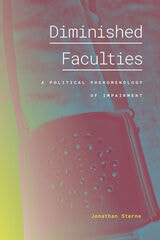
Diminished Faculties
A Political Phenomenology of ImpairmentJonathan Sterne
Duke University Press, 2021

Disability and Fandom
Katherine Anderson Howell
University of Iowa Press, 2024
Anderson Howell examines how key fandom platforms—including cons, Tumblr, Archive of Our Own, Instagram, Reddit, and TikTok—set up user interfaces that may mask their true values, potentially decreasing access and creating a system by which disability remains stigmatized. Readers will find case studies of fan fiction, disability influencers, anti-fans, trolls, and celebrities. The argument is made for incorporating disability into the analytical tools of fandom so that we may begin with better tools and better questions.
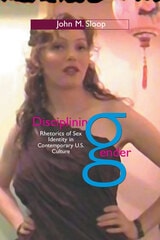
Disciplining Gender
Rhetorics of Sex Identity in Contemporary U.S. CultureJohn M. Sloop
University of Massachusetts Press, 2004
An expert on the rhetoric of the mass media, John M. Sloop has written several books on how the spoken and written word can influence political and cultural debate. In Disciplining Gender, he turns his attention to a topic that has attracted widespread public discussion—the treatment of gender ambiguity in American culture. He offers critical readings of five cases, showing the extent to which, in each instance, public discourse and media representations have served to reinforce dominant norms and constrain or “discipline” any behavior that blurs or subverts conventional gender boundaries.
The five cases include John/Joan or David Reimer, Brandon Teena, k.d. lang, Janet Reno, and Barry Winchell/Calpernia Addams. Sloop draws on queer theory and research in the field of critical rhetoric to examine representations of “gender trouble” in these much-publicized stories. In each case, he provides a comprehensive analysis of the public discussions of their significance. In short, rather than simply study the people and circumstances involved in each case, he examines the public meanings attached to them and the implications of those meanings for how contemporary culture comes to understand what “man” and “woman” mean and which sexual behaviors are appropriate and inappropriate.
In highlighting the ideological constraints imposed by our society, Sloop also suggests the ways that these constraints might be loosened and understandings of gender and sexuality diversified.
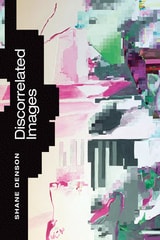
Discorrelated Images
Shane Denson
Duke University Press, 2020
Disney Culture
Wills, John
Rutgers University Press, 2017
Disney Culture proposes that there is still a unifying Disney ethos, one that can be traced back to the corporate philosophy that Walt Disney himself developed back in the 1920s. Yet, as cultural historian John Wills demonstrates, Disney’s values have also adapted to changing social climates. At the same time, the world of Disney has profoundly shaped how Americans view the world.
Wills offers a nuanced take on the corporate ideologies running through animated and live-action Disney movies from Frozen to Fantasia, from Mary Poppins to Star Wars: The Force Awakens. But Disney Culture encompasses much more than just movies as it explores the intersections between Disney’s business practices and its cultural mythmaking. Welcome to “the Disney Way.”
Disney's Star Wars
Forces of Production, Promotion, and ReceptionWilliam Proctor and Richard McCulloch
University of Iowa Press, 2019
Covering the period from Disney’s purchase through the release of The Force Awakens, the book reveals how fans anticipated, interpreted, and responded to the steady stream of production stories, gossip, marketing materials, merchandise, and other sources in the build-up to the movie’s release. From fears that Princess Leia would be turned into a “Disney princess” to collaborative brand management, the authors explore the shifting relationship between fans, texts, and media industries in the context of a crucial rebranding campaign. The result is a fascinating examination of a critical moment in the iconic series’ history.

Disobedient Aesthetics
Surveillance, Bodies, ControlAnthony Stagliano
University of Alabama Press, 2024
A compelling inquiry into the rhetorical and aesthetic techniques that subvert contemporary regimes of digital surveillance, embodiment, and control.
The contemporary world bristles with tools of observation and manipulation. Security cameras, social media, data mining, biometric scans, and other instruments ensnare the individual in a web of surveillance. In Disobedient Aesthetics, Anthony Stagliano exposes the use of human lives as sites of data exploitation and outlines paths of resistance. From the thermal-vision systems used on military drones, which use human body heat itself as a media object, to facial recognition platforms that use human faces as data mines, and from law enforcement tools of DNA analysis to data-driven urban governance, the realm of algorithmic surveillance and control is wide and subtle.
Disobedient Aesthetics outlines interventions into the technical systems subtending data-driven surveillance and control. Stagliano maps not only the surveillant regimes afforded by recent networked technologies, but also the inventive, artistic research into ways of undermining, upending, or redirecting such technologies. The concluding chapter examines creative, critical, and collective efforts to democratize access to the technology that undergirds such scrutiny and enables ways to detect and contest its power.
In a fascinating epilogue, Stagliano revisits current theories of control and offers an alternative reading of Gilles Deleuze’s oft-cited thesis on control societies: namely that it is not a matter of “finding new weapons” to undermine control but developing new techniques, new designs, new prototypes, and new modes of creative escape.

Disorienting Politics
Chimerican Media and Transpacific EntanglementsFan Yang
University of Michigan Press, 2024
Examining how Chimerican media are shaped by and perpetuate uneven power relations, Disorienting Politics argues that the pervasive tendency among wide-ranging cultural producers to depict the Chinese state as a racialized Other in American media life diminishes the possibility of engaging transpacific entanglements as a basis for envisioning new political horizons. Such othering of China not only results in overt racism against people of Asian descent, Yang argues, but also impacts the wellbeing of people of color more generally. This interdisciplinary book demonstrates the ways in which race is embedded in geopolitics even when the subject of discussion is not the people, but the (Chinese) state. Bridging media and cultural studies, Asian and Asian American studies, geography, and globalization studies, Disorienting Politics calls for a relational politics that acknowledges the multifarious interconnectivity between people, places, media, and environment.
Display, Distribute, Disrupt
Contemporary Moving Image PracticesEdited by Wolfgang Brückle and Fred Truniger
Diaphanes, 2023
Over the last two decades, the field of audiovisual media has changed dramatically. Until recently, there was only a small number of technologies, distribution channels were few, and moving images were largely limited to cinemas, televisions, galleries, or art museums. Also, both the producers and the audiences of such content clearly identified as human beings. Those days are over.
The digitization of image production and distribution ushered in a massive disruption to the traditional landscape of the moving image that had existed since the advent of the audiovisual industry. Touching on discussions such as child producers, the marketing interests of big corporations, and the origins of new media formats and practices, Display, Distribute, Disrupt maps the new conditions for creative work in the ever-widening sphere of audiovisual media.

Dissing Elizabeth
Negative Representations of GlorianaJulia M. Walker, ed.
Duke University Press, 1998
As editor Julia M. Walker suggests, the breadth of dissent considered in this collection points to a dark side of the Cult of Elizabeth. Reevaluating neglected texts that had not previously been perceived as critical of the queen or worthy of critical appraisal, contributors consider dissent in a variety of forms, including artwork representing (and mocking) the queen, erotic and pornographic metaphors for Elizabeth in the popular press, sermons subtly critiquing her actions, and even the hostility encoded in her epitaph and in the placement of her tomb. Other chapters discuss gossip about Elizabeth, effigies of the queen, polemics against her marriage to the Duke of Alençon, common verbal slander, violence against emblems of her authority, and the criticism embedded in the riddles, satires, and literature of the period.
Distant Early Warning
Marshall McLuhan and the Transformation of the Avant-GardeAlex Kitnick
University of Chicago Press, 2021
Kitnick builds the story of McLuhan’s entanglement with artists by carefully drawing out the connections among McLuhan, his theories, and the artists themselves. The story is packed with big names: Marcel Duchamp, Niki de Saint Phalle, Jasper Johns, Andy Warhol, Nam June Paik, and others. Kitnick masterfully weaves this history with McLuhan’s own words and his provocative ideas about what art is and what artists should do, revealing McLuhan’s influence on the avant-garde through the confluence of art and theory. The illuminating result sheds light on new aspects of McLuhan, showing him not just as a theorist, or an influencer, but as a richly multifaceted figure who, among his many other accolades, affected multiple generations of artists and their works. The book finishes with Kitnick overlaying McLuhan’s ethos onto the state of contemporary and post-internet art. This final channeling of McLuhan is a swift and beautiful analysis, with a personal touch, of art’s recent transgressions and what its future may hold.
Documenting the American Student Abroad
The Media Cultures of International EducationKelly Hankin
Rutgers University Press, 2021
In Documenting the American Student Abroad, Kelly Hankin explores the documentary media cultures that shape these beliefs, drawing our attention to the broad range of stakeholders and documentary modes involved in defining the core values and practices of study abroad. From study abroad video contests and a F.B.I. produced docudrama about student espionage to reality television inspired educational documentaries and docudramas about Amanda Knox, Hankin shows how the institutional values of "global citizenship," "intercultural communication," and "cultural immersion" emerge in contradictory ways through their representation.
By bringing study abroad and media studies into conversation with one another, Documenting the American Student Abroad: The Media Cultures of International Education offers a much needed humanist contribution to the field of international education, as well as a unique approach to the growing scholarship on the intersection of media and institutions. As study abroad practitioners and students increase their engagement with moving images and digital environments, the insights of media scholars are essential for helping the field understand how the mediation of study abroad rhetoric shapes rather than reflects the field's central institutional ideals
Does Writing Have a Future?
Vilém Flusser
University of Minnesota Press, 2010
Confirming Flusser’s status as a theorist of new media in the same rank as Marshall McLuhan, Jean Baudrillard, Paul Virilio, and Friedrich Kittler, the balance of this book teases out the nuances of these developments. To find a common denominator among texts and practices that span millennia, Flusser looks back to the earliest forms of writing and forward to the digitization of texts now under way. For Flusser, writing—despite its limitations when compared to digital media—underpins historical consciousness, the concept of progress, and the nature of critical inquiry. While the text as a cultural form may ultimately become superfluous, he argues, the art of writing will not so much disappear but rather evolve into new kinds of thought and expression.
Double Exposure
How Social Psychology Fell in Love with the MoviesKathryn Millard
Rutgers University Press, 2022

Double Negative
The Black Image and Popular CultureRacquel J. Gates
Duke University Press, 2018

Down Syndrome Culture
Life Writing, Documentary, and Fiction Film in Iberian and Latin American ContextsBenjamin Fraser
University of Michigan Press, 2024
Down Syndrome Culture also pushes the traditionally Anglophone borders of disability studies by examining examples in Spanish, Catalan, and Portuguese-language texts, and incorporating the work of thinkers in Iberian and Latin American studies. Through a close analysis of life writing, documentaries, and fiction films, the book emphasizes the central role of people with Down syndrome in contemporary cultural production. Chapters discuss the autobiography of Andy Trias Trueta, the social actors of the documentary Los niños [The Grown-Ups] (2016), dancers from Danza Mobile, and a variety of fiction films, challenging ableist understandings of disability in nuanced ways. Ultimately, this book reveals the lives, cultural work, and representations of people with trisomy 21 in an international context.
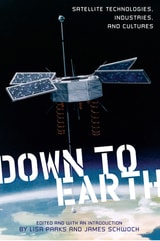
Down to Earth
Satellite Technologies, Industries, and CulturesParks, Lisa
Rutgers University Press, 2012
Down to Earth presents the first comprehensive overview of the geopolitical maneuvers, financial investments, technological innovations, and ideological struggles that take place behind the scenes of the satellite industry. Satellite projects that have not received extensive coverage—microsatellites in China, WorldSpace in South Africa, SiriusXM, the failures of USA 193 and Cosmos 954, and Iridium—are explored. This collection takes readers on a voyage through a truly global industry, from the sites where satellites are launched to the corporate clean rooms where they are designed, and along the orbits and paths that satellites traverse. Combining a practical introduction to the mechanics of the satellite industry, a history of how its practices and technologies have evolved, and a sophisticated theoretical analysis of satellite cultures, Down to Earth opens up a new space for global media studies.
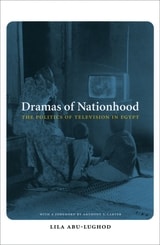
Dramas of Nationhood
The Politics of Television in EgyptLila Abu-Lughod
University of Chicago Press, 2004
Representing a decade's worth of research, Dramas of Nationhood makes a case for the importance of studying television to answer larger questions about culture, power, and modern self-fashionings. Abu-Lughod explores the elements of developmentalist ideology and the visions of national progress that once dominated Egyptian television—now experiencing a crisis. She discusses the broadcasts in rich detail, from the generic emotional qualities of TV serials and the depictions of authentic national culture, to the debates inflamed by their deliberate strategies for combating religious extremism.
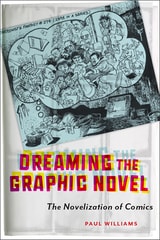
Dreaming the Graphic Novel
The Novelization of ComicsPaul Williams
Rutgers University Press, 2020
Honorable Mention, 2019-2020 Research Society for American Periodicals Book Prize
The term “graphic novel” was first coined in 1964, but it wouldn’t be broadly used until the 1980s, when graphic novels such as Watchmen and Maus achieved commercial success and critical acclaim. What happened in the intervening years, after the graphic novel was conceptualized yet before it was widely recognized?
Dreaming the Graphic Novel examines how notions of the graphic novel began to coalesce in the 1970s, a time of great change for American comics, with declining sales of mainstream periodicals, the arrival of specialty comics stores, and (at least initially) a thriving underground comix scene. Surveying the eclectic array of long comics narratives that emerged from this fertile period, Paul Williams investigates many texts that have fallen out of graphic novel history. As he demonstrates, the question of what makes a text a ‘graphic novel’ was the subject of fierce debate among fans, creators, and publishers, inspiring arguments about the literariness of comics that are still taking place among scholars today.
Unearthing a treasure trove of fanzines, adverts, and unpublished letters, Dreaming the Graphic Novel gives readers an exciting inside look at a pivotal moment in the art form’s development.

Drug Cartels Do Not Exist
Narcotrafficking in US and Mexican CultureOswaldo Zavala
Vanderbilt University Press, 2022
Yet the realities of violence in Mexico and along the border are obscured by the books, films, and TV series we consume. In truth, works like Sicario, The Queen of the South, and Narcos hide Mexico's political realities. Alongside these examples, Zavala discusses Charles Bowden, 2666 by Roberto Bolaño, and other important Latin American writers as examples of those who do capture the realities of the drug war.
Translated into English by William Savinar, Drug Cartels Do Not Exist will be useful for journalists, political scientists, philosophers, and writers of any kind who wish to break down the constructed barriers—physical and mental—created by those in power around the reality of the Mexican drug trade.