Results by title
3576 books match the query 'American' and 110 start with d
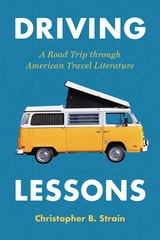
Driving Lessons
A Road Trip through American Travel LiteratureChristopher B. Strain
University of Alabama Press, 2025
Weaves the author’s own four-month cross-country sojourn in a VW van with thoughts on travel narratives across the history of American literature
In Driving Lessons, Christopher B. Strain sets out on a quintessential American road trip, exploring not just the roads and byways of the country but the road trip’s place in American culture. Strain dives into the well of American travel writing, illuminating fascinating aspects of the road trip, such as how race, class, and gender shape the experiences of road trippers.
In the summer of 1998, amid a professional crisis of confidence, Strain settled on a plan to reconnect with both himself and the country he studies. He purchased a 1972 Volkswagen Westfalia van and set off on his own cross-country odyssey. In the weeks that followed, he ruminated on his own ongoing journey alongside great journeys from the past and how they reveal the heart of the traveler as well as the landscape of the nation.
Visiting archives and landmarks across the United States, Strain's journey became a parallel to the stories he studied—an opportunity to see and experience the cities, national parks, and monuments that define US history. Driving Lessons is a compelling blend of literary analysis and memoir, offering readers an insightful and heartfelt reflection on the enduring power of the American road trip.
Driving the Body Back
Mary Swander
University of Iowa Press, 1998
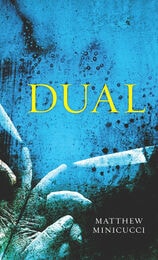
Dual
PoemsMatthew Minicucci
Acre Books, 2023
In his fourth poetry collection, Matthew Minicucci examines masculinity and gun violence as he brings to life the grammatical concept of the dual, a number that is neither singular nor plural. Though now lost in English, the concept is present in other languages both extant and ancient. The poems’ forms fittingly include the elegy, palinode, and contrapuntal, which is both a single poem and two poems intertwined. They align contemporary moments with key texts from Western literature, including ancient Greek epics, in a way that helps us reconsider the aggression of young men. “The world kills kind boys,” Minicucci writes, and “we bury the bodies inside men.”
Minicucci recategorizes our idea of “West,” the Western canon, and the Old West and its bullets, comparing them to modern-day landscapes in Utah, Oregon, Washington, California, and Hawai’i. Whether memorializing a woodworking grandfather or poets Brigit Pegeen Kelly and James Longenbach, Dual notes that loss has a double vision. While weighty in their subjects, Dual’s poems make room for unexpected moments of lightness, such as when the speaker compares the complications of love to “reading the Iliad and realizing, sure, there's anger, // but before that there’s just a lot of camping.”
The book argues, in the end, that there is an unalienable dual between the observer and the observed, the self and the self as confessed to another.
Dual
PoemsMatthew Minicucci
Acre Books, 2023
In his fourth poetry collection, Matthew Minicucci examines masculinity and gun violence as he brings to life the grammatical concept of the dual, a number that is neither singular nor plural. Though now lost in English, the concept is present in other languages both extant and ancient. The poems’ forms fittingly include the elegy, palinode, and contrapuntal, which is both a single poem and two poems intertwined. They align contemporary moments with key texts from Western literature, including ancient Greek epics, in a way that helps us reconsider the aggression of young men. “The world kills kind boys,” Minicucci writes, and “we bury the bodies inside men.”
Minicucci recategorizes our idea of “West,” the Western canon, and the Old West and its bullets, comparing them to modern-day landscapes in Utah, Oregon, Washington, California, and Hawai’i. Whether memorializing a woodworking grandfather or poets Brigit Pegeen Kelly and James Longenbach, Dual notes that loss has a double vision. While weighty in their subjects, Dual’s poems make room for unexpected moments of lightness, such as when the speaker compares the complications of love to “reading the Iliad and realizing, sure, there's anger, // but before that there’s just a lot of camping.”
The book argues, in the end, that there is an unalienable dual between the observer and the observed, the self and the self as confessed to another.
Dusk, Empire
New and SelectedDaniel Tobin
Four Way Books, 2026
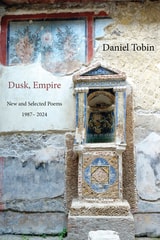
Dusk, Empire: New and Selected Poems 1987-2024 is a panoramic collection of Daniel Tobin’s most exemplary, ambitious, and accomplished poems from nearly forty years at work in the art. These range from his award-winning first book, Where the World is Made, through successive volumes that reveal a progressive deepening of his essential themes even as the poems evolve to an ever more refined technical risk and mastery. These themes include the unflinching encounter with time, suffering, and mortality, as well as what one earlier reviewer called “a quest for transcendence, a search for the sacred.” They seek, in short, to do, as another reviewer observed, what Yeats said was “one ideal for poetry: to hold justice and reality in a single thought.” In so doing, Tobin’s poems probe the individual life in relation to the pressures of history, including his own family’s perilous and traumatic immigration from famine in the 19th century—a backstory he explores in The Narrows, which he has called “a mural in verse.” At the same time, his “Homage to Bartolomeo de las Casas” delves into the fraught early colonial history of the Americas through the eyes of the eponymous friar, a repentant colonizer.
These earlier works establish Tobin’s mastery of the poetic sequence, among a wide variety of other formal displays, all amply evident in the books that follow, including the lyrically meditative orchestrations of Second Things, the award-winning poems of Belated Heavens, The Net, and Blood Labors, characterized at once by their compendious erudition, their sense of intellectual and cultural history, as well as their emotional urgency and formal variousness. This generous selection from Tobin’s work is intended to be a companion volume to The Mansions, his trilogy of book-length poems that explore twentieth century history, and the counter claims of science and religion, through three exemplary lives, which reviewers said inspired genuine awe. Finally, Dusk, Empire leads with a gripping selection of new work that engages the enormous pressures and troubles of the present historical moment, set in dialogue with Tobin’s characteristic passion for what would transcend it. Or as he asks in “The Sand Painting,” “What is that joyous singing inside the rock / Though each intricate, lovely thing will be erased?”

Dwan Gallery
Los Angeles to New York, 1959–1971James Meyer
University of Chicago Press, 2016
Alongside lush full-color images of one hundred leading artworks, the book deepens our understanding of the artistic exchanges Dwan facilitated during this age of mobility, when air travel and the interstate highway system linked the two coasts and transformed the making of art and the sites of its exhibition. James Meyer, the curator of the exhibition and the foremost authority on minimal art, contributes an essay that is a sophisticated and broad-ranging analysis of Dwan’s legacy.
Honoring Dwan’s significant influence and impact on postwar art, Dwan Gallery is a rich and informative collection that will be treasured by fans of contemporary art.
Dwelling Places
Poems and TranslationsDavid Ferry
University of Chicago Press, 1993
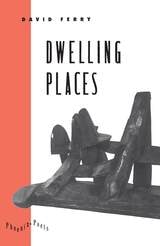
"David Ferry's Dwelling Places is a marvelous, extremely moving book, distinguished by Ferry's characteristic formal virtuosity, extraordinarily fresh and 'inner' translations, and a kind of driven anguished rage at both the social conditions in which human beings have to live and the mysteriously unchangeable tragedies of individual human lives. The translations amplify and deepen the contemporary scenes. I feel that in the future this will be perceived as a great book."—Frank Bidart
"Not until I had read Dwelling Places several times did I see how ingeniously resourceful, ambitious, and admirably modest a book David Ferry has made."—Boston Review
Dwelling in American
Dissent, Empire, and GlobalizationJohn Muthyala
Dartmouth College Press, 2012
Dying in Character
Memoirs on the End of LifeJeffrey Berman
University of Massachusetts Press, 2012
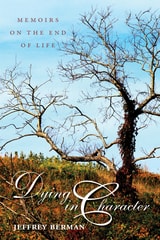
Examining the works cited above, as well as memoirs by Mitch Albom, Roland Barthes, Jean-Dominique Bauby, Art Buchwald, Randy Pausch, David Rieff, Philip Roth, and Morrie Schwartz, Jeffrey Berman's analysis of this growing genre yields some surprising insights. While the authors have much to say about the loneliness and pain of dying, many also convey joy, fulfillment, and gratitude. Harold Brodkey is willing to die as long as his writings survive. Art Buchwald and Randy Pausch both use the word fun to describe their dying experiences. Dying was not fun for Morrie Schwartz and Tony Judt, but they reveal courage, satisfaction, and fearlessness during the final stage of their lives, when they are nearly paralyzed by their illnesses.
It is hard to imagine that these writers could feel so upbeat in their situations, but their memoirs are authentically affirmative. They see death coming, yet they remain stalwart and focused on their writing. Berman concludes that the contemporary end-of-life memoir can thus be understood as a new form of death ritual, "a secular example of the long tradition of ars moriendi, the art of dying."
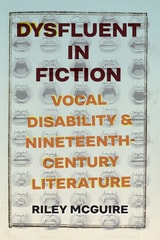
Dysfluent in Fiction
Vocal Disability and Nineteenth-Century LiteratureRiley McGuire
The Ohio State University Press, 2025
Honorable Mention, 2025 Victorian Popular Fiction Association First Book Prize
In Dysfluent in Fiction, Riley McGuire unspools a literary history of vocal disability in the nineteenth century, arguing that this underexamined literary trope helps us to understand vocal hierarchies that still structure our present. Adopting the term “dysfluency” to show departure from normative expectations of pace, pitch, and fluency, McGuire reveals how dysfluent speech populates an enormous number of nineteenth-century texts and played a formative role in the lives of some of the period’s most influential writers.
Dysfluent in Fiction examines anglophone literature during the long nineteenth century in both England and America by authors such as William Makepeace Thackeray, Charlotte Brontë, Lewis Carroll, Mary Elizabeth Braddon, and Frederick Douglass. Examples of dysfluencies across genres include lisping lovers, a baby-talking fairy, a mute detective, various disabilities in narratives of enslavement, and more. These representations show how disabled speech was both stigmatized and celebrated in ways that clarify our contemporary response to the spectrum of human articulation and that are a vocal corollary to current notions of neurodiversity. Dysfluency’s power, McGuire contends, lies in its denial that a single mode of articulation is possible, let alone desirable.