Results by title
3369 books match the query 'Cultural & Social' and 131 start with d
Domesticating Democracy
The Politics of Conflict Resolution in BoliviaSusan Helen Ellison
Duke University Press, 2018

Domesticating Organ Transplant
Familial Sacrifice and National Aspiration in MexicoMegan Crowley-Matoka
Duke University Press, 2016
Domestication Gone Wild
Politics and Practices of Multispecies RelationsHeather Anne Swanson, Gro B. Ween, and Marianne E. Lien, editors
Duke University Press, 2018
Contributors. Inger Anneberg, Natasha Fijn, Rune Flikke, Frida Hastrup, Marianne Elisabeth Lien, Knut G. Nustad, Sara Asu Schroer, Heather Anne Swanson, Anna Lowenhaupt Tsing, Mette Vaarst, Gro B. Ween, Jon Henrik Ziegler Remme
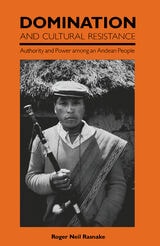
Domination and Cultural Resistance
Authority and Power Among an Andean PeopleRoger Neil Rasnake
Duke University Press, 1988
Domination without Dominance
Inca-Spanish Encounters in Early Colonial PeruGonzalo Lamana
Duke University Press, 2008
Lamana’s redefinition of the order of things reveals that, contrary to the conquerors’ accounts, what the Spanairds achieved was a “domination without dominance.” This conclusion undermines common ideas of Spanish (and Western) superiority. It shows that casting order as a by-product of military action rests on a pervasive fallacy: the translation of military superiority into cultural superiority. In constant dialogue with critical thinking from different disciplines and traditions, Lamana illuminates how this new interpretation of the conquest of the Incas revises current understandings of Western colonialism and the emergence of still-current global configurations.

Don't Kill in Our Names
Families of Murder Victims Speak Out against the Death PenaltyKing, Rachel
Rutgers University Press, 2003
Could you forgive the murderer of your husband? Your mother? Your son?
Families of murder victims are often ardent and very public supporters of the death penalty. But the people whose stories appear in this book have chosen instead to forgive their loved ones’ murderers, and many have developed personal relationships with the killers and have even worked to save their lives. They have formed a nationwide group, Murder Victims’ Families for Reconciliation (MVFR), to oppose the death penalty.
MVFR members are often treated as either saints or lunatics, but the truth is that they are neither. They are ordinary people who have responded to an extraordinary and devastating tragedy with courage and faith, choosing reconciliation over retribution, healing over hatred. Believing that the death penalty is a form of social violence that only repeats and perpetuates the violence that claimed their loved one’s lives, they hold out the hope of redemption even for those who have committed the most hideous crimes.
Weaving third-person narrative with wrenching first-hand accounts, King presents the stories of ten MVFR members. Each is a heartrending tale of grief, soul searching, and of the challenge to choose forgiveness instead of revenge. These stories, which King sets in the context of the national discussion over the death penalty debate and restorative versus retributive justice, will appeal not only to those who oppose the death penalty, but also to those who strive to understand how people can forgive the seemingly unforgivable.

Doomed by Hope
Essays on Arab TheatreEdited by Eyad Houssami and Elias Khoury
Pluto Press, 2012
Doomed by Hope is a beautifully presented collection of essays by writers and artists which traces the history of contemporary Arab theatre and its relationship to social change.
With contributors from Syria, Egypt, Lebanon, Palestine, Kuwait and Yemen, this book includes both academic discussions and personal narratives, alongside a number of specially commissioned portraits of contemporary Arab theatre artists. The essays revolve around the legacy of the late Syrian dramatist Saadallah Wannous, whose monumental plays incited audiences to rise up against tyranny decades ago.
This unique book is one of the first English language volumes on Arab theatre. In a highly topical manner following the Arab Spring, it explores cultural practices – from reading plays in a classroom to performing in a security state and directing in theatres, prisons, and international festivals – in times of revolt.
Dos Mundos
Rural Mexican Americans, Another AmericaRichard Baker
Utah State University Press, 1995
Mexican Americans make up the largest minority in Idaho, yet they seemingly live in a different world from the dominant Anglo population, and because of pervasive stereotypes and exclusive policies, their participation in the community's social, economic, and political life is continually impeded.
This unique ethnographic study of a small Idaho community with a large Hispanic population examines many dimensions of the impact race relations have on everyday life for rural Mexican Americans.
Down and Out in the New Economy
How People Find (or Don’t Find) Work TodayIlana Gershon
University of Chicago Press, 2017
Finding a job used to be simple. Now . . . well, it’s complicated. In today’s economy, you can’t just be an employee looking to get hired—you have to market yourself as a business, one that can help another business achieve its goals.
That’s a radical transformation in how we think about work and employment, says Ilana Gershon. And with Down and Out in the New Economy, she digs deep into that change and what it means, not just for job seekers, but for businesses and our very culture. In telling this story, Gershon covers all parts of the employment spectrum: she interviews hiring managers about how they assess candidates; attends personal branding seminars; talks with managers at companies around the United States to suss out regional differences—like how Silicon Valley firms look askance at the lengthier employment tenures of applicants from the Midwest. And she finds that not everything has changed: though the technological trappings may be glitzier, in a lot of cases, who you know remains more important than what you know.
Rich in the voices of people deeply involved with all parts of the employment process, Down and Out in the New Economy offers a snapshot of the quest for work today—and a pointed analysis of its larger meaning.

Downed by Friendly Fire
Black Girls, White Girls, and Suburban SchoolingSignithia Fordham
University of Minnesota Press, 2016
Most Americans would never willingly revisit their high school experiences; the nation’s school systems reflect the broader society’s hierarchical emphasis on race, class, and gender. While schools purport to provide equal opportunities for all students, this rarely happens in actuality—particularly for girls.
In Downed by Friendly Fire, Signithia Fordham unmasks and examines female-centered bullying in schools, arguing that it is essential to unmask female aggression, bullying, and competition, all of which directly relate to the structural violence embedded in the racialized and gendered social order. For two and a half years, Fordham conducted field research at “Underground Railroad High School,” a suburban high school in upstate New York. Through a series of composite student profiles, she examines the girls’ relationships to academic achievement, social competition, and aggression toward one another. Fordham argues that girls academically “compete to lose,” which only perpetuates their subordination through the misrecognition of their own competitive behaviors. She goes further to expand the meaning of violence to include what is seen as normal, including suffering, humiliation, and social and economic abuse.
Using the concept “symbolic violence,” Fordham theorizes the psychological and social damage suffered especially by black girls in schools. The five narratives in Downed by Friendly Fire ultimately highlight the pain and suffering this violence produces as well as the ways in which it promotes inequality, exclusion, and marginalization among girls.
Downtown Juárez
Underworlds of Violence and AbuseHoward Campbell
University of Texas Press, 2021
At least 200,000 people have died in Mexico’s so-called drug war, and the worst suffering has been in Ciudad Juárez, across the border from El Paso, Texas. How did it get so bad? After three decades studying that question, Howard Campbell doesn’t believe there is any one answer. Misguided policies, corruption, criminality, and the borderland economy are all factors. But none of these reasons explain how violence in downtown Juárez has become heartbreakingly “normal.”
A rigorous yet moving account, Downtown Juárez is informed by the sex workers, addicts, hustlers, bar owners, human smugglers, migrants, and down-and-out workers struggling to survive in an underworld where horrifying abuses have come to seem like the natural way of things. Even as Juárez’s elite northeast section thrives on the profits of multinational corporations, and law-abiding citizens across the city mobilize against crime and official malfeasance, downtown’s cantinas, barrios, and brothels are tyrannized by misery.
Campbell’s is a chilling perspective, suggesting that, over time, violent acts feed off each other, losing their connection to any specific cause. Downtown Juárez documents this banality of evil—and confronts it—with the stories of those most affected.
Downtown Ladies
Informal Commercial Importers, a Haitian Anthropologist and Self-Making in JamaicaGina A. Ulysse
University of Chicago Press, 2008
Both by-products of and participants in globalization, ICIs operate on multiple levels and, since their emergence in the 1970s, have made significant contributions to the regional, national, and global economies. Gina Ulysse carefully explores how ICIs, determined to be self-employed, struggle with government regulation and other social tensions to negotiate their autonomy. Informing this story of self-fashioning with reflections on her own experience as a young Haitian anthropologist, Ulysse combines the study of political economy with the study of individual and collective identity to reveal the uneven consequences of disrupting traditional class, color, and gender codes in individual societies and around the world.

Downwardly Global
Women, Work, and Citizenship in the Pakistani DiasporaLalaie Ameeriar
Duke University Press, 2017
Drama of Democracy
Political Representation in MumbaiLisa Björkman
University of Minnesota Press, 2025
The performative arts of political communication and representation in Mumbai
In an era of global political passions, many have wondered whether some sort of natural affinity exists between political style and substance. Does liberal democracy speak the language of rationality and sincerity while political emotion, imagery, and embodiment properly belong to authoritarianism? Taking an ethnographic approach to the relationship between political form and political content, Drama of Democracy explores the material substance of representations (things like heady crowds and rousing images) together with language-based forms of political communication, such as public oration and community meetings.
Drawing on a decade of research in the city of Mumbai, Lisa Björkman shows that embodied performance is the very site and substance of representation and demonstrates how Mumbaikars evaluate performative bids to represent. The ethnographic accounts demonstrate the extraordinary fluency in this evaluative work in Mumbai, where people from all walks of life are remarkably astute at navigating and assessing political signs and representations, endlessly discussing and debating possible meanings of the city’s dense material-semiotic ecologies—whether words or images, cash or crowds, flyers or flowers.
In Mumbai, Björkman argues, the evaluative criterion of representation is not whether something is sign or substance, or even whether people are deemed to utter truths or falsehoods. Rather, what matters is whether and how a performance activates and actuates the social relations and political subjectivities that it professes to display. Drama of Democracy highlights Mumbaikars’ communicative fluency and theatrical acumen to offer a conceptual toolbox through which contemporary political churnings around the globe might be understood.
Dramas of Nationhood
The Politics of Television in EgyptLila Abu-Lughod
University of Chicago Press, 2004
Representing a decade's worth of research, Dramas of Nationhood makes a case for the importance of studying television to answer larger questions about culture, power, and modern self-fashionings. Abu-Lughod explores the elements of developmentalist ideology and the visions of national progress that once dominated Egyptian television—now experiencing a crisis. She discusses the broadcasts in rich detail, from the generic emotional qualities of TV serials and the depictions of authentic national culture, to the debates inflamed by their deliberate strategies for combating religious extremism.
Dream Trippers
Global Daoism and the Predicament of Modern SpiritualityDavid A. Palmer and Elijah Siegler
University of Chicago Press, 2017
Dream Trippers draws on more than a decade of ethnographic work with Daoist monks and Western seekers to trace the spread of Westernized Daoism in contemporary China. David A. Palmer and Elijah Siegler take us into the daily life of the monastic community atop the mountain of Huashan and explore its relationship to the socialist state. They follow the international circuit of Daoist "energy tourism," which connects a number of sites throughout China, and examine the controversies around Western scholars who become practitioners and promoters of Daoism. Throughout are lively portrayals of encounters among the book’s various characters—Chinese hermits and monks, Western seekers, and scholar-practitioners—as they interact with each other in obtuse, often humorous, and yet sometimes enlightening and transformative ways. Dream Trippers untangles the anxieties, confusions, and ambiguities that arise as Chinese and American practitioners balance cosmological attunement and radical spiritual individualism in their search for authenticity in a globalized world.
Dreaming Down the Track
Awakenings in Aboriginal CinemaWilliam Lempert
University of Minnesota Press, 2025
What can Aboriginal filmmaking reveal about Indigenous presence and futures?
The product of years of embedded fieldwork within Indigenous film crews in Northwestern Australia, Dreaming Down the Track delves deeply into Aboriginal cinema as a transformative community process. It follows the social lives of projects throughout their production cycles, from planning and editing to screening, broadcasting, and after-images. Across its narrative sweep, this ethnography engages the film career of Kukatja elder Mark Moora to demonstrate the impact of filmmaking on how Aboriginal futures are collectively imagined and called forth.
William Lempert highlights a series of awakenings through which Moora ultimately came to view cinema as a process for catalyzing his family’s return to their home country of Mangkayi. This biographical media journey paints an intimate portrait of the inspiring possibilities and sobering limitations of Indigenous envisioning within settler states. Lempert traces how Moora’s life and films convey a multiplicity of Aboriginal experiences across time and space, from colonial contact to contemporary life in communities like Balgo, including the continued governmental attempts to undermine them.
Amid ongoing negotiations to establish the first treaties between Indigenous nations and Australian states, Dreaming Down the Track illustrates what is at stake in how Aboriginal–State relations are represented and understood, both within communities and for the broader public. Lempert stays true to Moora’s insight that film can preserve community stories for generations to come, toward the aim of enacting sovereign futures.

Dreaming a Paradise
Migrations and the Story of Buland MasjidChitvan Gill
Seagull Books, 2023
In Dreaming a Paradise, Chitvan Gill draws on years of research and photographic reportage to unveil the tales of individuals driven to escape poverty, violence, and despair in search of happiness and a place to call home. At the heart of this book lies Buland Masjid, an unauthorized colony on the Yamuna riverbank in Delhi, India, which thrives with restless industry even under the unyielding grip of poverty. The women and men of this colony recycle scrap, repair machines, manufacture clothes, run schools, and sell delicious food, breathing new energy into a once-desolate economy. However, beneath the surface lies a tale of urban planning gone awry, reflecting the comprehensive failure of those in power. Delving into the lives of those cast aside and walled off from India’s vast wealth, this book highlights the huge divide between modern India’s haves and have-nots, and the inherent contradictions in a nation grappling with its identity.
In a compelling exploration of humanity’s journey, Dreaming a Paradise reveals the triumphs, tragedies, hopes, and hardships of resilient souls seeking their own patch of heaven amidst chaos. From the eternal cycles of loss and discovery, we witness the formation of civilizations and the timeless yearning that defines the human condition.
Dreaming and Historical Consciousness in Island Greece
Charles Stewart
University of Chicago Press, 2017
Charles Stewart tells the story of the inhabitants of Kóronos, on the Greek island of Naxos, who, in the 1830s, began experiencing dreams in which the Virgin Mary instructed them to search for buried Christian icons nearby and build a church to house the ones they found. Miraculously, they dug and found several icons and human remains, and at night the ancient owners of them would speak to them in dreams. The inhabitants built the church and in the years since have experienced further waves of dreams and startling prophesies that shaped their understanding of the past and future and often put them at odds with state authorities. Today, Kóronos is the site of one of the largest annual pilgrimages in the Mediterranean. Telling this fascinating story, Stewart draws on his long-term fieldwork and original historical sources to explore dreaming as a mediator of historical change, while widening the understanding of historical consciousness and history itself.
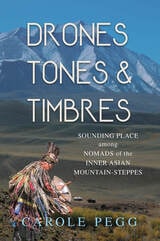
Drones, Tones, and Timbres
Sounding Place among Nomads of the Inner Asian Mountain-SteppesCarole Pegg
University of Illinois Press, 2024
Based on more than twenty years of collaborative research, Carole Pegg’s long-awaited participatory ethnography explores how Indigenous nomadic peoples of Russia’s southern Siberian republics (Altai, Khakassia, Tyva) sound multiphonies of place in a post-Soviet global world. Inspired by the mountain-steppe ecology and pathways of nomadism, soundscapes created in performative ritual events cross political and multiple-world boundaries in a shamanic-animist universe, enabling human and spirit actor interactions in a series of sensuous worlds. As with the “throat-singing” for which Indigenous Altai-Sayan peoples are famous, senses of place involve sonic relations, rootedness, movement, and plurality. Pegg echoes their drone-partials musical and ontological models in an innovative theoretical entwinement. Three strands form the book’s multivocal drone, the partials of which sound in each chapter: ontological sonicality and musicality that enables emplacement and movement; the importance of shamanism-animism--at the core of Indigenous spiritual practices--for personhood and community; and the agency of sonic performances. Sounding place, Pegg demonstrates, is essential to the identities, ways of life, and very senses of being of Indigenous Altai-Sayan peoples.

Drug War Zone
Frontline Dispatches from the Streets of El Paso and JuárezBy Howard Campbell
University of Texas Press, 2009
Winner, Southwest Book Award, Border Regional Library Association, 2011
Thousands of people die in drug-related violence every year in Mexico. Ciudad Juárez, Chihuahua, adjacent to El Paso, Texas, has become the most violent city in the Mexican drug war. Much of the cocaine, marijuana, and methamphetamine consumed in the United States is imported across the Mexican border, making El Paso/Juárez one of the major drug-trafficking venues in the world.
In this anthropological study of drug trafficking and anti-drug law enforcement efforts on the U.S.-Mexico border, Howard Campbell uses an ethnographic perspective to chronicle the recent Mexican drug war, focusing especially on people and events in the El Paso/Juárez area. It is the first social science study of the violent drug war that is tearing Mexico apart.
Based on deep access to the drug-smuggling world, this study presents the drug war through the eyes and lives of direct participants. Half of the book consists of oral histories from drug traffickers, and the other half from law enforcement officials. There is much journalistic coverage of the drug war, but very seldom are the lived experiences of traffickers and "narcs" presented in such vivid detail. In addition to providing an up-close, personal view of the drug-trafficking world, Campbell explains and analyzes the functioning of drug cartels, the corruption that facilitates drug trafficking, the strategies of smugglers and anti-narcotics officials, and the perilous culture of drug trafficking that Campbell refers to as the "Drug War Zone."

Drugs for Life
How Pharmaceutical Companies Define Our HealthJoseph Dumit
Duke University Press, 2012
Drugs, Labor and Colonial Expansion
William Jankowiak
University of Arizona Press, 2003
This book explores how Europeans introduced and used drugs in colonial contexts for the exploitation and placation of indigenous labor. Combining history and anthropology, it examines the role of drugs in trade and labor during the age of western colonial expansion. From considering the introduction of alcohol in the West African slave trade to the use of coca as a labor enhancer in the Andes, these original contributions examine both the encouragement of drug use by colonial powers and the extent to which local peoples' previous experience with psychoactive substances shaped their use of drugs introduced by Europeans.
The authors show that drugs possessed characteristics that made them a particularly effective means for propagating trade or increasing the extent and intensity of labor. In the early stages of European expansion, drugs were introduced to draw people, quite literally, into relations of dependency with European trade partners. Over time, the drugs used to intensify the amount and duration of labor shifted from alcohol, opium, and marijuana—which were used to overcome the drudgery and discomfort of physical labor—to caffeine-based stimulants, which provided a more alert workforce.
Valuable not only for its ethnographic detail but also for its broader insight into the nature of capitalist expansion, this collection reveals the surprising consistency of drug use in the colonial process. Drugs, Labor and Colonial Expansion is a book rich with cross-cultural insights that ranges widely across disciplines to provide a new and needed look at the colonial experience.

Dubai, the City as Corporation
Ahmed Kanna
University of Minnesota Press, 2010
Exposing local struggles over power and meaning in the making and representation of Dubai, Kanna examines the core questions of what gets built and for whom. His work, unique in its view of the interconnectedness of cultural identity, the built environment, and politics, offers an instructive picture of how different factions—from local and non-Arab residents and expatriate South Asians to the cultural and economic elites of the city—have all participated in the creation and marketing of Dubai. The result is an unparalleled account of the ways in which the built environment shapes and is shaped by the experience of globalization and neoliberalism in a diverse, multinational city.
Duress
Imperial Durabilities in Our TimesAnn Laura Stoler
Duke University Press, 2016

Durkheim and the Jews of France
Ivan Strenski
University of Chicago Press, 1997
Strenski begins each chapter by weighing particular claims (some anti-Semitic, some not) for the Jewishness of Durkheim's work. In each case Strenski overturns the claim while showing that it can nonetheless open up a fruitful inquiry into the relation of Durkheim to French Jewry. For example, Strenski shows that Durkheim's celebration of ritual had no innately Jewish source but derived crucially from work on Hinduism by the Jewish Indologist Sylvain Lévi, whose influence on Durkheim and his followers has never before been acknowledged.
Dust of the Zulu
Ngoma Aesthetics after ApartheidLouise Meintjes
Duke University Press, 2017
Dust
The Archive and Cultural HistoryCarolyn Steedman
Rutgers University Press, 2002
In this witty, engaging, and challenging book, Carolyn Steedman has produced an originaland sometimes irreverentinvestigation into how modern historiography has developed. Dust: The Archive and Cultural History considers our stubborn set of beliefs about an objective material worldinherited from the nineteenth centurywith which modern history writing and its lack of such a belief, attempts to grapple. Drawing on her own published and unpublished writing, Carolyn Steedman has produced a sustained argument about the way in which history writing belongs to the currents of thought shaping the modern world.
Steedman begins by asserting that in recent years much attention has been paid to the archive by those working in the humanities and social sciences; she calls this practice "archivization." By definition, the archive is the repository of "that which will not go away," and the book goes on to suggest that, just like dust, the "matter of history" can never go away or be erased.
This unique work will be welcomed by all historians who want to think about what it is they do.
Dyeing with the Earth
Textiles, Tradition, and Sustainability in Contemporary JapanCharlotte Linton
Duke University Press, 2025
Dying to Count
Post-Abortion Care and Global Reproductive Health Politics in SenegalSiri Suh
Rutgers University Press, 2021

Dysfunction and Decentralization in New Media Art and Education
Robert W. Sweeny
Intellect Books, 2015