Results by title
2728 books match the query 'Education' and 139 start with d

Disputable Decisions in Special Education
William M. Cruickshank
University of Michigan Press, 1986

Disputing Discipline
Child Protection, Punishment, and Piety in Zanzibar SchoolsFranziska Fay
Rutgers University Press, 2021
Disrupt This!
MOOCs and the Promises of TechnologyKaren J. Head
University Press of New England, 2017
Disrupting Colonial Pedagogies
Theories and TransgressionsEdited by Jillian Ford and Nathalia Jaramillo
University of Illinois Press, 2023
Jillian Ford and Nathalia E. Jaramillo edit a collection of writings by women that examine womanist worldviews in philosophy, theory, curriculum, public health, and education. Drawing on thinkers like bell hooks and Cynthia Dillard, the essayists challenge the colonizing hegemonies that raise and sustain patriarchal and male-centered systems of teaching and learning. Part One examines how womanist theorizing and creative activity offer a space to study the impact of conquest and colonization on the Black female body and spirit. In Part Two, the contributors look at ways of using text, philosophy, and research methodologies to challenge colonizing and colonial definitions of womanhood, enlightenment, and well-being. The essays in Part Three undo the colonial pedagogical project and share the insights they have gained by freeing themselves from its chokehold.
Powerful and interdisciplinary, Disrupting Colonial Pedagogies challenges colonialism and its influence on education to advance freer and more just forms of knowledge making.
Contributors: Silvia García Aguilár, Khalilah Ali, Angela Malone Cartwright, Adriana Diego, LeConté Dill, Sameena Eidoo, Genevieve Flores-Haro, Jillian Ford, Leena Her, Nathalia E. Jaramillo, Patricia Krueger-Henney, Claudia Lozáno, Liliana Manriquez, Alberta Salazár, León Salazár, and Lorri Santamaría
Disrupting the Center
A Partnership Approach to Writing Across the UniversityRebecca Hallman Martini
Utah State University Press, 2021
Using on-site research and critical ethnographic study from one university writing center, Rebecca Hallman Martini establishes an innovative, cross-disciplinary partnership approach to writing instruction in which peer tutoring plays an integral curricular role. Case studies detail three partnerships that respond directly to existing or potential disruptive innovations in higher education and showcase important concepts: mapping mutual benefit and stakeholder engagement in an online studio/hybrid first-year writing program partnership in response to online education, creating negotiated space to work through ethical issues involved when working with a public-private partnership to develop a required extracurricular portfolio project in a business school, and building transformational partnerships through establishing a writing-in-the-professions curriculum in the College of Engineering in response to career readiness initiatives.
Disrupting the Center uses interviews, observations, focus groups, analysis of consultations, meetings, and shared documents such as annual reports, budgets, assessment data, assignments, and syllabi to generate a wide view of how systems work. Writing centers are flexible university-wide service spaces where students go for one-on-one and group writing support that can become dynamic spaces for writing pedagogy by disrupting, revitalizing, and reinventing the epistemic foundations of current rhetoric and composition landscapes and traditional approaches to writing.
Disruptive Stories
Amplifying Voices from the Writing Center MarginsElizabeth Kleinfeld
Utah State University Press, 2024
While US tenure-track writing center administrators (WCAs) do not make up the majority of those who hold WCA positions in writing centers, they are more likely to be the storytellers of the writing center grand narrative. They publish more, present more conference papers, edit more journals, and participate more in organizational leadership. This collection complicates that narrative by adding marginalized voices and experiences in three thematic categories: structural marginalization, globalization and marginalization, and embodied marginalization.
Disruptive Stories spurs further conversations about ways to improve the review process in writing center scholarship so that it more accurately reflects the growing diversity of its administrators and practitioners.

Disruptive Voices
The Possibilities of Feminist ResearchMichelle Fine
University of Michigan Press, 1992
Distant Readings of Disciplinarity
Knowing and Doing in Composition/Rhetoric Dissertationsby Benjamin Miller
Utah State University Press, 2022
Writing studies has long been marked by a multitude of methods and interlocking purposes, partaking of not just humanities approaches but also social scientific ones, with data drawn from interviews and surveys alongside historical and philosophical arguments and with corpus analytics in large-scale collections jostling against small-scale case studies of individuals. These areas of study aren’t always cleanly separable; shifting modes mark the discipline as open and welcoming to many different angles of research. The field needs to embrace that vantage point and generate new degrees of familiarity with methods beyond those of any individual scholar.
Not only a training genre and not only a knowledge-making genre, the dissertation is also a discipline-producing genre. Illustrating what the field has been studying, and how, Distant Readings of Disciplinarity supports more fruitful collaborations within and across research areas and methods.
Distinguishing Disability
Parents, Privilege, and Special EducationColin Ong-Dean
University of Chicago Press, 2009
Students in special education programs can have widely divergent experiences. For some, special education amounts to a dumping ground where schools unload their problem students, while for others, it provides access to services and accommodations that drastically improve chances of succeeding in school and beyond. Distinguishing Disability argues that this inequity in treatment is directly linked to the disparity in resources possessed by the students’ parents.
Since the mid-1970s, federal law has empowered parents of public school children to intervene in virtually every aspect of the decision making involved in special education. However, Colin Ong-Dean reveals that this power is generally available only to those parents with the money, educational background, and confidence needed to make effective claims about their children’s disabilities and related needs. Ong-Dean documents this class divide by examining a wealth of evidence, including historic rates of learning disability diagnosis, court decisions, and advice literature for parents of disabled children. In an era of expanding special education enrollment, Distinguishing Disability is a timely analysis of the way this expansion has created new kinds of inequality.
Divergent Paths to College
Race, Class, and Inequality in High SchoolsHolland, Megan M
Rutgers University Press, 2019
Diverse by Design
Literacy Education within Multicultural InstitutionsChristopher Schroeder
Utah State University Press, 2011
Diversity, despite what we say, disturbs us. In the U.S., we debate linguistic rights, the need for an official language, and educational policies for language minority students. On the one hand, we believe in the rights of individuals, including (at least in the academy) the right to one’s own language. On the other hand, we sponsor a single common language, monolingual and standard, for full participation and communication in both the academy and in U.S. society.
In Diverse by Design, Christopher Schroeder reports on an institutional case study conducted at an officially designated Hispanic-Serving Institution. He gives particular attention to a cohort of Latino students in a special admissions program, to document their experience of a program designed to help students surmount the “obstacle” that ethnolinguistic diversity is perceived to be.
Ultimately, Schroeder argues for reframing multilingualism and multiculturalism, not as obstacles, but as intellectual resources to exploit. While diversity might disturb us, we can overcome its challenges by a more expansive sense of social identity. In an increasingly globalized society, literacy ideologies are ever more critical to educational equity, and to human lives.
Diversifying STEM
Multidisciplinary Perspectives on Race and GenderEbony O. McGee
Rutgers University Press, 2020
Research frequently neglects the important ways that race and gender intersect within the complex structural dynamics of STEM. Diversifying STEM fills this void, bringing together a wide array of perspectives and the voices of a number of multidisciplinary scholars. The essays cover three main areas: the widely-held ideology that science and mathematics are “value-free,” which promotes pedagogies of colorblindness in the classroom as well as an avoidance of discussions around using mathematics and science to promote social justice; how male and female students of color experience the intersection of racist and sexist structures that lead to general underrepresentation and marginalization; and recognizing that although there are no quick fixes, there exists evidence-based research suggesting concrete ways of doing a better job of including individuals of color in STEM. As a whole this volume will allow practitioners, teachers, students, faculty, and professionals to reimagine STEM across a variety of educational paradigms, perspectives, and disciplines, which is critical in finding solutions that broaden the participation of historically underrepresented groups within the STEM disciplines.
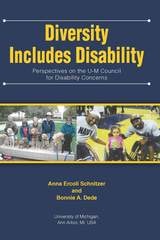
Diversity Includes Disability
Perspectives on the U-M Council for Disability ConcernsAnna Ercoli Schnitzer and Bonnie A. Dede
Michigan Publishing Services, 2018
The Council has changed and enlarged its membership from its origins as a small, low-key group consisting primarily of faculty and staff engaged in the disability arena, to an organization that encompasses a diverse, cross-campus and local community membership, with an extensive mailing list, as well. The achievements of the Council over the years and the goals that it envisions for the future, we hope, will serve as a template for other institutions.
Diversity Regimes
Why Talk Is Not Enough to Fix Racial Inequality at UniversitiesJames M. Thomas
Rutgers University Press, 2020
As a major, public flagship university in the American South, so-called “Diversity University” has struggled to define its commitments to diversity and inclusion, and to put those commitments into practice. In Diversity Regimes, sociologist James M. Thomas draws on more than two years of ethnographic fieldwork at DU to illustrate the conflicts and contingencies between a core set of actors at DU over what diversity is and how it should be accomplished. Thomas’s analysis of this dynamic process uncovers what he calls “diversity regimes”: a complex combination of meanings, practices, and actions that work to institutionalize commitments to diversity, but in doing so obscure, entrench, and even magnify existing racial inequalities. Thomas’s concept of diversity regimes, and his focus on how they are organized and unfold in real time, provides new insights into the social organization of multicultural principles and practices.
Divided Conversations
Identities, Leadership, and Change in Public Higher EducationKristin G. Esterberg
Vanderbilt University Press, 2013
Many faculty believe that one of their own who becomes an administrator has gone over to "the dark side." One provost recalled going for a beer with a faculty colleague and hearing the colleague complain about the latest memo "from the administration." He had to remind his friend of many years that he was the author of the offending document. Now he was "the administration." He realized that former colleagues now appeared in his office wearing suits and ties and referring to him by his title rather than his first name.
The disciplines serve as the tribes into which individual scholars are organized; the discipline is where a faculty member finds his community and identity. Administrators, on the other hand, identify with each other in trying to get the tribes to work together. Though most administrators came from the faculty ranks, their career paths take a different shape, especially in terms of mobility to another institution. It's not surprising that the two groups talk past each other.
A chapter is devoted to chairs of departments, who occupy an interesting middle ground. To their faculty, they can come across as a nurturing parent or a petty bureaucrat. The authors recommend training for chairs and administrative internships offered by the American Council on Education and other organizations.
The men and women on the campuses of the public universities described in the book make clear the challenges that universities face in terms of budgets, legislative politics, collective bargaining, rankings, and control of academic programs. If public institutions are truly to serve a public purpose, faculty and administrators must find ways to engage each other in shared conversation and management and find ways of engaging the university with the community.

Doc
The Story of a Birmingham Jazz ManFrank "Doc" Adams and Burgin Mathews
University of Alabama Press, 2012
Autobiography of jazz elder statesman Frank “Doc” Adams, highlighting his role in Birmingham, Alabama’s, historic jazz scene and tracing his personal adventure that parallels, in many ways, the story and spirit of jazz itself.
Doc tells the story of an accomplished jazz master, from his musical apprenticeship under John T. “Fess” Whatley and his time touring with Sun Ra and Duke Ellington to his own inspiring work as an educator and bandleader.
Central to this narrative is the often-overlooked story of Birmingham’s unique jazz tradition and community. From the very beginnings of jazz, Birmingham was home to an active network of jazz practitioners and a remarkable system of jazz apprenticeship rooted in the city’s segregated schools. Birmingham musicians spread across the country to populate the sidelines of the nation’s bestknown bands. Local musicians, like Erskine Hawkins and members of his celebrated orchestra, returned home heroes. Frank “Doc” Adams explores, through first-hand experience, the history of this community, introducing readers to a large and colorful cast of characters—including “Fess” Whatley, the legendary “maker of musicians” who trained legions of Birmingham players and made a significant mark on the larger history of jazz. Adams’s interactions with the young Sun Ra, meanwhile, reveal life-changing lessons from one of American music’s most innovative personalities.
Along the way, Adams reflects on his notable family, including his father, Oscar, editor of the Birmingham Reporter and an outspoken civic leader in the African American community, and Adams’s brother, Oscar Jr., who would become Alabama’s first black supreme court justice. Adams’s story offers a valuable window into the world of Birmingham’s black middle class in the days before the civil rights movement and integration. Throughout, Adams demonstrates the ways in which jazz professionalism became a source of pride within this community, and he offers his thoughts on the continued relevance of jazz education in the twenty-first century.
Documenting the American Student Abroad
The Media Cultures of International EducationKelly Hankin
Rutgers University Press, 2021
In Documenting the American Student Abroad, Kelly Hankin explores the documentary media cultures that shape these beliefs, drawing our attention to the broad range of stakeholders and documentary modes involved in defining the core values and practices of study abroad. From study abroad video contests and a F.B.I. produced docudrama about student espionage to reality television inspired educational documentaries and docudramas about Amanda Knox, Hankin shows how the institutional values of "global citizenship," "intercultural communication," and "cultural immersion" emerge in contradictory ways through their representation.
By bringing study abroad and media studies into conversation with one another, Documenting the American Student Abroad: The Media Cultures of International Education offers a much needed humanist contribution to the field of international education, as well as a unique approach to the growing scholarship on the intersection of media and institutions. As study abroad practitioners and students increase their engagement with moving images and digital environments, the insights of media scholars are essential for helping the field understand how the mediation of study abroad rhetoric shapes rather than reflects the field's central institutional ideals
Doing Development in West Africa
A Reader by and for UndergraduatesCharles Piot
Duke University Press, 2016
Doing Difference Differently
Chinese International Students’ Literacy Practices and AffordancesZhaozhe Wang
Utah State University Press, 2024
Doing Difference Differently provides an in-depth, nuanced understanding of the multifaceted literate lives of this often-marginalized cultural group, highlighting their diverse aspirations, personas, communities, challenges, and strategies. The book reconceptualizes the linguistic and cultural differences of Chinese international students as active processes of embracing, performing, resisting, negotiating, and redefining the identities that institutions impose on them through everyday literacy practices. Wang offers an analytical heuristic for researchers and educators to better understand these students’ backgrounds and to more effectively and ethically support and advocate for them. This case study critically engages broad and interconnected concepts that are essential to educators’ collective understanding of Generation Z students brought up in cultural and educational contexts outside of the European-American sphere.
This book appeals to scholars, researchers, teachers, and administrators working in North American higher education and English-speaking countries, particularly those in the fields of writing studies, second language studies, applied linguistics, multilingual education, literacy studies, and international education. Educators across disciplines seeking to better understand the growing population of Chinese international students in North America will likewise benefit.
Doing Diversity in Higher Education
Faculty Leaders Share Challenges and StrategiesBrown-Glaude, Winnifred R
Rutgers University Press, 2008
The rich variety of colleges and universities included provides a wide array of models that faculty can draw upon to inspire institutional change.
Doing Honest Work in College, Third Edition
How to Prepare Citations, Avoid Plagiarism, and Achieve Real Academic SuccessCharles Lipson
University of Chicago Press, 2018
Doing Honest Work in College
How to Prepare Citations, Avoid Plagiarism, and Achieve Real Academic Success, Second EditionCharles Lipson
University of Chicago Press, 2008
For this second edition, Charles Lipson has updated hundreds of examples and included many new media sources. There is now a full chapter on how to take good notes and use them properly in papers and assignments. The extensive list of citation styles incorporates guidelines from the American Anthropological Association. The result is the definitive resource on academic integrity that students can use every day.
“Georgetown’s entering class will discover that we actually have given them what we expect will be a very useful book, Doing Honest Work in College. It will be one of the first things students see on their residence hall desks when they move in, and we hope they will realize how important the topic is.”—James J. O’Donnell, Provost, Georgetown University
“A useful book to keep on your reference shelf.”—Bonita L. Wilcox, English Leadership Quarterly
Doing Time, Writing Lives
Refiguring Literacy and Higher Education in PrisonPatrick W. Berry
Southern Illinois University Press, 2018
Doing Time, Writing Lives offers a much-needed analysis of the teaching of college writing in U.S. prisons, a racialized space that—despite housing more than 2 million people—remains nearly invisible to the general public. Through the examination of a college-in-prison program that promotes the belief that higher education in prison can reduce recidivism and improve life prospects for the incarcerated and their families, author Patrick W. Berry exposes not only incarcerated students’ hopes and dreams for their futures but also their anxieties about whether education will help them.
Combining case studies and interviews with the author’s own personal experience of teaching writing in prison, this book chronicles the attempts of incarcerated students to write themselves back into a society that has erased their lived histories. It challenges polarizing rhetoric often used to describe what literacy can and cannot deliver, suggesting more nuanced and ethical ways of understanding literacy and possibility in an age of mass incarceration.
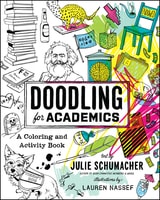
Doodling for Academics
A Coloring and Activity BookJulie Schumacher
University of Chicago Press, 2017
But those in the trenches of academe are well acquainted with the professoriate’s dark underside: the hierarchies and pseudo-political power plays, the peculiar colleagues, the over-parented students, the stacks of essays that need to be graded ASAP.
No one understands this world better than novelist Julie Schumacher, who here provides a bitingly funny distraction designed to help you survive life in higher education without losing your mind. Sardonic yet shrewdly insightful, Doodling for Academics offers the perfect cognitive relief for the thousands of faculty and grad students whose mentors and loved ones failed to steer them toward more reasonable or lucrative fields.
Through forty pages of original illustrations and activities—from coloring to paper dolls to mad libs—this book traces the arc of a typical day on campus. Get a peek inside the enigma of the student brain. Imagine a utopian faculty meeting. Navigate the red tape maze of university administration. With the help of hilarious illustrations by Lauren Nassef, Schumacher infuses the world of campus greens and university quads with cutting wit, immersing you deep into the weirdly creative challenges of university life. Offering a satirical interactive experience for scholars, the combination of humor and activities in this book will bring academia into entertaining relief, making it the perfect gift for your colleagues, advisors, or newly minted graduates.
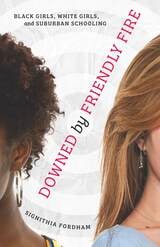
Downed by Friendly Fire
Black Girls, White Girls, and Suburban SchoolingSignithia Fordham
University of Minnesota Press, 2016
Most Americans would never willingly revisit their high school experiences; the nation’s school systems reflect the broader society’s hierarchical emphasis on race, class, and gender. While schools purport to provide equal opportunities for all students, this rarely happens in actuality—particularly for girls.
In Downed by Friendly Fire, Signithia Fordham unmasks and examines female-centered bullying in schools, arguing that it is essential to unmask female aggression, bullying, and competition, all of which directly relate to the structural violence embedded in the racialized and gendered social order. For two and a half years, Fordham conducted field research at “Underground Railroad High School,” a suburban high school in upstate New York. Through a series of composite student profiles, she examines the girls’ relationships to academic achievement, social competition, and aggression toward one another. Fordham argues that girls academically “compete to lose,” which only perpetuates their subordination through the misrecognition of their own competitive behaviors. She goes further to expand the meaning of violence to include what is seen as normal, including suffering, humiliation, and social and economic abuse.
Using the concept “symbolic violence,” Fordham theorizes the psychological and social damage suffered especially by black girls in schools. The five narratives in Downed by Friendly Fire ultimately highlight the pain and suffering this violence produces as well as the ways in which it promotes inequality, exclusion, and marginalization among girls.

Dr. David Murray
Superintendent of Education in the Empire of Japan, 1873-1879Duke, Benjamin
Rutgers University Press, 2018
Benjamin Duke has compiled this comprehensive biography of David Murray to showcase Murray’s work, both in assisting around 100 samurai students in their studies at Rutgers, and in his unprecedented role in early Japanese-American relations. This fascinating story uncovers a little-known link between Rutgers University and Japan, and it is the only book to conclude that Rutgers made a greater contribution to the development of modern education in the early Meiji Era than any other non-Japanese college or university in the world.

Dr. Nurse
Science, Politics, and the Transformation of American NursingDominique A. Tobbell
University of Chicago Press, 2022
Nurses represent the largest segment of the U.S. health care workforce and spend significantly more time with patients than any other member of the health care team. Dr. Nurse probes their history to examine major changes that have taken place in American health care in the second half of the twentieth century. The book reveals how federal and state health and higher education policies shaped education within health professions after World War II.
Starting in the 1950s, academic nurses sought to construct a science of nursing—distinct from that of the related biomedical or behavioral sciences—that would provide the basis for nursing practice. Their efforts transformed nursing’s labor into a valuable site of knowledge production and proved how the application of their knowledge was integral to improving patient outcomes. Exploring the knowledge claims, strategies, and politics involved as academic nurses negotiated their roles and nursing’s future, Dr. Nurse highlights how state-supported health centers have profoundly shaped nursing education and health care delivery.
Drama in the Language Classroom
What Every ESL Teacher Needs to KnowCarmela Romano Gillette and Deric McNish
University of Michigan Press, 2019

Drama-based Pedagogy
Activating Learning Across the CurriculumKathryn Dawson and Bridget Kiger Lee
Intellect Books, 1995
Kathryn Dawson and Bridget Kiger Lee provide an extensive range of tried and tested strategies, planning processes, and learning experiences, in order to create a uniquely accessible manual for those who work, think, train, and learn in educational and/or artistic settings. It is the perfect companion for professional development and university courses, as well as for already established educators who wish to increase student engagement and ownership of learning.

Dramatic Proverbs
Françoise d’Aubigné, Marquise de Maintenon
Iter Press, 2025
Madame de Maintenon’s Dramatic Proverbs provides unprecedented access to an important transitional marker between the society games of the salon and the education theater of the eighteenth century. Composed for the impoverished female pupils at the boarding school she and King Louis XIV founded at Saint-Cyr, Maintenon’s dramatic proverbs crucially reveal the values emphasized in female education at the end of the seventeenth century—a period plagued by economic crisis and growing aristocratic poverty. Some of the first to exclusively express a woman’s point of view, Maintenon’s dramatic proverbs challenged traditional female education and promoted improved conditions for women. The proverbs contributed uniquely to improvisational educational theater, inaugurating a tradition that continued well into the eighteenth century.
This edition of the plays aims to privilege accessibility and accuracy so that twenty-first-century students can act out, interpret, and discuss these historical texts.
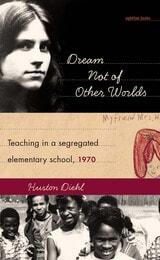
Dream Not of Other Worlds
Teaching in a Segregated Elementary School, 1970Huston Diehl
University of Iowa Press, 2007
When Huston Diehl began teaching a fourth-grade class in a "Negro" elementary school in rural Louisa County, Virginia, the school's white superintendent assured her that he didn't expect her to teach "those children" anything. She soon discovered how these low expectations, widely shared by the white community, impeded her students' ability to learn. With its overcrowded classrooms, poorly trained teachers, empty bookshelves, and meager supplies, her segregated school was vastly inferior to the county's white elementary schools, and the message it sent her students was clear: "dream not of other worlds."
In her often lyrical memoir, Diehl reveals how, in the intimacy of the classroom, her students reached out to her, a young white northerner, and shared their fears, anxieties, and personal beliefs. Repeatedly surprised and challenged by her students, Diehl questions her long-standing middle-class assumptions and confronts her own prejudices. In doing so, she eloquently reflects on what the students taught her about the hurt of bigotry and the humiliation of poverty as well as dignity, courage, and resiliency.
Set in the waning days of the Jim Crow South, Dream Not of Other Worlds chronicles an important moment in American history. Diehl examines the history of black education in the South and narrates the dramatic struggle to integrate Virginia's public schools. Meeting with some of her former students and colleagues and visiting the school where she once taught, she considers what has—and has not—changed after more than thirty years of integrated schooling. This provocative book raises many issues that are of urgent concern today: the continuing social consequences of segregated schools, the role of public education in American society, and the challenges of educating minority and poor children.
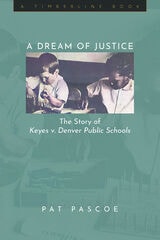
Dream of Justice
The Story of Keyes v. Denver Public Schoolsby Pat Pascoe
University Press of Colorado, 2023
Pascoe details Denver’s desegregation battle, beginning with the citizen studies that exposed the inequities of segregated schools and Rachel Noel’s resolution to integrate the system, followed by the momentous pro-integration Benton-Pascoe campaign of Ed Benton and Monte Pascoe for the school board in 1969. When segregationists won that election and reversed the integration plan for northeast Denver, Black, white, and Latino parents filed Keyes v. School District No. 1. This book follows the arguments in the case through briefs, transcripts, and decisions from district court to the Supreme Court of the United States and back, to its ultimate order to desegregate all Denver schools “root and branch.” It was the first northern city desegregation suit to be brought before the Supreme Court. However, with the end of court-ordered busing in 1995, schools quickly resegregated and are now more segregated than before Keyes was filed.
Pascoe asserts that school integration is a necessary step toward eliminating systemic racism in our country and should be the objective of every school board. A Dream of Justice will appeal to students, scholars, and readers interested in the history of civil rights in America, Denver history, and the history of US education.

Dreams of Flight
The Lives of Chinese Women Students in the WestFran Martin
Duke University Press, 2022
Dropping In
What Skateboarders Can Teach Us about Learning, Schooling, and Youth DevelopmentRobert Petrone
University of Massachusetts Press, 2023
The die-hard local skateboarders of Franklin Skatepark—a group of working-class, Latino and white young men in the rural Midwest—are typically classified by schools and society as “struggling,” “at-risk,” “failing,” and “in crisis.” But at the skatepark, they thrive and succeed, not only by landing tricks but also by finding meaning and purpose in their lives.
In Dropping In, Robert Petrone draws from multiple years of ethnographic research to bring readers into this rich environment, exploring how and why these young men engage more with skateboarding and its related cultural communities than with school. For them, it is in these alternative communities and spaces that they meet their intellectual, literate, and learning needs; cultivate meaningful and supportive relationships; and develop a larger understanding of their place in the world. By looking at what these skateboarders can teach us about what is right and working in their lives, Petrone asks educators and others committed to youth development to rethink schooling structures and practices to provide equitable education for all students.

Duels and the Roots of Violence in Missouri
Dick Steward
University of Missouri Press, 2000
In early-nineteenth-century Missouri, the duel was a rite of passage for many young gentlemen seeking prestige and power. In time, however, other social groups, influenced by the ruling class, engaged in a variety of violent acts and symbolic challenges under the rubric of the code duello. In Duels and the Roots of Violence in Missouri, Dick Steward takes an in-depth look at the evolution of dueling, tracing the origins, course, consequences, and ultimate demise of one of the most deadly art forms in Missouri history. By focusing on the history of dueling in Missouri, Steward details an important part of our culture and the long-reaching impact this form of violence has had on our society.
Drawing upon accounts of at least a hundred duels—from little-known encounters to those involving celebrated figures such as Senator Thomas Hart Benton, Charles Lucas, Thomas Biddle, Spencer Pettis, and John Smith T—Steward shows how the roots of violence have penetrated our modern culture. He traces the social and cultural changes in the nature of the duel from its earliest form as a defense of honor to its use as a means of revenge. By the latter part of the nineteenth century, the formal southern duel had for the most part given way to the improvised western duel, better known as the gunfight. Involving such gunslingers as Wild Bill Hickok and Jesse James, these violent acts captivated people not only in the state but also across the nation. Although the violence entailed different methods of killing, its allure remained as strong as ever.
Steward re-creates the human drama and tragedy in many of these hostile encounters, revealing how different groups operating under the code duello justified family and clan feuds, vigilante justice, and revenge killings. This often-glamorized violence, Steward argues, was viewed as a symbol of honor and courage throughout the century and greatly influenced behavior and attitudes toward violence well into the twentieth century.
While this work centers mainly on Missouri and the history of dueling in the state, its inferences extend well past the region itself. Well-written and thoroughly researched, Duels and the Roots of Violence in Missouri provides valuable insight into the violent social climate of yesterday.
During the Dissertation
A Textual Mentor for Doctoral Students in the Process of WritingChristine Pearson Casanave
University of Michigan Press, 2020
This volume is a sequel to Casanave’s popular Before the Dissertation. Like that volume, this book is designed as a companion for doctoral dissertation writers of qualitative or mixed methods work in fields related to language education. It could also benefit those writing master’s theses and those writing in other social science fields. It is meant to be consulted once the writing has begun—once students have settled on a topic, designed the project, or collected the data—because this is the time when they are analyzing, drafting, revising, polishing, and probably fretting, deleting, reconstructing, and even losing sleep. Also, like its predecessor, it is not designed to teach anyone how to write a dissertation as there are plenty of those available elsewhere.
For most doctoral students, writing will happen at different stages of the project. Strategies for timing of these kinds of writing differ across students, and also across supervisors and advisers. If dissertation writers do not know by the time they start writing which strategies and issues pertain to them, this book can help them craft some approaches to suit their own personalities, preferred practices, and individual goals and visions, as well as help them figure out how dissertation writing might fit into the real-life intrusions of work and family.
Issues covered in the book are: starting to write, envisioning the project as a whole, relationships with supervisors, perfectionism and other maladies, health, low- and high-IQ days, loneliness and isolation, distractions and interruptions, revising, and knowing when to stop.

Dutch is Beautiful
Fifty Years of Dutch and Flemish Studies at the University of MichiganTon Broos, Annemarie Toebosch, and Karla Vandersypen
Michigan Publishing Services, 2019
Dutch is Beautiful tells the story of the fifty years of Dutch and Flemish Studies at the University of Michigan in Ann Arbor, Michigan, USA. It is an account of the efforts to promote Dutch and Flemish culture and language, as well as a description of how the teaching of Dutch language, literature, history and culture can be a tool to look at a world of diverse identities. It also offers a comprehensive overview of the beginnings of a successful program that included Dutch writers-in-residence, visiting Netherlands professors, cultural and educational events, arts, music, films, conferences and publications. Several alumni of the program look back at their college years with appreciation. Articles and essays on history, Anne Frank, and conversations on colonialism discuss critical and educational views on Dutch and Flemish Studies in past, present and future, when diversity, equity and inclusion are important goals and objectives, and public scholarship and academic activism will be a larger part of the curriculum. This book will inform, entertain, stimulate and impress everyone who is interested in the culture of the Low Countries. The title says it all!

Dynamics Of Folklore
Revised and Expanded EditionBarre Toelken
Utah State University Press, 1996
One of the most comprehensive and widely praised introductions to folklore ever written. Toelken's discussion of the history and meaning of folklore is delivered in straightforward language, easily understood definitions, and a wealth of insightful and entertaining examples.
Toelken emphasizes dynamism and variety in the vast array of folk expressions he examines, from "the biology of folklore," to occupational and ethnic lore, food ways, holidays, personal experience narratives, ballads, myths, proverbs, jokes, crafts, and others. Chapters are followed by bibliographical essays, and over 100 photographs illustrate the text. This new edition is accessible to all levels of folklore study and an essential text for classroom instruction.
dear elia
Letters from the Asian American AbyssMimi Khúc
Duke University Press, 2024