4917 books match the query 'Philosophy' and 177 start with d
cover of Digital Technology and Democratic Theory

Digital Technology and Democratic Theory

Edited by Lucy Bernholz, Hélène Landemore, and Rob Reich

University of Chicago Press, 2021

One of the most far-reaching transformations in our era is the wave of digital technologies rolling over—and upending—nearly every aspect of life. Work and leisure, family and friendship, community and citizenship have all been modified by now-ubiquitous digital tools and platforms. Digital Technology and Democratic Theory looks closely at one significant facet of our rapidly evolving digital lives: how technology is radically changing our lives as citizens and participants in democratic governments.
To understand these transformations, this book brings together contributions by scholars from multiple disciplines to wrestle with the question of how digital technologies shape, reshape, and affect fundamental questions about democracy and democratic theory. As expectations have whiplashed—from Twitter optimism in the wake of the Arab Spring to Facebook pessimism in the wake of the 2016 US election—the time is ripe for a more sober and long-term assessment. How should we take stock of digital technologies and their promise and peril for reshaping democratic societies and institutions? To answer, this volume broaches the most pressing technological changes and issues facing democracy as a philosophy and an institution.
 
[more]
cover of Dimensions Of Forgiveness: A Research Approach

Dimensions Of Forgiveness

A Research Approach

Everett L. Worthington

Templeton Press, 1999

The scientific study of forgiveness is a new approach to an age-old problem. For thousands of years, people have practiced forgiveness within religious systems. Now, the field of scholarly research of forgiveness reveals the beneficial aspects of the process.

p>Contributors include Elliot Dorff and Martin Marty discussing religious interpretations, followed by social implications explained by Kenneth Pargament and Mark Rye. Roy Baumeister, Julie Exline, and Kristin Sommer present the victim's point of view. Other contributors focusing on the forgiveness research are: Everett Worthington, Robert Enright, Catherine Coyle, Carl Thoresen, Frederic Luskin, and Alex Harris. An annotated bibliography by Michael McCullough, Julie Exline, and Roy Baumeister, covers the empirical literature on the subject. Lewis Smedes concludes with the four steps necessary for forgiveness: moving from estrangement to forgiveness to reconciliation to hope.

[more]
cover of Dimensions Of Forgiveness: A Research Approach

Dimensions Of Forgiveness

A Research Approach

Everett L. Worthington

Templeton Press, 0

The scientific study of forgiveness is a new approach to an age-old problem. For thousands of years, people have practiced forgiveness within religious systems. Now, the field of scholarly research of forgiveness reveals the beneficial aspects of the process.

p>Contributors include Elliot Dorff and Martin Marty discussing religious interpretations, followed by social implications explained by Kenneth Pargament and Mark Rye. Roy Baumeister, Julie Exline, and Kristin Sommer present the victim's point of view. Other contributors focusing on the forgiveness research are: Everett Worthington, Robert Enright, Catherine Coyle, Carl Thoresen, Frederic Luskin, and Alex Harris. An annotated bibliography by Michael McCullough, Julie Exline, and Roy Baumeister, covers the empirical literature on the subject. Lewis Smedes concludes with the four steps necessary for forgiveness: moving from estrangement to forgiveness to reconciliation to hope.

[more]
cover of Dimensions of Property in Reproductive Economies: Practices, Structures, and Discourses

Dimensions of Property in Reproductive Economies

Practices, Structures, and Discourses

Edited by Irina Herb, Stefanie Graefe, and Susanne Lettow

Campus Verlag, 2024

A study of property in transitional economies of reproduction.

Besides reshaping human generativity, reproductive technologies such as IVF, egg donation, and surrogacy give rise to whole new value-creation systems and forms of ownership of the human body. The project is designed as a philosophical and sociological dual project with the aim of exploring discursive, institutional, and subjective pro­cesses of doing property in transnational economies of reproduction. It focuses, on the one hand, on bioethical problems surrounding ownership of the human body and, on the other hand, on patterns of interpretation and practices employed by various players in the context of the transnational propertization of human ova in Germany and Spain.
 
[more]
cover of Diminished Faculties: A Political Phenomenology of Impairment

Diminished Faculties

A Political Phenomenology of Impairment

Jonathan Sterne

Duke University Press, 2021
In Diminished Faculties Jonathan Sterne offers a sweeping cultural study and theorization of impairment. Drawing on his personal history with thyroid cancer and a paralyzed vocal cord, Sterne undertakes a political phenomenology of impairment in which experience is understood from the standpoint of a subject that is not fully able to account for itself. He conceives of impairment as a fundamental dimension of human experience, examining it as both political and physical. While some impairments are enshrined as normal in international standards, others are treated as causes or effects of illness or disability. Alongside his fractured account of experience, Sterne provides a tour of alternative vocal technologies and practices; a study of “normal” hearing loss as a cultural practice rather than a medical problem; and an intertwined history and phenomenology of fatigue that follows the concept as it careens from people to materials science to industrial management to spoons. Sterne demonstrates how impairment is a problem, opportunity, and occasion for approaching larger questions about disability, subjectivity, power, technology, and experience in new ways. Diminished Faculties ends with a practical user’s guide to impairment theory.
[more]
cover of Diné Perspectives: Revitalizing and Reclaiming Navajo Thought

Diné Perspectives

Revitalizing and Reclaiming Navajo Thought

Edited by Lloyd L. Lee; Foreword by Gregory Cajete

University of Arizona Press, 2014

What does it mean to be a Navajo (Diné) person today? What does it mean to “respect tradition”? How can a contemporary life be informed by the traditions of the past? These are the kinds of questions addressed by contributors to this unusual and pathbreaking book.
 
All of the contributors are coming to personal terms with a phrase that underpins the matrix of Diné culture: Sa’ah Naagháí Bik’eh Hózhóón. Often referred to simply as SNBH, the phrase can be translated in many ways but is generally understood to mean “one’s journey of striving to live a long, harmonious life.” The book offers a variety of perspectives of Diné men and women on the Diné cultural paradigm that is embedded in SNBH. Their writings represent embodied knowledge grounded in a way of knowing that connects thought, speech, experience, history, tradition, and land. Some of the contributors are scholars. Some are Diné who are fighting for justice and prosperity for the Navajo Nation. Some are poets and artists. They are united in working to preserve both intellectual and cultural sovereignty for Diné peoples. And their contributions exemplify how Indigenous peoples are creatively applying tools of decolonization and critical research to re-create Indigenous thought and culture in a present day that rarely resembles the days of their ancestors.
 
More than 300,000 people self-identify as Diné today. Every one must grapple with how to make a life that acknowledges Sa’ah Naagháí Bik’eh Hózhóón. Diné Perspectives is unique in bringing such personal journeys to the public eye.
[more]
cover of Diogenes the Dog-Man

Diogenes the Dog-Man

Yan Marchand and Vincent Sorel

Diaphanes, 2017

At its most basic, philosophy is about learning how to think about the world around us. It should come as no surprise, then, that children make excellent philosophers! Naturally inquisitive, pint-size scholars need little prompting before being willing to consider life’s “big questions,” however strange or impractical. Plato & Co. introduces children—and curious grown-ups—to the lives and work of famous philosophers, from Socrates to Descartes, Einstein, Marx, and Wittgenstein. Each book in the series features an engaging—and often funny—story that presents basic tenets of philosophical thought alongside vibrant color illustrations.
           
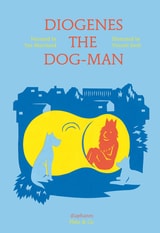
In Diogenes the Dog-Man, the philosopher Diogenes not only admires the honesty of dogs, he has actually become one—sleeping, eating, and lifting his leg to pee wherever he chooses! Best of all, unlike humans, who dupe one another as to their true feelings, Diogenes the Dog-Man is free to bark his displeasure and even bite his adversaries in the calves—even if they happen to be Alexander the Great. Initially, the citizens gathered in the Agora think Diogenes is mad. Does he have rabies? But it soon becomes clear that we can all learn a thing or two from dogs about how to live a simple life.
[more]
cover of Dionysus, Christ, and the Death of God, Volume 1: The Great Mediations of the Classical World

Dionysus, Christ, and the Death of God, Volume 1

The Great Mediations of the Classical World

Giuseppe Fornari

Michigan State University Press, 2020
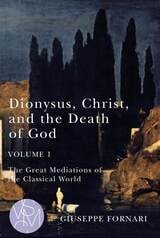
This magisterial reflection on the history and destiny of the West compares Greco-Roman civilization and the Judeo-Christian tradition in order to understand what both unites and divides them. Mediation, understood as a collective, symbolic experience, gives society unity and meaning, putting human beings in contact with a universal object known as the world or reality. But unity has a price: the very force that enables peaceful coexistence also makes us prone to conflict. As a result, in order to find a common point of convergence—of at-one-ment—someone must be sacrificed. Sacrifice, then, is the historical pillar of mediation. It was endorsed in a cosmic-religious sense in antiquity and rejected for ethical reasons in modernity, where the Judeo-Christian tradition plays an intermediate role in condemning sacrificial violence as such, while accepting sacrifice as a voluntary act offered to save other human beings. Today, as we face the collapse of all shared mediations, this intermediating solution offers a way out of our moral and cultural plight.
[more]
cover of Dionysus, Christ, and the Death of God, Volume 2: Christianity and Modernity

Dionysus, Christ, and the Death of God, Volume 2

Christianity and Modernity

Giuseppe Fornari

Michigan State University Press, 2020
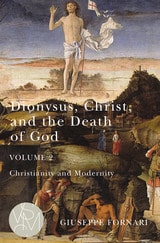
This magisterial reflection on the history and destiny of the West compares Greco-Roman civilization and the Judeo-Christian tradition in order to understand what both unites and divides them. Mediation, understood as a collective, symbolic experience, gives society unity and meaning, putting human beings in contact with a universal object known as the world or reality. But unity has a price: the very force that enables peaceful coexistence also makes us prone to conflict. As a result, in order to find a common point of convergence—of at-one-ment—someone must be sacrificed. Sacrifice, then, is the historical pillar of mediation. It was endorsed in a cosmic-religious sense in antiquity and rejected for ethical reasons in modernity, where the Judeo-Christian tradition plays an intermediate role in condemning sacrificial violence as such, while accepting sacrifice as a voluntary act offered to save other human beings. Today, as we face the collapse of all shared mediations, this intermediating solution offers a way out of our moral and cultural plight.
[more]
cover of Direct Reference, Indexicality, and Propositional Attitudes

Direct Reference, Indexicality, and Propositional Attitudes

Edited by Wolfgang Künne, Albert Newen, and Martin Anduschus

CSLI, 1997

This volume is a compilation of revised versions of papers presented at a conference held in spring 1994 at the Centre for Interdisciplinary Research (ZiF) in Bielefeld, Germany.
[more]
cover of Dirty Waters: Confessions of Chicago's Last Harbor Boss

Dirty Waters

Confessions of Chicago's Last Harbor Boss

R. J. Nelson

University of Chicago Press, 2016

A wry, no-holds-barred memoir of Nelson’s time controlling some of Chicago's most beautiful spots while facing some of its ugliest traditions.

In 1987, the city of Chicago hired a former radical college chaplain to clean up rampant corruption on the waterfront. R. J. Nelson thought he was used to the darker side of the law—he had been followed by federal agents and wiretapped due to his antiwar stances in the sixties—but nothing could prepare him for the wretched bog that constituted the world of a Harbor Boss. Dirty Waters is the wry, no-holds-barred memoir of Nelson’s time controlling some of the city’s most beautiful spots while facing some of its ugliest traditions. Nelson takes us through Chicago's beloved “blue spaces” and deep into the city’s political morass, revealing the different moralities underlining three mayoral administrations and navigating the gritty mechanisms of the city’s political machine. Ultimately, Dirty Waters is a tale of morality, of what it takes to be a force for good in the world and what struggles come from trying to stay ethically afloat in a sea of corruption. 
 
[more]
cover of Disability Aesthetics

Disability Aesthetics

Tobin Siebers

University of Michigan Press, 2010

"Disability Aesthetics ambitiously redefines both 'disability' and 'aesthetics,' showing us that disability is central not only to modern art but also to the way we apprehend (and interact with) bodies and buildings. Along the way, Tobin Siebers revisits the beautiful and the sublime, 'degenerate' art and 'disqualified' bodies, culture wars and condemned neighborhoods, the art of Marc Quinn and the fiction of Junot Díaz---and much, much more. Disability Aesthetics is a stunning achievement, a must-read for anyone interested in how to understand the world we half create and half perceive."
---Michael Bérubé, Paterno Family Professor in Literature, Pennsylvania State University

"Rich with examples of the disabled body in both historical and modern art, Tobin Siebers's new book explores how disability problematizes commonly accepted ideas about aesthetics and beauty. For Siebers, disability is not a pejorative condition as much as it is a form of embodied difference. He is as comfortable discussing the Venus de Milo as he is discussing Andy Warhol. Disability Aesthetics is a prescient and much-needed contribution to visual & critical studies."
---Joseph Grigely, Professor of Visual and Critical Studies, The School of the Art Institute of Chicago

Disability Aesthetics is the first attempt to theorize the representation of disability in modern art and visual culture. It claims that the modern in art is perceived as disability, and that disability is evolving into an aesthetic value in itself. It argues that the essential arguments at the heart of the American culture wars in the late twentieth century involved the rejection of disability both by targeting certain artworks as "sick" and by characterizing these artworks as representative of a sick culture. The book also tracks the seminal role of National Socialism in perceiving the powerful connection between modern art and disability. It probes a variety of central aesthetic questions, producing a new understanding of art vandalism, an argument about the centrality of wounded bodies to global communication, and a systematic reading of the use put to aesthetics to justify the oppression of disabled people. In this richly illustrated and accessibly written book, Tobin Siebers masterfully demonstrates the crucial roles that the disabled mind and disabled body have played in the evolution of modern aesthetics, unveiling disability as a unique resource discovered by modern art and then embraced by it as a defining concept.

Tobin Siebers is V. L. Parrington Collegiate Professor of English Language and Literature and Art and Design at the University of Michigan. His many books include Disability Theory and The Subject and Other Subjects: On Ethical, Aesthetic, and Political Identity.

A volume in the series Corporealities: Discourses of Disability

[more]
cover of Disagreement: Politics And Philosophy

Disagreement

Politics And Philosophy

Jacques Ranciere

University of Minnesota Press, 2004

“Is there any such thing as political philosophy?” So begins this provocative book by one of the foremost figures in Continental thought. Here, Jacques Rancière brings a new and highly useful set of terms to the vexed debate about political effectiveness and “the end of politics.”

What precisely is at stake in the relationship between “philosophy” and the adjective “political”? In Disagreement, Rancière explores the apparent contradiction between these terms and reveals the uneasy meaning of their union in the phrase “political philosophy”—a juncture related to age-old attempts in philosophy to answer Plato’s devaluing of politics as a “democratic egalitarian” process.

According to Rancière, the phrase also expresses the paradox of politics itself: the absence of a proper foundation. Politics, he argues, begins when the “demos” (the “excessive” or unrepresented part of society) seeks to disrupt the order of domination and distribution of goods “naturalized” by police and legal institutions. In addition, the notion of “equality” operates as a game of contestation that constantly substitutes litigation for political action and community. This game, Rancière maintains, operates by a primary logic of “misunderstanding.” In turn, political philosophy has always tried to substitute the “politics of truth” for the politics of appearances.

Disagreement investigates the various transformations of this regime of “truth” and their effects on practical politics. Rancière then distinguishes what we mean by “democracy” from the practices of a consensual system in order to unravel the ramifications of the fashionable phrase “the end of politics.” His conclusions will be of interest to readers concerned with political questions from the broadest to the most specific and local.

[more]
cover of Disalienation: Politics, Philosophy, and Radical Psychiatry in Postwar France

Disalienation

Politics, Philosophy, and Radical Psychiatry in Postwar France

Camille Robcis

University of Chicago Press, 2021

From 1940 to 1945, forty thousand patients died in French psychiatric hospitals. The Vichy regime’s “soft extermination” let patients die of cold, starvation, or lack of care. But in Saint-Alban-sur-Limagnole, a small village in central France, one psychiatric hospital attempted to resist. Hoarding food with the help of the local population, the staff not only worked to keep patients alive but began to rethink the practical and theoretical bases of psychiatric care. The movement that began at Saint-Alban came to be known as institutional psychotherapy and would go on to have a profound influence on postwar French thought.

In Disalienation, Camille Robcis grapples with the historical, intellectual, and psychiatric meaning of the ethics articulated at Saint-Alban by exploring the movement’s key thinkers, including François Tosquelles, Frantz Fanon, Félix Guattari, and Michel Foucault. Anchored in the history of one hospital, Robcis's study draws on a wide geographic context—revolutionary Spain, occupied France, colonial Algeria, and beyond—and charts the movement's place within a broad political-economic landscape, from fascism to Stalinism to postwar capitalism.
[more]
cover of Discerning The Subject

Discerning The Subject

Paul Smith

University of Minnesota Press, 1988

"Smith's prose is filled with rich insights and original thinking...with informed, cogent arguments capable of altering the course of disciplinary thinking. this ability to affirm and encourage internal heterogeneity and contradiction while simultaneously struggling for external solidarity in maintaining a strong social and political conscience could serve as an exemplary identity for the future of English studies." John Clifford, College English "Smith has brought together and scrutinized a wide range of issues and arguments in an intellectually and politically challenging way." Thomas E. Lewis, MMLA Journal "Paul Smith expertly treats the status of the 'subject' in critical and political discourse, and carefully explores possibilities for individual initiative, resistance, and social change as these are articulated by major literary and cultural theorists." William E. Cain, The South Carolina Review "Discerning the Subject will set the standard for discussions in 'theory' for some time to come. Books with the range and sophistication of Smith's perform a powerful promise for the future of theoretical discourse and practice in the humanities." Alan Kennedy, Dalhousie Review
[more]
cover of Discipline Of Architecture

Discipline Of Architecture

Andrzej Piotrowski

University of Minnesota Press, 2001

In the vast literature on architectural theory and practice, the ways in which architectural knowledge is actually taught, debated, and understood are too often ignored. The essays collected in this groundbreaking volume address the current state of architecture as an academic and professional discipline. The issues considered range from the form and content of architectural education to the architect’s social and environmental obligations and the emergence of a new generation of architects. Often critical of the current paradigm, these essays offer a provocative challenge to accepted assumptions about the production, dissemination, and reception of architectural knowledge. 

Contributors: Sherry Ahrentzen, U of Wisconsin-Milwaukee; Stanford Anderson, MIT; Carol Burns, Harvard U; Russell Ellis, UC Berkeley; Thomas Fisher, U of Minnesota; Linda Groat, U of Michigan; Kay Bea Jones, Ohio State U; David Leatherbarrow, U of Pennsylvania; A. G. Krishna Menon, TVB School of Habitat Studies, India; Garth Rockcastle, U of Minnesota; Michael Stanton, American U, Beirut; Sharon E. Sutton, U of Washington; David J. T. Vanderburgh, Université Catholique de Louvain, Belgium; and Donald Watson, Rensselaer Polytechnic Institute.

[more]
cover of Discourse Analysis: The Sociolinguistic Analysis of Natural Language

Discourse Analysis

The Sociolinguistic Analysis of Natural Language

Michael Stubbs

University of Chicago Press, 1983

Linguistics has traditionally concentrated on studying single sentences or isolated speech acts. In this book Michael Stubbs explores one of the most promising new directions in contemporary linguistics—the study of many sentences and how they fit together to form discourse. Using many examples drawn from recorded conversations, fieldwork observations, experimental data, and written texts, he discusses such questions as how far discourse structure is comparable to sentence structure; whether it is possible to talk of "well formed" discourse as one does of "grammatical" sentences; and whether the relation between question and answer in conversation is syntactic, semantic, or pragmatic.
[more]
cover of Discourse on the Origins of Inequality (Second Discourse), Polemics, and Political Economy

Discourse on the Origins of Inequality (Second Discourse), Polemics, and Political Economy

Jean-Jacques Rousseau

Dartmouth College Press, 1993

Includes the Second Discourse (complete with the author’s extensive notes), contemporary critiques by Voltaire, Diderot, Bonnet, and LeRoy, Rousseau’s replies (some never before translated), and Political Economy, which first outlined principles that were to become famous in the Social Contract. This is the first time that the works of 1755 and 1756 have been combined with careful commentary to show the coherence of Rousseau’s “political system.” The Second Discourse examines man in the true “state of nature,” prior to the formation of the first human societies, tracing the “hypothetical history” of political society and social inequality as they developed out of natural equality and independence.
[more]
cover of Discourse on the Sciences and Arts (First Discourse) and Polemics

Discourse on the Sciences and Arts (First Discourse) and Polemics

Jean-Jacques Rousseau

Dartmouth College Press, 1992

Contains the entire First Discourse, contemporary attacks on it, Rousseau’s replies to his critics, and his summary of the debate in his preface to Narcissus. A number of these texts have never before been available in English. The First Discourse and Polemics demonstrate the continued relevance of Rousseau’s thought. Whereas his critics argue for correction of the excesses and corruptions of knowledge and the sciences as sufficient, Rousseau attacks the social and political effects of the dominant forms of scientific knowledge.
[more]
cover of Discourse to Lady Lavinia His Daughter

Discourse to Lady Lavinia His Daughter

Annibal Guasco

University of Chicago Press, 2003

When eleven-year-old Lavinia Guasca began her new life as a lady-in-waiting at the court of Turin, she brought with her a parting gift from her father Annibal (1540-1619): a detailed guidebook he wrote to help steer her through the many pitfalls of court life. Lavinia had her father's Discourse published in 1586; this English translation is the first version published in any form since that time.

The Discourse displays an incredibly far-sighted view of women's education. Annibal thought gifted young girls should develop their talents and apply them to careers outside the home. In the Discourse, he details the unique and extremely rigorous educational program to which he had subjected Lavinia almost from the cradle with this end in mind. To complete Lavinia's education, Annibal filled the Discourse with advice on spirituality and morality, health and beauty, and how to behave at court—everything a well-bred lady-in-waiting would need to know. This edition also includes an appendix that traces the later events of Lavinia's life through excerpts from her father's letters.
[more]
cover of Discourse, Figure

Discourse, Figure

lyotard

University of Minnesota Press, 2019

Lyotard’s earliest major work, available in English for the first time​

Choice Outstanding Academic Title


Jean-François Lyotard is recognized as one of the most significant French philosophers of the twentieth century. Although nearly all of his major writing has been translated into English, one important work has until now been unavailable. Discourse, Figure is Lyotard’s thesis. Provoked in part by Lacan’s influential seminars in Paris, Discourse, Figure distinguishes between the meaningfulness of linguistic signs and the meaningfulness of plastic arts such as painting and sculpture. Lyotard argues that because rational thought is discursive and works of art are inherently opaque signs, certain aspects of artistic meaning such as symbols and the pictorial richness of painting will always be beyond reason’s grasp.
 
A wide-ranging and highly unusual work, Discourse, Figure proceeds from an attentive consideration of the phenomenology of experience to an ambitious meditation on the psychoanalytic account of the subject of experience, structured by the confrontation between phenomenology and psychoanalysis as contending frames within which to think the materialism of consciousness. In addition to prefiguring many of Lyotard’s later concerns, Discourse, Figure captures Lyotard’s passionate engagement with topics beyond phenomenology and psychoanalysis to structuralism, semiotics, poetry, art, and the philosophy of language.
[more]
cover of Discourses of Sexuality: From Aristotle to AIDS

Discourses of Sexuality

From Aristotle to AIDS

Donna C. Stanton, Editor

University of Michigan Press, 1993

Michael Foucault called sex “the explanation for everything, our master key.” In Discourses of Sexuality, fourteen distinguished scholars, artists, and critics examine sexuality from a fascinating array of perspectives. The book’s opening section reopens the question of “the history of sexuality;” it is followed by “Regimes of Knowledge and Desire,” which explores gender and sexuality in the Elizabethan period, sexual desire and the market economy during the Industrial Revolution, and Freud’s notions of sexuality of “perversion.” The next section, “The Constructed Body,” examines conceptions, representations, and implications of the body through written and visual representation. The last part of the book, “AIDS and the Crisis of Modernity,” looks at the place of AIDS in the study of sexuality, provides an analysis of Nicholas Nixon’s portraits of people with AIDS, and demonstrates the importance of rediscovering values that help us to live with human variety and social diversity.
 
[more]
cover of Discourses on Livy

Discourses on Livy

Niccolò Machiavelli

University of Chicago Press, 1998

Discourses on Livy is the founding document of modern republicanism, and Harvey C. Mansfield and Nathan Tarcov have provided the definitive English translation of this classic work. Faithful to the original Italian text, properly attentive to Machiavelli's idiom and subtlety of thought, it is eminently readable. With a substantial introduction, extensive explanatory notes, a glossary of key words, and an annotated index, the Discourses reveals Machiavelli's radical vision of a new science of politics, a vision of "new modes and orders" that continue to shape the modern ethos.

"[Machiavelli] found in Livy the means to inspire scholars for five centuries. Within the Discourses, often hidden and sometimes unintended by their author, lie the seeds of modern political thought. . . . [Mansfield and Tarcov's] translation is careful and idiomatic."—Peter Stothard, The Times

"Translated with painstaking accuracy—but also great readability."—Weekly Standard

"A model of contemporary scholarship and a brave effort at Machiavelli translation that allows the great Florentine to speak in his own voice."—Choice
[more]
cover of Discourses on Livy

Discourses on Livy

Niccolò Machiavelli

University of Chicago Press, 1996

Discourses on Livy is the founding document of modern republicanism, and Harvey C. Mansfield and Nathan Tarcov have provided the definitive English translation of this classic work. Faithful to the original Italian text, properly attentive to Machiavelli's idiom and subtlety of thought, it is eminently readable. With a substantial introduction, extensive explanatory notes, a glossary of key words, and an annotated index, the Discourses reveals Machiavelli's radical vision of a new science of politics, a vision of "new modes and orders" that continue to shape the modern ethos.

"[Machiavelli] found in Livy the means to inspire scholars for five centuries. Within the Discourses, often hidden and sometimes unintended by their author, lie the seeds of modern political thought. . . . [Mansfield and Tarcov's] translation is careful and idiomatic."—Peter Stothard, The Times

"Translated with painstaking accuracy—but also great readability."—Weekly Standard

"A model of contemporary scholarship and a brave effort at Machiavelli translation that allows the great Florentine to speak in his own voice."—Choice
[more]
cover of Discovering Existence with Husserl

Discovering Existence with Husserl

Emmanuel Levinas

Northwestern University Press, 1997

Contemporary philosophers are increasingly turning to the work of Emmanuel Levinas to bring a consideration of ethics into their own thinking. As an exponent of the phenomenological tradition, Levinas ranks with Heidegger and Sartre; as a disciple of Husserl, he was one of the most independent and original interpreters, testifying to the fruitfulness of Husserl's phenomenology.

In collecting almost all of Levinas's articles on Husserlian phenomenology, this volume gathers together a wealth of thoughtful exposition and interpretation by one of the most important European philosophers of the twentieth century. Levinas's thought is relevant to a broad variety of disciplines and concerns. This volume serves as a reliable introduction for the beginning student, as well as satisfying the expert's more demanding and critical desire for insight into the complexities of Levinas's thought.
[more]
cover of Discovery and Explanation in Biology and Medicine

Discovery and Explanation in Biology and Medicine

Kenneth F. Schaffner

University of Chicago Press, 1993

Kenneth F. Schaffner compares the practice of biological and medical research and shows how traditional topics in philosophy of science—such as the nature of theories and of explanation—can illuminate the life sciences. While Schaffner pays some attention to the conceptual questions of evolutionary biology, his chief focus is on the examples that immunology, human genetics, neuroscience, and internal medicine provide for examinations of the way scientists develop, examine, test, and apply theories.

Although traditional philosophy of science has regarded scientific discovery—the questions of creativity in science—as a subject for psychological rather than philosophical study, Schaffner argues that recent work in cognitive science and artificial intelligence enables researchers to rationally analyze the nature of discovery. As a philosopher of science who holds an M.D., he has examined biomedical work from the inside and uses detailed examples from the entire range of the life sciences to support the semantic approach to scientific theories, addressing whether there are "laws" in the life sciences as there are in the physical sciences. Schaffner's novel use of philosophical tools to deal with scientific research in all of its complexity provides a distinctive angle on basic questions of scientific evaluation and explanation.
[more]
cover of Discursive Ideologies: Reading Western Rhetoric

Discursive Ideologies

Reading Western Rhetoric

C. H. Knoblauch

Utah State University Press, 2014

In Discursive Ideologies, C. H. Knoblauch argues that European rhetorical theory comprises several distinct and fundamentally opposed traditions of discourse. Writing accessibly for the upper division student, Knoblauch resists the conventional narrative of a unified Western rhetorical tradition. He identifies deep ideological and epistemological differences that exist among strands of Western thought and that are based in divergent "grounds of meaningfulness.” These conflicts underlie and influence current discourse about vital public issues.

Knoblauch considers six "stories” about the meaning of meaning in an attempt to answer the question, what encourages us to believe that language acts are meaningful? Six distinctive ideologies of Western rhetoric emerge: magical rhetoric, ontological rhetoric, objectivist rhetoric, expressivist rhetoric, sociological rhetoric, and deconstructive rhetoric. He explores the nature of language and the important role these rhetorics play in the discourses that matter most to people, such as religion, education, public policy, science, law, and history.

[more]
cover of Disinflation in Transition Economies

Disinflation in Transition Economies

Marek Dabrowski

Central European University Press, 2003

The authors of this outstanding scholarly work analyze the dynamics of disinflation in transition economies in Central and Eastern Europe. The volume covers all the key factors of this process: changes in money supply and money demand; exchange rate policy; currency crisis; fiscal policy; legal status of central banks; monetary policy strategy; changes in relative prices and changes in nominal and real wages. The book contains 13 chapters related to various aspects of disinflation and covering different sets of transition countries depending on their relevance to the analyzed topic and data availability.
[more]
cover of Disorienting Phenomenology: Queer Space and Trans Life

Disorienting Phenomenology

Queer Space and Trans Life

Eden Kinkaid

University of Minnesota Press, 2026

Rethinking space from the ground up through trans theory, philosophy, and radical possibility

Disorienting Phenomenology takes as its point of departure the trans mundane: entering a public restroom, moving through airport security, navigating professional spaces. These ordinary yet unsettling encounters become portals into urgent philosophical questions about space, embodiment, perception, power, and violence. Attending closely to how trans people experience everyday life, Eden Kinkaid shows that space is never neutral. It is felt, negotiated, and contested at the level of the body, shaping one’s capacities, safety, and sense of self.

Weaving together philosophy, queer and trans studies, geography, and personal narrative, Kinkaid develops an intersectional theory of space grounded in lived experience. They bring the foundational spatial theories of Henri Lefebvre together with critical phenomenologies of gender, race, and disability to demonstrate how systems of oppression are built into the environments we inhabit, configuring movement and constraining possibility for minoritized people. Bold and interdisciplinary, Disorienting Phenomenology offers vital conceptual tools for understanding—and transforming—the worlds we move through each day.

Retail e-book files for this title are screen-reader friendly.

[more]
cover of Displacing Christian Origins: Philosophy, Secularity, and the New Testament

Displacing Christian Origins

Philosophy, Secularity, and the New Testament

Ward Blanton

University of Chicago Press, 2007

Recent critical theory is curiously preoccupied with the metaphors and ideas of early Christianity, especially the religion of Paul. The haunting of secular thought by the very religion it seeks to overcome may seem surprising at first, but Ward Blanton argues that this recent return by theorists to the resources of early Christianity has precedent in modern and ostensibly secularizing philosophy, from Kant to Heidegger.

Displacing Christian Origins traces the current critical engagement of Agamben, Derrida, and Žižek, among others, back into nineteenth- and early-twentieth-century philosophers of early Christianity. By comparing these crucial moments in the modern history of philosophy with exemplars of modern biblical scholarship—David Friedrich Strauss, Adolf Deissmann, and Albert Schweitzer—Blanton offers a new way for critical theory to construe the relationship between the modern past and the biblical traditions to which we seem to be drawn once again.

An innovative contribution to the intellectual history of biblical exegesis, Displacing Christian Origins will promote informed and fruitful debate between religion and philosophy. 
[more]
cover of Dispositional Properties

Dispositional Properties

David Weissman

Southern Illinois University Press, 1965

In Dispositional Properties, David Weissman attacks a problem central to the philosophy of mind and, by implication, to the theory of being: Are there potentialities, capabilities, which dispose the mind to think in one way rather than another?

The volume is arranged in the form of four arguments that converge upon a single point. First, there is an intricate discussion of the shortcomings of Hume's account of mind as ideas and impressions. Next comes a brief treatment of the arguments of some of Weissman's contemporaries, including Carnap and Braithwaite. Third, Weissman discusses Wittgenstein's theories of learning and knowledge. Finally, there is a full discussion of Aristotle and his doctrine of potentialities.

The question this book ultimately raises is how to steer between a doctrine of mind as no more than a series of acts, on the one hand, and a doctrine of mind as a kind of unitary object, on the other. The solution is to show first of all that there must be a potentiality in the universe, and then to show clearly and in detail that the mind is shot through with that potentiality.

[more]
cover of Dissemination

Dissemination

Jacques Derrida

University of Chicago Press, 1981

"The English version of Dissemination [is] an able translation by Barbara Johnson . . . . Derrida's central contention is that language is haunted by dispersal, absence, loss, the risk of unmeaning, a risk which is starkly embodied in all writing. The distinction between philosophy and literature therefore becomes of secondary importance. Philosophy vainly attempts to control the irrecoverable dissemination of its own meaning, it strives—against the grain of language—to offer a sober revelation of truth. Literature—on the other hand—flaunts its own meretriciousness, abandons itself to the Dionysiac play of language. In Dissemination—more than any previous work—Derrida joins in the revelry, weaving a complex pattern of puns, verbal echoes and allusions, intended to 'deconstruct' both the pretension of criticism to tell the truth about literature, and the pretension of philosophy to the literature of truth."—Peter Dews, New Statesman
[more]
cover of Dissent from the Homeland: Essays after September 11

Dissent from the Homeland

Essays after September 11

Stanley Hauerwas and Frank Lentricchia, eds.

Duke University Press, 2003

Dissent from the Homeland is a book about patriotism, justice, revenge, American history and symbology, art and terror, and pacifism. In this deliberately and urgently provocative collection, noted writers, philosophers, literary critics, and theologians speak out against the war on terrorism and the government of George W. Bush as a response to the events of September 11, 2001. Critiquing government policy, citizen apathy, and societal justifications following the attacks, these writers present a wide range of opinions on such issues as contemporary American foreign policy and displays of patriotism in the wake of the disaster.

Whether illuminating the narratives that have been used to legitimate the war on terror, reflecting on the power of American consumer culture to transform the attack sites into patriotic tourist attractions, or insisting that to be a Christian is to be a pacifist, these essays refuse easy answers. They consider why the Middle East harbors a deep-seated hatred for the United States. They argue that the U.S. drive to win the cold war made the nation more like its enemies, leading the government to support ruthless anti-Communist tyrants such as Mobutu, Suharto, and Pinochet. They urge Americans away from the pitfall of national self-righteousness toward an active peaceableness—an alert, informed, practiced state of being—deeply contrary to both passivity and war. Above all, the essays assembled in Dissent from the Homeland are a powerful entreaty for thought, analysis, and understanding. Originally published as a special issue of the journal South Atlantic Quarterly, Dissent from the Homeland has been expanded to include new essays as well as a new introduction and postscript.

Contributors. Srinivas Aravamudan, Michael J. Baxter, Jean Baudrillard, Robert N. Bellah, Daniel Berrigan, Wendell Berry, Vincent J. Cornell, David James Duncan, Stanley Hauerwas, Fredric Jameson, Frank Lentricchia, Catherine Lutz, Jody McAuliffe, John Milbank, Peter Ochs, Donald E. Pease, Anne R. Slifkin, Rowan Williams, Susan Willis, Slavoj Zizek

[more]
cover of Distant Early Warning: Marshall McLuhan and the Transformation of the Avant-Garde

Distant Early Warning

Marshall McLuhan and the Transformation of the Avant-Garde

Alex Kitnick

University of Chicago Press, 2021

Marshall McLuhan (1911–1980) is best known as a media theorist—many consider him the founder of media studies—but he was also an important theorist of art. Though a near-household name for decades due to magazine interviews and TV specials, McLuhan remains an underappreciated yet fascinating figure in art history. His connections with the art of his own time were largely unexplored, until now. In Distant Early Warning, art historian Alex Kitnick delves into these rich connections and argues both that McLuhan was influenced by art and artists and, more surprisingly, that McLuhan’s work directly influenced the art and artists of his time.
 
Kitnick builds the story of McLuhan’s entanglement with artists by carefully drawing out the connections among McLuhan, his theories, and the artists themselves. The story is packed with big names: Marcel Duchamp, Niki de Saint Phalle, Jasper Johns, Andy Warhol, Nam June Paik, and others. Kitnick masterfully weaves this history with McLuhan’s own words and his provocative ideas about what art is and what artists should do, revealing McLuhan’s influence on the avant-garde through the confluence of art and theory. The illuminating result sheds light on new aspects of McLuhan, showing him not just as a theorist, or an influencer, but as a richly multifaceted figure who, among his many other accolades, affected multiple generations of artists and their works. The book finishes with Kitnick overlaying McLuhan’s ethos onto the state of contemporary and post-internet art. This final channeling of McLuhan is a swift and beautiful analysis, with a personal touch, of art’s recent transgressions and what its future may hold.
[more]
cover of Distracted: A Philosophy of Cars and Phones

Distracted

A Philosophy of Cars and Phones

Robert Rosenberger

University of Minnesota Press, 2024

Applying insights from philosophy and cognitive science to address the urgent issue of smartphone-induced distracted driving
 

Although the dangers of texting while driving are widely known, many people resist the idea that phone usage will impair their driving. And connectivity features in new cars have only made using technology behind the wheel more tempting. What will it take to change people’s minds and behavior? Robert Rosenberger contends that a better understanding of why this combination of technologies is so dangerous could effectively adjust both habits and laws.


Rosenberger brings together ideas from philosophy and cognitive science to leverage a postphenomenological perspective that reveals how our smartphones make us such bad drivers. Reviewing decades of empirical studies in cognitive science, he shows that we have developed habits of perception regarding our compulsive technology use—habits that may wrest our attention away from the road. 


Distracted develops innovative concepts for understanding technology-related habits and the ways that our relationships to our devices influence how we perceive the world. In turn, these ideas can help drivers be more cognizant of the effect that smartphone usage has on their perceptions, better inform efforts to enact stricter regulations, and help us all to be more reflective about the technologies that shape our lives.

[more]
cover of Distributions of the Sensible: Rancière, between Aesthetics and Politics

Distributions of the Sensible

Rancière, between Aesthetics and Politics

Edited by Scott Durham and Dilip Gaonkar With an afterword by Jacques Rancière

Northwestern University Press, 2019

Jacques Rancière’s work is increasingly central to several debates across the humanities. Distributions of the Sensible confronts a question at the heart of his thought: How should we conceive the relationship between the “politics of aesthetics” and the “aesthetics of politics”? Specifically, the book explores the implications of Rancière’s rethinking of the relationship of aesthetic to political democracy from a wide range of critical perspectives.

Distributions of the Sensible contains original essays by leading scholars on topics such as Rancière’s relation to political theory, critical theory, philosophical aesthetics, and film. The book concludes with a new essay by Rancière himself that reconsiders the practice of theory between aesthetics and politics.

[more]
cover of Disturbing Revelation: Leo Strauss, Eric Voegelin, and the Bible

Disturbing Revelation

Leo Strauss, Eric Voegelin, and the Bible

John J. Ranieri

University of Missouri Press, 2009

Political philosophers Leo Strauss and Eric Voegelin share an abiding interest in the Judeo-Christian tradition. In Disturbing Revelation, the first book to focus on their treatment of the Bible, John Ranieri explores how they draw on its texts in their philosophies and shows what these considerations say about whether the combination of religion and politics leads to violence or can prevent it.
            In addressing fundamental questions of reason and revelation, Ranieri focuses not on Strauss’s treatment of Judaism or Voegelin’s of Christianity, but rather on the place of the Bible in their thought. He first examines the differences between their methodological approaches and attitudes toward the Bible and biblical criticism—rather than their attitudes toward religion or questions of faith—and then explores in depth their interpretations of the biblical message and its contribution to the modern world.
Ranieri shows how both men recognized that biblical texts must be seriously engaged in order for us to understand our contemporary situation—but that their appreciation of the Bible is marked by deep ambivalence concerning its vision of life and its influence on the political sphere. He brings their thought into conversation with that of René Girard, whose writings on violence and religion shed light on the problems that arise when biblical insights take root in a culture, and also offers fresh insight into Strauss’s elusive writings, such as his indebtedness to Nietzsche.
            Disturbing Revelation reveals how Strauss and Voegelin viewed the applicability of biblical texts to what they considered the crisis of modernity without belaboring questions of their own personal faith. It is a clearly written exposition that reflects a rich understanding of the work of these thinkers and is as provocative as it is informative, not only for students of the two men but also for anyone interested in the relationship between philosophy and religious belief.
[more]
cover of Diversity: The History of a Wandering Value

Diversity

The History of a Wandering Value

Lorraine Daston

Central European University Press, 2026

It is startling to realize how quickly and thoroughly the value of diversity, until a few decades ago a value largely confined to the aesthetic and organic realms, has acquired deep political and moral significance. Universities, corporations, and governments are now judged by the degree to which they achieve diversity among their leaders and recognize diversity among their publics. Older values of the liberal polity, for example that of honoring merit without regard to creed, race, sex, or ethnicity, have been increasingly eclipsed by values that closely attend to these and other differentiating traits (which traits matter is contentious). How did this sea change in value come about, and come about so swiftly? And what kind of value is diversity? The long history of diversity as an aesthetic and economic value helps explain the recent rapid rise of diversity as a moral and political value.
[more]
cover of Divest: An Essay on Political Masochism

Divest

An Essay on Political Masochism

Steven Swarbrick

University of Minnesota Press, 2026

A manifesto for liberating desire from the grip of capital and colonial violence in Palestine

Could a psychoanalytic theory of masochism help us to understand the politics of protest? A socially engaged psychoanalysis of 2024’s widespread student uprisings in support of Palestine, Divest posits that masochism, as theorized by Freud in his later years, is a fundamental structure at the heart of anticapitalist and anticolonial resistance. Conceptualizing masochism as a radical form of divestment, Steven Swarbrick theorizes the affective economies of solidarity, self-sacrifice, and collective struggle. Through vivid film readings and sharp critique of state and university violence, Swarbrick explores the emancipatory potential of masochism in the protest movement and the sadistic machinery of capitalist governance it has laid bare.

Divest is both a politically urgent manifesto and a theoretical companion to the global movement for Palestinian liberation. Asserting that the politics of left-wing solidarity must reckon with the libidinal investments that sustain both power and resistance, this bold volume argues that divestment from global capitalism may begin with a revolution in our psychic attachments.

Retail e-book files for this title are screen-reader friendly with image accompanied by short alt text and/or extended descriptions.

[more]
cover of Divine Beauty: The Aesthetics of Charles Hartshorne

Divine Beauty

The Aesthetics of Charles Hartshorne

Daniel A. Dombrowski

Vanderbilt University Press, 2004

Considered by many to be one of the greatest philosophers of religion and metaphysicians of the twentieth century, Charles Hartshorne (1897-2000) addressed questions of aesthetics throughout his long career. Yet his efforts in this area are perhaps the most neglected aspect of his extensive and highly nuanced thought. Divine Beauty offers the first detailed explication of Hartshorne's aesthetic theory and its place within his theocentric philosophy.

As Daniel A. Dombrowski explains, Hartshorne advanced a neoclassical or process theism that contrasted with the "classical" theism defended by traditionalist Jews, Christians, and Muslim believers. His conception of God was dipolar, which could attribute to God certain qualities that traditionalists would exclude. For example, in Hartshorne's view, God can embrace excellent aspects of both activity and passivity, or of permanence and change; classical theists, on the other hand, exclude passivity and change from their conceptions.

Dombrowski goes on to explain the ramifications of Hartshorne's view of God for aesthetics, which for him had both broad and narrow meanings: all sensory feeling or sensation, in the broad sense, and a disciplined feeling for beauty, in the narrow sense. Included are discussions on Hartshorne's famous appreciation for the aesthetics of bird song; his view of beauty as a mean between two sets of extremes; his idea of the aesthetic attitude, which concentrates on values that are intrinsic and immediately felt; and the place of death in his aesthetics, in which the value of our lives consists in the beauty or intensity of experience that we contribute to the divine life.

Filling an important gap in our understanding of Hartshorne, Divine Beauty also makes a persuasive case for the superiority of his neoclassical theism over classical theism.

[more]
cover of Divine Speech in Human Words: Thomistic Engagements with Scripture

Divine Speech in Human Words

Thomistic Engagements with Scripture

Emmanuel Durand, OP

Catholic University of America Press, 2022

Is the portrait of God revealed in Scripture fundamentally intelligible? The biblical accounts of God reveal seemingly contradictory themes: God’s holiness and narratives telling of his anger; the Divine Omnipotence faced with the Impossible; the suffering Christ upon the Cross and the transcendent Trinity of Persons in God; the unique Savior and the universality of God’s salvific will; and so forth. How are we to hold together all of this data without denying any aspect of the mystery of God? Must we give into our ambient culture’s sense that the biblical God cannot be taken seriously by truly discerning and rational minds when they try to understand “the Divine”? Or, in the midst of this apparent contradiction, can we find the lines of harmony in the revealed mysteries? In Divine Speech in Human Words, Fr. Emmanuel Durand unties some of the knots that face us when we reflect on the God of biblical Revelation. In each of the essays gathered here, Fr. Durand sympathetically articulates the tensions and apparent contradictions experienced by contemporary minds as they strive to understand the revealed truth of God. A whole host of topics are covered in this volume: the Cross and the revelation of the Trinity; God’s holiness and transcendence; divine immutability and the sorrow of a loving God; Divine Providence and human prayer; the fatherhood of God and eschatology; Christ’s way of life; and many others. Drawing philosophical insights from the Thomistic tradition as his intellectual tools, Fr. Durand nonetheless emphasizes the importance of a properly theological mode of reflection, allowing these issues to be illuminated by the revealed truth of Sacred Scripture. Thus, for each of these difficult topics, he shows that a vital theological response must not limit itself to mere logical rigor but, rather, requires metaphysical insight and, above all, sapiential appreciation of God’s revealed word. With such instruments in hand, each essay approaches the tensions of biblical revelation with an eager readiness to show how a thoughtful Thomistic practice of biblical theology can guide faith as it seeks an understanding of both contemporary and perennial theological problems.
[more]
cover of Do Not Reisist the Spirit's Call

Do Not Reisist the Spirit's Call

Michael D. Torre

Catholic University of America Press, 2013

In this book, Michael D. Torre makes Marín-Sola's articles available in English for the first time. The articles are preceded by an introduction on Marín-Sola and followed by a conclusion that traces the reception of his thought within the Catholic theological community. In Torre's afterword, he defends Marín-Sola's position as substantively the same as that of Aquinas.
[more]
cover of Do Nothing: Peace for Everyday Living: Reflections on Chuang Tzu's Philosophy

Do Nothing

Peace for Everyday Living: Reflections on Chuang Tzu's Philosophy

Siroj Sorajjakool

Templeton Press, 2009

"Words," writes Chuang Tzu, "are for catching ideas; once you've caught the idea, you can forget the words." In Do Nothing, author Siroj Sorajjakool lends us some of his insightful words to help us all "catch" the provocative ideas of one of China's most important literary and philosophical giants—one who emerged at a time when China had several such giants philosophizing on Tao or "the Way."

Though his thinking dates back to the fourth century, Chuang Tzu's Tao has profound implications for our modern lives. He welcomes an existence that is radically removed from the image of normalcy that society often projects, wherein the individual must always strive for more, always seek greater productivity, and always try to better him or herself and his or her place in life. Chuang Tzu would posit that the definitions of normalcy, success, and happiness are arbitrarily assigned and that our rigid and unquestioning adherence to these so-called "norms" leads to existential restlessness and unease. Instead of striving, he would say, be still. Instead of acquiring, embrace nothingness. Instead of seeking to understand the limitlessness of the universe during your brief and extremely limited existence, enjoy the wonder of it.

Siroj Sorajjakool suggests that when we can embrace nothingness, we undergo a spiritual transformation that liberates us to see more clearly and truly find ourselves. He offers a very personal exploration of Chuang Tzu's Tao, first in its historical and literary context, and then in the context of our twenty-first century existence. What emerges is a liberating and highly readable meditation on the many lessons we can "catch" from Chuang Tzu on how we view our aspirations, our joys and sorrows, our successes and failures, and what it means to be a worthwhile person.

[more]
cover of Documentary Time: Film and Phenomenology

Documentary Time

Film and Phenomenology

Malin Wahlberg

University of Minnesota Press, 2008

Finding the theoretical space where cinema and philosophy meet, Malin Wahlberg’s sophisticated approach to the experience of documentary film aligns with attempts to reconsider the premises of existential phenomenology. The configuration of time is crucial in organizing the sensory affects of film in general but, as Wahlberg adroitly demonstrates, in nonfiction films the problem of managing time is writ large by the moving image’s interaction with social memory and historical figures.

Wahlberg discusses a thought-provoking corpus of classical and recent experiments in film and video (including Andy Warhol’s films) in which creative approaches to the time of the image and the potential archive memory of filmic representation illuminates meanings of temporality and time experience. She also offers a methodological account of film and brings Deleuze and Ricoeur into dialogue with Bazin and Mitry on the subject of cinema and phenomenology.

Drawing attention to the cultural significance of the images’ imprint as a trace of the past, Documentary Time brings to bear phenomenological inquiry on nonfiction film while at the same time reconsidering the existential dimensions of time that have always puzzled humans.

Malin Wahlberg is a research fellow in cinema studies at Stockholm University.

[more]
cover of Does Writing Have a Future?

Does Writing Have a Future?

Vilém Flusser

University of Minnesota Press, 2010

In Does Writing Have a Future?, a remarkably perceptive work first published in German in 1987, Vilém Flusser asks what will happen to thought and communication as written communication gives way, inevitably, to digital expression. In his introduction, Flusser proposes that writing does not, in fact, have a future because everything that is now conveyed in writing—and much that cannot be—can be recorded and transmitted by other means.

Confirming Flusser’s status as a theorist of new media in the same rank as Marshall McLuhan, Jean Baudrillard, Paul Virilio, and Friedrich Kittler, the balance of this book teases out the nuances of these developments. To find a common denominator among texts and practices that span millennia, Flusser looks back to the earliest forms of writing and forward to the digitization of texts now under way. For Flusser, writing—despite its limitations when compared to digital media—underpins historical consciousness, the concept of progress, and the nature of critical inquiry. While the text as a cultural form may ultimately become superfluous, he argues, the art of writing will not so much disappear but rather evolve into new kinds of thought and expression.
[more]
cover of Does the Earth Care?: Indifference, Providence, and Provisional Ecology

Does the Earth Care?

Indifference, Providence, and Provisional Ecology

Mick Smith

University of Minnesota Press, 2022

Rethinking our relationship with Earth in a time of environmental emergency

The world is changing. Progress no longer has a future but any earlier sense of Earth as “providential” seems of merely historical interest. The apparent absence of Earthly solicitude is a symptom and consequence of these successive Western modes of engagement with the Earth, now exemplified in global capitalism. Within these constructs, Earth can only appear as constitutively indifferent to the fate of all its inhabitants. The “provisional ecology” outlined in Does the Earth Care?—drawing on a variety of literary and philosophical sources from Richard Jefferies and Robert Macfarlane to Martin Heidegger and Gaia theory—fundamentally challenges that assumption, while offering an Earthly alternative to either cold realism or alienated despair in the face of impending ecological disaster.

Forerunners is a thought-in-process series of breakthrough digital works. Written between fresh ideas and finished books, Forerunners draws on scholarly work initiated in notable blogs, social media, conference plenaries, journal articles, and the synergy of academic exchange. This is gray literature publishing: where intense thinking, change, and speculation take place in scholarship.

[more]
cover of Doing

Doing

Jean-Luc Nancy

Seagull Books, 2020

In Doing, Jean-Luc Nancy, one of the most prominent and lucid articulators of contemporary French theory and philosophy, examines the precarious but urgent relationship between being and doing. His book is not so much a call to action as a summons to more vigorous thinking, the examination and reflection that must precede any effective action. The first section of the book considers this matter tersely: Jean-Luc Nancy’s quickness of language and grace of humor lead the reader carefully past the dangers of oversimplification, toward a general awareness of meaningful being. In the last section, Nancy examines the realities of terrorist actions—specifically those that shocked Paris a few years ago, and more generally the frightening world of politics without conscience, where conscience is the root of all thinking.
 
[more]
cover of Doing Psychotherapy Effectively

Doing Psychotherapy Effectively

Mona Sue Weissmark and Daniel A. Giacomo

University of Chicago Press, 1997

Psychotherapy is a $2.5 billion business in the United States, but no one can answer the basic question of how therapy works. No watchdog groups rank therapists for potential consumers; no one school of thought has proven to be superior to another. And no method has emerged for determining what makes therapy successful for some but not for others. Doing Psychotherapy Effectively proposes much-needed answers to the puzzling questions of what therapists actually do when they are effective.

Mona Sue Weissmark and Daniel A. Giacomo offer a unique mode of evaluation that focuses not on a particular school of therapy but on the relationship between therapist and patient. Their approach, the "Harvard Psychotherapy Coding Method," begins with the assumption that good therapeutic relationships are far from intuitive. Successful relationships follow a pattern of behaviors that can be identified and quantified, as the authors demonstrate through clinical research and videotaped sessions of expert therapists. Likewise, positive changes in the patient, observed through client feedback and case studies, can be described operationally; they involve the process of overcoming feelings of detachment, helplessness, and rigidity and becoming more involved, effective, and adaptable.

Weissmark and Giacomo explain and ground these principles in the practice of psychotherapy, making Doing Psychotherapy Effectively an accessible and pragmatic work which will give readers a tool for measuring therapeutic effectiveness and further understanding human transformation. For the first time, successful therapy is described in a way that can be practiced and communicated.
[more]
cover of Don Isaac Abravanel: An Intellectual Biography

Don Isaac Abravanel

An Intellectual Biography

Cedric Cohen-Skalli

Brandeis University Press, 2020

Don Isaac Abravanel (1437–1508) was one of the great inventors of Jewish modernity. A merchant, banker, and court financier, a scholar versed in both Jewish and Christian writings, a preacher and exegete, a prominent political actor in royal entourages and Jewish communities, Abravanel was one of the greatest leaders and thinkers of Iberian Jewry in the aftermath of the expulsion of 1492. This book, the first new intellectual biography of Abravanel in twenty years, depicts his life in three cultural milieus—Portugal, Castile, and post-expulsion Italy—and analyzes his major literary accomplishments in each period. Abravanel was a traditionalist with innovative ideas, a man with one foot in the Middle Ages and the other in the Renaissance. An erudite scholar, author of a monumental exegetical opus that is still studied today, and an avid book collector, he was a transitional figure, defined by an age of contradictions. Yet, it is these very contradictions that make him such an important personality for understanding the dawn of Jewish modernity.

[more]