Results by title
4030 books match the query 'Language Arts & Disciplines' and 161 start with d
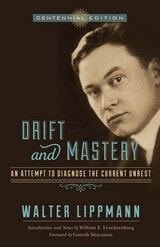
Drift and Mastery
An Attempt to Diagnose the Current UnrestWalter Lippmann, Introduction and notes by William E. Leuchtenburg, Foreword by Ganesh Sitaraman
University of Wisconsin Press, 2015
Lippman’s Drift and Mastery became one of the most important and influential documents of the Progressive Movement. It remains a valuable text for understanding the political thought of early twentieth-century America and a lucid exploration of timeless themes in American government and politics. Distinguished historian Walter Leuchtenberg’s 1986 introduction and notes are retained in this edition.
Drilled to Write
Becoming a Cadet Writer at a Senior Military Collegeby J. Michael Rifenburg
Utah State University Press, 2022
Drilled to Write offers a rich account of US Army cadets navigating the unique demands of Army writing at a senior military college. In this longitudinal case study, J. Michael Rifenburg follows one cadet, Logan Blackwell, for four years and traces how he conceptualizes Army writing and Army genres through immersion in military science classes, tactical exercises in the Appalachian Mountains, and specialized programs like Airborne School.
Drawing from research on rhetorical genre studies, writing transfer, and materiality, Drilled to Write speaks to scholars in writing studies committed to capturing how students understand their own writing development. Collectively, these chapters articulate four ways Blackwell leveraged resources through ROTC to become a cadet writer at this military college. Each chapter is dedicated to one year of his undergraduate experience with focus on curricular writing for his business management major and military science classes as well as his extracurricular writing, like his Ballroom Dance Club bylaws and a three-thousand-word short story.
In Drilled to Write, Rifenburg invites readers to see how cadets are positioned between civilian and military life—a curiously liminal space where they develop as writers. Using Army ROTC as an entry into genre theory and larger conversations about the role higher education plays in developing Army officers, he shows how writing students develop genre awareness and flexibility while forging a personal identity.
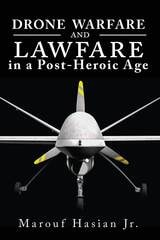
Drone Warfare and Lawfare in a Post-Heroic Age
Marouf Hasian Jr.
University of Alabama Press, 2016
With a growing fleet of more than 7,500 drones, these emblems of what one commentary has dubbed “push-button, bloodless wars” comprise as much as a third of the US aircraft force. Their use is hotly debated, some championing air power that doesn’t risk the lives of pilots, others arguing that drone strikes encourage cycles of violence against the United States, its allies, and interests.
In this landmark study, Hasian illuminates both the discursive and visual argumentative strategies that drone supporters and critics both rely on. He comprehensively reviews how advocates and detractors parse and re-contextualize drone images, casualty figures, governmental “white papers,” NGO reports, documentaries, and blogs to support their points of view. He unpacks the ideological reflexes and assumptions behind these legal, ethical, and military arguments.
Visiting both formal legal language used by legislators, political leaders, and policy makers as well as public, vernacular commentaries about drones, Drone Warfare and Lawfare in a Post-Heroic Age dispassionately illuminates the emotive, cognitive, and behavioral strategies partisans use to influence public and official opinion.
Dual Enrollment Kaleidoscope
Reconfiguring Perceptions of First-Year Writing and Composition StudiesChristine Denecker
Utah State University Press, 2022
DE disrupts long-held beliefs of who should take and who should teach college writing. Giving higher education pause about the place of writing instruction within the academy, DE force those in the field to reflect upon the purposes and value of FYC and its pedagogical approaches. Featuring seventeen chapters written by a wide and diverse range of authors, this collection includes the voices of prominent scholars in rhetoric and composition at two- and four-year public and private institutions, as well as emerging scholars in the field. It also features a variety of methodologies, including archival research, quantitative and qualitative data collection, and autoethnography.
Few texts have been published on dual enrollment writing in rhetoric and composition studies. The Dual Enrollment Kaleidoscope should be mandatory reading for anyone interested in or tasked with doing the work of DE writing instruction, administration, mentoring, or assessment.
Contributors: Dominic Ashby, Anna Bogen, Tyler Branson, Melanie Burdick, Scott Campbell, Christine R. Farris, David Gehler, Leigh Graziano, Jane Greer, Jennifer Hadley, Jacquelyn Hoermann-Elliott, Joseph Jones, Nancy Knowles, Amy Lueck, Miles McCrimmon, Katie McWain, Annie S. Mendenhall, Keith Miller, Brice Nordquist, Cornelia Paraskevas, Jill Parrot, Shirley K Rose, Barbara Schneider, Erin Scott-Stewart
Duped
Truth-Default Theory and the Social Science of Lying and DeceptionTimothy R. Levine
University of Alabama Press, 2020
Unmasking the science of deception—and why truth wins by default.
From the advent of fake news to climate-science denial and Bernie Madoff’s appeal to investors, people can be astonishingly gullible. Some people appear authentic and sincere even when the facts discredit them, and many people fall victim to conspiracy theories and economic scams that should be dismissed as obviously ludicrous. This happens because of a near-universal human tendency to operate within a mindset that can be characterized as a “truth-default.” We uncritically accept most of the messages we receive as “honest.” We all are perceptually blind to deception. We are hardwired to be duped. The question is, can anything be done to militate against our vulnerability to deception without further eroding the trust in people and social institutions that we so desperately need in civil society?
Timothy R. Levine’s Duped: Truth-Default Theory and the Social Science of Lying and Deception recounts a decades-long program of empirical research that culminates in a new theory of deception—truth-default theory. This theory holds that the content of incoming communication is typically and uncritically accepted as true, and most of the time, this is good. Truth-default allows humans to function socially. Further, because most deception is enacted by a few prolific liars, the so called “truth-bias” is not really a bias after all. Passive belief makes us right most of the time, but the catch is that it also makes us vulnerable to occasional deceit.
Levine’s research on lie detection and truth-bias has produced many provocative new findings over the years. He has uncovered what makes some people more believable than others and has discovered several ways to improve lie-detection accuracy. In Duped, Levine details where these ideas came from, how they were tested, and how the findings combine to produce a coherent new understanding of human deception and deception detection.
During the Dissertation
A Textual Mentor for Doctoral Students in the Process of WritingChristine Pearson Casanave
University of Michigan Press, 2020
This volume is a sequel to Casanave’s popular Before the Dissertation. Like that volume, this book is designed as a companion for doctoral dissertation writers of qualitative or mixed methods work in fields related to language education. It could also benefit those writing master’s theses and those writing in other social science fields. It is meant to be consulted once the writing has begun—once students have settled on a topic, designed the project, or collected the data—because this is the time when they are analyzing, drafting, revising, polishing, and probably fretting, deleting, reconstructing, and even losing sleep. Also, like its predecessor, it is not designed to teach anyone how to write a dissertation as there are plenty of those available elsewhere.
For most doctoral students, writing will happen at different stages of the project. Strategies for timing of these kinds of writing differ across students, and also across supervisors and advisers. If dissertation writers do not know by the time they start writing which strategies and issues pertain to them, this book can help them craft some approaches to suit their own personalities, preferred practices, and individual goals and visions, as well as help them figure out how dissertation writing might fit into the real-life intrusions of work and family.
Issues covered in the book are: starting to write, envisioning the project as a whole, relationships with supervisors, perfectionism and other maladies, health, low- and high-IQ days, loneliness and isolation, distractions and interruptions, revising, and knowing when to stop.
Dynamic Conceptual Semantics
A Logico-Philosophical Investigation into Concept Formation and UnderstandingRenate Bartsch
CSLI, 1998

Dynamic Youth Services through Outcome-Based Planning and Evaluation
Eliza T. Dresang
American Library Association, 2006
Dynamic Youth Services through Outcome-Based Planning and Evaluation
Eliza T. Dresang
American Library Association, 2006
Dynamics of Meaning
Anaphora, Presupposition, and the Theory of GrammarGennaro Chierchia
University of Chicago Press, 1995
Chapter 1 introduces the notion of dynamic semantics and discusses in detail the phenomena that have been used to motivate it, such as "donkey" sentences and adverbs of quantification. The second chapter explores in greater depth the interpretation of indefinites and issues related to presuppositions of uniqueness and the "E-type strategy." In Chapter 3, Chierchia extends the dynamic approach to the domain of syntactic theory, considering a range of empirical problems that includes backwards anaphora, reconstruction effects, and weak crossover. The final chapter develops the formal system of dynamic semantics to deal with central issues of definites and presupposition. Chierchia shows that an approach based on a principled enrichment of the mechanisms dealing with meaning is to be preferred on empirical grounds over approaches that depend on an enrichment of the syntactic apparatus.
Dynamics of Meaning illustrates how seemingly abstract stances on the nature of meaning can have significant and far-reaching linguistic consequences, leading to the detection of new facts and influencing our understanding of the syntax/semantics/pragmatics interface.

Dysfunction and Decentralization in New Media Art and Education
Robert W. Sweeny
Intellect Books, 2015